







Published: October 20, 2026
Category: AI
By: Akinyele Oluwale
The AI race will not ultimately be won by access to intelligence alone. It will be won by the economies that convert intelligence into productivity.
Artificial intelligence is entering a more consequential phase. The first phase of the AI boom was dominated by models, chips, computing power and extraordinary investment in data centres.
The next phase will increasingly ask a different question:
For advanced economies, the AI investment chain has increasingly looked like:
Models → Chips → Data Centres → Electricity → Capital
But for many developing economies, the challenge begins much earlier:
That distinction could become one of the defining economic divides of the AI era.
The World Bank's final summary of its 2026 Annual Meetings highlighted jobs, “Small AI” and private capital among the major themes, while its broader AI work emphasizes that countries begin the AI transition with very different levels of connectivity, computing infrastructure, skills and institutional capability.
The opportunity is enormous.
But access to AI alone will not guarantee prosperity.
The winners could ultimately be those economies that successfully convert increasingly accessible intelligence into:
Higher productivity.
Better businesses.
Improved public services.
New economic opportunities.
Sustainable employment.
That is the emerging AI Productivity Divide.
The world is simultaneously confronting two enormous transitions.
The first is technological.
AI is becoming cheaper, more capable and more widely available.
The second is demographic.
Approximately 1.2 billion young people are expected to reach working age across developing economies over the next 10–15 years, while current trajectories imply only about 400 million jobs.
That potentially leaves an employment gap approaching:
AI therefore arrives at an extraordinary moment.
Used effectively, it could help workers become more productive, companies reduce inefficiencies, governments improve services and entrepreneurs build new businesses.
Used poorly or without the infrastructure necessary to support adoption it could deepen existing inequalities.
This is why the AI debate must move beyond:
Who has the biggest model?
toward:
The 2026 IMF World Bank Annual Meetings sharpened this debate.
World Bank President Ajay Banga placed employment at the centre of the development agenda, arguing that creating economic opportunity for the enormous number of young people entering working age requires stronger infrastructure, private investment and technology adoption.
At the same time, attention has increasingly shifted toward what the World Bank describes as “Small AI.”
The idea is important.
Developing economies do not necessarily need to build the world's largest frontier AI models to benefit from artificial intelligence.
Practical AI applications can increasingly operate through smaller models, ordinary devices and more constrained computing environments.
That opens possibilities across:
Agriculture
Healthcare
Education
Financial services
Manufacturing
Small businesses
Government services
The economic opportunity therefore becomes:
The objective isn't simply possessing advanced technology.
It is solving real economic problems with it.
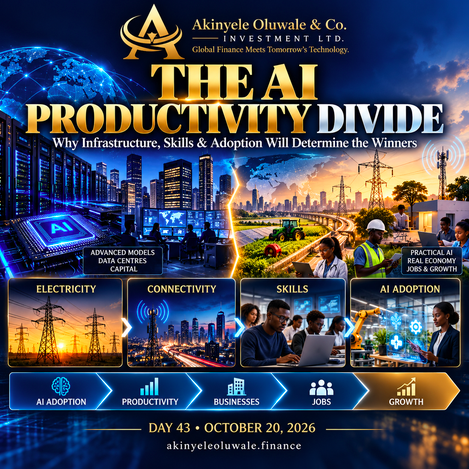
There are effectively two AI races underway.
This is the highly visible competition.
Advanced Models → GPUs → Data Centres → Electricity → Capital
It requires enormous amounts of computing infrastructure and financing.
This could prove equally consequential.
Electricity → Connectivity → Skills → AI Tools → Business Adoption → Productivity
The first race determines who builds the most advanced AI.
The second may determine who captures the broadest economic benefits.
That distinction is particularly important for emerging economies.
They do not necessarily need to reproduce Silicon Valley's infrastructure spending.
They need to determine where AI can improve existing economic activity.
For example:
An agricultural business doesn't need to train a frontier model to use AI for crop analysis.
A hospital doesn't need its own hyperscale data centre to benefit from AI-supported diagnostics.
A small business doesn't need billions in computing infrastructure to use AI for administration, customer service or productivity.
A government doesn't need to build a global chatbot to use AI to improve public-service delivery.
This is where Small AI becomes economically significant.
For investors, companies and policymakers, the critical distinction is:
Having access to artificial intelligence is only the first stage.
The economic transmission mechanism looks more like:
↓
↓
↓
↓
↓
↓
↓
A weakness at any stage can limit the economic benefit of the stages that follow.
An economy with sophisticated AI tools but unreliable electricity faces an obvious constraint.
An economy with electricity but poor digital connectivity faces another.
Connectivity without relevant skills creates another bottleneck.
Skills without investable businesses create another.
This means the AI opportunity is fundamentally an ecosystem challenge.
The AI boom has generated extraordinary expectations.
But technological capability and economic productivity are not identical.
A more powerful model does not automatically produce a more productive economy.
That transformation requires businesses.
Infrastructure.
Workers.
Capital.
Skills.
Institutions.
And ultimately customers willing to pay for useful products and services.
This is why the next phase of AI should increasingly be judged by economic outcomes, not simply technical benchmarks.
Can a farmer produce more efficiently?
Can a manufacturer reduce waste?
Can a hospital improve service delivery?
Can a bank serve customers more efficiently?
Can a small business expand without increasing administrative costs proportionately?
Can workers use AI to increase the economic value of their skills?
Those questions will matter more to long-term economic development than another leaderboard ranking.
The AI race will not ultimately be won by access to intelligence alone. It will be won by the economies that convert intelligence into productivity.
And our second principle:
AI infrastructure creates capacity. AI adoption creates economic value.
AI cannot scale economically without reliable power.
For developing economies, electricity infrastructure may therefore become part of AI policy.
Affordable broadband and mobile connectivity determine who can actually access digital services.
The critical skill may increasingly be not simply building AI, but knowing how to work effectively with AI.
Large corporations will naturally adopt AI.
The larger productivity breakthrough could come when millions of smaller businesses can use it economically.
Avoid simplistic predictions.
AI could automate some tasks while augmenting others and creating entirely new activities.
The key question is whether economies can move workers toward higher-productivity opportunities quickly enough.
Watch whether capital begins moving from the broad AI narrative toward companies producing measurable productivity improvements.
This may be particularly important.
Africa's demographic growth creates both an enormous opportunity and an enormous employment requirement.
The strategic question becomes:
Can Africa use AI to leapfrog productivity constraints rather than simply consume AI products created elsewhere?
1. The AI story is moving from capability toward productivity.
2. Developing economies face a different AI challenge from technology superpowers.
3. Building frontier models is not the only route to economic benefit.
4. Practical or “Small AI” could broaden adoption across agriculture, healthcare, education, finance and small businesses.
5. Electricity, connectivity and skills are fundamental AI infrastructure.
6. AI access does not automatically equal AI productivity.
7. Employment outcomes will depend heavily on how businesses, workers and governments adapt.
8. The long-term winners may be economies that deploy AI most effectively not simply those that build the biggest models.
And the shorter investment framework:
Akinyele Oluwale & Co. Investment Ltd. provides institutional financial intelligence covering the intersection of global finance and emerging technology.
Our coverage includes artificial intelligence, blockchain technology, crypto and digital assets, institutional finance, stablecoins and payments, tokenization and real-world assets, central banks, and macroeconomic developments.
Our objective is to move beyond headlines to understand:
What changed?
Why does it matter?
How could it affect capital, businesses and economies?
What should serious investors and decision-makers watch next?
Observe the change.
Understand the implications.
Position with discipline.
Akinyele Oluwale & Co. Investment Ltd.
Where Global Finance Meets Tomorrow's Technology.
Published: October 19, 2026
Category: Macro & Global Markets
By: Akinyele Oluwale
The next development challenge is not simply finding more capital. It is directing capital toward productive investment that creates jobs, raises incomes and strengthens the capacity to repay.
The 2026 IMF World Bank Annual Meetings ended in Bangkok with a difficult message for developing economies.
Capital is needed more urgently, but traditional sources of development financing are becoming increasingly constrained.
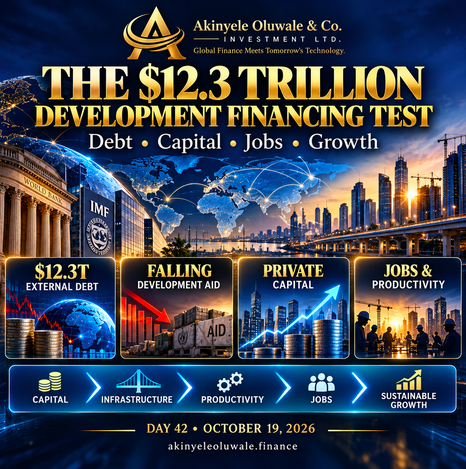
Developing countries' external debt has reached approximately $12.3 trillion, while official development assistance fell 23% in 2025, according to reporting from the meetings. At the same time, higher borrowing costs are placing greater pressure on government budgets. Reuters
For poorer countries, average debt-service payments are now consuming approximately 14% of government revenues. Reuters
Yet the financing challenge coincides with an even larger demographic challenge.
World Bank Group President Ajay Banga told the Annual Meetings that over the next 10–15 years approximately 1.2 billion young people will reach working age in developing countries, while current projections suggest only around 400 million jobs will be available. World Bank
That potentially leaves an employment gap approaching:
The development equation is therefore becoming increasingly difficult:
High Debt → Expensive Debt Service → Less Fiscal Space → Falling Aid → Private-Capital Need → Productive Investment → Jobs & Growth
The central question is no longer simply:
Where will developing economies find money?
It is:
Debt itself is not automatically harmful.
Borrowing can finance infrastructure, electricity, transport, education, healthcare, digital connectivity and productive businesses.
The critical question is what happens after the money is borrowed.
If capital increases productive capacity, future economic growth can help support repayment.
But when debt servicing grows faster than government revenues, fiscal space contracts.
Governments then have less capacity to fund:
This is the danger facing many developing economies.
The G24 warned during the meetings that developing nations face a significant debt burden alongside elevated borrowing costs and fiscal pressures that constrain inclusive growth. Reuters
The issue therefore extends beyond debt sustainability.
It becomes a question of economic opportunity.
Three developments converged during the Annual Meetings.
Developing countries' external debt reached approximately:
That represents obligations accumulated across governments, corporations and other borrowers—not a single government debt figure. Reuters
Official development assistance declined 23% during 2025, reported as the largest annual decline on record. Reuters
Banga told delegates:
1.2 billion young people → approximately 400 million projected jobs
over the coming 10–15 years. World Bank
This creates an enormous economic challenge.
Countries need investment precisely when governments and traditional donors have less room to provide it.
That explains why private capital mobilisation became one of the central themes of the 2026 Annual Meetings.
The World Bank says it mobilised a record $112 billion in private capital and issued $25 billion in guarantees in FY2026. World Bank Live
The development-finance model is changing.
For decades, development financing could broadly be understood as:
That model is not disappearing.
Public and concessional finance remain particularly important for poorer and more vulnerable economies.
But the emerging architecture increasingly looks like:
Banga explicitly described the future of development as bringing together public finance, private investment, philanthropy and technology, with the mix changing as countries develop. World Bank
This represents a major strategic shift.
Governments cannot finance everything.
Multilateral institutions cannot finance everything.
Private investors cannot solve every development problem.
The challenge is therefore to allocate risk intelligently.
Public and multilateral capital can potentially absorb or reduce risks that private investors are unwilling to accept.
That can help mobilise larger pools of private investment.
But there is an essential condition:
Private capital is not automatically development capital.
Its economic contribution depends on where it goes and what it produces.
The investment chain we should watch is:
Each link matters.
Countries require financing.
But capital alone is an input not an outcome.
Investment in electricity, transportation, telecommunications, water and digital infrastructure can reduce the cost of doing business.
Better infrastructure and technology can enable workers and companies to produce more efficiently.
Productive companies expand economic activity, investment and entrepreneurship.
Business expansion can create employment.
Productive employment raises household earning capacity.
Higher productivity and incomes can expand economic output and potentially strengthen government revenues.
That final stage matters for debt sustainability.
The strongest development-finance model is therefore not:
Borrow → Spend → Borrow Again
It should increasingly aim for:
That is the difference between financing consumption and financing productive economic capacity.
The $12.3 trillion headline is important.
But debt is not the only story.
The deeper story is a global capital-allocation problem.
The developing world needs enormous investment in infrastructure, businesses, technology and human capital.
At the same time:
Aid is declining.
Debt-service burdens are elevated.
Fiscal space is constrained.
Borrowing costs remain difficult.
The employment requirement is expanding.
That combination creates a fundamental challenge for development finance.
The solution cannot simply be:
Nor can it simply be:
The better objective is:
Capital that expands electricity generation.
Capital that improves transportation.
Capital that builds digital infrastructure.
Capital that increases agricultural productivity.
Capital that helps viable businesses expand.
Capital that improves skills.
Capital that ultimately creates sustainable employment.
This is why job creation has become central to the World Bank's strategy. World Bank
The next development challenge is not simply finding more capital. It is directing capital toward productive investment that creates jobs, raises incomes and strengthens the capacity to repay.
Watch whether multilateral institutions, governments and private creditors develop faster mechanisms for countries experiencing unsustainable debt burdens.
Falling policy rates alone will not solve the problem if sovereign risk premiums and long-term borrowing costs remain elevated.
The critical metric should not simply be the amount of capital announced.
Watch the progression:
Capital Mobilised → Capital Disbursed → Projects Delivered → Productivity Improved → Jobs Created
Energy, transportation and digital connectivity remain essential foundations for private-sector growth.
The development question is shifting from whether emerging economies can access technology to whether technology can improve productivity and create economic opportunity.
Indeed, the World Bank's Global AI & Digital Summit begins today, October 19, immediately after the Annual Meetings, with jobs, productivity and broader economic opportunity at the centre of the agenda. World Bank
Africa deserves particular attention because demographics make the jobs challenge especially consequential.
Infrastructure + skills + investment climate + productive capital will increasingly determine whether demographic growth becomes an economic dividend.
1. Developing-country external debt has reached approximately $12.3 trillion. Reuters
2. Official development assistance fell 23% in 2025, increasing pressure to find alternative financing models. Reuters
3. Debt service is consuming roughly 14% of government revenue on average among poorer countries. Reuters
4. Around 1.2 billion young people are expected to reach working age in developing countries over the next 10–15 years, against approximately 400 million projected jobs. World Bank
5. Private capital will therefore become increasingly important—but capital mobilisation alone is not success.
6. The ultimate test is productive economic impact.
High Debt → Expensive Debt Service → Less Fiscal Space → Private-Capital Need → Productive Investment → Jobs → Growth
And our economic-value framework:
Akinyele Oluwale & Co. Investment Ltd. provides financial intelligence at the intersection of global finance, macroeconomics and emerging technology.
Our coverage includes artificial intelligence, blockchain technology, crypto and digital assets, institutional finance, stablecoins and payments, tokenization and real-world assets, central banks, and global macroeconomic developments.
Our objective is to move beyond headlines to understand:
What changed?
Why does it matter?
Where could capital move next?
What are the long-term implications for investors, institutions and economies?
Observe the change.
Understand the implications.
Position with discipline.
Akinyele Oluwale & Co. Investment Ltd.
Where Global Finance Meets Tomorrow's Technology.
Day 40: The Global Liquidity Reset Why Interest Rates, Government Debt and Central-Bank Policy Could Determine Where Capital Moves Next
Day 41: Wall Street's Tokenization Shift Why Goldman Sachs, Morgan Stanley and Wells Fargo Are Beginning to See Tokenized Finance as an Opportunity Not a Threat
Day 35: Nigeria's $5.79 Billion Investment Test From Financing Commitments to Real Economic Impact
Day 37: Private Capital's Big Test Can Global Finance Turn Investment Into Jobs, Infrastructure and Sustainable Growth?

The real tokenization revolution may not be the replacement of traditional finance. It may be the transformation of traditional finance from within.
For years, one of the dominant narratives surrounding blockchain technology was disruption: decentralized financial systems would challenge banks, exchanges, custodians and other traditional financial intermediaries.
The institutional conversation is changing.
Major financial institutions are increasingly examining how tokenization can be incorporated into the existing financial system rather than simply competing against it.
A fresh October 17 report indicates that Goldman Sachs, Wells Fargo and Morgan Stanley are viewing tokenization through potential opportunities in trading, payments and investment advisory services. CoinDesk
But the institutional shift extends beyond Wall Street.
On September 21, the Eurosystem launched Pontes, enabling wholesale transactions involving tokenized assets to settle in central-bank money. An initial group of banks and market infrastructures had already completed onboarding at launch. European Central Bank
Even more significantly, the ECB has begun preparing to invest a small portion of its own funds in tokenized securities, initially focusing on euro-denominated public-sector and supranational securities. European Central Bank
The emerging transition can therefore be summarized as:
Experimentation → Infrastructure → Integration → Scale
Tokenization is no longer only a discussion about putting traditional assets on blockchain networks.
The deeper question is whether financial institutions can use tokenization to redesign parts of the infrastructure through which assets are issued, traded, settled, held and serviced.
Financial markets depend on infrastructure.
Behind every bond, equity or other financial instrument sits a network of exchanges, custodians, clearing systems, settlement mechanisms, banks and record-keeping processes.
Many of these systems work effectively, but they can also involve multiple intermediaries and operational steps.
Tokenization proposes a different architecture.
A traditional financial asset or the legal economic claim associated with it can be represented digitally and transferred using distributed-ledger infrastructure.
The potential benefits include greater automation, faster settlement, improved transparency and more efficient processing.
The ECB itself says tokenization could bundle multiple stages of an asset's lifecycle from issuance and trading through settlement, custody and servicing while enabling greater automation through smart contracts. European Central Bank
This matters because the competition may ultimately be about something much larger than cryptocurrency.
It may be about the future operating system of financial markets.
The latest Wall Street development provides an important signal.
Reporting published October 17 describes Goldman Sachs, Wells Fargo and Morgan Stanley as increasingly viewing tokenization as a potential growth opportunity, with possible applications spanning trading, payments and advisory activities. CoinDesk
Different institutions may pursue different opportunities.
But the strategic direction is becoming clearer:
Blockchain technology does not necessarily require banks to disappear.
Banks can instead attempt to incorporate blockchain-based infrastructure into their existing businesses.
At the same time, Europe's central-bank infrastructure is moving beyond experimentation.
The Eurosystem launched Pontes on September 21. It connects distributed-ledger market platforms with existing TARGET Services so tokenized wholesale transactions can settle using central-bank money. European Central Bank
That distinction is important.
A pilot demonstrates possibility.
Production infrastructure demonstrates institutional commitment.
The evolution of tokenization can increasingly be viewed through four stages:
Financial institutions test blockchain technology through proofs of concept and limited pilots.
↓
Custody, settlement, identity, compliance and interoperability systems begin developing.
↓
Tokenized assets begin interacting with established banking and capital-market infrastructure.
↓
Tokenized markets become sufficiently liquid, standardized and interoperable to support significant institutional activity.
The industry is not uniformly at Stage 4.
Far from it.
The World Bank noted earlier this year that approximately $3.7 billion of DLT-based fixed-income instruments were issued globally in 2024, tiny relative to a roughly $100 trillion global bond market. World Bank Blogs
That comparison is essential.
It prevents us from confusing technological potential with present market scale.
Tokenized finance is growing, but conventional capital markets remain vastly larger.
The long-term significance of tokenization can be understood through this chain:
Traditional Assets
↓
Tokenization
↓
Digital Market Infrastructure
↓
Potentially Faster & More Automated Settlement
↓
Institutional Adoption
↓
New Financial Services
But investors and financial institutions should examine tokenization through four separate lenses.
Asset: What economic value or legal claim does the token actually represent?
Infrastructure: Who provides the blockchain, custody, settlement and operational systems?
Regulation: Are ownership rights and investor protections legally enforceable?
Utility: Does tokenization materially improve cost, settlement, transparency, liquidity or accessibility?
This distinction matters because tokenizing an asset does not automatically make the underlying asset more valuable.
Technology can improve infrastructure.
It cannot transform a poor-quality economic asset into a high-quality one simply by representing it digitally.
The World Bank has similarly identified technological vulnerabilities, interoperability problems, smart-contract risks and regulatory uncertainty among issues that tokenized bond markets must address. World Bank Blogs
The most interesting development in tokenization is not necessarily happening at the edges of traditional finance.
It is increasingly happening inside traditional finance itself.
Central banks are examining settlement infrastructure.
Commercial banks are exploring tokenized payments and deposits.
Capital-market institutions are investigating tokenized securities.
Asset managers and investors are examining how digital infrastructure could change issuance, settlement and portfolio administration.
This changes the central question.
The old question was:
Will blockchain replace traditional finance?
The better question may increasingly be:
Which parts of traditional finance will blockchain infrastructure improve and which institutions will successfully adapt?
The ECB's strategy is particularly revealing. Pontes is designed to connect tokenized markets to central-bank-money settlement, while the broader Appia initiative is examining standards, interoperability, governance and the architecture of a more integrated tokenized European financial ecosystem. European Central Bank
That represents evolution rather than revolution.
The real tokenization revolution may not be the replacement of traditional finance. It may be the transformation of traditional finance from within.
Five developments deserve particular attention.
Institutional adoption: Watch whether today's experiments become recurring commercial transactions rather than isolated demonstrations.
Central-bank settlement: Pontes is especially important because institutional tokenized markets need credible settlement infrastructure. The ECB plans gradual enhancements, with fuller implementation expected by 2028. European Central Bank
Interoperability: A financial system consisting of hundreds of disconnected tokenization platforms would recreate fragmentation rather than eliminate it.
Legal and regulatory clarity: Technology can record ownership, but institutions still require clear legal recognition of the underlying rights and obligations.
Economic utility: Ultimately, tokenization must demonstrate measurable improvements in cost, settlement, liquidity, transparency or access.
The winners may therefore not necessarily be the institutions making the loudest blockchain announcements.
They may be those building infrastructure that solves genuine financial-market problems.
1. Tokenization is moving deeper into institutional finance. Major banks increasingly appear to be considering it as a business opportunity rather than purely a competitive threat. CoinDesk
2. Central-bank infrastructure is beginning to support the transition. The Eurosystem's Pontes has moved tokenized wholesale settlement in central-bank money into an operational environment. European Central Bank
3. Traditional finance is unlikely simply to disappear. Existing institutions may adopt tokenized infrastructure themselves.
4. Scale remains limited relative to traditional markets. Tokenization's potential should not be confused with its current market size. World Bank Blogs
5. Infrastructure matters more than hype. Custody, settlement, regulation, interoperability and legal ownership will determine whether tokenization achieves sustainable institutional scale.
6. Tokenization does not automatically improve an underlying investment. The economic quality of the asset remains fundamental.
Traditional Assets → Tokenization → Digital Market Infrastructure → Faster Settlement → Institutional Adoption → New Financial Services
And the institutional progression:
Experimentation → Infrastructure → Integration → Scale
Akinyele Oluwale & Co. Investment Ltd. is a financial intelligence platform focused on the intersection of global finance and emerging technology.
Our coverage includes artificial intelligence, blockchain technology, digital assets, institutional finance, stablecoins and payments, tokenization and real-world assets, central banks, and macroeconomic developments.
Our objective is not simply to report what happened.
We seek to understand what is changing, why it matters and how those changes could reshape capital, markets and investment thinking over time.
Observe the change.
Understand the implications.
Position with discipline.
Akinyele Oluwale & Co. Investment Ltd.
Where Global Finance Meets Tomorrow’s Technology.