


Published: October 20, 2026
Category: AI
By: Akinyele Oluwale
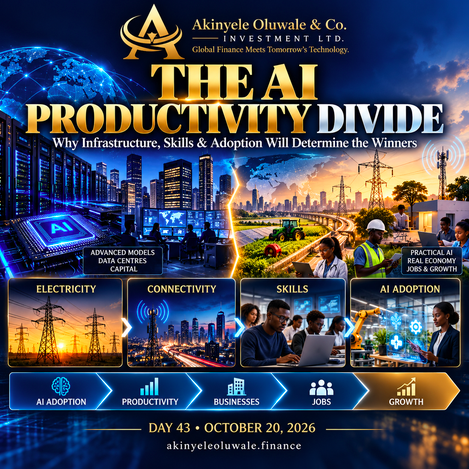
The AI race will not ultimately be won by access to intelligence alone. It will be won by the economies that convert intelligence into productivity.
Artificial intelligence is entering a more consequential phase. The first phase of the AI boom was dominated by models, chips, computing power and extraordinary investment in data centres.
The next phase will increasingly ask a different question:
For advanced economies, the AI investment chain has increasingly looked like:
Models → Chips → Data Centres → Electricity → Capital
But for many developing economies, the challenge begins much earlier:
That distinction could become one of the defining economic divides of the AI era.
The World Bank's final summary of its 2026 Annual Meetings highlighted jobs, “Small AI” and private capital among the major themes, while its broader AI work emphasizes that countries begin the AI transition with very different levels of connectivity, computing infrastructure, skills and institutional capability.
The opportunity is enormous.
But access to AI alone will not guarantee prosperity.
The winners could ultimately be those economies that successfully convert increasingly accessible intelligence into:
Higher productivity.
Better businesses.
Improved public services.
New economic opportunities.
Sustainable employment.
That is the emerging AI Productivity Divide.
The world is simultaneously confronting two enormous transitions.
The first is technological.
AI is becoming cheaper, more capable and more widely available.
The second is demographic.
Approximately 1.2 billion young people are expected to reach working age across developing economies over the next 10–15 years, while current trajectories imply only about 400 million jobs.
That potentially leaves an employment gap approaching:
AI therefore arrives at an extraordinary moment.
Used effectively, it could help workers become more productive, companies reduce inefficiencies, governments improve services and entrepreneurs build new businesses.
Used poorly or without the infrastructure necessary to support adoption it could deepen existing inequalities.
This is why the AI debate must move beyond:
Who has the biggest model?
toward:
The 2026 IMF World Bank Annual Meetings sharpened this debate.
World Bank President Ajay Banga placed employment at the centre of the development agenda, arguing that creating economic opportunity for the enormous number of young people entering working age requires stronger infrastructure, private investment and technology adoption.
At the same time, attention has increasingly shifted toward what the World Bank describes as “Small AI.”
The idea is important.
Developing economies do not necessarily need to build the world's largest frontier AI models to benefit from artificial intelligence.
Practical AI applications can increasingly operate through smaller models, ordinary devices and more constrained computing environments.
That opens possibilities across:
Agriculture
Healthcare
Education
Financial services
Manufacturing
Small businesses
Government services
The economic opportunity therefore becomes:
The objective isn't simply possessing advanced technology.
It is solving real economic problems with it.
There are effectively two AI races underway.
This is the highly visible competition.
Advanced Models → GPUs → Data Centres → Electricity → Capital
It requires enormous amounts of computing infrastructure and financing.
This could prove equally consequential.
Electricity → Connectivity → Skills → AI Tools → Business Adoption → Productivity
The first race determines who builds the most advanced AI.
The second may determine who captures the broadest economic benefits.
That distinction is particularly important for emerging economies.
They do not necessarily need to reproduce Silicon Valley's infrastructure spending.
They need to determine where AI can improve existing economic activity.
For example:
An agricultural business doesn't need to train a frontier model to use AI for crop analysis.
A hospital doesn't need its own hyperscale data centre to benefit from AI-supported diagnostics.
A small business doesn't need billions in computing infrastructure to use AI for administration, customer service or productivity.
A government doesn't need to build a global chatbot to use AI to improve public-service delivery.
This is where Small AI becomes economically significant.
For investors, companies and policymakers, the critical distinction is:
Having access to artificial intelligence is only the first stage.
The economic transmission mechanism looks more like:
↓
↓
↓
↓
↓
↓
↓
A weakness at any stage can limit the economic benefit of the stages that follow.
An economy with sophisticated AI tools but unreliable electricity faces an obvious constraint.
An economy with electricity but poor digital connectivity faces another.
Connectivity without relevant skills creates another bottleneck.
Skills without investable businesses create another.
This means the AI opportunity is fundamentally an ecosystem challenge.
The AI boom has generated extraordinary expectations.
But technological capability and economic productivity are not identical.
A more powerful model does not automatically produce a more productive economy.
That transformation requires businesses.
Infrastructure.
Workers.
Capital.
Skills.
Institutions.
And ultimately customers willing to pay for useful products and services.
This is why the next phase of AI should increasingly be judged by economic outcomes, not simply technical benchmarks.
Can a farmer produce more efficiently?
Can a manufacturer reduce waste?
Can a hospital improve service delivery?
Can a bank serve customers more efficiently?
Can a small business expand without increasing administrative costs proportionately?
Can workers use AI to increase the economic value of their skills?
Those questions will matter more to long-term economic development than another leaderboard ranking.
The AI race will not ultimately be won by access to intelligence alone. It will be won by the economies that convert intelligence into productivity.
And our second principle:
AI infrastructure creates capacity. AI adoption creates economic value.
AI cannot scale economically without reliable power.
For developing economies, electricity infrastructure may therefore become part of AI policy.
Affordable broadband and mobile connectivity determine who can actually access digital services.
The critical skill may increasingly be not simply building AI, but knowing how to work effectively with AI.
Large corporations will naturally adopt AI.
The larger productivity breakthrough could come when millions of smaller businesses can use it economically.
Avoid simplistic predictions.
AI could automate some tasks while augmenting others and creating entirely new activities.
The key question is whether economies can move workers toward higher-productivity opportunities quickly enough.
Watch whether capital begins moving from the broad AI narrative toward companies producing measurable productivity improvements.
This may be particularly important.
Africa's demographic growth creates both an enormous opportunity and an enormous employment requirement.
The strategic question becomes:
Can Africa use AI to leapfrog productivity constraints rather than simply consume AI products created elsewhere?
1. The AI story is moving from capability toward productivity.
2. Developing economies face a different AI challenge from technology superpowers.
3. Building frontier models is not the only route to economic benefit.
4. Practical or “Small AI” could broaden adoption across agriculture, healthcare, education, finance and small businesses.
5. Electricity, connectivity and skills are fundamental AI infrastructure.
6. AI access does not automatically equal AI productivity.
7. Employment outcomes will depend heavily on how businesses, workers and governments adapt.
8. The long-term winners may be economies that deploy AI most effectively not simply those that build the biggest models.
And the shorter investment framework:
Akinyele Oluwale & Co. Investment Ltd. provides institutional financial intelligence covering the intersection of global finance and emerging technology.
Our coverage includes artificial intelligence, blockchain technology, crypto and digital assets, institutional finance, stablecoins and payments, tokenization and real-world assets, central banks, and macroeconomic developments.
Our objective is to move beyond headlines to understand:
What changed?
Why does it matter?
How could it affect capital, businesses and economies?
What should serious investors and decision-makers watch next?
Observe the change.
Understand the implications.
Position with discipline.
Akinyele Oluwale & Co. Investment Ltd.
Where Global Finance Meets Tomorrow's Technology.
Published: October 19, 2026
Category: Macro & Global Markets
By: Akinyele Oluwale
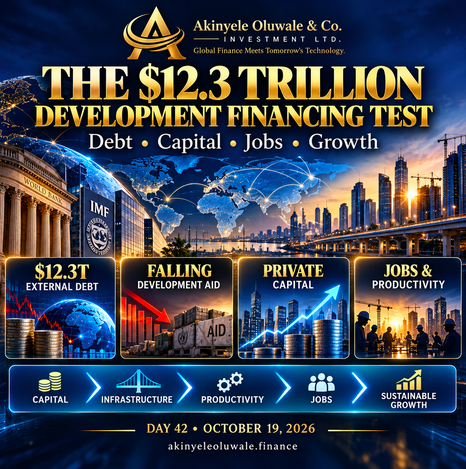
The next development challenge is not simply finding more capital. It is directing capital toward productive investment that creates jobs, raises incomes and strengthens the capacity to repay.
The 2026 IMF World Bank Annual Meetings ended in Bangkok with a difficult message for developing economies.
Capital is needed more urgently, but traditional sources of development financing are becoming increasingly constrained.
Developing countries' external debt has reached approximately $12.3 trillion, while official development assistance fell 23% in 2025, according to reporting from the meetings. At the same time, higher borrowing costs are placing greater pressure on government budgets. Reuters
For poorer countries, average debt-service payments are now consuming approximately 14% of government revenues. Reuters
Yet the financing challenge coincides with an even larger demographic challenge.
World Bank Group President Ajay Banga told the Annual Meetings that over the next 10–15 years approximately 1.2 billion young people will reach working age in developing countries, while current projections suggest only around 400 million jobs will be available. World Bank
That potentially leaves an employment gap approaching:
The development equation is therefore becoming increasingly difficult:
High Debt → Expensive Debt Service → Less Fiscal Space → Falling Aid → Private-Capital Need → Productive Investment → Jobs & Growth
The central question is no longer simply:
Where will developing economies find money?
It is:
Debt itself is not automatically harmful.
Borrowing can finance infrastructure, electricity, transport, education, healthcare, digital connectivity and productive businesses.
The critical question is what happens after the money is borrowed.
If capital increases productive capacity, future economic growth can help support repayment.
But when debt servicing grows faster than government revenues, fiscal space contracts.
Governments then have less capacity to fund:
This is the danger facing many developing economies.
The G24 warned during the meetings that developing nations face a significant debt burden alongside elevated borrowing costs and fiscal pressures that constrain inclusive growth. Reuters
The issue therefore extends beyond debt sustainability.
It becomes a question of economic opportunity.
Three developments converged during the Annual Meetings.
Developing countries' external debt reached approximately:
That represents obligations accumulated across governments, corporations and other borrowers—not a single government debt figure. Reuters
Official development assistance declined 23% during 2025, reported as the largest annual decline on record. Reuters
Banga told delegates:
1.2 billion young people → approximately 400 million projected jobs
over the coming 10–15 years. World Bank
This creates an enormous economic challenge.
Countries need investment precisely when governments and traditional donors have less room to provide it.
That explains why private capital mobilisation became one of the central themes of the 2026 Annual Meetings.
The World Bank says it mobilised a record $112 billion in private capital and issued $25 billion in guarantees in FY2026. World Bank Live
The development-finance model is changing.
For decades, development financing could broadly be understood as:
That model is not disappearing.
Public and concessional finance remain particularly important for poorer and more vulnerable economies.
But the emerging architecture increasingly looks like:
Banga explicitly described the future of development as bringing together public finance, private investment, philanthropy and technology, with the mix changing as countries develop. World Bank
This represents a major strategic shift.
Governments cannot finance everything.
Multilateral institutions cannot finance everything.
Private investors cannot solve every development problem.
The challenge is therefore to allocate risk intelligently.
Public and multilateral capital can potentially absorb or reduce risks that private investors are unwilling to accept.
That can help mobilise larger pools of private investment.
But there is an essential condition:
Private capital is not automatically development capital.
Its economic contribution depends on where it goes and what it produces.
The investment chain we should watch is:
Each link matters.
Countries require financing.
But capital alone is an input not an outcome.
Investment in electricity, transportation, telecommunications, water and digital infrastructure can reduce the cost of doing business.
Better infrastructure and technology can enable workers and companies to produce more efficiently.
Productive companies expand economic activity, investment and entrepreneurship.
Business expansion can create employment.
Productive employment raises household earning capacity.
Higher productivity and incomes can expand economic output and potentially strengthen government revenues.
That final stage matters for debt sustainability.
The strongest development-finance model is therefore not:
Borrow → Spend → Borrow Again
It should increasingly aim for:
That is the difference between financing consumption and financing productive economic capacity.
The $12.3 trillion headline is important.
But debt is not the only story.
The deeper story is a global capital-allocation problem.
The developing world needs enormous investment in infrastructure, businesses, technology and human capital.
At the same time:
Aid is declining.
Debt-service burdens are elevated.
Fiscal space is constrained.
Borrowing costs remain difficult.
The employment requirement is expanding.
That combination creates a fundamental challenge for development finance.
The solution cannot simply be:
Nor can it simply be:
The better objective is:
Capital that expands electricity generation.
Capital that improves transportation.
Capital that builds digital infrastructure.
Capital that increases agricultural productivity.
Capital that helps viable businesses expand.
Capital that improves skills.
Capital that ultimately creates sustainable employment.
This is why job creation has become central to the World Bank's strategy. World Bank
The next development challenge is not simply finding more capital. It is directing capital toward productive investment that creates jobs, raises incomes and strengthens the capacity to repay.
Watch whether multilateral institutions, governments and private creditors develop faster mechanisms for countries experiencing unsustainable debt burdens.
Falling policy rates alone will not solve the problem if sovereign risk premiums and long-term borrowing costs remain elevated.
The critical metric should not simply be the amount of capital announced.
Watch the progression:
Capital Mobilised → Capital Disbursed → Projects Delivered → Productivity Improved → Jobs Created
Energy, transportation and digital connectivity remain essential foundations for private-sector growth.
The development question is shifting from whether emerging economies can access technology to whether technology can improve productivity and create economic opportunity.
Indeed, the World Bank's Global AI & Digital Summit begins today, October 19, immediately after the Annual Meetings, with jobs, productivity and broader economic opportunity at the centre of the agenda. World Bank
Africa deserves particular attention because demographics make the jobs challenge especially consequential.
Infrastructure + skills + investment climate + productive capital will increasingly determine whether demographic growth becomes an economic dividend.
1. Developing-country external debt has reached approximately $12.3 trillion. Reuters
2. Official development assistance fell 23% in 2025, increasing pressure to find alternative financing models. Reuters
3. Debt service is consuming roughly 14% of government revenue on average among poorer countries. Reuters
4. Around 1.2 billion young people are expected to reach working age in developing countries over the next 10–15 years, against approximately 400 million projected jobs. World Bank
5. Private capital will therefore become increasingly important—but capital mobilisation alone is not success.
6. The ultimate test is productive economic impact.
High Debt → Expensive Debt Service → Less Fiscal Space → Private-Capital Need → Productive Investment → Jobs → Growth
And our economic-value framework:
Akinyele Oluwale & Co. Investment Ltd. provides financial intelligence at the intersection of global finance, macroeconomics and emerging technology.
Our coverage includes artificial intelligence, blockchain technology, crypto and digital assets, institutional finance, stablecoins and payments, tokenization and real-world assets, central banks, and global macroeconomic developments.
Our objective is to move beyond headlines to understand:
What changed?
Why does it matter?
Where could capital move next?
What are the long-term implications for investors, institutions and economies?
Observe the change.
Understand the implications.
Position with discipline.
Akinyele Oluwale & Co. Investment Ltd.
Where Global Finance Meets Tomorrow's Technology.
Day 40: The Global Liquidity Reset Why Interest Rates, Government Debt and Central-Bank Policy Could Determine Where Capital Moves Next
Day 41: Wall Street's Tokenization Shift Why Goldman Sachs, Morgan Stanley and Wells Fargo Are Beginning to See Tokenized Finance as an Opportunity Not a Threat
Day 35: Nigeria's $5.79 Billion Investment Test From Financing Commitments to Real Economic Impact
Day 37: Private Capital's Big Test Can Global Finance Turn Investment Into Jobs, Infrastructure and Sustainable Growth?
The real tokenization revolution may not be the replacement of traditional finance. It may be the transformation of traditional finance from within.
For years, one of the dominant narratives surrounding blockchain technology was disruption: decentralized financial systems would challenge banks, exchanges, custodians and other traditional financial intermediaries.
The institutional conversation is changing.
Major financial institutions are increasingly examining how tokenization can be incorporated into the existing financial system rather than simply competing against it.
A fresh October 17 report indicates that Goldman Sachs, Wells Fargo and Morgan Stanley are viewing tokenization through potential opportunities in trading, payments and investment advisory services. CoinDesk
But the institutional shift extends beyond Wall Street.
On September 21, the Eurosystem launched Pontes, enabling wholesale transactions involving tokenized assets to settle in central-bank money. An initial group of banks and market infrastructures had already completed onboarding at launch. European Central Bank
Even more significantly, the ECB has begun preparing to invest a small portion of its own funds in tokenized securities, initially focusing on euro-denominated public-sector and supranational securities. European Central Bank
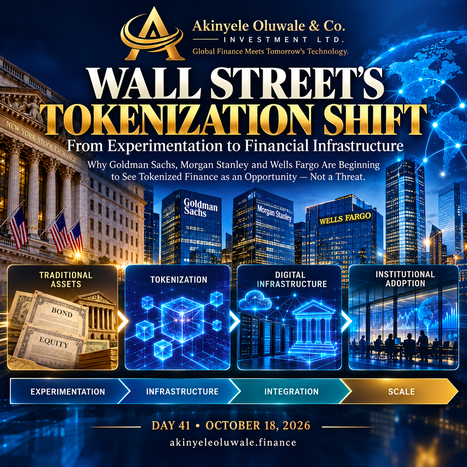
The emerging transition can therefore be summarized as:
Experimentation → Infrastructure → Integration → Scale
Tokenization is no longer only a discussion about putting traditional assets on blockchain networks.
The deeper question is whether financial institutions can use tokenization to redesign parts of the infrastructure through which assets are issued, traded, settled, held and serviced.
Financial markets depend on infrastructure.
Behind every bond, equity or other financial instrument sits a network of exchanges, custodians, clearing systems, settlement mechanisms, banks and record-keeping processes.
Many of these systems work effectively, but they can also involve multiple intermediaries and operational steps.
Tokenization proposes a different architecture.
A traditional financial asset or the legal economic claim associated with it can be represented digitally and transferred using distributed-ledger infrastructure.
The potential benefits include greater automation, faster settlement, improved transparency and more efficient processing.
The ECB itself says tokenization could bundle multiple stages of an asset's lifecycle from issuance and trading through settlement, custody and servicing while enabling greater automation through smart contracts. European Central Bank
This matters because the competition may ultimately be about something much larger than cryptocurrency.
It may be about the future operating system of financial markets.
The latest Wall Street development provides an important signal.
Reporting published October 17 describes Goldman Sachs, Wells Fargo and Morgan Stanley as increasingly viewing tokenization as a potential growth opportunity, with possible applications spanning trading, payments and advisory activities. CoinDesk
Different institutions may pursue different opportunities.
But the strategic direction is becoming clearer:
Blockchain technology does not necessarily require banks to disappear.
Banks can instead attempt to incorporate blockchain-based infrastructure into their existing businesses.
At the same time, Europe's central-bank infrastructure is moving beyond experimentation.
The Eurosystem launched Pontes on September 21. It connects distributed-ledger market platforms with existing TARGET Services so tokenized wholesale transactions can settle using central-bank money. European Central Bank
That distinction is important.
A pilot demonstrates possibility.
Production infrastructure demonstrates institutional commitment.
The evolution of tokenization can increasingly be viewed through four stages:
Financial institutions test blockchain technology through proofs of concept and limited pilots.
↓
Custody, settlement, identity, compliance and interoperability systems begin developing.
↓
Tokenized assets begin interacting with established banking and capital-market infrastructure.
↓
Tokenized markets become sufficiently liquid, standardized and interoperable to support significant institutional activity.
The industry is not uniformly at Stage 4.
Far from it.
The World Bank noted earlier this year that approximately $3.7 billion of DLT-based fixed-income instruments were issued globally in 2024, tiny relative to a roughly $100 trillion global bond market. World Bank Blogs
That comparison is essential.
It prevents us from confusing technological potential with present market scale.
Tokenized finance is growing, but conventional capital markets remain vastly larger.
The long-term significance of tokenization can be understood through this chain:
Traditional Assets
↓
Tokenization
↓
Digital Market Infrastructure
↓
Potentially Faster & More Automated Settlement
↓
Institutional Adoption
↓
New Financial Services
But investors and financial institutions should examine tokenization through four separate lenses.
Asset: What economic value or legal claim does the token actually represent?
Infrastructure: Who provides the blockchain, custody, settlement and operational systems?
Regulation: Are ownership rights and investor protections legally enforceable?
Utility: Does tokenization materially improve cost, settlement, transparency, liquidity or accessibility?
This distinction matters because tokenizing an asset does not automatically make the underlying asset more valuable.
Technology can improve infrastructure.
It cannot transform a poor-quality economic asset into a high-quality one simply by representing it digitally.
The World Bank has similarly identified technological vulnerabilities, interoperability problems, smart-contract risks and regulatory uncertainty among issues that tokenized bond markets must address. World Bank Blogs
The most interesting development in tokenization is not necessarily happening at the edges of traditional finance.
It is increasingly happening inside traditional finance itself.
Central banks are examining settlement infrastructure.
Commercial banks are exploring tokenized payments and deposits.
Capital-market institutions are investigating tokenized securities.
Asset managers and investors are examining how digital infrastructure could change issuance, settlement and portfolio administration.
This changes the central question.
The old question was:
Will blockchain replace traditional finance?
The better question may increasingly be:
Which parts of traditional finance will blockchain infrastructure improve and which institutions will successfully adapt?
The ECB's strategy is particularly revealing. Pontes is designed to connect tokenized markets to central-bank-money settlement, while the broader Appia initiative is examining standards, interoperability, governance and the architecture of a more integrated tokenized European financial ecosystem. European Central Bank
That represents evolution rather than revolution.
The real tokenization revolution may not be the replacement of traditional finance. It may be the transformation of traditional finance from within.
Five developments deserve particular attention.
Institutional adoption: Watch whether today's experiments become recurring commercial transactions rather than isolated demonstrations.
Central-bank settlement: Pontes is especially important because institutional tokenized markets need credible settlement infrastructure. The ECB plans gradual enhancements, with fuller implementation expected by 2028. European Central Bank
Interoperability: A financial system consisting of hundreds of disconnected tokenization platforms would recreate fragmentation rather than eliminate it.
Legal and regulatory clarity: Technology can record ownership, but institutions still require clear legal recognition of the underlying rights and obligations.
Economic utility: Ultimately, tokenization must demonstrate measurable improvements in cost, settlement, liquidity, transparency or access.
The winners may therefore not necessarily be the institutions making the loudest blockchain announcements.
They may be those building infrastructure that solves genuine financial-market problems.
1. Tokenization is moving deeper into institutional finance. Major banks increasingly appear to be considering it as a business opportunity rather than purely a competitive threat. CoinDesk
2. Central-bank infrastructure is beginning to support the transition. The Eurosystem's Pontes has moved tokenized wholesale settlement in central-bank money into an operational environment. European Central Bank
3. Traditional finance is unlikely simply to disappear. Existing institutions may adopt tokenized infrastructure themselves.
4. Scale remains limited relative to traditional markets. Tokenization's potential should not be confused with its current market size. World Bank Blogs
5. Infrastructure matters more than hype. Custody, settlement, regulation, interoperability and legal ownership will determine whether tokenization achieves sustainable institutional scale.
6. Tokenization does not automatically improve an underlying investment. The economic quality of the asset remains fundamental.
Traditional Assets → Tokenization → Digital Market Infrastructure → Faster Settlement → Institutional Adoption → New Financial Services
And the institutional progression:
Experimentation → Infrastructure → Integration → Scale
Akinyele Oluwale & Co. Investment Ltd. is a financial intelligence platform focused on the intersection of global finance and emerging technology.
Our coverage includes artificial intelligence, blockchain technology, digital assets, institutional finance, stablecoins and payments, tokenization and real-world assets, central banks, and macroeconomic developments.
Our objective is not simply to report what happened.
We seek to understand what is changing, why it matters and how those changes could reshape capital, markets and investment thinking over time.
Observe the change.
Understand the implications.
Position with discipline.
Akinyele Oluwale & Co. Investment Ltd.
Where Global Finance Meets Tomorrow’s Technology.
For more than a decade, global investors became accustomed to an extraordinary financial environment.
Interest rates were exceptionally low.
Capital was relatively inexpensive.
Governments could borrow cheaply.
Companies could finance expansion at attractive rates.
Investors searching for higher returns moved aggressively into equities, technology, property and other risk assets.
That environment has changed.
Inflation has returned as a major policy challenge.
Government borrowing requirements have increased.
Bond yields have risen.
Artificial-intelligence infrastructure is creating enormous additional demand for capital.
And central banks are confronting a difficult question:
For investors, however, another question may be even more important:
The answer cannot be determined by policy rates alone.
A central bank can reduce its official interest rate while long-term government bond yields remain elevated.
Governments can continue issuing large quantities of debt.
Banks can maintain strict lending standards.
And investors can continue demanding high returns for providing capital.
This means:
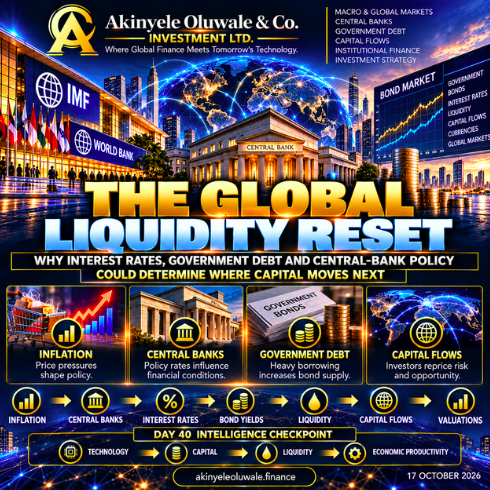
The wider framework is:
Understanding this chain may be essential to understanding the next phase of global markets.
The global financial system may be undergoing a structural change in the price and availability of capital.
During the years following the global financial crisis, extraordinarily low interest rates supported borrowing and asset valuations.
Today, several forces are operating differently.
Inflation remains important.
Government debt is elevated.
Governments require substantial financing.
AI, defence, energy and infrastructure investment are competing for capital.
And investors are demanding greater compensation for holding some long-term debt.
The IMF reported this week that average 10-year government bond yields across the G7 increased by more than one percentage point between February and September 2026, reaching their highest level in nearly two decades. PFM
The investment question is therefore changing from:
When will central banks cut rates?
to:
Those are not necessarily the same event.
Liquidity is one of the most misunderstood concepts in financial markets.
It does not simply mean that there is “money in the system.”
For investors, liquidity is better understood through the availability, cost and willingness of capital to move through the financial system.
Consider a simplified example.
Suppose a central bank reduces its policy rate from 5% to 4.5%.
At first glance, this appears positive for markets.
But imagine that, at the same time:
Government borrowing increases.
Long-term bond yields remain high.
Banks tighten lending standards.
Corporate credit spreads widen.
Investors become more risk-averse.
Would financial conditions necessarily become dramatically easier?
No.
The policy rate has fallen.
But the actual financing environment may remain restrictive.
That distinction matters because asset valuations depend partly on the returns investors can obtain elsewhere.
When relatively safe government bonds offer attractive yields, investors may demand greater expected returns before accepting the additional risks associated with equities, property, private markets and other assets.
The true liquidity question is therefore broader than:
Investors should ask:
The IMF's October 2026 Global Financial Stability Report says financial markets have remained surprisingly resilient.
But it explicitly warns that resilience should not be confused with safety.
One major risk identified by the Fund is a sharp increase in sovereign bond yields driven by inflation pressures, fiscal imbalances and heavy issuance of government and private-sector debt. International Monetary Fund
Why does this matter?
Government bond yields influence borrowing costs throughout financial markets.
They affect:
Mortgages.
Corporate bonds.
Business loans.
Infrastructure financing.
Equity valuations.
Government interest costs.
And international capital flows.
The sovereign bond market is therefore not a side story.
Government borrowing has become another important part of the liquidity equation.
The IMF's April 2026 Fiscal Monitor estimated global public debt at just under 94% of global GDP in 2025, with debt projected to reach approximately 100% by 2029. International Monetary Fund
This week, the IMF again called for governments to address deficits and debt as borrowing costs rise. Reuters
The mechanism matters.
Governments finance deficits partly by issuing bonds.
When government borrowing increases substantially, more bonds must be absorbed by investors.
Those bonds compete with other investments for capital.
The relationship becomes:
This does not mean government borrowing automatically causes bond yields to rise.
Inflation, monetary policy, economic growth, investor demand and global risk sentiment also matter.
But large financing requirements can become increasingly important when markets are already sensitive to inflation and debt sustainability.
Yesterday's Day 39 analysis examined the financing behind the AI boom.
That issue also belongs inside today's liquidity story.
AI requires enormous investment in:
Data centres.
Semiconductors.
Electricity generation.
Transmission infrastructure.
Cooling systems.
And telecommunications.
Central bankers meeting in Bangkok have been examining whether this investment boom is increasing demand for capital before its longer-term productivity benefits fully materialise. Reuters reports that this dynamic is contributing to debate about whether interest rates may remain structurally higher than investors became accustomed to during the previous era of cheap money. Reuters
This creates competition for capital:
When many sectors simultaneously require substantial financing, the price of capital becomes increasingly important.
Central banks cannot focus solely on economic growth.
Their mandates generally require significant attention to price stability.
If inflation remains persistent, policymakers may be reluctant to reduce interest rates aggressively.
The current environment is complicated further by energy costs, geopolitical uncertainty and large investment requirements.
This means monetary policy may remain restrictive even when parts of the economy would benefit from cheaper financing.
The relationship is:
But again, monetary policy is only one component of financial conditions.
The IMF reports that long-term sovereign yields have increased substantially across several major economies.
Between February and September, average G7 10-year government bond yields rose by more than one percentage point. PFM
That matters because long-term yields incorporate expectations about several factors:
Future inflation.
Future policy rates.
Economic growth.
Government borrowing.
Fiscal credibility.
And the compensation investors require for holding long-duration bonds.
This means bond markets can remain restrictive even if central banks eventually begin reducing short-term rates.
The global liquidity environment can be understood through two interconnected forces.
The first begins with inflation.
When inflation rises substantially, central banks may increase interest rates.
Higher rates generally make borrowing more expensive.
Credit growth can slow.
Economic demand can moderate.
Asset valuations may face pressure.
When inflation declines sustainably, central banks may eventually have more room to ease policy.
But this is only half the story.
The second begins with government finances.
Governments must finance spending that exceeds revenue.
One mechanism is bond issuance.
When borrowing requirements are large, investors must absorb substantial debt supply.
If investors demand greater compensation, yields can rise.
That can increase government interest costs.
The cycle can become:
This is why fiscal and monetary policy increasingly interact.
Put both forces together:
↓
↓
↓
↓
↓
↓
↓
This framework helps explain why investors should not analyse central-bank decisions in isolation.
Lower financing costs can support equity valuations because future corporate cash flows become more valuable when discounted at lower rates.
But if long-term yields remain high despite policy-rate reductions, valuation support may be weaker than investors expect.
Highly valued growth companies can be particularly sensitive.
Bond markets sit at the centre of the liquidity reset.
Investors must evaluate:
Inflation.
Government borrowing.
Fiscal credibility.
Central-bank policy.
Economic growth.
And term premiums.
Higher yields may attract investors seeking income.
But rising yields can also produce losses for existing holders of longer-duration bonds.
Companies generally borrow at a premium over government yields.
Therefore:
Highly leveraged businesses can become particularly vulnerable.
This was one of the lessons from our Day 39 AI-financing analysis.
Higher interest rates can initially improve some bank lending margins.
But prolonged high rates can also reduce credit demand and increase borrower stress.
The impact is therefore not one-directional.
Global liquidity conditions matter significantly for emerging economies.
When yields in advanced economies become more attractive, international investors may demand higher returns before allocating capital to riskier markets.
This can influence:
Currencies.
Government borrowing costs.
Corporate financing.
Portfolio flows.
And foreign investment.
The IMF has specifically warned that higher global yields can spill over into Asian financial markets. Reuters
The same transmission principle matters more broadly across emerging economies.
For Nigeria, global liquidity conditions matter through several channels.
International borrowing costs.
Foreign portfolio investment.
Exchange-rate dynamics.
Domestic bond yields.
Government debt servicing.
And the financing environment for businesses.
This means developments in major global bond markets can ultimately influence financing conditions much closer to home.
At Akinyele Oluwale & Co. Investment Ltd., we believe investors should stop treating the question:
as though it were the entire investment strategy.
It isn't.
The more important question is:
Consider three possible scenarios.
Scenario A
Central banks reduce rates.
Bond yields decline.
Credit spreads narrow.
Bank lending improves.
Capital flows toward productive investment.
This represents meaningful easing.
Scenario B
Central banks reduce rates.
But government borrowing remains enormous.
Long-term bond yields stay elevated.
Credit remains expensive.
Capital stays selective.
That represents only partial easing.
Scenario C
Inflation remains persistent.
Central banks maintain or increase rates.
Bond yields remain elevated.
Credit conditions tighten.
That represents continued restrictive conditions.
Investors therefore need to monitor the whole financial system, not one policy rate.
The next major market move may depend less on whether interest rates fall and more on whether the overall cost and availability of capital actually improve.
That distinction becomes increasingly important in an economy where governments, AI companies, energy projects and infrastructure developers are simultaneously competing for capital.
Eight indicators deserve attention.
Is inflation moving sustainably toward central-bank objectives?
Are policymakers signalling easing, tightening or prolonged restriction?
Do yields fall alongside policy rates—or remain elevated?
Are fiscal deficits and bond issuance continuing to increase?
Are investors demanding more or less compensation for corporate credit risk?
Are banks becoming more willing to provide credit?
Is money moving toward equities and emerging markets—or toward safer assets?
Are asset prices supported by improving fundamentals, or mainly by expectations of future monetary easing?
Together, these indicators provide a much better picture of liquidity than policy rates alone.
The global investment environment is being reshaped by the price and availability of capital.
Central-bank interest rates remain important.
But they are only one part of the liquidity equation.
Government debt and bond issuance can influence long-term borrowing costs.
Inflation can restrict the ability of central banks to ease policy.
AI, energy and infrastructure investment are creating additional demand for capital.
Elevated sovereign yields can influence corporate borrowing, asset valuations and emerging-market capital flows.
The central framework is:
Do not watch interest rates alone. Watch whether capital itself is becoming cheaper, more available and more willing to move.
Forty days into our intelligence experiment, four forces increasingly connect the themes we have been tracking:
Technology creates new investment opportunities.
Capital finances those opportunities.
Liquidity determines how easily and cheaply capital can move.
Productivity ultimately determines whether the investment creates sustainable economic value.
This is the connection between AI, tokenization, stablecoins, central banks, private capital and global markets.
Different technologies.
Different financial instruments.
But ultimately the same question:
Akinyele Oluwale & Co. Investment Ltd. is a global finance and digital-economy intelligence platform examining developments reshaping financial markets, institutional investment and emerging technologies.
Our intelligence coverage includes:
AI • Blockchain & Technology • Crypto & Digital Assets • Institutional Finance • Stablecoins & Payments • Tokenization & RWAs • Central Banks • Macro & Global Markets
We examine developments through three essential questions:
What changed?
Why does it matter?
What should investors watch next?
Our objective is to connect global financial developments with their implications for investors, businesses and economic decision-makers while promoting informed and disciplined investment thinking.
Akinyele Oluwale & Co. Investment Ltd.
Where Global Finance Meets Tomorrow's Technology.

Artificial intelligence has become one of the world's largest investment stories but behind the algorithms, chips and data centres lies another story:
Financing.
Building the infrastructure required for the AI economy requires enormous amounts of capital.
Data centres must be constructed.
Advanced semiconductors must be purchased.
Electricity generation and transmission must expand.
Cooling systems must be installed.
Telecommunications networks must be strengthened.
And increasingly, some companies are turning to debt markets, banks and private-credit investors to finance this expansion.
That financing model is now facing a significant test.
Markets have been shaken this week by concerns about higher interest rates and the sustainability of debt-funded AI infrastructure expansion. Technology and semiconductor stocks have come under pressure, while investors have scrutinised companies whose rapid expansion depends heavily on borrowed capital. Reuters
At the same time, the IMF's October outlook describes the technology boom largely driven by AI as a positive demand shock supporting investment and economic activity, but also contributing to price pressures. The IMF projects global growth of 3.1% in 2026 and 3.4% in 2027. The NewsMarket
The investment equation is therefore changing.
AI may determine where enormous amounts of capital want to go.
Interest rates will help determine what that capital is ultimately worth.
The AI investment boom is increasingly colliding with the realities of global capital markets.
AI infrastructure requires enormous investment in computing capacity, data centres, energy systems and telecommunications.
Initially, much of the market conversation concentrated on demand.
How many chips will be required?
How many data centres must be constructed?
How much electricity will AI consume?
The next question is increasingly financial:
This matters because interest rates influence the economics of investment.
When borrowing costs rise, companies must generate greater future cash flows to justify expensive capital projects.
Debt-heavy businesses become particularly sensitive.
The market is therefore moving from:
AI Growth at Almost Any Cost
toward:
AI Growth + Financing Discipline + Cash Flow + Sustainable Returns
This does not mean the AI investment cycle has ended.
It means investors are beginning to differentiate more aggressively between companies capable of financing growth sustainably and businesses whose expansion depends heavily on increasingly expensive capital.
To understand the issue, consider a simple example.
Imagine two companies each want to build a major AI data centre.
Company A finances much of the project from existing cash flows.
Company B relies heavily on borrowed money.
If interest rates rise, Company B faces a greater challenge.
Its interest expense increases.
Its required investment return rises.
Its future cash flows become more important.
And lenders may demand higher compensation for taking the additional risk.
This produces an important relationship:
A project that appeared financially attractive when financing was cheap may become less attractive when financing costs rise.
That principle extends beyond AI.
It applies across infrastructure, real estate, manufacturing and other capital-intensive sectors.
But AI is particularly important because the scale and speed of current infrastructure investment are exceptional.
The AI revolution is not simply a software story.
It requires physical infrastructure.
Reuters reported today that investment in chips, data centres, electricity grids and telecommunications is generating a major global demand for financing. Central bankers gathered in Bangkok are considering how this investment surge could affect interest rates and economic policy. Reuters
This gives us the first chain:
When enormous numbers of projects compete for capital, the cost and availability of financing become increasingly important.
The IMF's October World Economic Outlook describes AI-related investment as a positive demand shock.
That investment supports economic activity.
But stronger demand can also contribute to inflationary pressure.
The IMF projects global growth at 3.1% this year and 3.4% next year while describing global economic resilience as increasingly strained and uneven. The NewsMarket
This creates another transmission mechanism:
The relationship is not automatic.
Central banks consider many factors when setting monetary policy.
But sustained inflation can make aggressive interest-rate reductions more difficult.
One company has become an important case study.
CoreWeave provides computing infrastructure used for artificial-intelligence workloads.
Its rapid expansion has relied significantly on debt financing.
Reuters reports that the company has approximately $50 billion of debt, according to LSEG data, and that its bonds have experienced significant pressure as investors reassess the risks associated with debt-funded AI expansion. Reuters
In one particularly revealing example, Reuters reports that bonds issued in June at a yield of 9.675% were trading at levels implying yields around 15% this week. Reuters
That change matters.
It demonstrates how quickly markets can demand higher compensation when perceived credit risk increases.
CoreWeave should not be treated as a proxy for the entire AI industry.
But its experience provides a useful case study in the financial risks associated with rapid, debt-dependent expansion.
The market reaction extends beyond one company.
Reuters reports that higher borrowing costs are forcing some companies involved in AI infrastructure to reconsider fundraising plans or accept more expensive financing.
Investors increasingly want evidence that spending on computing power, land, electricity and data centres can generate sufficient returns. Reuters
This represents an important change in market psychology.
The question is moving from:
“How quickly can you expand?”
toward:
“Can that expansion generate returns above the cost of financing?”
That is a healthier question for long-term capital allocation.
The IMF has also warned about the possibility of market disruption if expectations surrounding AI investment weaken significantly.
Its latest Global Financial Stability analysis identifies potential corrections in AI-related investment and rising bond yields among important risks facing global financial markets. Reuters
This does not amount to a prediction that an AI crash is inevitable.
It means policymakers are monitoring the possibility that highly valued or highly leveraged investments could become vulnerable if expected productivity and earnings fail to materialise.
The AI financing story can be understood through six stages.
Businesses and consumers are adopting AI tools.
That creates demand for computing capacity.
Computing requires chips, data centres, electricity, cooling systems and network infrastructure.
Building this infrastructure requires enormous investment.
Capital can come from corporate cash flows, equity markets, banks, bonds or private credit.
Each source carries a different cost and risk.
The infrastructure must eventually generate sufficient economic value to justify the investment.
Markets ultimately compare expected future returns with the price investors are being asked to pay today.
The complete framework is:
This is where technology becomes finance.
AI-related companies may face greater differentiation.
Businesses with strong balance sheets and substantial cash generation may be better positioned to finance investment internally than highly leveraged companies.
But even strong companies must demonstrate adequate returns on large capital expenditures.
Credit markets may become an increasingly important indicator of AI investor sentiment.
Equity investors focus heavily on future growth.
Bond investors focus heavily on repayment capacity.
When bond yields rise sharply for a particular borrower, markets are effectively demanding greater compensation for perceived risk.
Private credit has become an important financing source for parts of the AI infrastructure build-out.
CoreWeave's difficulties are therefore also testing how private-credit markets have priced AI-related risk. Reuters
The lesson is straightforward:
High expected growth does not eliminate credit risk.
Data centres remain central to AI infrastructure.
But their economics depend on:
Utilisation.
Electricity costs.
Customer contracts.
Financing costs.
Technology changes.
And long-term demand.
Building capacity is only one part of the equation.
That capacity must ultimately produce sustainable revenue.
AI infrastructure requires substantial electricity.
That creates opportunities for power generation, transmission and energy infrastructure.
But energy costs can also affect data-centre profitability.
The AI investment story therefore increasingly intersects with energy markets.
Central banks must evaluate how large investment booms affect economic demand and inflation.
If AI investment contributes materially to demand while inflation remains elevated, monetary-policy decisions become more complicated.
This is why the AI story is now relevant to monetary policy—not just technology markets.
At Akinyele Oluwale & Co. Investment Ltd., we believe investors should avoid two extremes.
The first is:
That conclusion is dangerous.
A transformative technology can still produce unsuccessful companies and poorly financed projects.
The second extreme is:
That conclusion is equally weak.
Financial markets routinely reprice industries without eliminating the underlying technology.
The better framework separates four questions.
This measures technological demand.
This measures commercial viability.
This measures financial strength.
This measures investment discipline.
These are different questions.
A technology can be revolutionary while an individual investment in that technology remains unattractive.
That distinction is fundamental.
The internet transformed the global economy.
Yet many companies created during the internet boom failed.
Railways transformed commerce.
Yet not every railway investment produced attractive returns.
Technological importance and investment profitability are not identical.
The same principle applies to artificial intelligence.
That was our Day 32 principle.
Day 39 takes it one stage further:
AI may determine where capital wants to go. Interest rates will help determine what that capital is ultimately worth.
This is why bond markets deserve as much attention as technology headlines.
Investors should monitor eight indicators.
Are revenues growing fast enough to support investment spending?
How quickly are technology companies expanding AI infrastructure investment?
Which companies are funding expansion primarily through borrowing?
Are lenders demanding greater compensation for AI-related credit risk?
Higher yields can increase financing costs across capital-intensive sectors.
Persistent inflation could influence the path of monetary policy.
Interest-rate expectations remain critical to asset valuations and financing conditions.
Ultimately, the largest question remains:
Does AI generate enough productivity and economic value to justify the enormous capital being invested?
That question will take years—not days—to answer.
The AI boom is becoming one of the world's largest capital-financing stories.
AI infrastructure requires enormous spending on chips, data centres, electricity and networks.
Part of that expansion is being financed through debt.
Higher interest rates increase the required return on investment.
Debt-heavy AI companies may therefore face greater scrutiny.
Recent credit-market pressure illustrates how quickly financing conditions can change.
But a financing correction does not automatically mean the AI technology cycle is ending.
Instead, investors are increasingly demanding evidence of sustainable cash flow and returns.
The two essential frameworks are:
and:
The next phase of the AI investment cycle will not be judged by capital expenditure alone. It will increasingly be judged by whether that capital can earn returns above its rising cost.
Akinyele Oluwale & Co. Investment Ltd. is a global finance and digital-economy intelligence platform examining the forces reshaping financial markets, institutional investment and emerging technologies.
Our intelligence coverage includes:
AI • Blockchain & Technology • Crypto & Digital Assets • Institutional Finance • Stablecoins & Payments • Tokenization & RWAs • Central Banks • Macro & Global Markets
We analyse developments through three essential questions:
What changed?
Why does it matter?
What should investors watch next?
Our objective is to connect global financial developments with their implications for investors, businesses and economic decision-makers while promoting informed and disciplined investment thinking.
Akinyele Oluwale & Co. Investment Ltd.
Where Global Finance Meets Tomorrow's Technology.
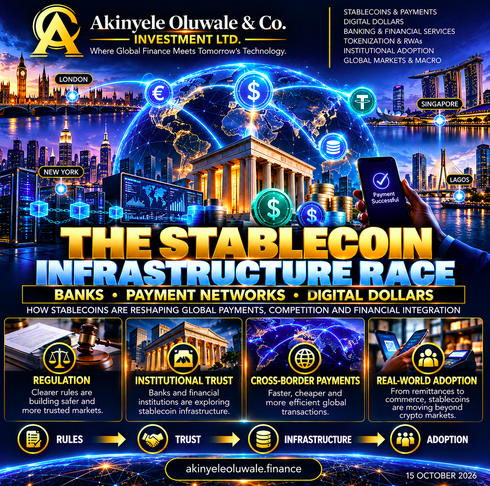
Published: Thursday, 15 October 2026
Primary Category: Stablecoins & Payments
By: Akinyele Oluwale
The global financial system is entering a new phase of digital transformation. For years, stablecoins were primarily associated with cryptocurrency trading, digital-asset exchanges and blockchain transactions.
Today, the conversation is expanding. Banks are examining blockchain-based payment instruments. Payment networks are exploring stablecoin settlement. Financial technology companies are developing cross-border payment infrastructure.
Regulators are establishing frameworks for issuance, reserves and oversight and institutional investors are evaluating the financial infrastructure supporting digital money.
These developments suggest that stablecoins are increasingly being considered as potential components of mainstream payment systems but this transition raises an important question:
Will traditional banks dominate?
Will established payment networks retain their central position?
Will blockchain-native companies develop alternative settlement systems?
Or will the future involve interconnected networks combining traditional finance with digital assets?
The answer will depend on several factors.
Regulation.
Institutional trust.
Liquidity.
Interoperability.
Transaction costs.
Consumer protection.
And commercial adoption.
The emerging framework is:
The next stage of stablecoin development may be less about speculative trading and more about the infrastructure supporting real financial transactions.
Stablecoins are digital assets designed to maintain a relatively stable value against a reference asset, commonly a national currency such as the US dollar.
Unlike highly volatile cryptocurrencies, fiat-referenced stablecoins generally seek to maintain a fixed exchange relationship with their reference currency.
However, that stability is not guaranteed.
Their reliability depends on reserve quality, redemption arrangements, governance, market liquidity and regulatory oversight.
Recent developments demonstrate growing institutional interest.
First, traditional financial institutions are exploring stablecoin issuance and settlement.
Second, regulatory frameworks are becoming more detailed.
Third, stablecoins are increasingly being evaluated for cross-border payments.
Fourth, payment infrastructure is emerging as an important competitive advantage.
Fifth, developing economies such as Nigeria are becoming significant markets for digital-dollar transactions.
The important shift is:
This does not mean stablecoins will replace commercial banks or traditional payment networks.
It means competition and cooperation between existing financial institutions and blockchain-based infrastructure are becoming more important.
International payments remain a major challenge for businesses and households.
Traditional cross-border transactions can involve multiple intermediaries.
These may include:
Sending banks.
Correspondent banks.
Clearing institutions.
Foreign-exchange providers.
Receiving banks.
Each stage can introduce costs, delays or operational complexity. For businesses, these frictions can affect working capital and cash-flow management.
For households, they can increase the cost of receiving money from abroad.
Stablecoins offer a potential alternative settlement mechanism.
For example, a digital-dollar transfer can move across a blockchain network without requiring the same sequence of correspondent-bank transfers.
However, the complete payment still depends on other important processes.
The sender must obtain the stablecoin.
The recipient must be able to receive it.
The recipient may need to convert it into local currency.
Financial institutions must comply with applicable regulations.
And users must be protected against operational, fraud and issuer risks.
Therefore:
The total transaction cost matters.
So do reliability, liquidity, compliance and customer protection.
The opportunity is significant, but the economics must be assessed carefully.
Recent reports indicate that Qivalis, a European banking consortium, has obtained electronic-money institution authorisation from the Dutch central bank.
The consortium reportedly includes 37 banks across 15 countries and is preparing a euro-denominated digital payment token.
The initiative is intended to operate within the European Union's regulatory framework for crypto-assets.
However, regulatory authorisation should not be confused with the commercial launch of a stablecoin.
Additional requirements and implementation steps may still apply. bloomingbit
The development illustrates how established banking institutions are considering participation in blockchain-based payment infrastructure.
It also highlights an emerging question:
Will stablecoin markets remain dominated by dollar-denominated tokens, or will regulated alternatives in other currencies gain meaningful adoption?
The answer will depend on liquidity, user demand, distribution networks and interoperability.
On 13 October 2026, Tether announced an investment in EFY Finance.
The stated objective is to strengthen infrastructure connecting stablecoins with traditional financial systems across Latin America.
The announcement focuses on institutional use cases involving USDT and USA₮. Tether
Stablecoin competition increasingly involves more than token issuance.
Issuers and infrastructure providers are seeking stronger relationships with:
Financial institutions.
Payment companies.
Business customers.
Liquidity providers.
And regulated financial intermediaries.
The competitive advantage may therefore shift toward distribution, institutional integration and practical payment utility.
The United States has moved toward a more defined regulatory structure for payment stablecoins through the GENIUS Act.
On 29 September 2026, the Federal Reserve published proposed regulations concerning its responsibilities under the legislation.
The proposal addresses regulatory requirements for certain permitted payment-stablecoin issuers and related activities.
The public comment deadline is 30 November 2026. GovInfo
Regulatory clarity can influence institutional participation.
Banks and payment companies need to understand the rules governing issuance, reserves, supervision and customer protection.
However, proposed regulations are not the same as finalised rules.
Investors should distinguish between:
Legislation enacted.
Regulations proposed.
Regulations finalised.
Institutions authorised.
Products commercially launched.
These are separate stages of market development.
In June 2026, the IMF published an assessment of stablecoin use in Nigeria.
The institution reported that Nigeria received approximately $59 billion in total crypto-asset inflows between July 2023 and June 2024.
Importantly, this figure represents crypto-asset inflows generally, not exclusively stablecoin transactions.
The IMF also reported that Nigeria accounted for approximately 60% of stablecoin inflows into sub-Saharan Africa over the period examined.
It identified cross-border payments, remittances and business transactions among the relevant use cases. International Monetary Fund
Nigeria illustrates how demand for digital dollars can arise from practical financial needs.
These include cross-border transfers, access to foreign-currency payment channels and international commercial transactions.
However, the IMF also identified important risks.
These include financial integrity, consumer protection, currency substitution and potential implications for monetary policy.
The policy challenge is to support useful innovation while maintaining financial stability.
The stablecoin infrastructure race involves five interconnected developments.
US dollar-denominated stablecoins currently play an important role in digital-asset markets.
But other currencies may become increasingly represented through regulated digital payment instruments.
Euro-denominated stablecoin initiatives illustrate this possibility.
The long-term outcome will depend on liquidity, adoption and trust.
Banks have established customer relationships, regulatory experience and payment infrastructure.
Blockchain-native companies often possess expertise in digital-asset technology and settlement networks.
Payment companies connect merchants, consumers and financial institutions.
The future may involve competition in some activities and cooperation in others.
Regulation can influence the credibility of stablecoin arrangements.
Reserve requirements, redemption rights, governance and supervision are especially important.
However, regulation cannot guarantee that every stablecoin arrangement will operate without risk.
Stablecoins may offer advantages for certain international transactions.
But commercial adoption requires reliable conversion between digital assets and traditional currencies.
It also requires compliance with applicable financial regulations.
The long-term opportunity is not necessarily the replacement of traditional finance.
It may involve greater integration between bank accounts, payment networks and blockchain-based settlement systems.
The emerging structure could be:
The commercial challenge is making these systems work together securely and efficiently.
Stablecoins may create opportunities for banks to develop new payment and settlement services.
However, they could also increase competition in certain payment activities.
Banks will need to evaluate regulatory obligations, customer demand and commercial viability.
Established payment networks may integrate blockchain-based settlement into existing services.
Their competitive advantages include distribution, merchant relationships and established operational systems.
The key question is whether stablecoin infrastructure improves payment economics.
Competition may increasingly depend on reserve transparency, redemption reliability, liquidity and institutional distribution.
A stablecoin's market relevance cannot be judged solely by its supply.
Actual payment use and sustainable commercial demand also matter.
Networks supporting stablecoin transfers may benefit from increased settlement activity.
However, transaction volume does not automatically translate into proportional economic value for a blockchain's native token.
Network fees, competitive conditions and token economics must be evaluated separately.
Businesses could benefit from faster settlement and improved payment visibility.
However, foreign-exchange conversion, compliance costs and liquidity remain important.
Stablecoins may continue to attract attention where international payments are expensive or difficult.
Nevertheless, financial inclusion must be balanced with consumer protection, monetary stability and effective regulation.
The broader investment theme is the development of financial infrastructure.
Relevant areas include payment technology, compliance systems, digital custody, settlement services and financial software.
The critical analytical distinction is:
Commercial success depends on business models, costs, competition and sustainable demand.
At Akinyele Oluwale & Co. Investment Ltd., we believe the next phase of stablecoin development should be assessed through financial infrastructure rather than market excitement alone.
For years, digital-asset discussions frequently focused on token prices and trading activity.
But payment systems operate according to a different economic logic.
Their value depends on reliability.
Efficiency.
Liquidity.
Trust.
Security.
And adoption.
A payment instrument that attracts attention but cannot provide reliable settlement has limited commercial usefulness.
Similarly, a technically advanced payment network may struggle to gain adoption without appropriate regulatory compliance and access to financial institutions.
This is why institutional integration matters.
The emerging competition involves three important questions.
First: Who issues the digital money?
Second: Who controls the payment infrastructure?
Third: Who owns the customer relationship?
These functions may be performed by different organisations.
For example, a regulated issuer may create a stablecoin.
A blockchain network may process transfers.
A financial technology company may provide the customer interface.
A bank may facilitate currency conversion.
And a payment network may connect the transaction to merchants.
Understanding these relationships is essential for evaluating the economics of digital payments.
For Nigeria, the opportunity must be considered alongside the risks.
Stablecoins may address certain cross-border payment difficulties.
But sustainable financial development also requires strong domestic payment systems, credible regulation and effective consumer protection.
Our editorial principle is:
The next generation of digital payments will be defined not simply by the movement of tokens, but by the creation of trusted, efficient and interoperable financial infrastructure.
The most important question is no longer only whether stablecoins can move money.
It is whether they can do so reliably, affordably and at meaningful commercial scale.
Eight developments deserve particular attention.
Will bank-backed euro stablecoin projects complete their remaining requirements and launch commercially?
How will final rules under the GENIUS Act affect issuers and financial institutions?
Are banks and payment companies expanding stablecoin-based settlement services?
What proportion of stablecoin transactions reflects payments and commerce rather than trading-related transfers?
Are issuers providing reliable information about reserves and redemption arrangements?
Are stablecoin-based payment services reducing total end-to-end transaction costs?
How are African regulators balancing payment innovation with financial stability?
Can stablecoin infrastructure connect efficiently with existing banking and payment systems?
These indicators will help determine whether stablecoins develop into widely used financial infrastructure.
Stablecoins are increasingly being evaluated as payment and settlement infrastructure.
Traditional banks are exploring participation in digital-money markets.
Institutional stablecoin infrastructure is attracting investment.
Regulators are developing more detailed frameworks.
Cross-border payments represent an important potential use case.
Nigeria is already a significant market for stablecoin-related financial activity.
However, adoption does not eliminate reserve, operational, regulatory or consumer risks.
The emerging framework is:
Day 38 conclusion:
The stablecoin infrastructure race will ultimately be determined by trust, interoperability, regulatory credibility and real economic utility—not token popularity alone.
Akinyele Oluwale & Co. Investment Ltd. is a global finance and digital-economy intelligence platform focused on developments reshaping investment, financial markets and emerging technologies.
Our intelligence coverage includes:
Artificial Intelligence.
Blockchain & Technology.
Crypto & Digital Assets.
Institutional Finance.
Stablecoins & Payments.
Tokenization & RWAs.
Central Banks.
Macro & Global Markets.
We examine global developments through three essential questions:
What changed?
Why does it matter?
What should investors watch next?
Our objective is to connect global financial developments with their implications for investors, businesses and economic decision-makers.
Akinyele Oluwale & Co. Investment Ltd.
Where Global Finance Meets Tomorrow's Technology.
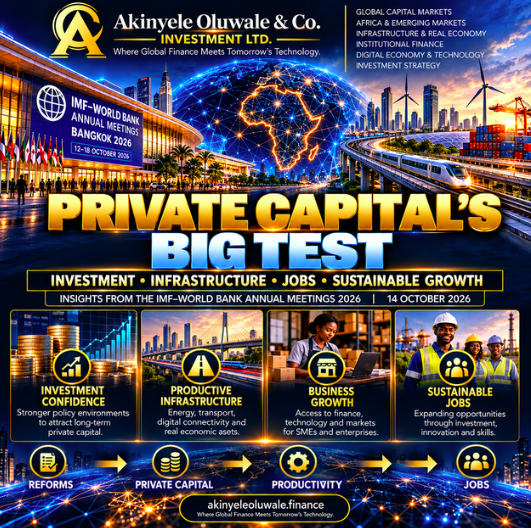
Published: 14 October 2026
Category: Institutional Finance
By: Akinyele Oluwale
The global development-finance conversation is changing. Governments need infrastructure. Businesses need financing.
Emerging economies need investment and growing populations need productive employment opportunities but the amount of capital required to meet these needs is enormous.
For many developing economies, government financing alone cannot sustainably provide all the investment required for electricity, transportation, telecommunications, agriculture, manufacturing and business development.
Public budgets already face competing demands, while higher borrowing and debt-servicing obligations can constrain governments' ability to finance additional development.
That makes one question increasingly important:
This question has moved to the centre of the 2026 IMF–World Bank Annual Meetings in Bangkok.
On 14 October, the World Bank Group's programme places particular emphasis on mobilising private capital for jobs and unlocking investment opportunities across emerging economies.
For Nigeria and Africa, however, attracting capital is only the beginning.
The bigger challenge is converting that capital into functioning infrastructure, productive businesses, higher productivity and sustainable employment.
The development equation is:
The amount of capital attracted matters.
What that capital ultimately produces matters even more.
Private capital is becoming increasingly important to the global development-finance agenda.
The reason is straightforward.
The investment requirements of developing economies are considerably larger than governments and development institutions can finance alone.
Private investors including banks, institutional investors, corporations, infrastructure funds and other financial institutions therefore have an important role.
But capital does not automatically flow toward countries simply because those countries need investment.
Investors evaluate:
Economic stability.
Expected returns.
Currency risk.
Political and regulatory conditions.
Infrastructure.
Legal protections.
Financing costs.
And project viability.
This means that governments seeking greater private investment must create conditions in which productive projects can generate reasonable risk-adjusted returns.
Development-finance institutions can also play an important role by supporting reforms, financing projects and mitigating certain investment risks.
But the objective must extend beyond raising money.
The complete economic process is:
Every stage matters.
And every stage should be measured separately.
The world's emerging economies face a difficult financing challenge.
Infrastructure requirements remain substantial.
Electricity systems need investment.
Transportation networks require expansion.
Digital connectivity must improve.
Agricultural productivity needs strengthening.
Businesses require long-term capital.
At the same time, governments have limited financial resources.
One solution is greater participation from private investors.
Consider a hypothetical $500 million infrastructure project.
The project may offer significant economic benefits.
But before committing capital, investors will ask:
Will the project generate sufficient revenue?
What risks could affect those revenues?
How stable is the regulatory environment?
Who carries construction risk?
How will currency movements affect returns?
Can contracts be enforced?
What happens if costs exceed projections?
These questions illustrate an important principle.
Projects must be structured in ways that appropriately allocate risks and potential returns.
Private capital can help close financing gaps.
But it does not eliminate economic risk.
Instead, it changes how capital and risk are distributed among governments, investors, lenders and other stakeholders.
The IMF–World Bank Annual Meetings are taking place in Bangkok, Thailand, from 12–18 October 2026.
Today's World Bank Group programme includes a flagship discussion focused on Mobilizing Private Capital for Jobs.
The discussion reflects a broader effort to examine how private investment can support businesses, infrastructure and employment.
This is significant.
For decades, development finance was often discussed primarily in terms of government spending, international aid and multilateral lending.
Those sources remain important.
But the scale of global investment requirements has increased the focus on private-sector participation.
A second important issue is the availability of projects capable of attracting private financing.
Emerging economies may possess significant economic opportunities while still struggling to attract investment.
Why?
Because investors do not invest in economic potential alone.
They invest in opportunities where expected returns reasonably compensate for risk.
Barriers can include:
Regulatory uncertainty.
Currency volatility.
Limited infrastructure.
Weak domestic capital markets.
High financing costs.
Insufficient project preparation.
And policy uncertainty.
Therefore, attracting capital requires more than promoting investment opportunities.
Employment is also becoming increasingly important in the development-finance discussion.
Economic growth alone does not necessarily guarantee sufficient employment opportunities.
Countries can experience GDP growth while large parts of the population continue to struggle with unemployment or weak income growth.
This is especially important for economies with rapidly expanding working-age populations.
Investment therefore needs to increase productive capacity.
Productive businesses can expand.
Expansion can increase demand for labour.
And greater productivity can support higher incomes over time.
The desired relationship is:
This is where development finance becomes directly connected to living standards.
Nigeria illustrates both the opportunity and the challenge.
Earlier this week, the World Bank Group highlighted initiatives helping mobilise up to $5.79 billion in private financing for Nigeria in fiscal year 2026.
Potential areas of impact include broadband connectivity, agricultural value chains and access to finance.
The figure is significant.
But investors should interpret it carefully.
Private capital mobilisation is not necessarily the same as money already disbursed.
And money disbursed is not necessarily the same as completed projects.
The proper analytical sequence is:
Maintaining these distinctions is essential for credible financial analysis.
The global private-capital challenge can be understood through five interconnected factors.
Capital generally moves toward environments where investors believe risks can be reasonably assessed.
Predictable regulation matters.
Macroeconomic stability matters.
Contract enforcement matters.
Institutional credibility matters.
Countries do not need to eliminate every investment risk.
That would be impossible.
They need to make risks sufficiently understandable and manageable.
Large investments involve multiple risks.
These may include:
Construction risk.
Operating risk.
Currency risk.
Political risk.
Regulatory risk.
Demand risk.
Financing risk.
The objective is not simply to transfer every risk to investors.
Instead, risks should generally be allocated to the parties best positioned to manage them.
Poorly structured risk allocation can make otherwise valuable projects difficult to finance.
Not every investment requires the same financing approach.
Some projects may use commercial bank loans.
Others may involve equity investment.
Infrastructure projects may use project-finance structures.
Certain investments may involve guarantees or public-private partnerships.
Domestic capital markets can also provide longer-term financing through bonds and other instruments.
The appropriate structure depends on the economics of the underlying project.
Capital should ultimately finance activities capable of generating sustainable economic value.
This includes:
Energy.
Transportation.
Telecommunications.
Manufacturing.
Agriculture.
Technology.
Logistics.
And productive businesses.
The size of an investment does not automatically determine its economic importance.
A smaller project that becomes operational and significantly improves productivity may create more value than a much larger project that remains unfinished.
The final objective is not merely financing.
It is economic development.
Investment should strengthen productive capacity.
Businesses should become more competitive.
Infrastructure should reduce economic inefficiencies.
And sustainable economic opportunities should expand.
This produces the wider development framework:
Greater private investment could increase demand for project finance, corporate lending, transaction banking and advisory services.
Banks can help channel savings toward productive economic activities.
However, increased lending must be accompanied by disciplined credit assessment.
Investment growth should not come at the expense of asset quality.
Infrastructure represents one of the clearest opportunities for private capital.
Electricity, transportation, telecommunications and logistics can increase the productive capacity of an economy.
But projects must remain commercially and economically viable.
Poorly structured infrastructure financing can create financial problems rather than solve them.
Strong domestic bond and equity markets can provide businesses with financing alternatives to traditional bank lending.
They can also help mobilise domestic savings.
For emerging economies, deeper local capital markets may reduce excessive dependence on foreign-currency financing.
Agricultural investment can extend beyond primary production.
Opportunities include:
Processing.
Storage.
Transportation.
Logistics.
Distribution.
Technology.
And market infrastructure.
Strengthening these value chains can improve productivity and reduce waste.
Manufacturing competitiveness depends heavily on infrastructure.
Reliable electricity reduces production disruptions.
Efficient transportation lowers logistics costs.
Access to financing allows businesses to purchase equipment and expand capacity.
Private investment can therefore influence industrial development through several channels.
Digital infrastructure can improve connectivity, financial inclusion and business efficiency.
However, technology investment should ultimately solve real economic problems.
Digital development becomes economically meaningful when it improves productivity, expands market access or reduces transaction costs.
Pension funds, insurance companies, asset managers and infrastructure investors represent potential sources of long-term capital.
But institutional investors require appropriate investment structures and risk-adjusted returns.
Mobilising institutional capital therefore requires a pipeline of credible, investable projects.
At Akinyele Oluwale & Co. Investment Ltd., we believe the global investment conversation must move beyond headline numbers.
A country may announce billions of dollars in investment commitments.
That can be encouraging.
But it does not tell the complete story.
Investors and policymakers should distinguish between five stages.
An investment intention, financing target or proposed transaction is publicly communicated.
Agreements establish financing obligations, subject to their conditions.
Funds are actually released.
The financing produces functioning assets or expanded businesses.
Productivity improves, businesses expand, employment increases or infrastructure becomes more efficient.
These stages are fundamentally different.
Consider two hypothetical countries.
Country A announces $20 billion in investment but struggles with project implementation.
Country B attracts $8 billion but successfully converts the financing into electricity, manufacturing facilities, logistics networks and productive enterprises.
Which country has achieved the better investment outcome?
The answer should not be determined by the headline number alone.
This is particularly important for Nigeria.
The country possesses significant economic potential.
It has a large population.
A substantial domestic market.
Entrepreneurial activity.
Natural resources.
A growing digital economy.
And considerable infrastructure requirements.
These characteristics can create investment opportunities.
But sustainable private investment also requires:
Credible economic reforms.
Regulatory consistency.
Currency stability.
Reliable infrastructure.
Strong institutions.
And disciplined project execution.
Nigeria's investment success should therefore not be measured solely by the number of announcements made.
It should ultimately be measured by the productive capacity created.
Investors should monitor eight indicators.
Are announced financing opportunities becoming binding agreements?
How much money is actually reaching projects and businesses?
Are financed projects becoming operational?
Foreign investors will continue evaluating currency risks and their effect on expected returns.
Are policy changes improving the investment environment?
Are local bond and equity markets becoming deeper and more capable of financing long-term investment?
Are investments creating sustainable economic opportunities?
Perhaps most importantly:
Are investments enabling businesses and workers to produce more economic value?
This ultimately determines whether capital contributes to sustainable development.
Private capital is becoming increasingly important to global development financing.
The 2026 IMF–World Bank Annual Meetings are placing greater attention on mobilising investment for jobs and economic development.
Developing economies cannot sustainably finance every infrastructure requirement through public borrowing.
Private investment can help close part of that financing gap.
But investors require credible economic conditions, viable projects and appropriate risk-adjusted returns.
Financing announcements should not be confused with actual investment outcomes.
The analytical sequence is:
For Nigeria and other emerging economies, the central development framework is:
And our Day 37 conclusion is:
The true measure of development finance is not capital mobilised alone, but productive economic value delivered.
Akinyele Oluwale & Co. Investment Ltd. is a global finance and digital-economy intelligence platform focused on developments reshaping investment, financial markets and emerging technologies.
Our intelligence coverage includes:
Artificial Intelligence
Blockchain & Technology
Crypto & Digital Assets
Institutional Finance
Stablecoins & Payments
Tokenization & RWAs
Central Banks
Macro & Global Markets
We examine global developments through three essential questions:
Our objective is to connect global financial developments with their implications for investors, businesses and economic decision-makers while promoting disciplined, informed investment thinking.
Akinyele Oluwale & Co. Investment Ltd.
Where Global Finance Meets Tomorrow's Technology.
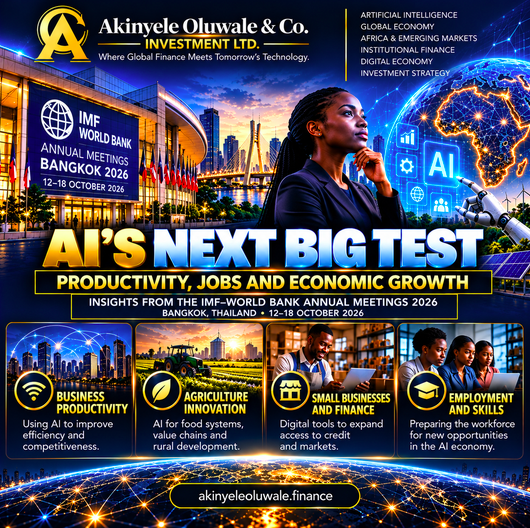
Today's central message:
Economic growth is important. But the real measure of progress is whether that growth improves productivity, creates jobs and raises living standards.
Published: 11 October 2026
Category: Macro & Global Markets
By: Akinyele Oluwale
Economic reforms are beginning to produce measurable improvements in several countries.
Investor confidence has strengthened in parts of the continent.
And international financial institutions are increasingly recognising Africa's growth potential.
But a fundamental question remains.
Is Africa's economic recovery translating into meaningful improvements in the lives of its people?
On 6 October, the World Bank raised its 2026 growth forecast for sub-Saharan Africa to approximately 4.3%.
However, it also warned that economic expansion remains insufficient to deliver the scale of poverty reduction and employment creation required across the region. Reuters
Nigeria offers a particularly important example.
On 8 October, the World Bank projected that Nigeria's economy could grow by an average of 4.4% annually through 2028, provided reforms continue and public-service delivery improves. Reuters
These forecasts provide reasons for cautious optimism.
But growth projections are not guarantees.
And rising gross domestic product does not automatically translate into rising household prosperity.
The next phase of Africa's economic development must therefore focus on converting macroeconomic progress into measurable improvements in productivity, employment and living standards.
Africa's economic outlook is improving, but several structural challenges remain.
Four developments deserve particular attention.
First, economic growth is recovering.
The World Bank has raised its 2026 growth forecast for sub-Saharan Africa to approximately 4.3%.
Second, Nigeria's medium-term outlook remains positive.
The World Bank expects average annual growth of approximately 4.4% through 2028, subject to continued reforms.
Third, debt and financing costs remain major constraints.
Elevated global interest rates and substantial debt-servicing obligations can limit governments' capacity to finance development.
Fourth, productivity and job creation remain essential.
Africa's youthful population creates considerable economic potential, but this potential requires investment in education, infrastructure, technology and productive industries. Reuters
The central development framework is:
Africa's long-term success will depend on strengthening every part of this chain.
Economic growth is one of the most widely discussed indicators of national progress.
But growth alone does not provide a complete picture of economic well-being.
A country's GDP can increase while many households continue struggling with high food prices, unemployment and declining purchasing power.
Consider a simplified example.
Suppose an economy grows by 4% annually.
At the same time, its population grows by 3%.
The improvement in economic output per person would be much smaller than the headline GDP growth rate.
Using the exact relationship:
\[ \text{Per-capita growth} = \frac{1.04}{1.03}-1 \]\[ =\boxed{0.97\%} \]
This demonstrates an important principle.
Headline GDP growth is not the same as growth in economic output per person.
Even rising GDP per capita does not guarantee that the benefits are distributed widely.
This is particularly relevant for African economies experiencing rapid population growth.
The objective must extend beyond producing stronger GDP figures.
It must include:
Growth becomes meaningful when it improves economic opportunity and living standards.
On 6 October 2026, the World Bank raised its economic growth forecast for sub-Saharan Africa to approximately 4.3%.
The improved outlook reflects economic reforms and stronger performance across several countries.
However, the institution also highlighted persistent development challenges.
Growth in income per person remains relatively modest, while debt-servicing pressures and high financing costs continue to affect public investment. Reuters
This creates an important distinction.
Economic recovery is underway, but the transformation required to deliver broad-based prosperity remains incomplete.
On 8 October, the World Bank projected that Nigeria could achieve average annual economic growth of approximately 4.4% through 2028.
The projection depends on continued reforms and improvements in public-service delivery. Reuters
This represents an opportunity.
However, the relevant questions extend beyond the growth forecast.
Will businesses become more productive?
Will electricity become more reliable?
Will food inflation ease?
Will investment create employment?
Will household purchasing power improve?
These are the indicators that determine whether macroeconomic progress translates into meaningful economic development.
The global financial environment remains difficult for many developing economies.
High sovereign borrowing costs, energy-price pressures and concerns about debt sustainability are expected to feature prominently during the IMF–World Bank meetings.
The IMF has warned that rising debt and elevated energy costs threaten the global growth outlook. Reuters
For African governments, this reinforces the importance of prudent borrowing and productive capital allocation.
The 2026 Annual Meetings take place in Bangkok, Thailand, from 12–18 October.
The meetings bring together finance ministers, central-bank governors, development institutions and financial-sector leaders.
They provide an opportunity to discuss global economic stability, development financing, debt sustainability and international financial cooperation. International Monetary Fund
For Africa, the important question is how these discussions translate into practical financing solutions and stronger economic outcomes.
Africa's economic development challenge can be understood through five interconnected priorities.
Stable economic conditions help businesses and households make long-term decisions.
Persistent inflation, exchange-rate instability and unpredictable policies increase uncertainty.
Greater stability can support investment confidence.
However, stability should be viewed as the foundation of economic development rather than its final destination.
Investment must expand the economy's productive capacity.
Examples include electricity infrastructure, manufacturing facilities, transportation networks, agricultural processing and digital connectivity.
Productive investment can improve efficiency and create opportunities for businesses.
Africa's young population represents considerable potential.
But that potential depends on the availability of productive employment.
Economic policies should therefore encourage industries capable of expanding output and creating sustainable jobs.
Artificial intelligence, digital payments, modern logistics and financial technology can help businesses improve efficiency.
The World Bank has highlighted opportunities for African countries to use AI in education, agriculture and small-business operations. Reuters
However, technology adoption requires investment in electricity, connectivity, skills and effective regulation.
Economic transformation requires capital.
But governments must ensure that borrowing remains sustainable.
Projects should be evaluated based on their economic benefits, financing costs and implementation risks.
The objective should be to strengthen productive capacity without creating excessive future financial obligations.
Nigeria's improving economic outlook could support investor confidence if reforms continue and economic fundamentals strengthen.
However, investors will continue monitoring inflation, exchange-rate developments, government borrowing and corporate earnings.
The distinction between projected growth and realised economic performance remains essential.
Debt sustainability is particularly important for sovereign bond investors.
Government borrowing costs depend on factors including inflation, fiscal credibility, monetary policy and investor perceptions of risk.
Improved fiscal management can strengthen confidence.
Conversely, excessive borrowing and weak revenue mobilisation can increase financing pressure.
Stronger economic activity can support demand for financial services.
But financial institutions must balance growth opportunities with credit quality, liquidity management and regulatory compliance.
Higher interest rates may improve some lending margins while simultaneously increasing borrowers' repayment difficulties.
Reliable electricity, transportation and digital connectivity remain central to Africa's productivity challenge.
Well-designed infrastructure investments can reduce business costs and support long-term economic growth.
However, financing structures must be sustainable.
Digital payments, artificial intelligence and financial technology can improve access to services and reduce transaction costs.
Their contribution to development will depend on practical adoption, reliable infrastructure and effective consumer protection.
Emerging-market investment remains sensitive to global interest rates and risk appetite.
Recent data showed significant portfolio outflows from emerging markets during September, illustrating the vulnerability of international capital flows to changing financial conditions. Reuters
For African economies, deeper domestic capital markets could help reduce excessive dependence on volatile external financing.
At Akinyele Oluwale & Co. Investment Ltd., we believe Africa's next development challenge is not simply achieving higher economic growth.
It is ensuring that growth becomes productive, inclusive and financially sustainable.
Macroeconomic stability matters.
Investor confidence matters.
International financing matters.
But these achievements must eventually translate into stronger businesses, productive employment and improved living standards.
For Nigeria, this distinction is especially important.
Economic reforms can create the conditions for recovery.
However, the long-term success of those reforms should be assessed through measurable improvements in productivity, infrastructure, purchasing power and employment.
A country does not become economically prosperous simply because investors become more optimistic.
Prosperity requires sustained improvements in the economy's capacity to produce goods and services efficiently.
This is why we believe Africa's development strategy must increasingly connect:
The continent has considerable economic potential.
But potential must be converted into productive capacity.
Our Day 34 editorial principle:
Economic recovery creates opportunity. Productive investment converts that opportunity into lasting prosperity.
As the IMF–World Bank Annual Meetings begin, eight developments deserve attention.
1. Updated Global Growth Forecasts
Will the IMF revise its outlook for global economic growth?
2. Africa's Economic Outlook
Will international institutions maintain their expectations for improving regional growth?
3. Debt Sustainability
What measures will be proposed to address elevated debt-servicing costs?
4. Development Financing
Will multilateral institutions announce new financing commitments or policy initiatives?
5. Nigeria's Reform Outlook
Will international assessments identify further improvements or emerging risks?
6. Inflation and Energy Prices
How will elevated energy costs affect economic growth and household purchasing power?
7. Private-Sector Investment
What measures could encourage greater investment in productive African industries?
8. Technology and Employment
How can Africa adopt emerging technologies while expanding economic opportunities?
These developments will help determine whether the region's improving growth outlook can translate into sustained economic progress.
Africa's economic outlook has improved.
The World Bank expects stronger growth across sub-Saharan Africa in 2026.
Nigeria's medium-term growth outlook also remains positive, subject to continued reforms.
However, economic growth alone is insufficient.
High debt-servicing costs, inflation, infrastructure deficiencies and employment challenges remain important constraints.
The next phase of development must prioritise productivity, sustainable investment and job creation.
The central framework is:
And today's most important conclusion is:
The true test of Africa's economic recovery is not simply whether GDP rises, but whether economic opportunity and living standards improve.
Akinyele Oluwale & Co. Investment Ltd. is a global finance and digital-economy intelligence platform dedicated to explaining developments reshaping financial markets, institutional investment and emerging technologies.
Our coverage includes:
Artificial Intelligence, Blockchain & Technology, Crypto & Digital Assets, Institutional Finance, Stablecoins & Payments, Tokenization & RWAs, Central Banks, and Macro & Global Markets.
We connect global economic developments with their implications for investors, businesses and policymakers.
Our editorial framework focuses on three questions:
What changed?
Why does it matter?
What should investors watch next?
We believe informed investment decisions require an understanding of economic fundamentals, technological transformation and disciplined capital allocation.
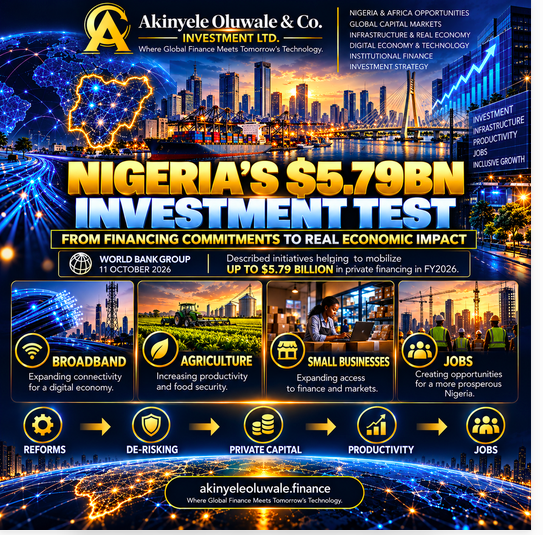
For decades, the country has faced substantial infrastructure requirements, financing constraints and difficulties translating economic potential into broad-based prosperity.
Electricity remains essential to industrial development.
Digital connectivity is increasingly important for productivity.
Agriculture requires investment in processing, logistics and market access.
Small businesses need affordable financing.
And a growing population requires productive employment opportunities.
Addressing these challenges will require substantial investment.
But the critical question is not simply how much financing Nigeria can attract.
It is whether that financing can be converted into measurable economic value.
On 11 October, the World Bank Group highlighted initiatives helping mobilise up to $5.79 billion in private financing in fiscal year 2026.
The institution identified broadband connectivity, agricultural value chains, access to finance and economic opportunities as important areas of potential impact. World Bank
This development deserves attention.
However, investors and policymakers must distinguish between financing mobilisation and completed economic outcomes.
Mobilising capital is an achievement. Deploying it productively is the real test.
Nigeria's investment outlook is receiving renewed attention as international development institutions seek to attract greater private-sector participation.
The World Bank Group's latest update highlights a financing approach combining:
The objective is to reduce barriers that discourage private investment while directing capital toward productive economic activities.
The World Bank Group identifies its different institutions as complementary participants in this process.
The International Finance Corporation supports private-sector investment and financing structures.
The Multilateral Investment Guarantee Agency provides instruments designed to mitigate certain investment risks.
Other World Bank Group operations support reforms and development programmes that can improve investment conditions. World Bank
The emerging development framework is:
The effectiveness of this approach will depend on implementation, actual financing flows and measurable development outcomes.
Nigeria requires substantial investment to expand its productive capacity.
Government financing alone cannot sustainably meet every infrastructure and development requirement.
Public resources must support education, healthcare, security, infrastructure and other essential services.
At the same time, government borrowing creates future repayment obligations.
This makes private capital an important component of economic development.
Private investment can help finance projects, introduce technology, improve management practices and expand employment.
However, attracting private capital requires credible investment conditions.
Investors generally evaluate several factors:
Political and regulatory stability.
Currency and inflation risks.
Infrastructure availability.
Expected cash flows.
Legal and contractual protections.
Financing costs.
Long-term investment returns.
If these conditions are uncertain, investors may demand higher returns or avoid projects entirely.
This is where development-finance institutions can play an important role.
By supporting reforms, providing financing and mitigating certain risks, they can help make otherwise difficult investments more commercially viable.
But an important distinction remains:
Private capital mobilisation is not equivalent to immediate economic development.
Economic development occurs when financing is translated into functioning infrastructure, productive businesses and improved economic opportunities.
In its 11 October update, the World Bank Group described initiatives helping mobilise up to $5.79 billion in private financing in Nigeria during fiscal year 2026.
The institution emphasised how reforms, financing platforms and risk-mitigation instruments can encourage private investment. World Bank
The figure is significant.
However, it should not be interpreted as confirmation that $5.79 billion has already been paid into Nigeria or fully invested in completed projects.
Financing mobilisation, commitments, disbursements and realised development outcomes are different measures.
Understanding those differences is essential for credible financial analysis.
Digital connectivity is increasingly central to economic productivity.
Reliable broadband can support:
Digital payments.
Online education.
Business communication.
Financial technology.
Electronic commerce.
Remote professional services.
And wider participation in the digital economy.
Improved connectivity can reduce transaction costs and help businesses access larger markets.
However, infrastructure must be affordable and accessible to produce widespread economic benefits.
Agriculture remains an important component of Nigeria's economy.
But agricultural productivity depends on more than production volumes.
Farmers and agribusinesses need access to storage, processing, transportation, financing and reliable markets.
Investment across agricultural value chains can reduce inefficiencies and improve commercial opportunities.
The World Bank Group identifies stronger agricultural value chains as one of the potential benefits of its financing initiatives. World Bank
Micro, small and medium-sized enterprises play an important role in economic activity.
Yet many businesses face financing constraints.
Limited access to affordable credit can restrict inventory purchases, equipment investment and expansion.
Improving access to finance can support business productivity.
But credit expansion must be accompanied by responsible lending, financial management and appropriate risk assessment.
The development comes as global financial leaders gather in Bangkok for the IMF–World Bank Annual Meetings.
The meetings are taking place amid concerns about high public debt, energy-price pressures and expensive international financing.
The World Bank has also disclosed discussions with dozens of countries about potential support to manage economic shocks. Reuters
For Nigeria, the meetings provide an opportunity to examine how international financing can support sustainable economic development.
Nigeria's development-financing challenge is part of a wider global problem.
Many developing economies need substantial infrastructure investment.
Yet borrowing costs remain elevated.
Government budgets face competing demands.
And private investors remain sensitive to economic and political risks.
The result is a financing gap.
Closing that gap requires more than additional borrowing.
It requires mechanisms that can attract capital toward economically productive projects.
Three concepts are particularly important.
This involves attracting private investment toward projects or businesses, sometimes with support from development institutions.
The objective is to expand financing beyond available public resources.
Investors may avoid commercially promising projects because of currency, political, regulatory or implementation risks.
Appropriate guarantees, insurance and project structures can reduce certain risks.
However, these instruments cannot eliminate every risk.
Financing should ultimately support projects capable of delivering sustainable economic benefits.
Consider two hypothetical projects.
Project A attracts $500 million but experiences persistent delays and produces limited economic benefits.
Project B attracts $250 million, becomes operational and improves transportation efficiency for thousands of businesses.
The larger project is not automatically the better development outcome.
The quality of investment matters as much as its size.
Greater private investment could expand demand for banking services, project finance and corporate lending.
Banks may participate in financing infrastructure, agriculture and small-business development.
However, institutions must maintain appropriate credit standards.
Financing growth should not come at the expense of asset quality.
Infrastructure development could benefit from increased private-sector participation.
Priority areas include electricity, transportation, telecommunications and logistics.
Commercial viability and effective project execution remain essential.
Investment in agricultural processing, storage and distribution could improve productivity and market access.
The economic benefits will depend on implementation and the ability of businesses to operate profitably.
Expanded broadband infrastructure could support greater adoption of digital financial services.
Better connectivity can improve access to payments, banking and business technology.
However, digital inclusion also requires affordability, consumer protection and financial literacy.
Improved financing availability could support business expansion.
But the impact should be assessed through measurable outcomes, including business survival, productivity and employment.
Development-finance participation may improve the attractiveness of certain projects by reducing specific risks.
Nevertheless, international investors will continue evaluating currency stability, inflation, legal protections and expected returns.
A stronger pipeline of commercially viable projects could create opportunities for institutional financing.
However, the eventual impact on equity and debt markets will depend on actual project structures, investor participation and market conditions.
At Akinyele Oluwale & Co. Investment Ltd., we believe Nigeria's investment conversation must evolve beyond financing announcements.
The country needs capital.
But capital alone does not guarantee economic transformation.
What matters is the relationship between financing and productive outcomes.
This requires asking five questions.
First: How much financing has actually been committed?
Second: How much has been disbursed?
Third: Which projects and businesses have received the funds?
Fourth: What measurable economic outcomes have been achieved?
Fifth: Are those outcomes financially and economically sustainable?
These questions are particularly important when evaluating large development-finance announcements.
An investment programme should not be judged solely by its headline value.
It should also be assessed through:
Infrastructure delivered.
Businesses financed.
Employment supported.
Productivity improvements.
Economic sustainability.
And long-term development impact.
Our editorial framework is therefore:
The central lesson is straightforward.
Nigeria's development success will not be measured simply by how much capital it attracts, but by how productively that capital is deployed.
Eight indicators deserve particular attention.
1. Actual Financing Commitments
What proportion of the announced mobilisation translates into binding commitments?
2. Disbursement Progress
How much financing reaches eligible projects and businesses?
3. Infrastructure Delivery
Are financed infrastructure projects completed on schedule?
4. Private-Sector Participation
Are domestic and international investors increasing their participation?
5. MSME Financing
Are smaller businesses gaining meaningful access to appropriate financing?
6. Agricultural Productivity
Are investments improving processing, storage, market access and production efficiency?
7. Employment Outcomes
Are projects supporting productive and sustainable jobs?
8. Development-Finance Announcements
What additional financing initiatives or policy commitments emerge from the IMF–World Bank meetings?
These indicators will help determine whether Nigeria's investment momentum produces measurable economic benefits.
The World Bank Group has highlighted initiatives helping mobilise up to $5.79 billion in private financing for Nigeria in fiscal year 2026.
The financing approach connects reforms, investment opportunities and risk mitigation.
Broadband, agriculture and small-business financing are among the potential areas of impact.
However, financing mobilisation should not be confused with actual disbursement or completed development outcomes.
Private capital can support economic transformation when it finances productive projects.
The central framework is:
And the most important conclusion is:
Attracting capital is progress. Turning capital into productive economic value is development.
Akinyele Oluwale & Co. Investment Ltd. is a global finance and digital-economy intelligence platform focused on developments reshaping investment, financial markets and emerging technologies.
Our coverage includes:
Artificial Intelligence, Blockchain & Technology, Crypto & Digital Assets, Institutional Finance, Stablecoins & Payments, Tokenization & RWAs, Central Banks, and Macro & Global Markets.
We examine the relationship between global financial developments and their implications for investors, businesses and policymakers.
Our editorial framework is built around three questions:
What changed?
Why does it matter?
What should investors watch next?
Our objective is to promote informed analysis, financial understanding and disciplined investment thinking.
Akinyele Oluwale & Co. Investment Ltd.
Where Global Finance Meets Tomorrow's Technology.
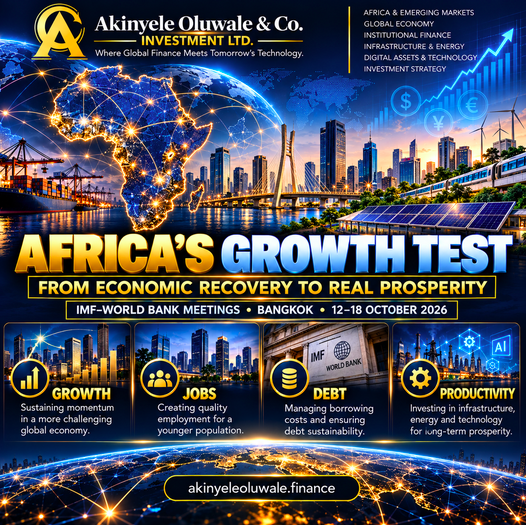
Africa enters the upcoming IMF–World Bank Annual Meetings with an encouraging economic outlook but significant development challenges.
Economic reforms are beginning to produce measurable improvements in several countries.
Investor confidence has strengthened in parts of the continent.
And international financial institutions are increasingly recognising Africa's growth potential.
But a fundamental question remains.
Is Africa's economic recovery translating into meaningful improvements in the lives of its people?
On 6 October, the World Bank raised its 2026 growth forecast for sub-Saharan Africa to approximately 4.3%.
However, it also warned that economic expansion remains insufficient to deliver the scale of poverty reduction and employment creation required across the region. Reuters
Nigeria offers a particularly important example.
On 8 October, the World Bank projected that Nigeria's economy could grow by an average of 4.4% annually through 2028, provided reforms continue and public-service delivery improves. Reuters
These forecasts provide reasons for cautious optimism.
But growth projections are not guarantees.
And rising gross domestic product does not automatically translate into rising household prosperity.
The next phase of Africa's economic development must therefore focus on converting macroeconomic progress into measurable improvements in productivity, employment and living standards.
Africa's economic outlook is improving, but several structural challenges remain.
Four developments deserve particular attention.
First, economic growth is recovering.
The World Bank has raised its 2026 growth forecast for sub-Saharan Africa to approximately 4.3%.
Second, Nigeria's medium-term outlook remains positive.
The World Bank expects average annual growth of approximately 4.4% through 2028, subject to continued reforms.
Third, debt and financing costs remain major constraints.
Elevated global interest rates and substantial debt-servicing obligations can limit governments' capacity to finance development.
Fourth, productivity and job creation remain essential.
Africa's youthful population creates considerable economic potential, but this potential requires investment in education, infrastructure, technology and productive industries. Reuters
The central development framework is:
Africa's long-term success will depend on strengthening every part of this chain.
Economic growth is one of the most widely discussed indicators of national progress.
But growth alone does not provide a complete picture of economic well-being.
A country's GDP can increase while many households continue struggling with high food prices, unemployment and declining purchasing power.
Consider a simplified example.
Suppose an economy grows by 4% annually.
At the same time, its population grows by 3%.
The improvement in economic output per person would be much smaller than the headline GDP growth rate.
Using the exact relationship:
This demonstrates an important principle.
Headline GDP growth is not the same as growth in economic output per person.
Even rising GDP per capita does not guarantee that the benefits are distributed widely.
This is particularly relevant for African economies experiencing rapid population growth.
The objective must extend beyond producing stronger GDP figures.
It must include:
Growth becomes meaningful when it improves economic opportunity and living standards.
On 6 October 2026, the World Bank raised its economic growth forecast for sub-Saharan Africa to approximately 4.3%.
The improved outlook reflects economic reforms and stronger performance across several countries.
However, the institution also highlighted persistent development challenges.
Growth in income per person remains relatively modest, while debt-servicing pressures and high financing costs continue to affect public investment. Reuters
This creates an important distinction.
Economic recovery is underway, but the transformation required to deliver broad-based prosperity remains incomplete.
On 8 October, the World Bank projected that Nigeria could achieve average annual economic growth of approximately 4.4% through 2028.
The projection depends on continued reforms and improvements in public-service delivery. Reuters
This represents an opportunity.
However, the relevant questions extend beyond the growth forecast.
Will businesses become more productive?
Will electricity become more reliable?
Will food inflation ease?
Will investment create employment?
Will household purchasing power improve?
These are the indicators that determine whether macroeconomic progress translates into meaningful economic development.
The global financial environment remains difficult for many developing economies.
High sovereign borrowing costs, energy-price pressures and concerns about debt sustainability are expected to feature prominently during the IMF–World Bank meetings.
The IMF has warned that rising debt and elevated energy costs threaten the global growth outlook. Reuters
For African governments, this reinforces the importance of prudent borrowing and productive capital allocation.
The 2026 Annual Meetings take place in Bangkok, Thailand, from 12–18 October.
The meetings bring together finance ministers, central-bank governors, development institutions and financial-sector leaders.
They provide an opportunity to discuss global economic stability, development financing, debt sustainability and international financial cooperation. International Monetary Fund
For Africa, the important question is how these discussions translate into practical financing solutions and stronger economic outcomes.
Africa's economic development challenge can be understood through five interconnected priorities.
Stable economic conditions help businesses and households make long-term decisions.
Persistent inflation, exchange-rate instability and unpredictable policies increase uncertainty.
Greater stability can support investment confidence.
However, stability should be viewed as the foundation of economic development rather than its final destination.
Investment must expand the economy's productive capacity.
Examples include electricity infrastructure, manufacturing facilities, transportation networks, agricultural processing and digital connectivity.
Productive investment can improve efficiency and create opportunities for businesses.
Africa's young population represents considerable potential.
But that potential depends on the availability of productive employment.
Economic policies should therefore encourage industries capable of expanding output and creating sustainable jobs.
Artificial intelligence, digital payments, modern logistics and financial technology can help businesses improve efficiency.
The World Bank has highlighted opportunities for African countries to use AI in education, agriculture and small-business operations. Reuters
However, technology adoption requires investment in electricity, connectivity, skills and effective regulation.
Economic transformation requires capital.
But governments must ensure that borrowing remains sustainable.
Projects should be evaluated based on their economic benefits, financing costs and implementation risks.
The objective should be to strengthen productive capacity without creating excessive future financial obligations.
Nigeria's improving economic outlook could support investor confidence if reforms continue and economic fundamentals strengthen.
However, investors will continue monitoring inflation, exchange-rate developments, government borrowing and corporate earnings.
The distinction between projected growth and realised economic performance remains essential.
Debt sustainability is particularly important for sovereign bond investors.
Government borrowing costs depend on factors including inflation, fiscal credibility, monetary policy and investor perceptions of risk.
Improved fiscal management can strengthen confidence.
Conversely, excessive borrowing and weak revenue mobilisation can increase financing pressure.
Stronger economic activity can support demand for financial services.
But financial institutions must balance growth opportunities with credit quality, liquidity management and regulatory compliance.
Higher interest rates may improve some lending margins while simultaneously increasing borrowers' repayment difficulties.
Reliable electricity, transportation and digital connectivity remain central to Africa's productivity challenge.
Well-designed infrastructure investments can reduce business costs and support long-term economic growth.
However, financing structures must be sustainable.
Digital payments, artificial intelligence and financial technology can improve access to services and reduce transaction costs.
Their contribution to development will depend on practical adoption, reliable infrastructure and effective consumer protection.
Emerging-market investment remains sensitive to global interest rates and risk appetite.
Recent data showed significant portfolio outflows from emerging markets during September, illustrating the vulnerability of international capital flows to changing financial conditions. Reuters
For African economies, deeper domestic capital markets could help reduce excessive dependence on volatile external financing.
At Akinyele Oluwale & Co. Investment Ltd., we believe Africa's next development challenge is not simply achieving higher economic growth.
It is ensuring that growth becomes productive, inclusive and financially sustainable.
Macroeconomic stability matters.
Investor confidence matters.
International financing matters.
But these achievements must eventually translate into stronger businesses, productive employment and improved living standards.
For Nigeria, this distinction is especially important.
Economic reforms can create the conditions for recovery.
However, the long-term success of those reforms should be assessed through measurable improvements in productivity, infrastructure, purchasing power and employment.
A country does not become economically prosperous simply because investors become more optimistic.
Prosperity requires sustained improvements in the economy's capacity to produce goods and services efficiently.
This is why we believe Africa's development strategy must increasingly connect:
The continent has considerable economic potential.
But potential must be converted into productive capacity.
Our Day 34 editorial principle:
Economic recovery creates opportunity. Productive investment converts that opportunity into lasting prosperity.
As the IMF–World Bank Annual Meetings begin, eight developments deserve attention.
1. Updated Global Growth Forecasts
Will the IMF revise its outlook for global economic growth?
2. Africa's Economic Outlook
Will international institutions maintain their expectations for improving regional growth?
3. Debt Sustainability
What measures will be proposed to address elevated debt-servicing costs?
4. Development Financing
Will multilateral institutions announce new financing commitments or policy initiatives?
5. Nigeria's Reform Outlook
Will international assessments identify further improvements or emerging risks?
6. Inflation and Energy Prices
How will elevated energy costs affect economic growth and household purchasing power?
7. Private-Sector Investment
What measures could encourage greater investment in productive African industries?
8. Technology and Employment
How can Africa adopt emerging technologies while expanding economic opportunities?
These developments will help determine whether the region's improving growth outlook can translate into sustained economic progress.
Africa's economic outlook has improved.
The World Bank expects stronger growth across sub-Saharan Africa in 2026.
Nigeria's medium-term growth outlook also remains positive, subject to continued reforms.
However, economic growth alone is insufficient.
High debt-servicing costs, inflation, infrastructure deficiencies and employment challenges remain important constraints.
The next phase of development must prioritise productivity, sustainable investment and job creation.
The central framework is:
And today's most important conclusion is:
The true test of Africa's economic recovery is not simply whether GDP rises, but whether economic opportunity and living standards improve.
Akinyele Oluwale & Co. Investment Ltd. is a global finance and digital-economy intelligence platform dedicated to explaining developments reshaping financial markets, institutional investment and emerging technologies.
Our coverage includes:
Artificial Intelligence, Blockchain & Technology, Crypto & Digital Assets, Institutional Finance, Stablecoins & Payments, Tokenization & RWAs, Central Banks, and Macro & Global Markets.
We connect global economic developments with their implications for investors, businesses and policymakers.
Our editorial framework focuses on three questions:
What changed?
Why does it matter?
What should investors watch next?
We believe informed investment decisions require an understanding of economic fundamentals, technological transformation and disciplined capital allocation.
Where Global Finance Meets Tomorrow's Technology.

GLOBAL DEBT MEETS EXPENSIVE CAPITAL
Why Rising Government Borrowing, Elevated Bond Yields and Energy Costs Could Define the Next Phase of the Global Economy
Published: 10 October 2026
Category: Macro & Global Markets
By: Akinyele Oluwale
The global economy is entering a period in which the cost of financing economic activity is becoming increasingly important.
Governments need capital.
Businesses need capital.
Artificial intelligence requires enormous infrastructure investment.
Energy systems require modernisation.
Emerging economies need financing for development.
But capital is becoming more expensive.
This creates an uncomfortable economic reality.
At precisely the moment when the world needs substantial investment, borrowing costs remain elevated.
The International Monetary Fund has warned that rising public debt, energy pressures and risks associated with AI investment could create significant challenges for global economic stability. AP News
Meanwhile, government bond markets have experienced substantial volatility.
The United States and several European economies have faced pressure from elevated sovereign borrowing costs and concerns about fiscal sustainability. Reuters
The emerging question is no longer simply:
How much capital does the global economy need?
It is:
How much will that capital cost, and who will ultimately pay for it?
The global financial system is confronting several interconnected challenges.
First, government borrowing requirements remain substantial.
Countries must finance public expenditure, infrastructure and existing debt obligations.
Second, bond yields remain elevated.
Higher yields increase the cost of new borrowing and refinancing.
Third, energy prices remain an inflation risk.
Persistent energy costs can place pressure on consumers, businesses and central banks.
Fourth, AI infrastructure is creating additional demand for capital.
Technology companies require substantial financing to construct data centres, purchase advanced chips and secure electricity.
Fifth, emerging economies face difficult financing conditions.
Higher global borrowing costs can increase debt-servicing pressures and discourage investment.
These developments create a powerful economic relationship:
Understanding this relationship is essential for investors, policymakers and financial institutions.
Debt is not automatically harmful.
Governments can borrow to finance productive infrastructure, education, healthcare and economic development.
Businesses can borrow to expand operations and generate additional revenue.
The problem arises when borrowing costs become difficult to sustain.
Consider a simplified example.
A government borrows ₦1 trillion.
At an annual interest rate of 5%, its interest expense is:
₦1 trillion × 5% = ₦50 billion.
If refinancing costs rise to 10%, annual interest expense becomes:
₦1 trillion × 10% = ₦100 billion.
The government now pays an additional ₦50 billion annually in interest.
That additional expense could otherwise have supported infrastructure, education or healthcare.
This demonstrates a fundamental economic principle:
The sustainability of debt depends not only on how much is borrowed, but also on the cost of borrowing and the capacity to repay.
The same principle applies to corporations.
A business can have strong revenue growth but still experience financial difficulties if debt-servicing costs rise faster than its operating cash flows.
Ahead of the IMF–World Bank meetings, IMF Managing Director Kristalina Georgieva warned that countries must address rising debt and broader economic vulnerabilities.
She also highlighted the potential consequences of energy pressures and AI-related investment risks. AP News
The message is important.
Governments cannot assume that favourable financing conditions will return automatically.
They must increasingly consider how public expenditure, taxation, borrowing and economic growth interact.
Fiscal discipline is therefore becoming more important.
Bond markets have experienced significant volatility as investors reassess inflation, government borrowing and interest-rate expectations.
During the past week, U.S. and French government bond yields attracted considerable attention.
Although U.S. Treasury yields retreated from recent highs toward the end of the week, borrowing costs remained elevated. The Wall Street Journal
The underlying issue is straightforward.
When governments issue substantial debt, investors must be willing to purchase that debt.
If investors demand higher returns, governments face higher financing costs.
This can create a difficult cycle:
Higher Debt → Higher Interest Costs → Greater Fiscal Pressure → Additional Borrowing Needs
However, the cycle is not inevitable. Economic growth, fiscal adjustments and changes in interest rates can alter the outcome.
Energy is a fundamental input into economic activity.
Higher oil and electricity costs can affect:
On 9 October, Brent crude remained near $104 per barrel, according to Reuters market reporting. Reuters
Sustained energy costs can complicate central-bank efforts to control inflation.
That can also make it more difficult for borrowing costs to decline.
Artificial intelligence is creating enormous demand for infrastructure financing.
Companies are investing in semiconductors, data centres, electricity and computing capacity.
Reuters reported that AI infrastructure could require approximately $1.5 trillion in external financing by 2028, citing Morgan Stanley estimates. Reuters
This introduces another important question.
If governments and corporations are simultaneously seeking enormous amounts of financing, how will financial markets allocate available capital?
The answer depends on expected returns, risk, liquidity and financing conditions.
The world is experiencing several investment cycles simultaneously.
Countries require roads, ports, electricity, healthcare and public services.
Technology companies require data centres, computing equipment and energy infrastructure.
Energy systems require investment in generation, transmission, storage and reliability.
Developing economies need capital for industrialisation, education, digital infrastructure and economic diversification.
Each of these areas competes for financing.
This creates an increasingly important global equation:
When financing conditions tighten, capital allocation becomes more selective.
Projects with credible cash flows, manageable risks and strong economic fundamentals may be better positioned to attract funding.
Projects dependent on unrealistic assumptions may face greater difficulties.
This is why investment discipline matters across both the public and private sectors.
Higher government borrowing requirements can increase pressure on sovereign bond markets.
Investors may demand higher yields when inflation, fiscal uncertainty or refinancing risks increase.
However, yields can also decline when economic growth weakens or demand for safe assets strengthens.
Therefore, government bond markets must be evaluated within the broader economic environment.
Higher interest rates can affect equity valuations.
When investors can earn higher returns on relatively low-risk government securities, they may become less willing to pay expensive valuations for uncertain future corporate earnings.
This is especially relevant for capital-intensive businesses.
Banks can benefit from higher lending rates, but they also face risks.
Higher borrowing costs may weaken customers' repayment capacity.
Government bond volatility can affect securities portfolios.
And slower economic growth can increase credit risk.
AI companies face the challenge of generating sufficient future cash flows to justify their capital expenditure.
Higher financing costs increase the importance of disciplined investment decisions.
Emerging economies can face additional pressure when global interest rates remain elevated.
Foreign-currency borrowing may become more expensive.
Exchange rates may experience volatility.
And international investors may become more selective.
For Nigeria, the broader implication is clear:
Fiscal sustainability, productive investment and efficient capital allocation are essential to long-term economic resilience.
At Akinyele Oluwale & Co. Investment Ltd., we believe one of the most important questions confronting the global economy is:
This question connects several major developments.
It connects government debt with central-bank policy.
It connects AI infrastructure with corporate financing.
It connects energy prices with inflation.
And it connects emerging-market development with global capital flows.
Investors should therefore avoid examining these developments in isolation.
A rising bond yield is not merely a bond-market event.
It can influence:
Government budgets.
Corporate investment.
Bank lending.
Equity valuations.
Currency markets.
Digital assets.
Economic growth.
The central lesson is:
Capital availability creates opportunity. Capital costs determine whether that opportunity is economically sustainable.
For governments, the challenge is to ensure borrowed funds support productive economic outcomes.
For corporations, the challenge is to generate returns above the cost of capital.
For investors, the challenge is to distinguish between economic opportunity and investment value.
As the new week approaches, investors should monitor eight developments.
1. IMF–World Bank Meetings: Watch updated assessments of global growth, debt and financial stability.
2. U.S. Inflation: The upcoming September CPI report could influence Federal Reserve expectations. The Wall Street Journal
3. Government Bond Yields: Monitor whether sovereign borrowing costs stabilise or rise again.
4. Energy Prices: Oil remains important for inflation and global growth.
5. Corporate Earnings: Major U.S. banks begin reporting quarterly results next week. Reuters
6. AI Financing: Watch whether investors continue demanding greater financial discipline from AI infrastructure projects.
7. Emerging-Market Capital Flows: Monitor currency pressures, borrowing costs and international investment.
8. Fiscal Policy: Governments' responses to higher debt-servicing costs will become increasingly important.
The global economy requires substantial investment.
But elevated borrowing costs are making capital allocation more difficult.
Government debt is becoming a central financial-market concern.
Energy prices remain an important inflation risk.
AI infrastructure is increasing demand for financing.
Emerging economies face additional challenges when global capital becomes expensive.
The most important investment framework is:
And today's central principle is:
The next global financial challenge may not be finding opportunities. It may be financing them sustainably.
Akinyele Oluwale & Co. Investment Ltd. is a global finance and digital-economy intelligence platform dedicated to helping investors, professionals and decision-makers understand developments reshaping modern financial markets.
Our coverage includes:
Artificial Intelligence, Blockchain & Technology, Crypto & Digital Assets, Institutional Finance, Stablecoins & Payments, Tokenization & RWAs, Central Banks, and Macro & Global Markets.
Our editorial approach focuses on three questions:
What changed?
Why does it matter?
What should investors watch next?
We connect macroeconomic developments with financial markets, institutional capital and emerging technologies.
Our objective is to support informed analysis, disciplined investment thinking and a deeper understanding of global financial transformation.
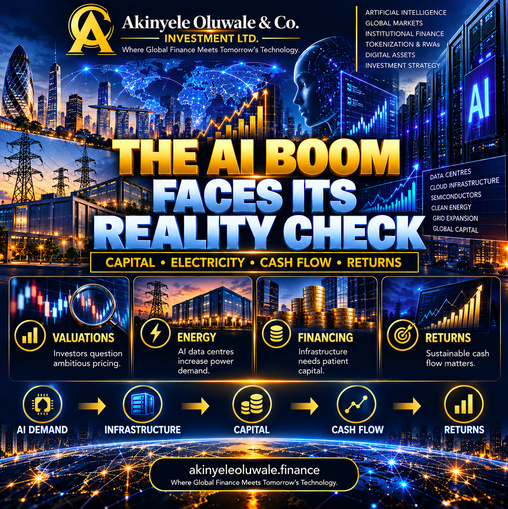
Published: October 9, 2026
Category: AI
Secondary Category: Institutional Finance
By: Akinyele Oluwale
Artificial intelligence is rapidly changing how companies operate, how technology is built and how investors think about the future.
But the AI investment story is entering a more demanding phase.
The first stage was dominated by technological excitement.
The second has been characterised by enormous spending on semiconductors, servers, data centres, electricity infrastructure and cloud computing.
The next stage will increasingly be about financial accountability.
Investors are beginning to ask harder questions:
How much capital will AI infrastructure require?
Who will finance it?
Where will the electricity come from?
How quickly will these investments generate revenue?
And, ultimately:
Will the cash flows generated by AI justify the enormous amount of capital being invested today?
This does not mean the artificial-intelligence revolution is ending.
It means the investment debate is maturing.
A technology can transform the world without every company, project or valuation associated with that technology becoming a successful investment.
That distinction could become one of the most important investment lessons of the AI era.
Artificial intelligence remains one of the most consequential technological developments in the global economy.
But building the infrastructure behind it requires extraordinary amounts of capital.
The investment chain increasingly looks like this:
Every part of that chain matters.
A shortage of computing capacity can constrain AI growth.
Insufficient electricity can delay data-centre development.
Expensive financing can reduce investment returns.
Excessive valuations can leave investors vulnerable even when the underlying business grows.
And enormous capital expenditure becomes economically valuable only when it eventually generates sufficient cash flow.
The investment question is therefore changing.
Yesterday's question was:
How large can the AI opportunity become?
Today's more sophisticated question is:
How much sustainable economic value will AI investment actually create?
This transition from technological excitement to financial discipline could define the next phase of the AI investment cycle.
AI often appears to be a software story.
Underneath the software, however, sits an enormous physical infrastructure system.
Generative AI requires advanced semiconductors.
Those chips operate inside servers.
Servers operate inside data centres.
Data centres require cooling, fibre connectivity and enormous amounts of electricity.
Electricity requires generation and transmission infrastructure.
And almost everything in that chain requires capital.
The AI revolution is therefore simultaneously a:
Technology story.
Infrastructure story.
Energy story.
Capital-markets story.
Investment-return story.
This distinction is essential for investors.
Suppose Company A announces $10 billion of AI investment while Company B invests $5 billion.
Company A is not automatically creating more shareholder value.
The investor still needs to know:
What revenue will each investment generate?
What are the operating costs?
How much debt is required?
What is the cost of financing?
When will the investment become productive?
And what return will ultimately be earned on the capital deployed?
This leads to an important principle:
Investment size is not the same as investment value.
Capital expenditure creates capacity.
Productive capital expenditure creates economic value.
One indication of changing sentiment has emerged from the data-centre market.
Investors have increasingly scrutinised the valuations, financing requirements and expansion assumptions attached to AI infrastructure businesses.
This does not necessarily represent declining confidence in artificial intelligence itself.
It represents something healthier:
An investor can simultaneously believe that AI will transform the global economy and conclude that a particular AI-related company is too expensive.
Those positions are not contradictory.
The same distinction has appeared throughout financial history.
Transformational technologies can create enormous economic value while individual businesses operating within those transformations still fail to generate attractive shareholder returns.
Computing power requires electrical power.
That simple relationship is becoming increasingly important.
Large AI data centres can consume substantial amounts of electricity, making access to reliable and affordable energy an important consideration when determining where new facilities are constructed.
The AI infrastructure equation therefore extends beyond:
to:
This could create investment opportunities far beyond conventional technology companies.
Utilities, grid infrastructure, power generation, cooling technology and energy-management systems could all become increasingly connected to the AI investment cycle.
But investors should apply the same discipline here.
Higher electricity demand does not automatically make every electricity-related investment attractive.
Costs, regulation, capital requirements and expected returns still matter.
Another development deserves attention.
Technology companies, data-centre operators and utilities are increasingly examining whether computing workloads can become more flexible.
Some AI workloads could potentially be shifted between locations or periods of the day depending on electricity availability.
If implemented effectively, such flexibility could reduce pressure on electricity grids and potentially improve infrastructure economics.
This introduces another potential competitive advantage:
The future AI winner may not simply be the company with the most computing power—it may be the company that uses computing power most efficiently.
Efficiency could therefore become increasingly important alongside scale.
The scale of planned AI infrastructure means corporate balance sheets alone may not always provide sufficient funding.
Companies can therefore turn toward:
Corporate bonds
Bank lending
Private credit
Joint ventures
Infrastructure funds
Special-purpose financing structures
and other capital-market solutions.
That brings another variable into the equation:
An AI project might appear attractive when borrowing costs are low.
The same project may look considerably less attractive when interest rates and bond yields are elevated.
That directly connects today's AI story with our recent analysis of central banks and global capital markets.
The AI investment cycle can increasingly be understood through three stages.
The market discovers the transformative potential of generative artificial intelligence.
Attention focuses on:
AI models,
semiconductors,
software,
productivity,
and technological leadership.
Valuations rise as investors anticipate future growth.
Companies begin investing enormous amounts of money to build the infrastructure necessary to support expected demand.
Attention shifts toward:
Semiconductors
Servers
Cloud infrastructure
Data centres
Electricity
Cooling
Networking
and increasingly:
Financing.
Capital expenditure accelerates.
Eventually, investors begin asking whether the infrastructure actually produces sufficient financial returns.
The relevant metrics change.
Instead of focusing mainly on:
AI spending
investors increasingly examine:
Revenue growth
Operating margins
Capital expenditure
Debt
Free cash flow
and
Return on invested capital.
That is where the AI investment cycle becomes particularly interesting.
The market begins moving from:
toward:
That is a much more important long-term question.
Large technology companies face increasing pressure to demonstrate that AI expenditure eventually translates into commercially valuable products and services.
Revenue growth will matter.
But investors will increasingly look beyond revenue.
They will examine whether companies can convert AI investment into:
higher margins,
stronger cash generation,
productivity gains,
and ultimately:
higher returns on capital.
Semiconductor demand remains central to the AI infrastructure buildout.
Advanced processors are effectively the engines behind modern AI computing.
But even strong chip demand must eventually connect to sustainable downstream economics.
If customers spend heavily on computing infrastructure but struggle to monetise that capacity, investment expectations throughout the supply chain could eventually adjust.
Electricity is becoming increasingly connected to AI development.
This potentially creates opportunities across:
power generation,
transmission infrastructure,
grid modernisation,
energy storage,
cooling,
and efficiency technologies.
The relationship increasingly becomes:
That makes AI a potentially important capital-allocation story for the energy sector as well.
Banks, private-credit providers, asset managers and infrastructure investors may increasingly finance the AI buildout.
Their challenge is different from that of technology investors.
They must ask:
Will the project generate enough cash to service its obligations?
AI enthusiasm does not eliminate credit risk.
Lenders must still evaluate:
cash flows,
collateral,
project execution,
counterparty strength,
and debt-service capacity.
AI investment increasingly intersects with the bond market.
Large technology companies and infrastructure developers can issue debt to finance expansion.
But governments are simultaneously borrowing heavily.
That creates competition for global capital.
The chain becomes:
This is why developments in AI cannot be separated completely from developments in interest rates and government bond markets.
For equity investors, the issue becomes valuation.
Higher expected growth can justify higher valuations.
But only to a point.
If:
capital expenditure rises faster than cash flow,
or
financing costs rise faster than expected returns,
valuation pressure can emerge.
The equation is straightforward:
That does not mean AI equities must decline.
It means valuation discipline becomes increasingly important.
At Akinyele Oluwale & Co. Investment Ltd., we believe investors should separate three questions that are often incorrectly treated as one.
Will artificial intelligence transform the global economy?
There are strong reasons to believe AI will have significant economic consequences.
Will demand for AI infrastructure continue growing?
Current investment trends suggest substantial infrastructure development remains necessary.
Will every AI-related investment generate attractive returns?
Absolutely not.
That third question is where investment discipline begins.
Financial history repeatedly demonstrates that revolutionary technologies do not automatically create successful investments at every valuation.
An investor can correctly predict the future of a technology and still lose money by paying too much for exposure to it.
That is why our attention is increasingly moving toward:
The crucial question is not simply:
How many billions are being invested in AI?
It is:
How much sustainable cash flow will each billion of investment ultimately generate?
This is our Day 32 principle:
Investors should now monitor eight indicators closely.
Are technology companies continuing to increase infrastructure spending?
Is AI-related revenue expanding quickly enough to justify investment?
How much cash remains after companies fund their enormous capital-expenditure programmes?
Are companies increasingly relying on borrowing to finance AI infrastructure?
Can power grids accommodate expanding data-centre demand?
Can AI companies reduce electricity consumption per unit of computing output?
Are newly constructed facilities being used sufficiently to justify their cost?
Are investors paying reasonable prices relative to realistic future earnings?
These indicators lead to one overriding question:
Will the growth in AI-related cash flows ultimately justify the amount of capital being committed today?
That question may become increasingly important throughout the remainder of 2026 and beyond.
Artificial intelligence remains a potentially transformative technology.
But technological transformation and investment performance are not the same thing.
AI requires enormous physical infrastructure.
That infrastructure requires electricity.
Electricity and infrastructure require capital.
Capital carries a cost.
And capital ultimately requires a return.
Therefore:
Investors should increasingly monitor free cash flow, debt, capital expenditure and return on invested capital not simply AI announcements.
Companies capable of combining technological leadership with disciplined capital allocation may be better positioned for the next phase.
And the central Day 32 lesson is:
Technology creates opportunity. Financial discipline determines investment quality.
Akinyele Oluwale & Co. Investment Ltd. is a global finance and digital-economy intelligence platform helping investors, professionals and decision-makers understand the forces reshaping modern markets.
Our intelligence covers:
Artificial Intelligence
Blockchain & Technology
Crypto & Digital Assets
Institutional Finance
Stablecoins & Payments
Tokenization & RWAs
Central Banks
Macro & Global Markets
Our research is organised around three fundamental questions:
We connect developments across technology, global markets, institutional finance and digital assets because the modern investment landscape increasingly requires understanding how these forces interact.
Information tells you what happened.