

Published: October 20, 2026
Category: AI
By: Akinyele Oluwale
The AI race will not ultimately be won by access to intelligence alone. It will be won by the economies that convert intelligence into productivity.
Artificial intelligence is entering a more consequential phase. The first phase of the AI boom was dominated by models, chips, computing power and extraordinary investment in data centres.
The next phase will increasingly ask a different question:
For advanced economies, the AI investment chain has increasingly looked like:
Models → Chips → Data Centres → Electricity → Capital
But for many developing economies, the challenge begins much earlier:
That distinction could become one of the defining economic divides of the AI era.
The World Bank's final summary of its 2026 Annual Meetings highlighted jobs, “Small AI” and private capital among the major themes, while its broader AI work emphasizes that countries begin the AI transition with very different levels of connectivity, computing infrastructure, skills and institutional capability.
The opportunity is enormous.
But access to AI alone will not guarantee prosperity.
The winners could ultimately be those economies that successfully convert increasingly accessible intelligence into:
Higher productivity.
Better businesses.
Improved public services.
New economic opportunities.
Sustainable employment.
That is the emerging AI Productivity Divide.
The world is simultaneously confronting two enormous transitions.
The first is technological.
AI is becoming cheaper, more capable and more widely available.
The second is demographic.
Approximately 1.2 billion young people are expected to reach working age across developing economies over the next 10–15 years, while current trajectories imply only about 400 million jobs.
That potentially leaves an employment gap approaching:
AI therefore arrives at an extraordinary moment.
Used effectively, it could help workers become more productive, companies reduce inefficiencies, governments improve services and entrepreneurs build new businesses.
Used poorly or without the infrastructure necessary to support adoption it could deepen existing inequalities.
This is why the AI debate must move beyond:
Who has the biggest model?
toward:
The 2026 IMF World Bank Annual Meetings sharpened this debate.
World Bank President Ajay Banga placed employment at the centre of the development agenda, arguing that creating economic opportunity for the enormous number of young people entering working age requires stronger infrastructure, private investment and technology adoption.
At the same time, attention has increasingly shifted toward what the World Bank describes as “Small AI.”
The idea is important.
Developing economies do not necessarily need to build the world's largest frontier AI models to benefit from artificial intelligence.
Practical AI applications can increasingly operate through smaller models, ordinary devices and more constrained computing environments.
That opens possibilities across:
Agriculture
Healthcare
Education
Financial services
Manufacturing
Small businesses
Government services
The economic opportunity therefore becomes:
The objective isn't simply possessing advanced technology.
It is solving real economic problems with it.
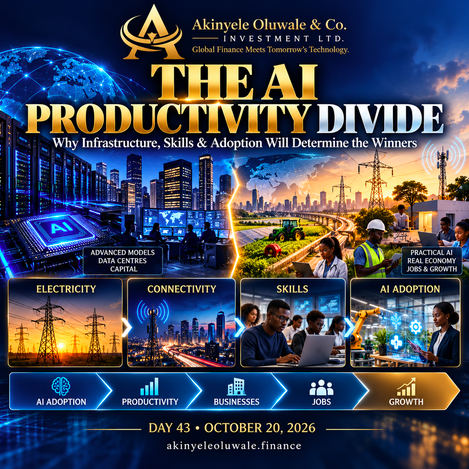
There are effectively two AI races underway.
This is the highly visible competition.
Advanced Models → GPUs → Data Centres → Electricity → Capital
It requires enormous amounts of computing infrastructure and financing.
This could prove equally consequential.
Electricity → Connectivity → Skills → AI Tools → Business Adoption → Productivity
The first race determines who builds the most advanced AI.
The second may determine who captures the broadest economic benefits.
That distinction is particularly important for emerging economies.
They do not necessarily need to reproduce Silicon Valley's infrastructure spending.
They need to determine where AI can improve existing economic activity.
For example:
An agricultural business doesn't need to train a frontier model to use AI for crop analysis.
A hospital doesn't need its own hyperscale data centre to benefit from AI-supported diagnostics.
A small business doesn't need billions in computing infrastructure to use AI for administration, customer service or productivity.
A government doesn't need to build a global chatbot to use AI to improve public-service delivery.
This is where Small AI becomes economically significant.
For investors, companies and policymakers, the critical distinction is:
Having access to artificial intelligence is only the first stage.
The economic transmission mechanism looks more like:
↓
↓
↓
↓
↓
↓
↓
A weakness at any stage can limit the economic benefit of the stages that follow.
An economy with sophisticated AI tools but unreliable electricity faces an obvious constraint.
An economy with electricity but poor digital connectivity faces another.
Connectivity without relevant skills creates another bottleneck.
Skills without investable businesses create another.
This means the AI opportunity is fundamentally an ecosystem challenge.
The AI boom has generated extraordinary expectations.
But technological capability and economic productivity are not identical.
A more powerful model does not automatically produce a more productive economy.
That transformation requires businesses.
Infrastructure.
Workers.
Capital.
Skills.
Institutions.
And ultimately customers willing to pay for useful products and services.
This is why the next phase of AI should increasingly be judged by economic outcomes, not simply technical benchmarks.
Can a farmer produce more efficiently?
Can a manufacturer reduce waste?
Can a hospital improve service delivery?
Can a bank serve customers more efficiently?
Can a small business expand without increasing administrative costs proportionately?
Can workers use AI to increase the economic value of their skills?
Those questions will matter more to long-term economic development than another leaderboard ranking.
The AI race will not ultimately be won by access to intelligence alone. It will be won by the economies that convert intelligence into productivity.
And our second principle:
AI infrastructure creates capacity. AI adoption creates economic value.
AI cannot scale economically without reliable power.
For developing economies, electricity infrastructure may therefore become part of AI policy.
Affordable broadband and mobile connectivity determine who can actually access digital services.
The critical skill may increasingly be not simply building AI, but knowing how to work effectively with AI.
Large corporations will naturally adopt AI.
The larger productivity breakthrough could come when millions of smaller businesses can use it economically.
Avoid simplistic predictions.
AI could automate some tasks while augmenting others and creating entirely new activities.
The key question is whether economies can move workers toward higher-productivity opportunities quickly enough.
Watch whether capital begins moving from the broad AI narrative toward companies producing measurable productivity improvements.
This may be particularly important.
Africa's demographic growth creates both an enormous opportunity and an enormous employment requirement.
The strategic question becomes:
Can Africa use AI to leapfrog productivity constraints rather than simply consume AI products created elsewhere?
1. The AI story is moving from capability toward productivity.
2. Developing economies face a different AI challenge from technology superpowers.
3. Building frontier models is not the only route to economic benefit.
4. Practical or “Small AI” could broaden adoption across agriculture, healthcare, education, finance and small businesses.
5. Electricity, connectivity and skills are fundamental AI infrastructure.
6. AI access does not automatically equal AI productivity.
7. Employment outcomes will depend heavily on how businesses, workers and governments adapt.
8. The long-term winners may be economies that deploy AI most effectively not simply those that build the biggest models.
And the shorter investment framework:
Akinyele Oluwale & Co. Investment Ltd. provides institutional financial intelligence covering the intersection of global finance and emerging technology.
Our coverage includes artificial intelligence, blockchain technology, crypto and digital assets, institutional finance, stablecoins and payments, tokenization and real-world assets, central banks, and macroeconomic developments.
Our objective is to move beyond headlines to understand:
What changed?
Why does it matter?
How could it affect capital, businesses and economies?
What should serious investors and decision-makers watch next?
Observe the change.
Understand the implications.
Position with discipline.
Akinyele Oluwale & Co. Investment Ltd.
Where Global Finance Meets Tomorrow's Technology.