

The real tokenization revolution may not be the replacement of traditional finance. It may be the transformation of traditional finance from within.
For years, one of the dominant narratives surrounding blockchain technology was disruption: decentralized financial systems would challenge banks, exchanges, custodians and other traditional financial intermediaries.
The institutional conversation is changing.
Major financial institutions are increasingly examining how tokenization can be incorporated into the existing financial system rather than simply competing against it.
A fresh October 17 report indicates that Goldman Sachs, Wells Fargo and Morgan Stanley are viewing tokenization through potential opportunities in trading, payments and investment advisory services. CoinDesk
But the institutional shift extends beyond Wall Street.
On September 21, the Eurosystem launched Pontes, enabling wholesale transactions involving tokenized assets to settle in central-bank money. An initial group of banks and market infrastructures had already completed onboarding at launch. European Central Bank
Even more significantly, the ECB has begun preparing to invest a small portion of its own funds in tokenized securities, initially focusing on euro-denominated public-sector and supranational securities. European Central Bank
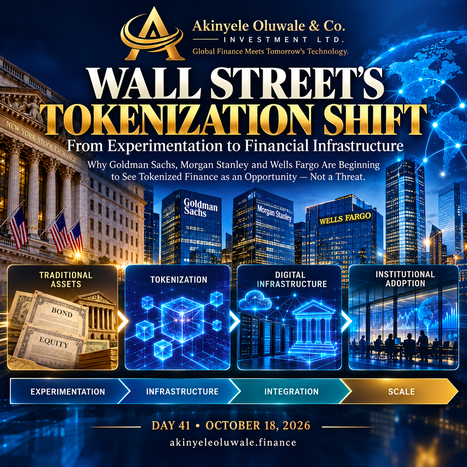
The emerging transition can therefore be summarized as:
Experimentation → Infrastructure → Integration → Scale
Tokenization is no longer only a discussion about putting traditional assets on blockchain networks.
The deeper question is whether financial institutions can use tokenization to redesign parts of the infrastructure through which assets are issued, traded, settled, held and serviced.
Financial markets depend on infrastructure.
Behind every bond, equity or other financial instrument sits a network of exchanges, custodians, clearing systems, settlement mechanisms, banks and record-keeping processes.
Many of these systems work effectively, but they can also involve multiple intermediaries and operational steps.
Tokenization proposes a different architecture.
A traditional financial asset or the legal economic claim associated with it can be represented digitally and transferred using distributed-ledger infrastructure.
The potential benefits include greater automation, faster settlement, improved transparency and more efficient processing.
The ECB itself says tokenization could bundle multiple stages of an asset's lifecycle from issuance and trading through settlement, custody and servicing while enabling greater automation through smart contracts. European Central Bank
This matters because the competition may ultimately be about something much larger than cryptocurrency.
It may be about the future operating system of financial markets.
The latest Wall Street development provides an important signal.
Reporting published October 17 describes Goldman Sachs, Wells Fargo and Morgan Stanley as increasingly viewing tokenization as a potential growth opportunity, with possible applications spanning trading, payments and advisory activities. CoinDesk
Different institutions may pursue different opportunities.
But the strategic direction is becoming clearer:
Blockchain technology does not necessarily require banks to disappear.
Banks can instead attempt to incorporate blockchain-based infrastructure into their existing businesses.
At the same time, Europe's central-bank infrastructure is moving beyond experimentation.
The Eurosystem launched Pontes on September 21. It connects distributed-ledger market platforms with existing TARGET Services so tokenized wholesale transactions can settle using central-bank money. European Central Bank
That distinction is important.
A pilot demonstrates possibility.
Production infrastructure demonstrates institutional commitment.
The evolution of tokenization can increasingly be viewed through four stages:
Financial institutions test blockchain technology through proofs of concept and limited pilots.
↓
Custody, settlement, identity, compliance and interoperability systems begin developing.
↓
Tokenized assets begin interacting with established banking and capital-market infrastructure.
↓
Tokenized markets become sufficiently liquid, standardized and interoperable to support significant institutional activity.
The industry is not uniformly at Stage 4.
Far from it.
The World Bank noted earlier this year that approximately $3.7 billion of DLT-based fixed-income instruments were issued globally in 2024, tiny relative to a roughly $100 trillion global bond market. World Bank Blogs
That comparison is essential.
It prevents us from confusing technological potential with present market scale.
Tokenized finance is growing, but conventional capital markets remain vastly larger.
The long-term significance of tokenization can be understood through this chain:
Traditional Assets
↓
Tokenization
↓
Digital Market Infrastructure
↓
Potentially Faster & More Automated Settlement
↓
Institutional Adoption
↓
New Financial Services
But investors and financial institutions should examine tokenization through four separate lenses.
Asset: What economic value or legal claim does the token actually represent?
Infrastructure: Who provides the blockchain, custody, settlement and operational systems?
Regulation: Are ownership rights and investor protections legally enforceable?
Utility: Does tokenization materially improve cost, settlement, transparency, liquidity or accessibility?
This distinction matters because tokenizing an asset does not automatically make the underlying asset more valuable.
Technology can improve infrastructure.
It cannot transform a poor-quality economic asset into a high-quality one simply by representing it digitally.
The World Bank has similarly identified technological vulnerabilities, interoperability problems, smart-contract risks and regulatory uncertainty among issues that tokenized bond markets must address. World Bank Blogs
The most interesting development in tokenization is not necessarily happening at the edges of traditional finance.
It is increasingly happening inside traditional finance itself.
Central banks are examining settlement infrastructure.
Commercial banks are exploring tokenized payments and deposits.
Capital-market institutions are investigating tokenized securities.
Asset managers and investors are examining how digital infrastructure could change issuance, settlement and portfolio administration.
This changes the central question.
The old question was:
Will blockchain replace traditional finance?
The better question may increasingly be:
Which parts of traditional finance will blockchain infrastructure improve and which institutions will successfully adapt?
The ECB's strategy is particularly revealing. Pontes is designed to connect tokenized markets to central-bank-money settlement, while the broader Appia initiative is examining standards, interoperability, governance and the architecture of a more integrated tokenized European financial ecosystem. European Central Bank
That represents evolution rather than revolution.
The real tokenization revolution may not be the replacement of traditional finance. It may be the transformation of traditional finance from within.
Five developments deserve particular attention.
Institutional adoption: Watch whether today's experiments become recurring commercial transactions rather than isolated demonstrations.
Central-bank settlement: Pontes is especially important because institutional tokenized markets need credible settlement infrastructure. The ECB plans gradual enhancements, with fuller implementation expected by 2028. European Central Bank
Interoperability: A financial system consisting of hundreds of disconnected tokenization platforms would recreate fragmentation rather than eliminate it.
Legal and regulatory clarity: Technology can record ownership, but institutions still require clear legal recognition of the underlying rights and obligations.
Economic utility: Ultimately, tokenization must demonstrate measurable improvements in cost, settlement, liquidity, transparency or access.
The winners may therefore not necessarily be the institutions making the loudest blockchain announcements.
They may be those building infrastructure that solves genuine financial-market problems.
1. Tokenization is moving deeper into institutional finance. Major banks increasingly appear to be considering it as a business opportunity rather than purely a competitive threat. CoinDesk
2. Central-bank infrastructure is beginning to support the transition. The Eurosystem's Pontes has moved tokenized wholesale settlement in central-bank money into an operational environment. European Central Bank
3. Traditional finance is unlikely simply to disappear. Existing institutions may adopt tokenized infrastructure themselves.
4. Scale remains limited relative to traditional markets. Tokenization's potential should not be confused with its current market size. World Bank Blogs
5. Infrastructure matters more than hype. Custody, settlement, regulation, interoperability and legal ownership will determine whether tokenization achieves sustainable institutional scale.
6. Tokenization does not automatically improve an underlying investment. The economic quality of the asset remains fundamental.
Traditional Assets → Tokenization → Digital Market Infrastructure → Faster Settlement → Institutional Adoption → New Financial Services
And the institutional progression:
Experimentation → Infrastructure → Integration → Scale
Akinyele Oluwale & Co. Investment Ltd. is a financial intelligence platform focused on the intersection of global finance and emerging technology.
Our coverage includes artificial intelligence, blockchain technology, digital assets, institutional finance, stablecoins and payments, tokenization and real-world assets, central banks, and macroeconomic developments.
Our objective is not simply to report what happened.
We seek to understand what is changing, why it matters and how those changes could reshape capital, markets and investment thinking over time.
Observe the change.
Understand the implications.
Position with discipline.
Akinyele Oluwale & Co. Investment Ltd.
Where Global Finance Meets Tomorrow’s Technology.