

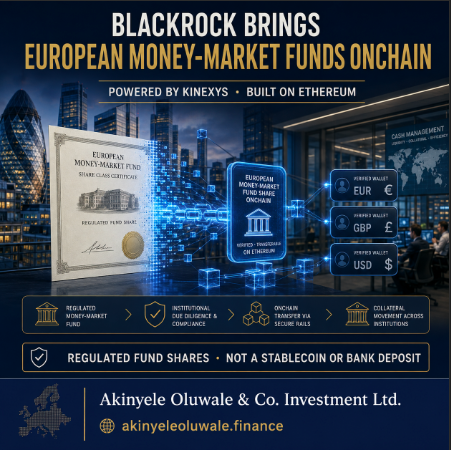
BlackRock Brings European Money-Market Funds Onchain with JPMorgan
Published: 4 September 2026
Category: Tokenization & RWAs • Institutional Finance • Blockchain & Technology
By: Akinyele Oluwale & Co. Investment Ltd.
Executive Summary
BlackRock has launched its first tokenised access to European money-market funds through onchain share classes covering selected euro, sterling and US dollar funds.
The tokens are minted on Ethereum using Kinexys by J.P. Morgan, while the funds retain their existing regulated structure and investment strategies.
Each token represents a share in an underlying BlackRock Institutional Cash Series fund. However, the official shareholder register remains within the traditional transfer-agent system.
This is not a cryptocurrency imitating a fund. It is blockchain-enabled access to existing regulated money-market funds initially intended for eligible professional and institutional investors across selected markets.
Background
Money-market funds invest primarily in high-quality, short-term debt instruments. Companies and financial institutions use them to manage surplus cash while maintaining liquidity and earning market-based returns.
BlackRock’s Institutional Cash Series platform oversees a large pool of cash-management assets. The new onchain share classes introduce tokenised functionality across a platform holding approximately $311 billion in combined assets under management.
The available classes cover public-debt constant-net-asset-value funds and low-volatility-net-asset-value funds denominated in euros, pounds sterling and US dollars.
Kinexys provides the technology for minting, transferring and burning the tokens. It also connects blockchain transactions with the transfer agent and official shareholder register.
Why It Matters
This launch moves tokenisation closer to the centre of institutional cash management.
Approved investors can transfer fund tokens between verified wallets at any time, rather than depending entirely on conventional market hours and manual processing.
Potential uses include:
* Moving liquidity between approved institutions.
* Using fund shares as digital collateral.
* Improving corporate treasury management.
* Connecting money-market funds with tokenised securities.
* Increasing transaction visibility.
* Automating permitted transfers through smart contracts.
* Supporting new banking and wealth-distribution channels.
Tokenised cash funds could become an important bridge between stablecoins, traditional deposits and capital-market instruments.
Stakeholders: Winners and Losers
Potential winners include corporate treasurers, banks, institutional investors and digital-asset platforms seeking regulated, yield-bearing instruments for liquidity and collateral.
BlackRock gains another distribution channel, while JPMorgan strengthens Kinexys as infrastructure for institutional tokenisation.
Potential losers include intermediaries whose revenue depends on slow transfers, fragmented record-keeping and manual reconciliation.
Stablecoin issuers may also face stronger competition for institutional balances. A regulated money-market fund can provide investment income and high-quality assets, although it does not offer the same certainty of value or payment functionality as a fully reserved stablecoin.
Short-Term Impact
The immediate impact will remain concentrated among approved professional investors.
Wallets must be verified, investor eligibility rules still apply and transfers occur within controlled smart-contract arrangements. Retail investors should not assume that a public Ethereum address automatically provides access.
Financial institutions will test whether tokenised shares improve collateral movement, intraday liquidity and operational efficiency without creating new legal or cybersecurity risks.
Long-Term Impact
Tokenised money-market funds could become a settlement and collateral layer for onchain financial markets.
An institution trading tokenised bonds or equities may eventually use a money-market-fund token as collateral or a cash-management asset without leaving digital infrastructure.
However, the model remains partly hybrid. The token moves onchain, but the legally authoritative shareholder register stays with the transfer agent.
This arrangement offers continuity and regulatory familiarity, although it also means the blockchain is not yet the complete system of record.
Editorial Perspective
BlackRock’s approach is more credible than tokenisation that merely creates price exposure through an unrelated derivative.
The token represents an interest in an established fund, supported by recognised investment, custody and transfer-agent arrangements.
Still, investors should not confuse a money-market fund with a bank deposit or stablecoin. Fund values and income can fluctuate, access may be restricted and government deposit insurance generally does not apply.
The real breakthrough will not be the number of tokens minted. It will be whether institutions use them repeatedly for collateral, treasury operations and settlement.
Tokenisation creates value when it improves financial workflows not when it simply gives an old product a blockchain label.
What to Watch Next
Investors should monitor assets entering the onchain share classes, transfer volumes between approved wallets and adoption as institutional collateral.
The relationship between the Ethereum token and the official shareholder register will also matter, particularly when correcting errors, processing redemptions or managing a blockchain disruption.
Notes
This analysis is based on [BlackRock’s official launch announcement](https://www.blackrock.com/cash/en-gb/press-release-t4), including information about the participating funds, eligible markets and Kinexys infrastructure. Product availability and investor eligibility vary by jurisdiction.
Akinyele Oluwale & Co. Investment Ltd.
Where Global Finance Meets Tomorrow’s Technology.