
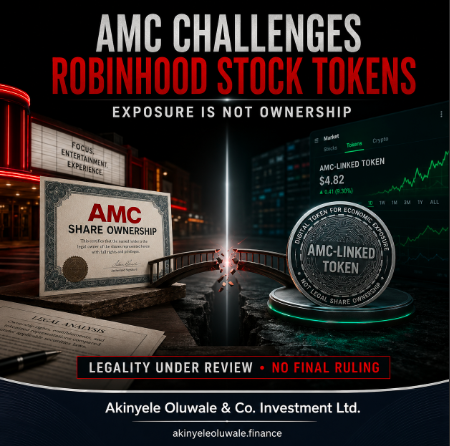
AMC Challenges Robinhood’s Tokenised Shares: Exposure Is Not Ownership
Published: 4 September 2026
Category: Tokenization & RWAs • Crypto & Digital Assets • Institutional Finance
By: Akinyele Oluwale & Co. Investment Ltd.
Executive Summary
AMC Entertainment CEO Adam Aron has launched a strong public attack on Robinhood for offering tokens linked to AMC shares without the company’s involvement.
Aron described the practice as unacceptable and said AMC would ask external securities lawyers to examine its legality.
The dispute exposes a fundamental weakness in the tokenised-equity market: many products marketed as “stock tokens” do not make their holders shareholders in the underlying company.
Robinhood’s own disclosures state that its stock tokens provide economic exposure but do not grant investors legal or beneficial rights against the company whose shares they track.
AMC has questioned the arrangement, but no court or regulator has yet declared Robinhood’s AMC-linked token illegal.
Background
Robinhood offers tokenised stock products to eligible investors outside the United States through European and Jersey-based entities.
Two related structures appear within its product offering.
Robinhood Europe’s Classic Stock Tokens are derivatives contracts that follow the prices of underlying securities. Robinhood also describes wallet-based Stock Tokens as tokenised debt securities issued by Robinhood Assets (Jersey) Limited.
In both cases, the customer does not directly purchase shares from AMC or become registered as an AMC shareholder.
Robinhood states that underlying public securities are held through licensed institutions and that eligible token holders may receive economic adjustments reflecting dividends and corporate actions. However, they generally do not receive voting rights or a direct legal claim against the underlying issuer.
That distinction is at the heart of AMC’s objection.
Why It Matters
Tokenisation is often presented as a way to place traditional shares on blockchain infrastructure. But a blockchain token can represent several very different legal relationships.
It may be:
* A genuine digital share issued by the company.
* A beneficial interest in shares held by a custodian.
* A derivative tracking the share price.
* A debt security linked to the underlying asset.
* A synthetic instrument carrying counterparty exposure.
These products may look similar inside an investment application while giving holders very different rights.
When the word “stock” is used loosely, investors may believe they own part of the company when they actually hold a contract issued by an intermediary.
Stakeholders: Winners and Losers
Potential winners include Robinhood and international investors seeking low-cost, fractional exposure to American equities beyond traditional market hours.
Tokenised structures could also improve distribution and allow financial products to move through digital wallets and blockchain applications.
Potential losers are investors who misunderstand what they have purchased. A token holder may receive price exposure but lack voting rights, direct ownership, conventional custody protection or a claim against the underlying company.
Public companies may also be concerned that third parties can commercially use their names and share prices without approval while creating products over which they have no operational control.
Short-Term Impact
AMC’s legal review could increase scrutiny of Robinhood’s disclosures, marketing language and product structure.
Other public companies may issue similar objections, particularly where tokenised products appear to blur the line between genuine equity and derivative exposure.
The controversy may also encourage regulators to require more prominent descriptions of the legal issuer, underlying assets, custody arrangements, voting rights and insolvency risks.
Long-Term Impact
The dispute could push the tokenisation industry towards clearer standards.
One model would involve issuer-sponsored digital shares carrying the same rights as conventional equity. Another would permit third-party tokens but require them to be described clearly as derivatives or debt instruments rather than shares.
Markets need both innovation and legal precision. Without them, tokenisation could create fragmented layers of exposure around the same asset, each carrying different counterparty and ownership risks.
Editorial Perspective
AMC is right to demand clarity, but its claim that the product is illegal must still be tested through law and regulation.
Robinhood openly states that customers are not purchasing the underlying shares. The deeper question is whether those disclosures are sufficiently prominent and whether investors genuinely understand the difference.
Tokenisation should not become financial theatre in which price exposure is dressed up as ownership.
A genuine tokenised share should preserve voting, dividend, information and insolvency rights. Where those rights are absent, the product should be labelled for what it is: an intermediary-issued financial contract linked to a share price.
What to Watch Next
Investors should monitor AMC’s legal review, Robinhood’s response and any action by European or Jersey regulators.
The critical issues will be whether Robinhood changes its disclosures, whether other companies object and whether regulators establish a clear naming standard separating tokenised shares from share-linked derivatives.
Notes
This analysis draws on [Robinhood’s official Stock Tokens description](https://robinhood.com/rhj/stocktokens/), its [Classic Stock Tokens FAQ](https://robinhood.com/eu/en/support/articles/stock-tokens-faq/) and [reporting on AMC’s objection](https://www.barrons.com/articles/amc-stock-robinhood-attack-vile-c3cc9d42). AMC’s allegation of illegality remains unproven pending legal or regulatory determination.
Akinyele Oluwale & Co. Investment Ltd.
Where Global Finance Meets Tomorrow’s Technology.