

Weekly Recap: Growth Stayed Strong, Inflation Stayed Complicated and Global Bond Markets Sent a Warning
Week ended Saturday, 22 August 2026 Strong U.S. business activity challenged hopes for easier monetary policy, Federal Reserve minutes kept further tightening on the table, Japanese bond yields approached levels unseen for decades, and energy-driven inflation remained a global concern. The week's message was uncomfortable but important: economic resilience and market-friendly monetary policy are not always the same thing.
Published: 23 August 2026
Category: Weekly Recap • Macro & Central Banks • Market Intelligence
By: Akinyele Oluwale & Co. Investment Ltd.
Executive Summary
The macro story this week was not recession.
It was resilience meeting inflation.
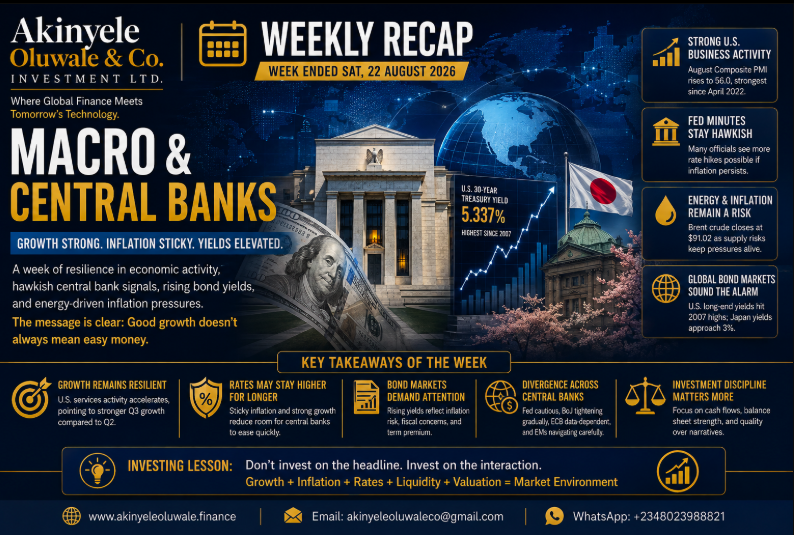
U.S. business activity accelerated sharply in August. The S&P Global Composite PMI rose to 56.0, its strongest reading since April 2022, while services PMI reached 56.8. (Reuters)
Normally, stronger growth should be welcomed.
But markets are operating in an environment where inflation remains uncomfortable and long-term borrowing costs are elevated. Minutes from the Federal Reserve's July meeting showed many officials believed higher rates could eventually be necessary if inflation remained persistent. (AP News)
Meanwhile, Japan's bond market delivered another warning as its benchmark yield moved close to 3%.
The central lesson of the week:
Good economic news can become complicated market news when inflation refuses to disappear.
What Happened?
Three developments defined the week.
First, the U.S. economy showed surprising strength.
Services activity accelerated, employment indicators improved and the Composite PMI suggested third-quarter growth could strengthen considerably from the second quarter. (Reuters)
Second, bond markets remained unsettled.
The U.S. 30-year Treasury yield briefly reached 5.337%, its highest level since 2007, as investors confronted inflation, oil prices and long-term fiscal concerns. (Reuters)
Third, Japan entered increasingly unfamiliar territory.
Its 10 year government bond yield reached a three-decade high during the week as investors priced stronger inflation pressures, yen weakness and the possibility of additional Bank of Japan tightening. (Reuters)
Background
For much of the post-pandemic cycle, markets asked one dominant question:
When will central banks cut rates?
That question is changing.
Investors increasingly need to consider whether some central banks could remain restrictive or tighten further because inflationary pressures have proved more persistent than expected.
Energy has complicated the picture.
Higher oil prices associated with Middle East disruptions have increased inflation risks at precisely the moment policymakers would prefer greater flexibility. Brent crude closed at $91.02 on August 18. (Reuters)
The result is a difficult combination:
Resilient Growth + Energy Pressure + Sticky Inflation + High Bond Yields
Why It Matters
Interest rates don't operate in isolation.
They influence:
Bonds → Currencies → Equities → Credit → Property → Crypto → Global Capital Flows
The longer yields remain elevated, the higher the hurdle rate becomes for investments.
This matters particularly for highly valued growth companies.
AI may produce extraordinary revenue growth, but investors still have to discount those future cash flows against prevailing interest rates.
That means even excellent businesses can face valuation pressure when the cost of capital rises.
Winners & Losers / Key Stakeholders
Banks and some financial companies can benefit from higher rates, provided credit quality remains healthy.
Savers and investors in selected fixed-income instruments may receive more attractive yields.
Companies dependent on cheap financing face greater pressure.
Highly leveraged governments also become increasingly sensitive to rising borrowing costs.
For equity investors, businesses producing strong current cash flows may become relatively more attractive than companies whose valuations depend heavily on profits expected many years ahead.
Short-Term Impact
Markets could remain caught between two competing narratives:
Strong growth supports earnings.
But:
Strong growth can delay monetary easing.
That tension helps explain why good economic data can sometimes push bond yields higher and pressure equities.
The Nasdaq and S&P 500 both finished the week lower despite resilient economic activity. (Investor's Business Daily)
Investors should therefore avoid automatically interpreting stronger economic numbers as bullish for every asset.
Long-Term Impact
A deeper shift may be developing.
The world could be moving away from decades of exceptionally cheap capital toward an environment where inflation, fiscal deficits, energy security and enormous AI infrastructure spending keep the cost of money structurally higher.
If so, portfolio construction will have to adapt.
Valuation discipline will matter again.
Cash flow will matter.
Balance-sheet strength will matter.
And diversification across countries and asset classes may become increasingly valuable.
Editorial Perspective
This week's most important investing lesson is simple:
Don't confuse a strong economy with an easy investment environment.
An economy can grow rapidly while bond yields rise.
Corporate earnings can increase while valuations contract.
Central banks can welcome economic resilience while simultaneously worrying that the same resilience is sustaining inflation.
Investors must understand both sides.
What to Watch Next
Attention now turns to U.S. PCE inflation, consumer confidence and revised GDP data.
Markets will also closely watch Federal Reserve Chair Kevin Warsh at Jackson Hole for clues about how policymakers interpret the combination of resilient growth and persistent inflation. (The Wall Street Journal)
Japan remains equally important.
Watch the yen, inflation and whether Japanese government bond yields decisively break above 3%.
Investing Lesson
Don't invest on the headline. Invest on the interaction.
Growth alone doesn't determine markets.
Neither does inflation.
Neither do interest rates.
The important question is how they interact:
Growth + Inflation + Rates + Liquidity + Valuation = Market Environment
Key Takeaways
This week reinforced three realities:
Growth remains resilient. Inflation risk remains alive. Bond markets are demanding attention.
Central banks therefore have less room for simple policy decisions than many investors would like.
Editorial Bottom Line
The macro environment is becoming more complex—not necessarily weaker.
That distinction matters.
Investors should stop asking only:
“When will rates fall?”
The better question is:
“What would have to happen economically for rates to fall—and would I actually want the conditions that caused it?”
Sometimes the reason behind the rate matters far more than the rate itself.
Notes
Weekly analysis based on Federal Reserve July meeting minutes, August S&P Global PMI data, U.S. Treasury-market developments, Japanese government bond movements and current global inflation and energy-market developments. (AP News)
Akinyele Oluwale & Co. Investment Ltd.
Where Global Finance Meets Tomorrow’s Technology.