

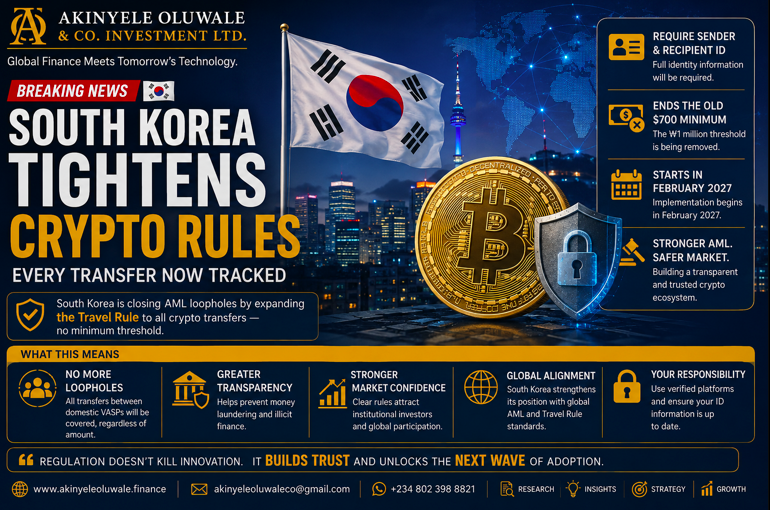
South Korea Tightens Crypto Transfers: Travel Rule Expands Below ₩1 Million as Seoul Closes AML Loopholes
South Korea is preparing to remove the ₩1 million threshold that has limited its crypto Travel Rule since 2022. The change means smaller transfers between domestic virtual-asset providers will also carry sender and recipient information another sign that crypto infrastructure is increasingly being regulated like mainstream finance.
Published: 12 August 2026
Category: Crypto Regulation • South Korea • Digital Assets • AML
By: Akinyele Oluwale & Co. Investment Ltd.
Executive Summary
The viral post is substantially correct on the regulatory direction, but one part needs careful wording.
South Korea's Financial Services Commission (FSC) has confirmed that its existing Travel Rule, currently applicable to transfers of ₩1 million or more, will be expanded to transactions below ₩1 million. The receiving Virtual Asset Service Provider (VASP) will also have responsibility for securing originator information. (Financial Services Commission)
That effectively removes the current threshold loophole for transfers between domestic VASPs.
Why now? According to the FSC, approximately 60% of domestic VASP-to-VASP crypto transfers in the second half of 2025 were below ₩1 million. Regulators argue that leaving these transactions outside the Travel Rule creates an anti-money-laundering blind spot. (Financial Services Commission)
However, the social-media description that “every transfer will now be tracked from February 2027” is broader than the official material reviewed. The confirmed policy specifically concerns expanding Travel Rule requirements and strengthening AML controls not government surveillance of every blockchain transaction everywhere.
The real story is significant enough without exaggeration:
South Korea is removing transaction size as an escape route from regulated crypto-transfer identification.
What Happened?
South Korea introduced its crypto Travel Rule in March 2022.
Under the existing framework, when a domestic VASP transfers crypto worth ₩1 million or more to another VASP, information concerning the originator and beneficiary must accompany the transaction. (Financial Services Commission)
The required information includes details such as:
Sender's name.
Recipient's name.
Relevant virtual-asset addresses.
Additional identification can also be requested under specified circumstances. (Law.go.kr)
The regulatory gap was obvious:
Transfers below ₩1 million escaped that particular Travel Rule threshold.
South Korea now intends to close it.
Why This Matters
The change isn't really about Bitcoin.
It's about financial identity.
Traditional bank transfers operate inside systems where financial institutions generally know who is sending and receiving money.
Crypto was originally very different.
A blockchain address could move value globally without necessarily carrying conventional identity information alongside the transaction.
Regulators increasingly want to bridge that gap.
South Korea's direction is essentially:
If regulated financial institutions move digital value, AML information should travel with that value regardless of whether the transaction is large or small.
That represents another step toward treating crypto infrastructure more like conventional financial infrastructure.
Why Remove the ₩1 Million Threshold?
The government's explanation is revealing.
Approximately 60% of transfers between domestic VASPs were below ₩1 million during H2 2025. (Financial Services Commission)
That creates an obvious weakness.
If compliance begins at ₩1 million, someone trying to avoid the threshold could potentially split a larger transfer into several smaller ones.
For example:
Instead of transferring ₩3 million once, funds could potentially be divided into multiple smaller transactions.
This practice commonly called structuring is exactly the kind of behaviour AML frameworks are designed to detect.
Removing the threshold makes transaction size less useful as a way around identification requirements.
What About Personal Wallets and Foreign Exchanges?
This is where South Korea's broader strategy becomes more important.
KoFIU has also been working on tighter controls for transfers involving domestic exchanges, overseas VASPs and personal wallets.
Its stated direction is to permit low-risk transfers involving external services or personal wallets where the originator and beneficiary are the same person, improving transparency around where assets are moving. (Financial Services Commission)
That potentially creates more friction for investors moving crypto between different platforms.
But it also reflects the international regulatory trend.
Governments increasingly distinguish between:
Owning crypto
and
moving crypto anonymously through regulated gateways.
The first can remain legal while the second receives progressively more scrutiny.
Is South Korea “Tracking Every Crypto Transfer”?
Not exactly.
That headline is too broad.
Bitcoin's blockchain remains a decentralised network. South Korea isn't rewriting the Bitcoin protocol or suddenly identifying every private transaction worldwide.
The rules concern regulated VASPs and their AML obligations.
That distinction matters.
If two regulated Korean exchanges facilitate a transfer, the regulatory infrastructure increasingly requires identity information to accompany it.
Pure wallet-to-wallet blockchain activity is technically different, although interactions between self-custody wallets and regulated exchanges can still trigger verification requirements.
So the more accurate headline is:
South Korea is expanding identity requirements across regulated crypto transfers not tracking every blockchain transaction on Earth.
Why South Korea Matters Globally
South Korea is one of the world's most active cryptocurrency markets.
Retail participation is substantial.
Major exchanges handle enormous volumes.
Crypto is deeply embedded in the country's investment culture.
That makes Korean regulation internationally relevant.
When a major crypto market tightens compliance, exchanges, wallet providers and blockchain infrastructure companies have to adapt.
And South Korea is not acting in isolation.
The Travel Rule originates from international AML standards developed by the Financial Action Task Force.
Crypto regulation is therefore increasingly becoming globally interconnected.
Winners and Losers
Potential Winners
Regulated exchanges: Strong compliance infrastructure could become a competitive advantage.
Blockchain analytics providers: Greater transaction monitoring increases demand for compliance technology.
Institutional investors: Stronger AML standards can make regulated crypto markets more acceptable to banks and professional investors.
Potential Losers
Compliance-light platforms: Regulatory arbitrage becomes harder.
Users seeking anonymity through regulated exchanges: Identification requirements continue expanding.
Smaller VASPs: Additional compliance systems can increase operating costs.
Short-Term Impact
For most investors, this does not change Bitcoin's underlying economics.
It changes the process of transferring it.
Users should expect regulated platforms to request more accurate recipient information and potentially apply additional verification to withdrawals and deposits.
The biggest immediate impact will therefore fall on exchanges and compliance departments rather than Bitcoin's protocol itself.
Long-Term Impact
The long-term direction is much more significant.
Crypto is gradually developing two layers.
The Open Blockchain Layer
Permissionless networks continue operating globally.
The Regulated Gateway Layer
Exchanges, custodians, brokers and financial institutions increasingly require:
Identity.
AML checks.
Transaction monitoring.
Reporting.
Record-keeping.
The interaction between these two layers will define much of crypto regulation over the next decade.
Editorial Perspective
South Korea's decision illustrates a fundamental reality about institutional crypto adoption:
More adoption usually means more compliance—not less.
Investors sometimes assume mainstream crypto adoption will eventually eliminate regulatory friction.
The opposite may happen.
As Bitcoin, Ethereum and stablecoins become more valuable and more deeply integrated into finance, governments have stronger incentives to apply familiar financial controls.
The challenge is balance.
Too little oversight can enable fraud and money laundering.
Too much surveillance can undermine privacy and push users toward unregulated markets.
South Korea now has to find that balance.
The ₩1 million threshold may disappear.
But the bigger question remains:
How much financial privacy should disappear with it?
What to Watch Next
Watch the final implementation timetable, technical standards for VASPs, treatment of self-custody wallets, overseas exchange transfers and whether compliance requirements create noticeable delays or higher costs for ordinary investors.
Also watch whether other Asian jurisdictions move toward similarly broad, low- or zero-threshold Travel Rule frameworks.
Investing Lesson
Institutionalisation comes with compliance.
Investors often want:
More institutional capital.
Bank adoption.
ETFs.
Regulated exchanges.
Stablecoins.
Tokenized assets.
But those developments inevitably bring:
KYC.
AML controls.
Tax reporting.
Transaction monitoring.
Custody rules.
The two trends are connected.
The investment lesson is simple:
Don't evaluate crypto regulation only by asking whether it is “pro-crypto” or “anti-crypto.”
Ask whether the rules make the market safer, more investable and scalable without destroying the properties that made the technology valuable in the first place.
Key Takeaways
Editorial Bottom Line
South Korea isn't banning crypto transfers. It is making anonymous movement through regulated crypto infrastructure increasingly difficult.
That may strengthen institutional confidence—but it also ensures that the debate over financial transparency versus financial privacy will become even more important as crypto enters mainstream finance.
Akinyele Oluwale & Co. Investment Ltd.
Global Finance Meets Tomorrow's Technology