

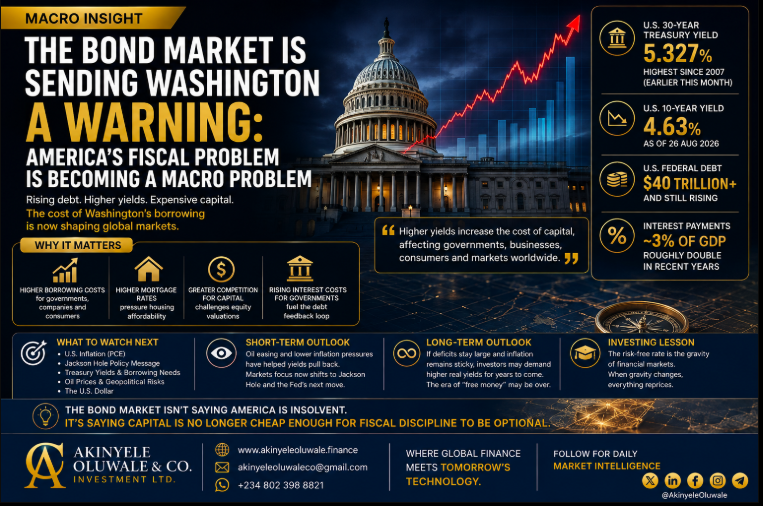
The bond market is sending Washington a warning: America’s fiscal problem is becoming a macro problem
Long-dated U.S. borrowing costs have jumped to near two-decade highs, America’s federal debt has soared past $40tn, and investors are fretting that large deficits will permanently distort the price of money. The confluence of factors has worrying implications for not only bonds, but equities, currencies, housing and the economy more generally.
Published: 26 August 2026
Category: Macro • Central Banks • Fixed Income • Global Markets
By: Akinyele Oluwale & Co. Investment Ltd
Executive Summary
Something important is happening in the world’s most important bond market.
The U.S. 30-year Treasury yield was at 5.327% last week, the highest level since 2007. It has since come down, to around 5.16% for the 30-year and 4.63% for the 10-year on Tuesday, but the debate around fiscal policy is far from over. ([Reuters][1])
America’s federal debt has crossed $40tn, while persistent deficits and soaring borrowing costs are forcing investors to rethink their views on compensation for the privilege of owning U.S. debt. ([Reuters][2])
This is one of the defining macro questions of the decade:
What happens when the world’s biggest borrower needs increasingly expensive funding?
What Happened
Duration has been the order of the day in government bond markets around the world.
The U.S. 30-year yield was near a 19-year peak, while Japanese, German, and French borrowing costs were also at multi-year highs. ([Reuters][1])
A confluence of factors, from huge fiscal deficits to heavy borrowing, persistent inflation worries, energy security concerns, and huge private-sector demand for capital, have been weighing on long-dated government bonds.
The Treasury has been buying back bonds, which has sent yields lower in recent days, but influential investors have warned that liquidity-fueled squeezes do not address the bigger fiscal issues. ([Reuters][3])
Background
Gone are the days of ultra-low inflation, ultra-low policy rates, ultra-low borrowing costs, and central banks buying up vast amounts of government debt.
That environment has been punctured by a combination of large fiscal deficits, even as the U.S. economy has avoided recession.
Interest payments on the debt have more than doubled as a share of gross domestic product, reaching around 3%, according to Reuters calculations. ([Reuters][2])
This is a worrying dynamic:
The bigger the bill, the more the government has to borrow, and the more that competition for capital hurts yields.
Meanwhile, higher borrowing costs further add to the bill, creating a dangerous spiral.
Why It Matters
Government bond yields are the ultimate benchmark for almost everything.
With higher risk-free yields, investors will always seek to get better compensation for taking on equity, property, or credit risk, simply because they can get attractive returns with zero risk by buying government bonds.
Higher long-dated yields will therefore automatically apply a negative carry to mortgages, corporate bonds, and government borrowing while also hurting equity valuations.
That is why this is not just a Treasury story – it is a capitalization story.
Winners & Losers / Key Stakeholders
Income-focused savers and investors will benefit from the rush to higher-yielding instruments. By contrast, governments, levered companies, and borrowers are all adverse creditors.
Growth-oriented companies are sensitive to higher yields because their future cash flows are heavily discounted at today’s rates.
Gold and crypto assets could benefit from a de-risking environment, but neither offers protection against all macro shocks.
Short Term Impact
Markets have seen some relief after oil prices dropped due to reduced tensions over the Strait of Hormuz, with U.S. 10-year yields down to 4.63% early on Wednesday. ([Reuters][4])
Most eyes are now on the U.S. inflation reports and Jackson Hole speech by Federal Reserve boss Kevin Warsh.
Markets are now pricing in a higher probability of the Fed being on pause in September, rather than raising rates. ([Reuters][5])
However, one easing policy meeting will do little to resolve America’s fiscal challenges.
Long Term Impact
Higher and longer-dated yields could represent a permanent repricing of risk-free returns in the global economy. Should investors decide that deficits will be persistent and inflation nontrivial, governments and supranational entities may have to pay permanently higher real yields.
That would have serious consequences for global investing:
Higher Cost of Capital → Lower Multiples → Higher Servicing Costs → Higher Demand for Cash Flow
The free money era is coming to an end.
Editorial View
There is an easy temptation to blame quantitative tightening and the Federal Reserve for the problems in the bond market.
While central banks determine short-term policy rates, the markets set long-dated yields, and therefore a government’s cost of borrowing.
Fiscal credibility matters and it is a choice made by elected officials, not determined by central bankers.
What To Watch
Watch the U.S. PCE figures, the Jackson Hole speech, Treasury yields, the borrowing program, oil prices, and the dollar.
Most importantly, keep a close eye on the long end of the yield curve, notably the 30year.
The long end of the bond market will always be where inflation, fiscal, and credibility concerns conflate.
Investing Lesson
The gravity of the financial universe is the risk-free rate.
When that moves, everything gets re-priced.
Investors should always be analyzing their stock, property, bond, gold, or crypto holdings in the context of the cost of capital.
Key Insights
The macro dynamics are becoming clearer by the day. Large fiscal deficits lead to higher debt levels, which cause increased competition for capital, leading to higher yields, which increase the cost of capital for governments and by extension, companies and individuals.
The chain can only be unwound through a combination of higher growth, lower spending, higher revenues, and/or lower inflation.
Editorial Bottom Line
The bond market is not pricing in permanent default it is simply recognizing that capital is no longer as plentiful as it used to be.
That nuance has huge implications for markets beyond just the bonds, not least because it permanently increases the cost of capital for governments and their private-sector creditors.
The dynamics will likely play out far beyond 2026.
Notes
Primarily based on Reuters coverage of U.S. Treasury yields, federal debt and deficits, Treasury buybacks, inflation, and Jackson Hole policy outlook. ([Reuters][2])
Akinyele Oluwale & Co. Investment Ltd
Where Global Finance Meets Tomorrow’s Technology.