

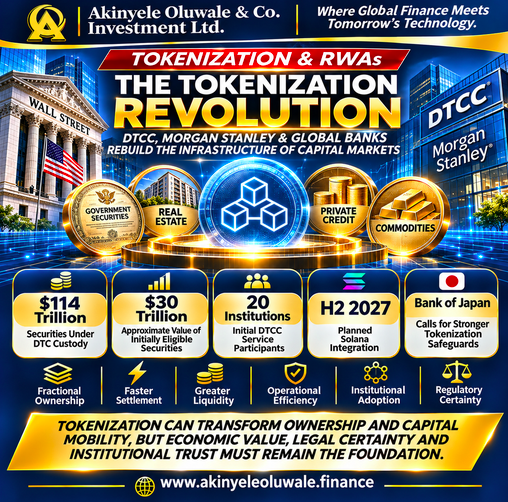
THE TOKENIZATION REVOLUTION: WHY THE WORLD'S LARGEST FINANCIAL INSTITUTIONS ARE REBUILDING THE INFRASTRUCTURE OF GLOBAL CAPITAL MARKETS
From government securities and money-market funds to real estate and private credit, real-world asset tokenization is creating new possibilities for ownership, financial settlement and capital mobility. However, legal certainty, institutional liquidity and investor protection will determine its long-term success.
Published: Friday, 27 November 2026
Category: Tokenization & RWAs
By: Akinyele Oluwale & Co. Investment Ltd.
Editorial Focus: Real-World Assets | Institutional Tokenization | Digital Securities | Tokenized Treasury Funds | Capital Markets | Financial Infrastructure
The global financial industry is undergoing a structural transformation that could fundamentally change how assets are issued, owned, transferred and administered. At the centre of this transformation is real-world asset tokenization the process of representing financial or physical assets, or legally defined rights associated with those assets, through digital tokens recorded on blockchain or distributed ledger infrastructure. Government securities, money-market funds, commercial real estate, private credit, commodities and investment funds are among the assets being examined for tokenization. For decades, global capital markets have relied on interconnected networks of banks, custodians, brokers, clearing houses and securities depositories. Although these institutions remain essential, their operating systems can involve fragmented records, settlement delays, administrative costs and restrictions on capital mobility. Tokenization could improve selected aspects of this infrastructure through programmable transactions, shared records and more efficient settlement. However, converting an asset into a digital token does not automatically increase its economic value, eliminate financial risk or guarantee liquidity. A poorly performing property remains a poorly performing property even when its ownership interests are tokenized. A borrower experiencing financial difficulties does not become more creditworthy simply because the associated debt is recorded on a blockchain.
Our central assessment is that the most consequential opportunity in tokenization lies in improving the infrastructure of global capital markets rather than creating another cycle of speculative cryptocurrency activity.
Imagine a commercial property valued at ₦1 billion. Under an appropriately structured legal arrangement, ownership interests in that property could potentially be represented by one million digital tokens, each initially representing ₦1,000 of economic interest. Such an arrangement could make fractional ownership administratively easier. However, the tokens would need to represent legally enforceable rights. Investors would also need clarity regarding rental income, management expenses, ownership transfers, taxation and the procedures applicable if the property were sold. Furthermore, dividing ownership into smaller units does not guarantee that buyers will be available when existing holders wish to sell. This distinction illustrates both the opportunity and the limitations of tokenization.
The technology could improve how financial interests are administered, but the underlying asset, legal structure and economic fundamentals remain essential. For financial institutions, tokenization could also support more efficient collateral management, securities settlement and investment administration.
The real revolution is not the creation of digital tokens. It is the potential transformation of how ownership, capital and financial obligations move through the global economy.
In the latest development this morning, 27 November 2026, Reuters reported that Bank of Japan Executive Director Kazushige Kamiyama called for stronger safeguards as digital money and tokenized financial infrastructure expand. Speaking at an International Monetary Fund seminar in Tokyo, Kamiyama highlighted concerns surrounding cybersecurity, interconnected financial platforms, market volatility and the legal rights associated with tokenized assets. His intervention raises an important question: does transferring a digital token legally transfer the rights and obligations associated with the underlying asset? He also emphasised the continuing importance of central bank money in maintaining confidence in the monetary system. This development deserves considerable attention. As financial institutions introduce increasingly interconnected blockchain infrastructure, operational failures within one system could potentially affect other participating institutions. Furthermore, continuous trading and faster asset transfers could amplify financial-market movements during periods of economic stress. The implication is that regulators are moving beyond questions of technological feasibility towards the more demanding responsibilities of financial supervision.
The institutional lesson: Tokenization must be supported by legal certainty, cybersecurity, institutional accountability and financial stability safeguards.
On 28 October 2026, the Depository Trust & Clearing Corporation (DTCC), through its subsidiary, the Depository Trust Company (DTC), launched its tokenization service. This represents an important milestone because DTCC occupies a central position within the infrastructure supporting American securities markets. The service allows eligible participants to create digital representations of selected securities already held in custody. Supported asset categories include selected American equities, exchange-traded funds and United States Treasury securities. The infrastructure initially supports the Canton Network and Hyperledger Besu, with additional network integrations planned. The service operates within a defined three-year authorisation period under an SEC no-action letter issued in December 2025. The significance extends beyond cryptocurrency adoption. Financial institutions could increasingly use tokenized securities for collateral management, securities transfers and institutional financing arrangements. However, the launch does not mean that every security held by DTCC has been tokenized. DTCC's subsidiary reportedly holds approximately $114 trillion in securities, while the initial eligible securities represented approximately $30 trillion in underlying assets. These figures describe custody and eligibility, not the actual value of assets already tokenized.
On 12 November 2026, DTCC announced plans to connect its tokenization service with the Solana blockchain. The integration is expected to become available during the second half of 2027. The proposed arrangement would allow eligible DTC-custodied securities to be represented on Solana, subject to the relevant operational and regulatory requirements. This development highlights the growing institutional importance of blockchain interoperability. Historically, blockchain networks have operated as relatively independent technological environments. Financial institutions, however, generally require infrastructure capable of interacting with multiple systems while maintaining consistent standards of security, governance and regulatory compliance. DTCC's multi-network strategy illustrates how established financial-market operators are approaching this challenge. Nevertheless, the distinction between technological adoption and cryptocurrency valuation remains important. A financial institution integrating a blockchain network does not automatically guarantee an increase in the market price of that network's native cryptocurrency. Commercial usage, transaction economics, token supply and market demand must be evaluated independently. Furthermore, Solana's integration remains a planned development for 2027, rather than an already operational component of DTCC's service.
The institutional lesson: Interoperability may become an important competitive advantage in digital capital markets, but announced integrations must not be confused with completed commercial deployment.
On 4 November 2026, financial industry reporting confirmed that Morgan Stanley was among the early institutions using DTCC's new tokenization service. The bank reported that it had tokenized American equities and Treasury securities. Approximately 20 institutions had joined the service at launch, including major participants such as J.P. Morgan, Citi, Bank of America and Fidelity. Morgan Stanley is also developing separate infrastructure intended to support tokenized equity trading, with a reported target of the first quarter of 2027. This represents a significant change in how traditional financial institutions approach blockchain technology. The discussion is moving beyond theoretical research towards practical integration with existing securities operations. For institutional participants, potential benefits include improved asset mobility, more efficient reconciliation and alternative collateral arrangements. However, implementation requires reliable connections between blockchain infrastructure, custody systems, accounting platforms and regulatory reporting procedures. The experience gained from these early transactions may help institutions determine which tokenization applications deliver genuine commercial benefits.
The institutional lesson: The commercial maturity of tokenization will increasingly be measured by operational results rather than promotional announcements.
On 18 November 2026, BNY and German blockchain infrastructure company SWIAT announced the successful completion of two institutional collateral pilot transactions. The participating financial institutions included Standard Chartered, DekaBank and Landesbank Baden-Württemberg (LBBW). The demonstrations involved a fixed-income securities transaction and a bilateral repurchase agreement, commonly called a repo. The initiative connected SWIAT's distributed ledger infrastructure with BNY's conventional custody arrangements. Earlier, on 13 October, BNY announced a separate transaction with Citadel Securities involving a tokenized two-year United States Treasury note. The security was settled almost immediately within the demonstrated workflow and subsequently used as collateral in overnight financing. These developments illustrate one of the most commercially significant applications of tokenization: collateral mobility. Financial institutions frequently use securities as collateral to obtain short-term financing or support other financial obligations. When collateral cannot be transferred efficiently, institutions may encounter unnecessary liquidity constraints. Tokenized infrastructure could improve selected aspects of this process. However, successful individual transactions do not establish that the same arrangements are commercially available across all financial markets.
The institutional lesson: Tokenized collateral could become one of blockchain technology's most economically meaningful applications within institutional finance.
For much of blockchain technology's history, public attention concentrated on Bitcoin, Ethereum and speculative cryptocurrency trading. The emerging institutional tokenization market represents a broader development. Traditional financial institutions are examining whether distributed ledger technology can improve the administration of assets already recognised within conventional financial markets. Several asset categories deserve attention.
Government bonds and Treasury bills represent established financial instruments used by governments to raise capital and by financial institutions to manage liquidity. Tokenization could improve how eligible securities are transferred, administered and pledged as collateral. However, their underlying sovereign credit, interest-rate and inflation risks remain.
Digital representations of money-market fund interests could support more efficient administration and selected institutional settlement applications. Nevertheless, tokenization does not guarantee liquidity under every market condition or eliminate the risks associated with the underlying portfolio.
Real estate tokenization could simplify the administration of fractional economic interests in property. However, the quality of property title, rental income, occupancy levels, maintenance expenses and legal ownership arrangements remain fundamental. A digital token is not a substitute for valid property documentation.
Private credit involves financing arrangements outside conventional public bond markets. Tokenization could improve recordkeeping and the administration of transferable credit interests. Nevertheless, borrowers can still default, collateral values can decline and secondary markets may remain limited.
Tokenized equities could support alternative ownership and settlement arrangements. However, different tokenized equity products may provide different rights. Some represent legally recognised interests in underlying shares, while others merely replicate their price movements through contractual arrangements. The distinction affects dividend entitlements, voting rights, insolvency protections and legal ownership.
The future of capital markets will depend not simply on making assets digital, but on ensuring that digital ownership remains economically meaningful and legally enforceable.
Banks could develop additional revenue opportunities through digital custody, securities administration, collateral management and institutional financing. However, they must balance these opportunities against implementation expenses, cybersecurity risks and regulatory responsibilities.
Asset managers could use tokenized infrastructure to improve administration, distribution and servicing of selected investment products. The commercial benefits will depend on customer demand, regulatory permissions and measurable operational improvements.
Traditional financial-market operators could expand their role by connecting conventional securities infrastructure with blockchain-based systems. The emerging model suggests that established financial intermediaries may evolve rather than disappear.
Blockchain networks could support additional institutional financial activity. Nevertheless, greater network adoption does not necessarily result in proportional appreciation of associated cryptocurrency tokens. The economic benefits depend on how the infrastructure generates revenue, distributes fees and captures commercial value.
Tokenization could increase demand for professionals capable of evaluating digital ownership arrangements, financial reporting requirements, reserve verification and regulatory obligations. The importance of independent auditing and professional accountability could become greater as financial systems become more technologically complex.
Nigeria possesses substantial economic assets across real estate, agriculture, infrastructure, commodities and private enterprise. However, many potentially productive assets face financing constraints, administrative inefficiencies or limited access to organised capital markets. Appropriately regulated tokenization could offer additional ways to administer certain forms of investment and ownership.
Tokenization could potentially support the administration of infrastructure-related financial instruments associated with electricity, transportation, logistics and renewable energy projects. However, infrastructure financing still requires credible project management, sustainable cash flows and enforceable contractual arrangements. Technology cannot compensate for an economically unviable project.
Nigeria's real estate market presents interesting possibilities for digital ownership administration. However, challenges involving land registration, title verification and ownership disputes must be addressed. Tokenizing an asset with disputed ownership could merely transfer existing legal uncertainty into a digital environment.
Tokenized financial instruments could potentially support the administration of financing arrangements associated with agricultural production, storage and distribution. Nevertheless, agricultural risks involving weather, commodity prices, transportation and borrower creditworthiness remain.
The potential tokenization of eligible Nigerian government securities deserves institutional consideration. Appropriately designed infrastructure could support more efficient securities administration, settlement and reconciliation. Such developments would require coordination among relevant regulatory authorities, financial institutions, securities depositories and technology providers.
Digital financial infrastructure could potentially improve how legitimate businesses document financial obligations and administer investment interests. However, businesses must still demonstrate commercial viability, financial transparency and responsible governance. For Nigeria, the objective should not simply be to replicate international tokenization initiatives. It should be to identify specific domestic economic problems that digital financial infrastructure can help address.
Africa does not lack valuable real-world assets. The greater challenge is creating credible institutions and financial structures capable of converting those assets into sustainable economic opportunities.
At Akinyele Oluwale & Co. Investment Ltd., our institutional assessment is that real-world asset tokenization represents one of the more commercially significant applications of blockchain technology. Its potential lies in connecting established economic assets with more flexible financial infrastructure. However, several fundamental principles must remain central to the industry's development.
First, the underlying asset must possess identifiable economic value. Technology cannot independently transform an unproductive asset into a profitable one. Second, digital ownership must be legally enforceable. Token holders must understand precisely what rights, obligations and protections their digital instruments represent. Third, liquidity must not be exaggerated. Creating transferable tokens does not automatically create an active secondary market or establish continuous demand. Fourth, independent verification remains essential. Financial institutions must establish credible arrangements for asset custody, valuation, auditing and ownership verification. Fifth, operational resilience must remain a priority. Smart contract errors, cybersecurity incidents and failures involving interconnected financial infrastructure could create significant operational consequences. Sixth, institutional adoption must be distinguished from speculative asset appreciation. The commercial success of tokenization does not automatically determine the investment performance of every cryptocurrency associated with the sector. Today's warning from the Bank of Japan reinforces the importance of these principles. Financial innovation must be developed within institutional arrangements capable of maintaining confidence during periods of economic uncertainty. A market may appear efficient during favourable economic conditions, but its resilience becomes particularly important when liquidity deteriorates, asset prices decline or financial institutions experience operational difficulties.
Blockchain can improve how financial assets move. It cannot remove the economic risks attached to those assets.
As the global financial industry approaches December 2026 and the beginning of 2027, several developments deserve continued institutional observation. DTCC's commercial expansion: Whether additional financial institutions and securities become eligible for its tokenization service. Solana integration: Whether DTCC progresses towards its proposed deployment during the second half of 2027. Morgan Stanley's digital securities infrastructure: Whether the institution meets its reported first-quarter 2027 target for supporting tokenized equities. Institutional collateral transactions: Whether demonstrations involving BNY, Standard Chartered and other financial institutions develop into recurring commercial applications. Central bank supervision: How monetary authorities respond to the financial stability and cybersecurity concerns associated with increasingly interconnected tokenized markets. Legal ownership standards: Whether jurisdictions establish clearer frameworks governing the relationship between digital tokens and underlying financial assets. Secondary-market liquidity: Whether tokenized securities demonstrate dependable liquidity beyond controlled institutional environments. African capital-market development: Whether Nigerian and other African financial institutions introduce appropriately regulated tokenization applications addressing genuine economic needs. Actual commercial adoption: Whether institutions disclose measurable improvements in settlement efficiency, operating costs and capital utilisation. The most meaningful evidence of progress will come from verified financial results and operational performance rather than ambitious market-size projections.
The Bank of Japan has called for stronger financial stability, cybersecurity and legal safeguards surrounding tokenization.
DTCC commercially launched its tokenization service on 28 October 2026.
DTCC plans to integrate Solana during the second half of 2027.
Morgan Stanley has begun tokenizing selected American equities and Treasury securities.
BNY, Standard Chartered and European financial institutions are demonstrating tokenized collateral arrangements.
Assets eligible for tokenization must not be confused with assets already tokenized.
Tokenized securities and synthetic financial tokens may provide substantially different legal rights.
Tokenization does not eliminate credit risk, market risk or liquidity constraints.
Nigeria's opportunity lies in connecting digital financial infrastructure with productive economic assets.
Legal certainty, institutional governance and genuine commercial usefulness will determine sustainable adoption.
Akinyele Oluwale & Co. Investment Ltd. is an independent financial intelligence and research platform covering global macroeconomics, institutional cryptocurrency, central banking, stablecoins, digital payments, tokenization, real-world assets, artificial intelligence and blockchain technology. Our editorial mission is to explain how economic fundamentals, technological innovations, institutional decisions and regulatory developments are transforming the global financial system.
We believe responsible financial journalism must distinguish verified institutional developments from speculative expectations, technological innovation from commercial profitability, and digital asset ownership from guaranteed financial returns. Our analytical approach combines economic reasoning, institutional research and financial education to promote a deeper understanding of emerging financial technologies.
The latest institutional developments reinforce an important conclusion. Tokenization is gradually moving from technological experimentation towards practical financial-market applications. DTCC has launched commercial tokenization infrastructure. Morgan Stanley is participating in the tokenization of traditional securities. BNY and other financial institutions are demonstrating new collateral arrangements. Meanwhile, central banks are recognising the need for stronger legal, financial stability and cybersecurity safeguards.
Together, these developments illustrate the emergence of a financial ecosystem in which traditional securities and blockchain infrastructure may increasingly coexist. However, the fundamental principles of finance remain unchanged. Assets must possess genuine economic value. Ownership must be legally enforceable. Financial obligations must be sustainable. Liquidity must be dependable and institutions must remain accountable.
For Nigeria and Africa, the greatest opportunity is not simply participating in the global tokenization market. It is developing credible financial infrastructure capable of connecting productive assets with sustainable capital formation, economic development and institutional confidence.
THE GREATEST VALUE OF TOKENIZATION IS NOT IN TURNING EVERYTHING INTO A DIGITAL TOKEN. IT IS IN MAKING GENUINE ECONOMIC ASSETS MORE ACCESSIBLE, TRANSFERABLE, TRANSPARENT AND FINANCIALLY PRODUCTIVE.
Technology is the instrument. Economic value is the foundation. Institutional trust is the bridge between them.
Observe the change. Understand the implications. Position with discipline.
Akinyele Oluwale & Co. Investment Ltd.
Where Global Finance Meets Tomorrow's Technology.
www.akinyeleoluwale.finance
Editorial disclaimer: This publication is intended for general financial education, economic research and institutional analysis. It does not constitute personalised investment advice, an endorsement of any digital asset or a guarantee of financial performance.