

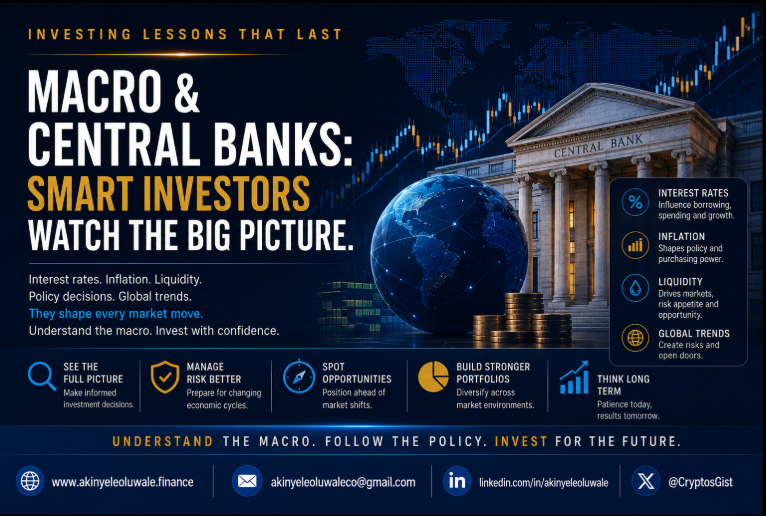
Macro & Central Banks: 10 Investing Lessons Every Investor Should Understand Before Making Their Next Move
By Akinyele Oluwale & Co. Investment Ltd.
Global Finance Meets Tomorrow's Technology
Executive Summary
Many investors spend hours analysing company earnings, cryptocurrency charts and economic headlines, yet overlook one of the most influential forces behind global financial markets: central banks.
Whether it is the U.S. Federal Reserve, the European Central Bank (ECB), the Bank of England, the Bank of Japan or the People's Bank of China, central banks play a critical role in shaping the flow of money through the global economy. Their decisions on interest rates, inflation management and liquidity often influence the performance of stocks, bonds, commodities, real estate and digital assets.
Institutional investors understand this reality. Before allocating billions of dollars, they closely monitor macroeconomic trends and central bank policy because these factors often determine the broader investment environment.
Retail investors, however, frequently focus on short-term price movements while ignoring the economic forces driving those movements.
Understanding macroeconomics does not require an economics degree. It simply means recognising how money moves through the financial system and how policy decisions affect investment opportunities.
The following lessons provide a practical framework for understanding how institutional investors think about macroeconomics and central banks.
Lesson 1: The Economy Drives the Market
Many investors believe markets move because of company news alone.
In reality, markets often respond first to changes in the economy.
Economic growth influences:
Strong economies generally support higher corporate profits, while weaker economies often increase uncertainty.
Institutional investors continuously evaluate economic conditions before making significant investment decisions.
Always remember:
Markets do not exist outside the economy they reflect it.
Lesson 2: Interest Rates Affect Almost Every Asset
Interest rates are among the most powerful tools available to central banks.
When rates rise:
When rates fall:
This is why interest rate decisions receive so much attention.
They influence nearly every financial market.
Lesson 3: Liquidity Is the Fuel of Financial Markets
Institutional investors often say:
"Don't fight liquidity."
Liquidity refers to how much money is flowing through the financial system.
When liquidity expands, investors generally become more willing to take risk.
When liquidity contracts, markets may become more cautious.
Liquidity influences:
Understanding liquidity often explains market movements better than daily headlines.
Lesson 4: Inflation Is More Than Rising Prices
Most people associate inflation with higher living costs.
Investors see something bigger.
Inflation influences:
Moderate inflation can support economic growth.
Persistent inflation may require tighter monetary policy.
This is why inflation data remains one of the most closely watched economic indicators worldwide.
Lesson 5: Central Banks Influence Confidence
Central banks do more than adjust interest rates.
They influence expectations.
When central bank officials communicate clearly, businesses and investors gain greater confidence.
Markets often respond not only to policy decisions but also to future guidance.
Institutional investors pay close attention to central bank speeches because expectations can move markets long before policy changes occur.
Lesson 6: Currency Strength Matters
Currencies affect international investing.
A stronger domestic currency can:
A weaker currency may improve export competitiveness but increase import costs.
Institutional investors regularly monitor foreign exchange markets because currency movements influence global capital flows.
Lesson 7: Geopolitics Cannot Be Ignored
Economic fundamentals remain important.
However, geopolitical developments increasingly shape investment decisions.
Examples include:
These events often influence inflation, commodity prices and investor confidence.
Successful investors consider both economics and geopolitics.
Lesson 8: Don't Confuse Short-Term Noise With Long-Term Trends
Financial markets react quickly.
Economic change usually happens gradually.
One employment report or inflation reading rarely changes the long-term outlook.
Institutional investors focus on trends rather than isolated data releases.
They ask:
Looking at broader patterns reduces emotional decision-making.
Lesson 9: Diversification Protects Against Uncertainty
Macroeconomic conditions can change unexpectedly.
Institutional portfolios are designed with this uncertainty in mind.
Diversification may include exposure to:
Different assets often respond differently to changing economic conditions.
Diversification helps improve resilience during periods of market volatility.
Lesson 10: Patience Is Often the Greatest Investment Advantage
Central bank policy works over time.
Interest rate decisions rarely affect the economy overnight.
Likewise, long-term investment success usually develops gradually.
Institutional investors understand that patience allows investment theses to mature.
Short-term volatility is often the price investors pay for long-term returns.
Patience remains one of the most underrated investment skills.
Why Institutional Investors Watch Every Central Bank Meeting
Many retail investors focus on quarterly earnings.
Institutional investors also focus on monetary policy.
Every major central bank meeting provides clues about:
These insights influence investment strategies across multiple asset classes.
Understanding central banks allows investors to interpret markets more effectively.
Macroeconomics and Digital Assets
Cryptocurrency markets are becoming increasingly connected to macroeconomic conditions.
Bitcoin, Ethereum and other digital assets now respond to:
This represents a major shift from earlier years when crypto markets were driven primarily by retail participation.
Today, institutional involvement has strengthened the relationship between digital assets and macroeconomics.
Common Mistakes Investors Make
Many investors unknowingly ignore macroeconomic fundamentals.
Common mistakes include:
These mistakes often result from viewing investments in isolation rather than within the broader economy.
What Should Investors Monitor?
Rather than trying to follow every headline, focus on a handful of important indicators:
Together, these indicators provide valuable insight into the health of the global economy.
Final Thoughts
Markets are influenced by many forces, but few are as significant as macroeconomic conditions and central bank policy.
Institutional investors recognise that successful investing requires understanding not only individual companies or cryptocurrencies but also the broader economic environment in which they operate.
Interest rates, inflation, liquidity and economic growth shape investment opportunities across every major asset class.
Retail investors who develop a stronger understanding of these fundamentals place themselves in a better position to make informed decisions during both periods of optimism and uncertainty.
No one can predict every market movement.
However, investors who understand the relationship between macroeconomics and financial markets are often better prepared to manage risk and identify opportunity.
The goal is not to forecast every central bank decision.
The goal is to build an investment process grounded in knowledge, patience and disciplined thinking.
Markets will continue to evolve.
Central bank policies will change.
Economic cycles will rise and fall.
But investors who understand the bigger picture will always have an important advantage.
Key Takeaways
Editorial Standards
This article is published by Akinyele Oluwale & Co. Investment Ltd. as part of our commitment to providing independent, research-driven insights into macroeconomics, central banking, digital assets and global financial markets. The content is intended solely for educational and informational purposes and should not be considered financial, investment, tax or legal advice. Readers are encouraged to conduct independent research and seek professional advice before making investment decisions.