

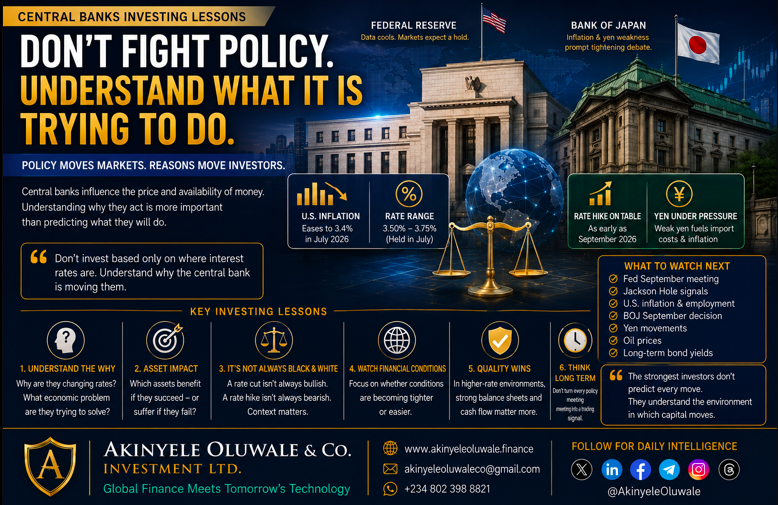
Central Banks Investing Lesson: Don’t Fight Policy. Understand What It Is Trying to Do
The Federal Reserve is weighing softer U.S. inflation against lingering price risks, while the Bank of Japan is considering faster tightening as it battles yen weakness. For investors, the lesson is not to predict every rate decision. It is to understand how central-bank policy changes the environment in which capital moves.
Published: 15 August 2026
Category: Central Banks • Investing Lessons
By: Akinyele Oluwale & Co. Investment Ltd.
Executive Summary
Central banks are again reminding investors why monetary policy matters.
In the United States, July inflation data softened enough to reduce the urgency for another immediate Federal Reserve rate increase. Reuters reports that markets have scaled back expectations of a September hike, although inflation remains above the Fed's 2% objective and policymakers remain divided. (Reuters)
Japan faces almost the opposite problem. The Bank of Japan is considering another rate increase as early as September as policymakers confront inflation and persistent yen weakness. (Reuters)
The investing lesson:
Don't invest based only on where interest rates are. Understand why the central bank is moving them.
What Happened?
The Federal Reserve held its policy rate at 3.50%–3.75% in July. Fresh data showed U.S. consumer inflation easing to 3.4% year-on-year in July, while producer prices were unchanged month-on-month. That has strengthened expectations that the Fed could remain on hold in September. (Reuters)
Meanwhile, the Bank of Japan is debating faster tightening. Reuters reports that officials are considering raising rates from the current 1% as early as September, with yen weakness adding to inflationary pressure through more expensive imports. (Reuters)
Two major central banks. Two different economies. Two different policy problems.
Context / Background
Central banks influence the price and availability of money.
When rates rise, borrowing becomes more expensive. Bonds can become more attractive. Equity valuations may face pressure. Property financing becomes harder. Highly leveraged companies feel the strain.
When rates fall, financial conditions generally become easier and investors may become more willing to take risk.
But there is an important complication:
A rate cut isn't automatically bullish.
A rate hike isn't automatically bearish.
Why the central bank is acting matters enormously.
A rate cut because inflation has safely returned to target is very different from an emergency cut because the economy is collapsing.
Why It Matters
Many investors make the mistake of trading the announcement rather than understanding the economic cycle behind it.
They hear:
“Rate cuts are coming.”
And immediately buy risk assets.
Or:
“Rates are rising.”
And immediately sell.
Markets are more complicated.
Sometimes central banks tighten because economic demand is exceptionally strong. Sometimes they ease because something has broken.
The policy decision is therefore only one piece of information.
The reason behind the decision often tells you more.
Winners & Losers / Key Stakeholders
Higher rates can benefit savers, cash-rich investors and some financial institutions while creating difficulties for heavily indebted companies, speculative assets and borrowers refinancing expensive debt.
Lower rates can support borrowers, property and growth assets—but falling rates accompanied by recession can still hurt corporate earnings and investor confidence.
Currency investors are also directly affected. Japan's experience demonstrates how interest-rate differentials can influence exchange rates and eventually force policymakers to respond. (Reuters)
Short-Term Impact
Central-bank communication will continue moving bonds, currencies, equities, gold and crypto.
The Fed's September decision remains uncertain, while the probability of a near-term BOJ increase has strengthened. (Reuters)
That creates volatility but volatility shouldn't automatically force portfolio changes.
Long-Term Impact
The larger lesson is that the era of assuming permanently cheap money may be over.
Investors may increasingly have to operate in a world where inflation, fiscal borrowing, energy shocks and enormous AI infrastructure spending keep capital costs structurally higher.
That means valuation and balance-sheet quality matter again.
Editorial Perspective
“Don't fight the Fed” is useful but incomplete.
A better principle is:
Understand the central bank before positioning around it.
Central banks don't control every market outcome. Long-term bond yields can rise even when policymakers hold or cut short-term rates because markets also price inflation, government borrowing and fiscal credibility.
The investor who watches only the policy rate is watching only part of the picture.
What to Watch Next
Watch the Fed's September meeting, Jackson Hole signals, U.S. inflation and employment, the BOJ's September decision, yen movements, oil prices and long-term government bond yields.
Most importantly, watch whether financial conditions are becoming tighter or easier.
Investing Lesson
Before reacting to a central-bank decision, ask three questions:
Why are they changing rates?
What economic problem are they trying to solve?
Which assets benefit if they succeed or suffer if they fail?
Those questions turn monetary-policy headlines into investment analysis.
Key Takeaways
The Fed may hold rates in September as U.S. inflation cools, while the BOJ is considering further tightening as yen weakness and inflation remain concerns. (Reuters)
Different policies reflect different economic conditions.
Never interpret interest rates without interpreting the economy behind them.
Editorial Bottom Line
Central banks can change the direction of capital but investors should resist turning every policy meeting into a trading signal.
Don't simply ask what the central bank did. Ask why it did it.
That is where the real investing lesson begins.
Sources / Notes
Primary reporting: Reuters, 10–14 August 2026, covering Federal Reserve policy, U.S. inflation and the Bank of Japan's tightening debate. (Reuters)
Akinyele Oluwale & Co. Investment Ltd.
Global Finance Meets Tomorrow's Technology.