

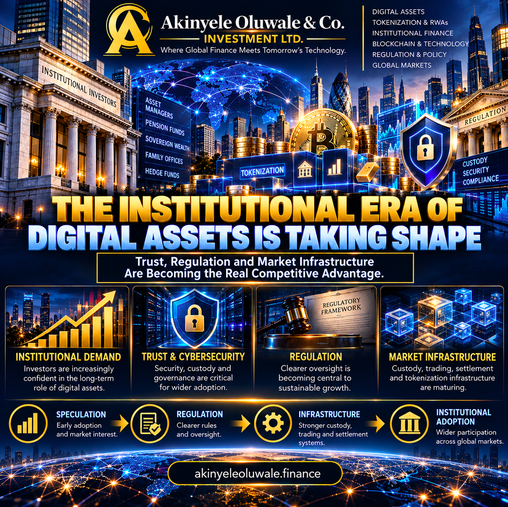
Digital assets are entering a different stage of development.
The first era was dominated by experimentation, cryptocurrency prices and retail speculation.
The emerging era looks increasingly institutional.
Asset managers, banks and other financial institutions are evaluating not simply whether digital assets will survive, but how they fit into investment products, custody, trading, settlement, tokenization and broader financial-market infrastructure.
A new 2026 Digital Assets Study released by State Street on October 6 says institutional investors are becoming increasingly confident about the long-term future of digital assets, while placing greater emphasis on trust, cybersecurity, regulation and market infrastructure as adoption develops. Business Wire
Morgan Stanley recently reached a similar conclusion: the next stage of digital assets increasingly involves an infrastructure buildout encompassing tokenization, tokenized products, custody, lending and wealth services. Morgan Stanley
The institutional question is therefore changing from:
“Should traditional finance take digital assets seriously?”
to:
“What infrastructure is required to integrate digital assets safely into mainstream finance?”
That is a much more consequential question.
Institutional adoption of digital assets is moving into a more mature phase.
The key development is not simply higher cryptocurrency prices.
It is the construction of the financial architecture required for institutions to participate.
That architecture includes:
regulated custody, secure infrastructure, clear regulation, liquidity, trading systems, risk management, settlement and tokenization.
State Street's latest institutional study identifies trust, cybersecurity, regulation and market infrastructure as critical dependencies as adoption grows. Business Wire
Meanwhile, the regulatory architecture is also evolving.
On October 5, the U.S. Commodity Futures Trading Commission proposed a federal framework covering certain cryptocurrency trading platforms offering leveraged or margined transactions, including anti-manipulation and proof-of-reserves requirements. Reuters
Tokenization is advancing at the same time.
A joint venture involving OKX and Intercontinental Exchange has filed with the SEC seeking approval for a platform that would use tokenization to facilitate around-the-clock trading of U.S. stocks. Reuters
These developments point toward the same structural transition:
Institutional finance operates differently from retail speculation.
A large pension fund, asset manager, insurer or bank cannot base its participation solely on whether an asset's price might increase.
Institutions need answers to much more fundamental questions:
Who holds the asset?
How is ownership verified?
What happens if the custodian fails?
How is the asset valued?
How liquid is the market?
How is settlement completed?
What regulations apply?
How are cybersecurity risks controlled?
How does the investment fit within governance and risk limits?
These questions explain why institutional adoption can take years even when the underlying technology develops rapidly.
For institutions:
Without those foundations, institutional participation remains limited.
With them, digital assets can potentially move deeper into mainstream financial markets.
State Street's newly published study points to growing confidence among institutional investors in digital assets' long-term role. But it simultaneously highlights something important:
confidence alone is not enough.
Institutions increasingly care about trust, cybersecurity, regulation and market infrastructure. Business Wire
That distinction matters.
The institutional phase will not necessarily be defined by institutions simply purchasing more cryptocurrencies.
It could be defined by institutions increasingly using digital infrastructure across:
investment products,
tokenized assets,
custody,
settlement,
payments,
and other financial services.
On October 5, the CFTC proposed new federal oversight rules for certain crypto trading platforms.
The proposed regime includes requirements around anti-manipulation controls and proof of reserves and would create a federal pathway for participating platforms. Reuters
There is an important qualification.
The proposal comes against the backdrop of Congress failing to enact comprehensive crypto-market legislation, meaning questions remain about the durability and legal foundations of parts of the regulatory approach. Reuters
Investors should therefore distinguish between:
and
Nevertheless, the direction is important.
Digital-asset markets are increasingly being asked to meet standards resembling those expected elsewhere in institutional finance.
Another major development came on October 5.
OKXICE, a joint venture involving cryptocurrency exchange OKX and Intercontinental Exchange, filed with the SEC seeking approval for a tokenized-securities trading platform.
The proposed system would facilitate 24/7 trading of U.S. stocks using blockchain-based tokenization. Reuters
This illustrates something fundamental.
The future of digital assets may not simply involve bringing traditional investors into cryptocurrency.
It may also involve:
That is a much larger financial transformation.
The evolution of digital finance can increasingly be viewed in three phases.
Bitcoin.
Crypto exchanges.
Retail trading.
Early blockchain applications.
Institutional investment products.
Custody.
Stablecoins.
Crypto-linked funds.
Institutional trading.
Tokenized securities.
Tokenized deposits.
Stablecoin settlement.
Programmable assets.
Blockchain-based market infrastructure.
24/7 financial markets.
Morgan Stanley describes this emerging stage as an infrastructure buildout in which tokenization, investment products, custody, lending and wealth services provide additional ways for investors to participate in digital assets. Morgan Stanley
That distinction is crucial.
The biggest long-term opportunity may not necessarily be:
Which cryptocurrency rises the most?
It could instead be:
Which technologies and institutions build the infrastructure through which global financial assets eventually move?
Banks face both disruption and opportunity.
Digital assets potentially challenge parts of traditional banking infrastructure.
But banks possess several advantages that become increasingly valuable during institutional adoption:
regulatory relationships,
customer trust,
capital,
risk-management expertise,
custody capabilities,
and existing institutional clients.
The future may therefore involve traditional banks adopting digital infrastructure rather than simply being displaced by it.
For asset managers, digital assets are increasingly becoming a portfolio and product-development issue.
Investment products provide regulated channels through which clients can obtain exposure without necessarily interacting directly with crypto-native infrastructure.
But tokenization could go considerably further.
Asset managers could eventually distribute conventional investment products through programmable digital infrastructure.
That means digital assets may change not only what investors own, but also how ownership itself is recorded and transferred.
This is where the competitive landscape becomes particularly interesting.
Traditional exchanges increasingly face the possibility of:
24/7 trading,
blockchain settlement,
tokenized securities,
and digitally native financial instruments.
The OKXICE filing illustrates the convergence between crypto-native technology and established financial-market infrastructure. Reuters
The future battle may therefore not be:
Traditional Exchanges vs Crypto Exchanges
but rather:
Institutional infrastructure can potentially increase access to digital assets.
But an essential distinction remains:
Infrastructure adoption and token value are separate questions.
An investor should still ask:
What economic purpose does the asset serve?
What creates demand?
How secure is the network?
What are the governance risks?
What regulatory risks exist?
And where does sustainable value ultimately accrue?
Institutional participation does not eliminate investment discipline.
It makes investment discipline more important.
At Akinyele Oluwale & Co. Investment Ltd., we believe one of the biggest mistakes investors can make is viewing institutional adoption simply as:
The transformation is much broader.
What appears to be developing is a convergence between:
Traditional Finance
and
Digital Financial Infrastructure.
The resulting architecture could look something like:
That is why our focus extends beyond cryptocurrency prices.
Prices attract attention.
Infrastructure determines whether markets can scale.
And trust determines whether institutions can participate.
This leads to today's central principle:
The next phase of digital assets may be won not by the loudest token, but by the strongest financial infrastructure.
For long-term investors and financial professionals, that distinction is critical.
Eight developments deserve particular attention.
Regulation: whether proposed U.S. rules develop into durable and coherent frameworks. Reuters
Institutional allocation: whether growing confidence translates into sustained capital commitments.
Custody: expansion of regulated institutional custody services.
Cybersecurity: institutions will demand resilient infrastructure before increasing exposure.
Tokenization: watch whether tokenized securities move from pilot projects into meaningful trading activity.
24/7 markets: the OKXICE proposal provides an important test of whether traditional securities trading can migrate toward continuously available infrastructure. Reuters
Stablecoins and tokenized deposits: yesterday's Day 29 theme remains directly connected because digital money could provide the settlement layer for tokenized assets.
Interoperability: institutions will need different blockchains, custodians, exchanges and conventional financial systems to communicate efficiently.
The crucial question is therefore:
Can digital finance build institutional-grade infrastructure without sacrificing the technological advantages that made blockchain attractive in the first place?
Institutional confidence in digital assets is developing, but trust, cybersecurity and infrastructure are increasingly decisive requirements. Business Wire
Regulation is becoming part of the infrastructure, not merely an external constraint.
Tokenization is moving closer to traditional securities markets, including proposals for 24/7 tokenized U.S. stock trading. Reuters
Traditional finance and digital finance are converging, rather than simply competing.
Stablecoins, tokenized deposits and custody infrastructure could become important settlement components.
Institutional adoption does not make every digital asset a good investment.
And today's Day 30 principle is:
The institutional era of digital assets will be built on trust, regulation and infrastructure not speculation alone.
Akinyele Oluwale & Co. Investment Ltd. is a global finance and digital-economy intelligence platform helping investors, professionals and decision-makers understand the forces reshaping modern markets.
Our intelligence covers:
Artificial Intelligence • Blockchain & Technology • Crypto & Digital Assets • Institutional Finance • Stablecoins & Payments • Tokenization & RWAs • Central Banks • Macro & Global Markets
Our research is organised around three questions:
We connect developments across traditional finance, emerging technology, digital assets and global markets to identify the structural changes beneath the daily headlines.
Information tells you what happened.
Stablecoins & Payments
How regulated digital money could become settlement infrastructure.
Tokenization & RWAs
The migration of traditional financial assets onto programmable rails.
Blockchain & Technology
The infrastructure underpinning digital financial markets.
Crypto & Digital Assets
How institutional access is changing the digital-asset ecosystem.
Akinyele Oluwale
Founder & Chief Investment Strategist
Akinyele Oluwale & Co. Investment Ltd.