

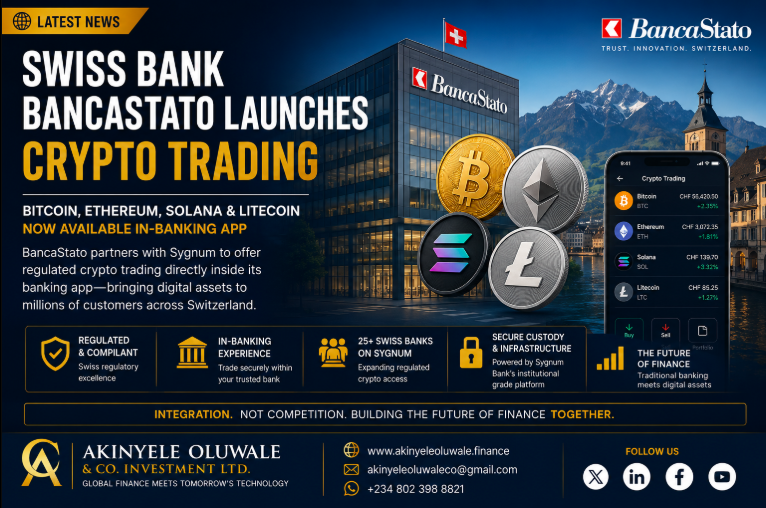
Swiss Banking Embraces Crypto: BancaStato Adds Bitcoin, Ethereum, Solana and Litecoin Trading
Another Milestone as Traditional Banking and Digital Assets Continue to Converge
By Akinyele Oluwale & Co. Investment Ltd.
🌐 www.akinyeleoluwale.finance
Executive Summary
Switzerland's state owned BancaStato has launched cryptocurrency trading directly within its banking application, allowing customers to buy and sell Bitcoin (BTC), Ethereum (ETH), Solana (SOL), and Litecoin (LTC) through their existing bank accounts. The service is powered by Sygnum Bank's regulated digital asset platform, expanding regulated crypto access to a significant portion of Switzerland's banking customers.
The development reflects a broader global trend: digital assets are increasingly being integrated into traditional banking rather than operating outside it.
What Happened?
According to reports, BancaStato has become one of more than 25 Swiss banks leveraging Sygnum's Banking-as-a-Service platform to offer regulated cryptocurrency services.
Customers can now access major digital assets directly from their familiar banking interface, without relying on separate cryptocurrency exchanges.
This represents another step in the integration of digital assets into mainstream financial services.
Why This Matters
For years, cryptocurrencies and traditional banks were often viewed as competing systems.
Today, that relationship is changing.
Rather than resisting digital assets, an increasing number of banks are choosing to incorporate regulated crypto services into their existing product offerings.
This shift reflects growing institutional confidence in blockchain technology and digital asset infrastructure.
Switzerland Continues to Lead
Switzerland has established itself as one of the world's most progressive jurisdictions for blockchain and digital assets.
The country combines:
This environment has helped attract blockchain companies, institutional investors, and regulated digital asset service providers.
The expansion of crypto services through traditional banks reinforces Switzerland's position as a global leader in digital finance.
Banking Is Changing
Historically, customers used separate platforms for:
Increasingly, those services are converging.
Modern banking platforms are evolving into integrated financial ecosystems where customers can manage:
from a single application.
Institutional Adoption Accelerates
Institutional adoption is no longer limited to investment funds or exchange-traded products.
Banks themselves are becoming active participants in the digital asset ecosystem.
This offers several potential advantages:
Why Sygnum's Platform Matters
Sygnum specialises in providing regulated digital asset infrastructure for financial institutions.
Instead of each bank building its own cryptocurrency platform, banks can utilise Sygnum's infrastructure to offer compliant digital asset services more efficiently.
This model reduces implementation complexity while maintaining regulatory oversight.
What This Means for Crypto
Developments like this suggest that the future of digital assets may involve greater integration with traditional finance rather than complete separation from it.
The focus is shifting from speculative trading alone to practical financial services that combine blockchain technology with regulated banking infrastructure.
What This Means for Investors
For investors, this trend could have several long-term implications:
However, digital assets remain volatile and carry investment risk. Greater accessibility should not be confused with lower risk. Investors should continue to assess their objectives, risk tolerance, and the underlying characteristics of each asset before investing.
Akinyele Oluwale & Co. Investment Ltd. Insight
The significance of this announcement extends beyond one Swiss bank.
It highlights a structural shift in global finance.
Banks are increasingly recognising that many customers expect digital assets to be available alongside traditional financial products.
Rather than replacing banks, blockchain technology is increasingly enhancing the services banks can provide.
This is consistent with broader trends in:
The future of finance is likely to be defined by integration rather than competition.
What to Watch Next
Investors should monitor:
These developments may influence how quickly digital assets become part of everyday banking worldwide.
Final Thoughts
BancaStato's decision to integrate cryptocurrency trading into its banking application is another indication that digital assets are becoming part of mainstream financial infrastructure.
The story is no longer simply about crypto adoption.
It is about the transformation of banking itself.
As regulation matures and financial institutions embrace blockchain technology, the distinction between traditional finance and digital finance may continue to narrow.
The next chapter of global banking may not replace existing institutions it may redefine them.
About Akinyele Oluwale & Co. Investment Ltd.
Global Finance Meets Tomorrow's Technology
We provide institutional-grade analysis covering:
Helping investors understand:
🌐 www.akinyeleoluwale.finance
📧 akinyeleoluwaleco@gmail.com
💬 WhatsApp: +234 802 398 8821
Editorial Note
This article is for informational and educational purposes only and should not be regarded as investment advice. Cryptocurrency investments involve risk, including the potential loss of capital. Readers should conduct independent research and consider their financial circumstances before making investment decisions.