

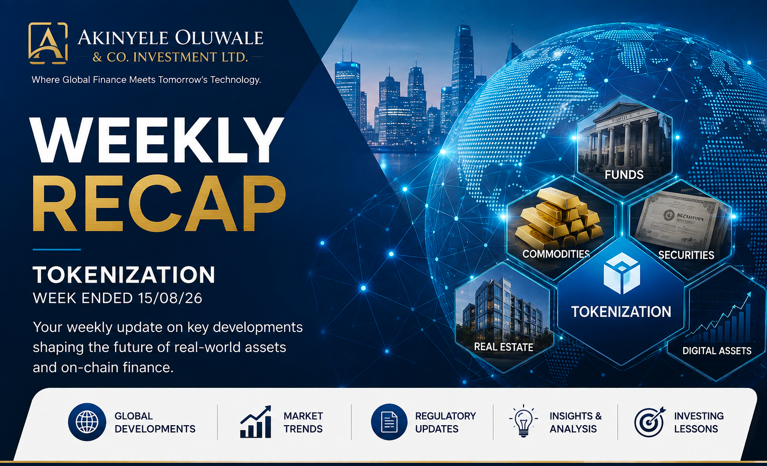
Weekly Tokenization Recap: From Korean Funds to Tokenized Gold, Traditional Assets Are Moving Closer to Blockchain Rails
The week ended 15 August 2026 showed tokenization entering a more practical phase. Shinhan Asset Management moved to test a KRW-denominated fund on-chain, a Philippine bank explored tokenized gold distribution, and regulators continued examining how blockchain could reshape securities trading. The question is shifting from whether assets can be tokenized to whether they can actually move, settle and create value better.
Published: 16 August 2026
Weekly Recap: Week Ended 15 August 2026
Category: Tokenization & RWAs • Weekly Recap
By: Akinyele Oluwale & Co. Investment Ltd.
Executive Summary
Tokenization's institutional momentum broadened this week.
South Korea's Shinhan Asset Management signed an agreement with Plume to develop a proof-of-concept for a KRW-denominated tokenized fund, using an ultra-short-term bond fund as the underlying product. The offshore test will examine issuance and compliance infrastructure rather than immediately distribute actual tokenized securities. (PR Newswire)
In the Philippines, RCBC and PDAX agreed to explore connecting regulated digital asset infrastructure with conventional mobile banking, beginning with tokenized gold. (BitPinas)
Meanwhile, the broader tokenized RWA market on public blockchains was estimated at roughly $38 billion by 9 August, with Ethereum maintaining the largest network share. (Finance Feeds)
The week's message is increasingly clear:
Tokenization is moving from proof of technology toward proof of economic usefulness.
What Happened?
The Shinhan Plume announcement was one of the week's most significant institutional developments.
Rather than launching another dollar-denominated product, Shinhan wants to test whether a Korean won investment fund can participate in today's largely dollar-centred on-chain capital markets. The proof-of-concept will take place offshore ahead of South Korea's domestic security-token framework. (PR Newswire)
Elsewhere in Asia, RCBC and PDAX announced plans to explore bringing tokenized gold into digital banking channels in the Philippines. (BitPinas)
Tokenization also continued expanding beyond financial securities. A new tokenized physical-silver vault was announced on Cardano during the week, illustrating the widening range of assets being brought on-chain. (FinancialContent)
Context / Background
The first tokenization wave focused heavily on demonstrating that ownership rights could be represented digitally.
The market has moved beyond that.
Tokenized Treasuries, money market funds, commodities and private assets are increasingly being built around real financial use cases.
Earlier this month, BlackRock expanded its blockchain-based money market offerings, including products aimed at institutional cash management and potentially stablecoin reserve assets. (CoinDesk)
That connection matters.
Stablecoins provide tokenized cash.
RWAs provide tokenized investments.
Connecting the two begins to create something resembling an on-chain capital market.
Why It Matters
Traditional financial markets contain enormous operational friction.
Assets can sit in separate databases. Settlement takes time. Collateral can be difficult to move. Cross-border distribution requires multiple intermediaries.
Tokenization potentially creates a common digital layer where ownership, transfer and settlement can become more programmable.
But putting an asset on blockchain doesn't automatically improve it.
The real test is whether tokenization delivers:
Faster settlement.
Lower operating costs.
Better collateral mobility.
Wider distribution.
Greater transparency.
Useful liquidity.
Without those benefits, tokenization risks becoming little more than a new wrapper around an old asset.
Winners & Losers / Key Stakeholders
Potential winners include asset managers, regulated tokenization providers, custodians, banks and blockchain networks capable of meeting institutional requirements.
Investors could benefit from fractional ownership, broader market access and more efficient settlement.
Legacy intermediaries dependent primarily on administrative friction could face pressure.
But blockchain platforms unable to provide compliance, security, liquidity and interoperability may struggle even if they can technically host tokenized assets.
Short-Term Impact
Expect more proofs-of-concept rather than an overnight migration of global finance.
Institutions are still testing legal structures, custody, identity, compliance and cross-chain infrastructure.
Regulation remains critical. In the United States, policymakers are examining frameworks that could eventually facilitate compliant tokenized securities and potentially expand trading beyond conventional market hours. (Investor's Business Daily)
That makes 2026 increasingly look like an infrastructure-building year.
Long-Term Impact
The larger opportunity is not simply tokenizing trillions of dollars of assets.
It is making those assets usable.
Imagine a tokenized money-market fund functioning as collateral, settling against stablecoins around the clock and moving between approved financial institutions without today's fragmented reconciliation process.
That is where tokenization starts changing capital markets rather than merely digitising certificates.
Editorial Perspective
This week's developments reveal an important evolution.
South Korea is testing tokenized local currency funds.
The Philippines is exploring tokenized commodities through banking channels.
Wall Street is building tokenized cash-management products.
Different markets. Different assets.
But they are gradually moving toward the same destination:
financial assets that can exist, move and settle on programmable infrastructure.
The winner will not necessarily be whoever tokenizes the most assets.
It may be whoever makes those assets most useful once they are on-chain.
What to Watch Next
Watch whether Shinhan moves from proof-of-concept to commercial issuance, whether RCBC integrates tokenized gold into customer-facing banking, and how regulators approach tokenized securities.
Also watch liquidity and interoperability.
Those two factors may ultimately determine whether tokenization becomes genuine financial infrastructure or simply a collection of disconnected digital assets.
Investing Lesson
Never invest in a tokenization narrative simply because an asset has moved on-chain.
Ask:
What became better?
However, settlement isn't faster, liquidity isn't deeper, costs aren't lower and accessibility hasn't improved, the technology may have changed without changing the economics.
Key Takeaways
The week ended 15 August showed tokenization expanding geographically and across asset classes. Shinhan advanced a KRW-denominated fund experiment, Philippine institutions explored tokenized gold, and the wider RWA market continued growing. (PR Newswire)
The industry is moving beyond “Can we tokenize it?”
The better question is becoming:
“What can we do with it after tokenization?”
Editorial Bottom Line
Tokenization is gradually becoming less about crypto and more about financial infrastructure.
The next stage will not be measured simply by how many dollars of assets appear on blockchain.
It will be measured by whether those assets can move faster, settle smarter, reach more investors and work more efficiently as capital.
That's when tokenization stops being an experiment.
That's when it starts becoming a market.
Sources / Notes
Primary and supporting reporting for the week ended 15 August 2026 includes Shinhan Asset Management/Plume's announcement, reporting on RCBC-PDAX's tokenized-gold initiative, current RWA market data and coverage of emerging tokenized-securities infrastructure. (PR Newswire)
Akinyele Oluwale & Co. Investment Ltd.
Where Global Finance Meets Tomorrow's Technology