

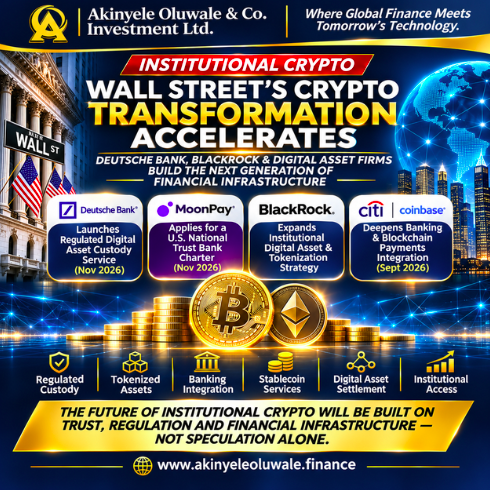
WALL STREET'S CRYPTO TRANSFORMATION ACCELERATES: WHY GLOBAL BANKS, BLACKROCK AND DIGITAL ASSET FIRMS ARE BUILDING THE NEXT GENERATION OF FINANCIAL INFRASTRUCTURE
From Deutsche Bank's regulated digital asset custody service to BlackRock's institutional strategy and a new wave of banking charter applications, cryptocurrency is moving deeper into conventional finance. But growing institutional participation does not eliminate market volatility, regulatory uncertainty or the need for financial discipline.
Published: Monday, 23 November 2026
Category: Institutional Crypto
By: Akinyele Oluwale & Co. Investment Ltd.
Editorial Focus: Institutional Adoption | Banking Infrastructure | Digital Asset Custody | Bitcoin ETFs | Stablecoins | Financial Regulation
The global cryptocurrency industry is undergoing an important structural transformation. For much of its history, the sector was defined by retail speculation, volatile prices and competition between blockchain networks. Today, a different development is becoming increasingly significant: the integration of digital assets into the operating infrastructure of established financial institutions. Major banks are developing regulated custody services. Asset managers are expanding their digital investment offerings. Payment companies are seeking banking permissions, while financial-market infrastructure providers are exploring blockchain-based settlement and tokenization. These developments suggest that institutional cryptocurrency adoption is becoming less dependent on publicity surrounding individual tokens and more focused on practical financial services.
Recent announcements from Deutsche Bank, MoonPay and other financial institutions illustrate this transition. Meanwhile, BlackRock's digital asset leadership continues to emphasise the importance of institutional expertise, market infrastructure and tokenization.
The arrival of established financial institutions changes how the cryptocurrency industry should be evaluated. Retail investors often focus on market prices, trading volumes and short-term price movements. Institutional investors and financial intermediaries must consider additional questions. Who is responsible for safeguarding digital assets? What happens if a custodian experiences an operational failure? How are transactions authorised and recorded? Can digital assets be integrated into existing accounting, compliance and risk-management systems? What legal rights does a customer possess when holding assets through a financial institution?
These questions are not secondary considerations. They are central to the functioning of modern financial markets. Traditional banks operate within established frameworks governing custody, customer identification, financial reporting and operational risk. Bringing digital assets into those environments requires more than creating cryptocurrency wallets. It requires infrastructure capable of satisfying institutional standards. That is why recent developments involving regulated custody, banking permissions and tokenized settlement deserve close attention. They indicate that the industry is increasingly addressing the operational requirements necessary for wider institutional participation but institutionalisation also introduces new dependencies, including reliance on intermediaries, technology vendors and regulatory approvals. The result is a more complex financial ecosystem rather than a risk-free one.
One of the most important institutional cryptocurrency developments this month came from Deutsche Bank. On 11 November 2026, the German banking group announced the launch of its Digital Asset Custody service for institutional and corporate clients in Europe. The service received regulatory approval from Germany's Federal Financial Supervisory Authority, BaFin. It supports selected digital assets, including Bitcoin, Ethereum and specified stablecoins. Deutsche Bank manages the custody arrangements, including digital wallets and private-key infrastructure, allowing eligible institutions to access digital assets without independently developing every technical component. The bank also announced cooperation with its asset management business to explore tokenized money-market funds, cryptocurrency-linked exchange-traded products and stablecoin applications.
On 20 November 2026, MoonPay applied to the U.S. Office of the Comptroller of the Currency for a national trust bank charter. The proposed institution would support digital asset custody and stablecoin-related services, subject to regulatory approval. The distinction between an application and an approval is essential. MoonPay's application represents an intention to operate within a particular regulatory structure. It does not establish that the proposed bank has already received authorisation. Nevertheless, the application reflects a broader industry trend. Digital asset companies increasingly recognise that long-term institutional growth may require stronger integration with regulated financial services.
This represents a shift from the industry's earlier emphasis on operating independently of conventional banking institutions. The emerging business model may combine blockchain infrastructure with the legal and operational frameworks associated with traditional finance. The institutional lesson: Regulatory credibility is becoming a competitive consideration for companies seeking to serve large financial institutions and corporate customers.
On 23 November 2026, the Financial News reported comments from Robert Mitchnick, BlackRock's head of digital assets, concerning the growing involvement of traditional financial professionals in the cryptocurrency sector. The discussion highlighted the role of institutional expertise in developing investment products, market infrastructure and tokenized financial instruments. BlackRock's digital asset operations have expanded considerably since the company began developing its blockchain capabilities. Its iShares Bitcoin Trust has become an important example of how conventional investment vehicles can provide exposure to cryptocurrency markets. The report also highlighted tokenization as an area of institutional development, including blockchain-based payments and digital representations of money-market fund interests. The broader significance is that cryptocurrency is increasingly attracting professionals experienced in asset management, risk controls, market operations and regulatory compliance. These capabilities matter because financial innovation requires more than technological expertise. It also requires product governance, liquidity management, investor servicing and operational accountability. However, institutional participation should not be interpreted as an assurance that cryptocurrency markets will become consistently stable. Bitcoin remains exposed to substantial price fluctuations.
The institutional lesson: The financial industry's growing involvement may strengthen market infrastructure, but it does not eliminate the fundamental risks associated with digital assets.
A major development announced on 28 September 2026 continues to influence the institutional digital asset landscape. Citigroup and Coinbase expanded their collaboration to connect conventional banking services with blockchain-based payment infrastructure. The initiative includes virtual account services and arrangements intended to support conversions between conventional currencies and stablecoins. It also includes capabilities designed to help institutional clients accept stablecoin payments through existing financial workflows. The significance lies in the relationship between traditional money and blockchain-based settlement. Businesses generally do not want to manage unnecessary complexity when receiving payments. They require systems that integrate with existing bank accounts, accounting procedures and treasury operations. Stablecoin infrastructure may support selected aspects of this process, but reliable conversion and banking connectivity remain essential. The Citi–Coinbase collaboration demonstrates how traditional financial institutions and cryptocurrency companies can pursue complementary roles. The bank provides established financial infrastructure, while the digital asset company contributes blockchain-related capabilities. The institutional lesson: The future of digital finance may involve cooperation between banks and blockchain companies rather than the wholesale replacement of one system by another.
Developments during the week ending 22 November 2026 also highlighted institutional interest in tokenized deposits and securities settlement. A legal industry review published on 23 November identified new initiatives involving banks and payment companies exploring tokenized U.S. dollar deposits, round-the-clock transfers and blockchain-based settlement arrangements. These developments are important because tokenized bank deposits and stablecoins are not identical financial instruments. A tokenized deposit generally represents a claim associated with a deposit-taking institution, subject to its specific legal structure.
A stablecoin is typically issued under a separate arrangement, with its rights and protections depending on the issuer and applicable regulatory framework. Both may use blockchain technology, but their legal and financial characteristics can differ significantly. For institutional users, those differences affect counterparty exposure, redemption, regulatory treatment and risk management. The broader objective is to improve how financial value moves between institutions. Yet round-the-clock technological capability does not automatically guarantee unrestricted commercial availability or immediate settlement finality in every jurisdiction. The institutional lesson: Digital settlement infrastructure must be evaluated according to the legal nature of the asset being transferred, not merely the technology supporting the transaction.
The latest developments reveal a fundamental change in the cryptocurrency industry's commercial direction. Institutional adoption is no longer confined to whether a bank or asset manager holds Bitcoin. The discussion increasingly involves the infrastructure required to support a broader digital financial system. That infrastructure includes regulated custody, tokenized investment products, digital payment arrangements, settlement systems and operational compliance. This distinction matters. An institution purchasing Bitcoin is making an investment decision. A bank launching a custody service is developing financial infrastructure. A payment company seeking a trust bank charter is pursuing a regulatory and business strategy and a financial-market operator exploring tokenized settlement is examining how securities transactions might be processed differently.
These activities are related, but they should not be treated as interchangeable. Together, they suggest that the financial sector is evaluating blockchain technology through a wider range of commercial applications. Deutsche Bank's November announcement illustrates the relationship between custody and tokenization. The bank's research reported that the market for tokenized assets, excluding stablecoins, increased from approximately $10 billion in January 2025 to $39 billion in September 2026. These are research estimates rather than a definitive measure of every tokenized asset worldwide. The growth indicates increasing institutional activity, but the market remains small relative to the enormous scale of global securities and banking systems.
The bigger picture is not that traditional finance has been replaced. It is that selected elements of traditional finance are being adapted to operate alongside blockchain-based infrastructure.
However, additional access does not automatically create additional demand. Institutions may increase, reduce or hedge their positions depending on market conditions, investment mandates and risk limits. Bitcoin and Ethereum remain volatile assets whose prices respond to liquidity, expectations and market sentiment.
Nigeria occupies an important position in Africa's digital financial economy. Its large population, active financial technology sector and international commercial relationships create interest in alternative payment and financial infrastructure. However, the institutional adoption of cryptocurrency presents challenges that differ from those faced by individual digital asset users. Banks and financial institutions must consider regulatory requirements, customer protection, foreign-exchange rules and financial stability. The recent expansion of regulated digital asset services internationally provides lessons for Nigerian financial institutions.
First, custody must be treated as a financial responsibility rather than simply a technological service. Institutions safeguarding customer assets require clear governance, reliable controls and accountability. Second, digital asset services must have identifiable economic purposes. A blockchain application should address an actual financial problem, such as settlement delays, administrative inefficiency or limited interoperability. Third, regulation must provide clarity without ignoring technological developments. Financial institutions need to understand which activities are permitted, which approvals are required and how customers are protected. Fourth, consumer and institutional education remain essential. The use of blockchain technology does not automatically establish that an investment is legitimate, adequately collateralised or financially suitable. For Nigeria, the opportunity is not simply to increase cryptocurrency trading. It is to examine whether responsible digital asset infrastructure can improve legitimate financial services while protecting monetary and financial stability. The international experience also demonstrates that institutional credibility develops through governance, supervision and operational reliability. These principles are particularly relevant for emerging markets seeking to attract long-term financial investment.
At Akinyele Oluwale & Co. Investment Ltd., we believe the cryptocurrency industry's most important long-term developments are increasingly taking place within financial infrastructure. The launch of regulated custody services, expansion of banking partnerships and development of tokenized settlement arrangements deserve serious attention. They indicate that established institutions see potential commercial applications for blockchain technology. However, financial journalism must distinguish between genuine progress and exaggerated expectations. A custody service is not a prediction of higher cryptocurrency prices. A banking charter application is not a banking licence. A successful pilot is not equivalent to unrestricted commercial deployment and institutional participation is not proof that every digital asset has sustainable economic value. These distinctions are essential for credible market analysis. The events of November 2026 also reinforce the importance of examining institutional cryptocurrency adoption alongside global monetary conditions. Financial institutions operate within markets influenced by interest rates, liquidity, borrowing costs and economic expectations. When market conditions deteriorate, institutional investors may reduce risk exposure even while remaining committed to developing digital asset infrastructure. This means infrastructure adoption and short-term market performance can move in different directions. A bank may expand cryptocurrency custody during a period when cryptocurrency prices are falling. An asset manager may continue developing tokenized funds while reducing exposure to volatile securities. Neither development is inherently contradictory.
Our institutional assessment is that cryptocurrency's next phase will be judged increasingly by the quality of financial services built around digital assets, not simply by the prices those assets achieve.
The institutions most likely to establish durable commercial operations will need to demonstrate sound governance, reliable custody, regulatory compliance and genuine customer value. That is a more demanding standard than attracting speculative attention. It is also a healthier foundation for the industry's development.
As November 2026 draws to a close, several developments deserve attention. Deutsche Bank's custody expansion: Whether the bank broadens its institutional client base, supported assets and related digital financial services. MoonPay's charter application: How the Office of the Comptroller of the Currency responds to the company's proposal and what conditions may apply. BlackRock's digital asset strategy: Whether institutional demand continues expanding across Bitcoin investment products and tokenized financial instruments. Banking partnerships: Whether collaborations involving banks and digital asset companies progress into wider commercial deployment. Institutional liquidity: How financial institutions manage cryptocurrency exposure during periods of heightened market volatility. Tokenized settlement: Whether banks demonstrate measurable improvements in operational efficiency, cost and settlement reliability. Regulatory supervision: How authorities balance innovation with financial stability, customer protection and market integrity. African participation: Whether financial institutions across Nigeria and other African markets develop appropriately regulated digital asset services. These developments should be monitored through official announcements, regulatory filings and verified operational disclosures rather than speculative market commentary.
1. Deutsche Bank launched a regulated digital asset custody service for institutional and corporate clients in November 2026.
2. The service supports selected cryptocurrencies and stablecoins, while the bank is exploring additional tokenized financial products.
3. MoonPay applied for a U.S. national trust bank charter on 20 November; the application does not constitute approval.
4. BlackRock's digital asset leadership continues to highlight the importance of institutional expertise and tokenization.
5. Banking collaborations are increasingly connecting stablecoins with conventional payment infrastructure.
6. Tokenized deposits and blockchain settlement arrangements are attracting greater institutional attention.
7. Institutional participation does not guarantee cryptocurrency price appreciation or eliminate financial risk.
8. Regulated custody, operational resilience, legal certainty and liquidity are becoming essential considerations.
9. Nigeria's long-term opportunity lies in credible digital financial infrastructure rather than speculative activity alone.
10. The next phase of institutional crypto will be measured by commercial usefulness, governance and financial accountability.
Akinyele Oluwale & Co. Investment Ltd. is an independent financial intelligence and research platform covering institutional cryptocurrency, global macroeconomics, central banking, stablecoins, digital payments, tokenization, real-world assets, artificial intelligence and blockchain technology. Our editorial mission is to explain how financial institutions, regulatory decisions and technological developments are transforming the global economy.
We believe responsible financial analysis must distinguish verified developments from expectations, commercial innovation from speculation, and institutional participation from investment guarantees. Our approach combines economic reasoning, market research and financial education to help readers understand the opportunities and limitations of emerging financial technologies.
The latest developments reinforce an important conclusion. Cryptocurrency is no longer being evaluated exclusively as a speculative asset class. Established financial institutions are increasingly examining how digital assets can be held, transferred, administered and integrated into conventional financial services. Deutsche Bank's custody launch demonstrates operational progress. MoonPay's banking charter application reflects the industry's growing interest in regulated financial structures. BlackRock's institutional strategy illustrates how traditional investment expertise is entering digital asset markets and banking partnerships demonstrate the potential for cooperation between blockchain companies and conventional financial institutions. However, the transition remains incomplete. Regulatory requirements, financial risks, cybersecurity threats and operational limitations continue to shape the industry's development.
Institutional adoption should therefore be understood as evidence of expanding financial infrastructure, not proof that cryptocurrency markets have become safe or predictable.
The next generation of digital finance will be defined by institutions capable of combining innovation with trust, accountability and measurable economic value.
The future of institutional crypto is not simply about who owns the most Bitcoin. It is about who can build the most reliable financial infrastructure around digital assets.
Observe the change. Understand the implications. Position with discipline.
Akinyele Oluwale & Co. Investment Ltd.
Where Global Finance Meets Tomorrow's Technology.
www.akinyeleoluwale.finance
Editorial disclaimer: This publication is intended for general financial education and institutional market analysis. It does not constitute personalised investment advice, an endorsement of any cryptocurrency or a guarantee of future investment performance.