

Artificial intelligence has become one of the world's largest investment stories but behind the algorithms, chips and data centres lies another story:
Financing.
Building the infrastructure required for the AI economy requires enormous amounts of capital.
Data centres must be constructed.
Advanced semiconductors must be purchased.
Electricity generation and transmission must expand.
Cooling systems must be installed.
Telecommunications networks must be strengthened.
And increasingly, some companies are turning to debt markets, banks and private-credit investors to finance this expansion.
That financing model is now facing a significant test.
Markets have been shaken this week by concerns about higher interest rates and the sustainability of debt-funded AI infrastructure expansion. Technology and semiconductor stocks have come under pressure, while investors have scrutinised companies whose rapid expansion depends heavily on borrowed capital. Reuters
At the same time, the IMF's October outlook describes the technology boom largely driven by AI as a positive demand shock supporting investment and economic activity, but also contributing to price pressures. The IMF projects global growth of 3.1% in 2026 and 3.4% in 2027. The NewsMarket
The investment equation is therefore changing.
AI may determine where enormous amounts of capital want to go.
Interest rates will help determine what that capital is ultimately worth.
The AI investment boom is increasingly colliding with the realities of global capital markets.
AI infrastructure requires enormous investment in computing capacity, data centres, energy systems and telecommunications.
Initially, much of the market conversation concentrated on demand.
How many chips will be required?
How many data centres must be constructed?
How much electricity will AI consume?
The next question is increasingly financial:
This matters because interest rates influence the economics of investment.
When borrowing costs rise, companies must generate greater future cash flows to justify expensive capital projects.
Debt-heavy businesses become particularly sensitive.
The market is therefore moving from:
AI Growth at Almost Any Cost
toward:
AI Growth + Financing Discipline + Cash Flow + Sustainable Returns
This does not mean the AI investment cycle has ended.
It means investors are beginning to differentiate more aggressively between companies capable of financing growth sustainably and businesses whose expansion depends heavily on increasingly expensive capital.
To understand the issue, consider a simple example.
Imagine two companies each want to build a major AI data centre.
Company A finances much of the project from existing cash flows.
Company B relies heavily on borrowed money.
If interest rates rise, Company B faces a greater challenge.
Its interest expense increases.
Its required investment return rises.
Its future cash flows become more important.
And lenders may demand higher compensation for taking the additional risk.
This produces an important relationship:
A project that appeared financially attractive when financing was cheap may become less attractive when financing costs rise.
That principle extends beyond AI.
It applies across infrastructure, real estate, manufacturing and other capital-intensive sectors.
But AI is particularly important because the scale and speed of current infrastructure investment are exceptional.
The AI revolution is not simply a software story.
It requires physical infrastructure.
Reuters reported today that investment in chips, data centres, electricity grids and telecommunications is generating a major global demand for financing. Central bankers gathered in Bangkok are considering how this investment surge could affect interest rates and economic policy. Reuters
This gives us the first chain:
When enormous numbers of projects compete for capital, the cost and availability of financing become increasingly important.
The IMF's October World Economic Outlook describes AI-related investment as a positive demand shock.
That investment supports economic activity.
But stronger demand can also contribute to inflationary pressure.
The IMF projects global growth at 3.1% this year and 3.4% next year while describing global economic resilience as increasingly strained and uneven. The NewsMarket
This creates another transmission mechanism:
The relationship is not automatic.
Central banks consider many factors when setting monetary policy.
But sustained inflation can make aggressive interest-rate reductions more difficult.
One company has become an important case study.
CoreWeave provides computing infrastructure used for artificial-intelligence workloads.
Its rapid expansion has relied significantly on debt financing.
Reuters reports that the company has approximately $50 billion of debt, according to LSEG data, and that its bonds have experienced significant pressure as investors reassess the risks associated with debt-funded AI expansion. Reuters
In one particularly revealing example, Reuters reports that bonds issued in June at a yield of 9.675% were trading at levels implying yields around 15% this week. Reuters
That change matters.
It demonstrates how quickly markets can demand higher compensation when perceived credit risk increases.
CoreWeave should not be treated as a proxy for the entire AI industry.
But its experience provides a useful case study in the financial risks associated with rapid, debt-dependent expansion.
The market reaction extends beyond one company.
Reuters reports that higher borrowing costs are forcing some companies involved in AI infrastructure to reconsider fundraising plans or accept more expensive financing.
Investors increasingly want evidence that spending on computing power, land, electricity and data centres can generate sufficient returns. Reuters
This represents an important change in market psychology.
The question is moving from:
“How quickly can you expand?”
toward:
“Can that expansion generate returns above the cost of financing?”
That is a healthier question for long-term capital allocation.
The IMF has also warned about the possibility of market disruption if expectations surrounding AI investment weaken significantly.
Its latest Global Financial Stability analysis identifies potential corrections in AI-related investment and rising bond yields among important risks facing global financial markets. Reuters
This does not amount to a prediction that an AI crash is inevitable.
It means policymakers are monitoring the possibility that highly valued or highly leveraged investments could become vulnerable if expected productivity and earnings fail to materialise.
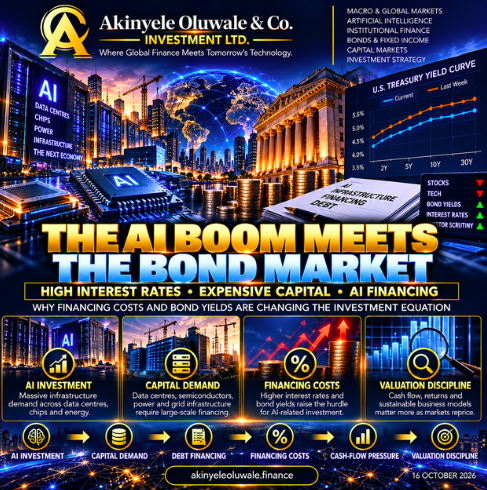
The AI financing story can be understood through six stages.
Businesses and consumers are adopting AI tools.
That creates demand for computing capacity.
Computing requires chips, data centres, electricity, cooling systems and network infrastructure.
Building this infrastructure requires enormous investment.
Capital can come from corporate cash flows, equity markets, banks, bonds or private credit.
Each source carries a different cost and risk.
The infrastructure must eventually generate sufficient economic value to justify the investment.
Markets ultimately compare expected future returns with the price investors are being asked to pay today.
The complete framework is:
This is where technology becomes finance.
AI-related companies may face greater differentiation.
Businesses with strong balance sheets and substantial cash generation may be better positioned to finance investment internally than highly leveraged companies.
But even strong companies must demonstrate adequate returns on large capital expenditures.
Credit markets may become an increasingly important indicator of AI investor sentiment.
Equity investors focus heavily on future growth.
Bond investors focus heavily on repayment capacity.
When bond yields rise sharply for a particular borrower, markets are effectively demanding greater compensation for perceived risk.
Private credit has become an important financing source for parts of the AI infrastructure build-out.
CoreWeave's difficulties are therefore also testing how private-credit markets have priced AI-related risk. Reuters
The lesson is straightforward:
High expected growth does not eliminate credit risk.
Data centres remain central to AI infrastructure.
But their economics depend on:
Utilisation.
Electricity costs.
Customer contracts.
Financing costs.
Technology changes.
And long-term demand.
Building capacity is only one part of the equation.
That capacity must ultimately produce sustainable revenue.
AI infrastructure requires substantial electricity.
That creates opportunities for power generation, transmission and energy infrastructure.
But energy costs can also affect data-centre profitability.
The AI investment story therefore increasingly intersects with energy markets.
Central banks must evaluate how large investment booms affect economic demand and inflation.
If AI investment contributes materially to demand while inflation remains elevated, monetary-policy decisions become more complicated.
This is why the AI story is now relevant to monetary policy—not just technology markets.
At Akinyele Oluwale & Co. Investment Ltd., we believe investors should avoid two extremes.
The first is:
That conclusion is dangerous.
A transformative technology can still produce unsuccessful companies and poorly financed projects.
The second extreme is:
That conclusion is equally weak.
Financial markets routinely reprice industries without eliminating the underlying technology.
The better framework separates four questions.
This measures technological demand.
This measures commercial viability.
This measures financial strength.
This measures investment discipline.
These are different questions.
A technology can be revolutionary while an individual investment in that technology remains unattractive.
That distinction is fundamental.
The internet transformed the global economy.
Yet many companies created during the internet boom failed.
Railways transformed commerce.
Yet not every railway investment produced attractive returns.
Technological importance and investment profitability are not identical.
The same principle applies to artificial intelligence.
That was our Day 32 principle.
Day 39 takes it one stage further:
AI may determine where capital wants to go. Interest rates will help determine what that capital is ultimately worth.
This is why bond markets deserve as much attention as technology headlines.
Investors should monitor eight indicators.
Are revenues growing fast enough to support investment spending?
How quickly are technology companies expanding AI infrastructure investment?
Which companies are funding expansion primarily through borrowing?
Are lenders demanding greater compensation for AI-related credit risk?
Higher yields can increase financing costs across capital-intensive sectors.
Persistent inflation could influence the path of monetary policy.
Interest-rate expectations remain critical to asset valuations and financing conditions.
Ultimately, the largest question remains:
Does AI generate enough productivity and economic value to justify the enormous capital being invested?
That question will take years—not days—to answer.
The AI boom is becoming one of the world's largest capital-financing stories.
AI infrastructure requires enormous spending on chips, data centres, electricity and networks.
Part of that expansion is being financed through debt.
Higher interest rates increase the required return on investment.
Debt-heavy AI companies may therefore face greater scrutiny.
Recent credit-market pressure illustrates how quickly financing conditions can change.
But a financing correction does not automatically mean the AI technology cycle is ending.
Instead, investors are increasingly demanding evidence of sustainable cash flow and returns.
The two essential frameworks are:
and:
The next phase of the AI investment cycle will not be judged by capital expenditure alone. It will increasingly be judged by whether that capital can earn returns above its rising cost.
Akinyele Oluwale & Co. Investment Ltd. is a global finance and digital-economy intelligence platform examining the forces reshaping financial markets, institutional investment and emerging technologies.
Our intelligence coverage includes:
AI • Blockchain & Technology • Crypto & Digital Assets • Institutional Finance • Stablecoins & Payments • Tokenization & RWAs • Central Banks • Macro & Global Markets
We analyse developments through three essential questions:
What changed?
Why does it matter?
What should investors watch next?
Our objective is to connect global financial developments with their implications for investors, businesses and economic decision-makers while promoting informed and disciplined investment thinking.
Akinyele Oluwale & Co. Investment Ltd.
Where Global Finance Meets Tomorrow's Technology.