

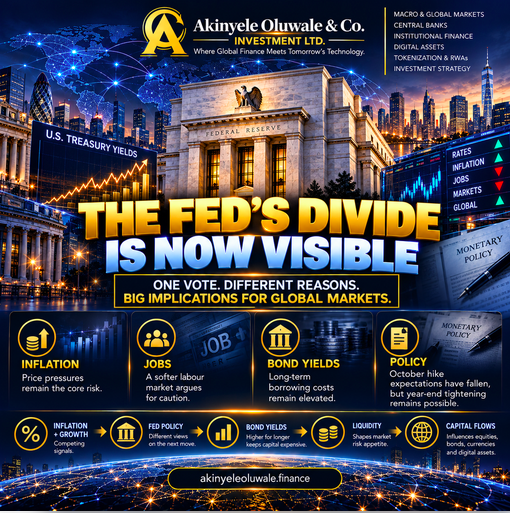
A unanimous vote can hide a disagreement.
That is one of the most important messages from the minutes of the Federal Reserve's September 15–16 policy meeting.
The Federal Open Market Committee unanimously raised its benchmark interest-rate range by 25 basis points to 3.75%–4.00%.
On the surface, the message appeared straightforward.
But the minutes released yesterday reveal a more complicated debate underneath that 12–0 vote.
Some policymakers viewed the increase primarily as protection against energy and other price shocks becoming embedded in inflation.
A more hawkish group saw a broader problem: signs that inflationary pressure was increasingly being generated by demand itself. Reuters
That distinction matters enormously.
Because policymakers who disagree about why inflation exists can also disagree about how much monetary tightening is ultimately required.
And that leaves global investors confronting a critical question:
Is the September increase close to the end of the tightening cycle or merely another step in it?
The Federal Reserve's September decision looked unified.
Another increase later in the year remains possible. Reuters
The emerging policy equation is therefore:
versus
with
complicating both.
Central banks influence the price of money.
And the price of money influences almost everything else.
Our framework remains:
A change in Fed expectations can therefore affect:
government bonds, equities, currencies, corporate borrowing, real estate, commodities and digital assets.
But today's issue goes deeper.
Monetary policy depends on diagnosis.
Imagine two doctors observing the same symptom but identifying different causes.
Their treatments may differ.
The same principle applies to inflation.
If inflation is primarily caused by temporary energy or supply shocks, aggressive monetary tightening may have limited ability to solve the underlying problem.
But if inflation reflects excessive demand across the economy, higher interest rates become a more powerful and potentially more necessary response.
Therefore:
The argument about the cause of inflation becomes an argument about the future path of interest rates.
That is why the disagreement revealed in the Fed minutes matters.
The September rate increase was unanimous.
Yet the minutes showed differing interpretations of inflation.
Some policymakers saw the increase as necessary insurance against energy and other price shocks becoming persistent.
A more hawkish group believed stronger demand pressures were also contributing to inflation and therefore warranted tighter monetary policy.
That is an important distinction.
If the problem is temporary:
Temporary shock → Inflation fades → Less tightening required
If the problem is persistent demand:
Strong demand → Persistent inflation → More tightening required
Markets therefore cannot interpret the unanimous September vote as evidence that every policymaker supports exactly the same future policy path.
Since the September meeting, labour-market data have weakened.
That creates a counterargument against aggressive tightening.
Higher rates work partly by slowing borrowing, spending and investment.
Eventually, those effects can reach employment.
The Fed therefore faces competing risks:
Inflation could remain entrenched.
Employment and economic growth could deteriorate unnecessarily.
This is the classic central-bank balancing problem.
Markets have responded strongly to the weaker employment picture and Fed commentary.
Following yesterday's minutes, expectations for an October rate increase fell to around 19.4%.
But investors should be careful with the interpretation.
The Fed can pause.
Study additional data.
And potentially increase rates later.
That is why December remains important.
Another important part of the minutes received less attention.
Some policymakers discussed preparing more effectively for potential stress in the Treasury market.
They considered how the Fed could improve its tools, strategy and communications for dealing with episodes of market dysfunction without unnecessarily expanding its market footprint.
This matters because the Treasury market sits at the centre of global finance.
U.S. government yields influence the pricing of enormous amounts of financial activity around the world.
The Fed's challenge is part of a much larger global development.
Central banks are dealing with an uncomfortable combination:
And the pressure is not limited to the United States.
India's central bank yesterday raised its policy rate by 25 basis points to 5.5%, its first increase in almost four years, and shifted its stance from “neutral” toward “calibrated tightening.” Reuters
Meanwhile, IMF Managing Director Kristalina Georgieva warned that high energy prices, rising public debt and risks surrounding the enormous AI investment boom threaten the global economic outlook. Reuters
This suggests the story is becoming bigger than:
“What will the Fed do?”
It is increasingly:
How will the global economy adjust to a world in which capital may remain expensive for longer?
That is a structural investment question.
Bond markets remain at the centre of the story.
U.S. long-term yields climbed again yesterday before retreating after a strong $39 billion 10-year Treasury auction reassured investors that demand for government debt remained intact. Reuters
The broader issue remains:
That question is becoming increasingly important as governments and AI-intensive corporations compete for capital.
Wall Street closed lower yesterday as rising Treasury yields revived concerns about inflation and borrowing costs. The S&P 500 and Dow ended four-day winning streaks, while the Nasdaq recorded its first decline in six sessions. Reuters
The relationship remains:
Higher yields → Higher discount rates → Greater valuation pressure
especially for assets whose expected cash flows lie far into the future.
This is especially important for emerging economies.
Foreign investors withdrew approximately $26.3 billion from emerging-market stocks and bonds in September, according to Institute of International Finance data reported by Reuters. It was the first monthly outflow since June. Reuters
Higher U.S. yields can attract global capital toward dollar assets.
That can pressure emerging-market currencies and increase financing costs.
Bitcoin and other digital assets remain exposed to the same liquidity environment.
The relevant framework is not:
Fed decision → automatic crypto movement.
It is:
This is why institutional digital-asset investors increasingly need to understand macroeconomics as well as blockchain technology.
At Akinyele Oluwale & Co. Investment Ltd., we believe investors should focus less on predicting a single Fed meeting and more on understanding the forces determining the entire policy cycle.
The simplistic question is:
“Will the Fed hike in October?”
The more intelligent questions are:
Why is inflation remaining persistent?
Is demand actually weakening?
How quickly is employment cooling?
Are long-term yields tightening financial conditions without additional Fed action?
Can the Treasury market absorb increasing debt issuance efficiently?
And:
How expensive is capital becoming for governments and corporations?
This leads us to an important Day 31 principle:
A unanimous decision does not necessarily mean a unanimous outlook.
The September vote was unanimous.
The reasoning behind it was not.
For investors, understanding that distinction is considerably more useful than simply watching the headline interest-rate decision.
Our dashboard now has eight indicators: U.S. inflation data; labour-market weakness; October Fed communications; the October 27–28 FOMC meeting; December rate expectations; 10-year and 30-year Treasury yields; oil and energy prices; and Treasury-market liquidity.
One additional indicator deserves attention: corporate borrowing for AI infrastructure. Reuters reports that large technology companies are seeking tens of billions of dollars in new financing for AI investment, intensifying competition for capital at the same time sovereign bond markets are already under pressure. Reuters
That connects Day 31 directly back to our earlier AI analysis:
The stories are converging.
The September Fed increase was unanimous, but policymakers differed over why tighter policy was necessary. Reuters
Markets now assign a much lower probability to another increase in October. Reuters
That does not eliminate the possibility of additional tightening later in 2026.
Long-term bond yields remain a major source of financial tightening.
The Fed is also considering how it should respond if Treasury-market functioning becomes stressed. Reuters
Emerging markets are already feeling the effects of higher U.S. yields and a stronger dollar through capital outflows. Reuters
And the central lesson is:
Don't watch the Fed vote alone. Understand the reasoning behind it.
Because today's disagreement over inflation could determine tomorrow's interest rates.
Akinyele Oluwale & Co. Investment Ltd. is a global finance and digital-economy intelligence platform helping investors, professionals and decision-makers understand the forces reshaping modern markets.
Our intelligence covers:
Artificial Intelligence • Blockchain & Technology • Crypto & Digital Assets • Institutional Finance • Stablecoins & Payments • Tokenization & RWAs • Central Banks • Macro & Global Markets
Our research centres on three questions:
We connect macroeconomics, capital markets, institutional finance and emerging technology because increasingly these forces cannot be understood in isolation.
Information tells you what happened.