

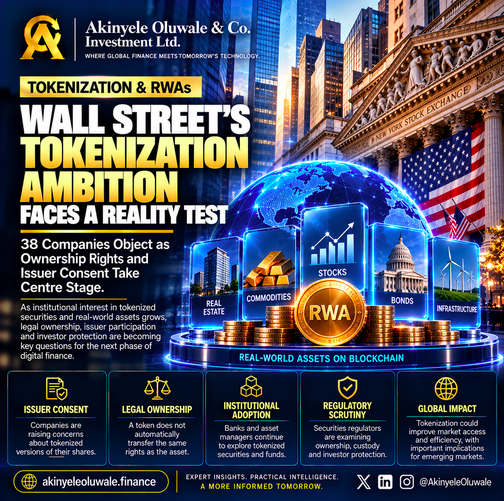
Banks and financial technology companies want to move stocks, bonds and real-world assets onto blockchain networks. But a critical question is emerging: Does owning a digital token give an investor the same rights as owning the underlying asset?
Published: October 30, 2026 | Category: Tokenization & RWAs | By: Akinyele Oluwale
As institutional interest in tokenized securities accelerates, questions about issuer consent, legal ownership, custody and investor protection are becoming just as important as blockchain technology itself.
The financial industry has spent several years exploring how traditional assets can be represented and transferred through blockchain networks.
Government bonds, investment funds, corporate securities, property interests and other real-world assets are increasingly being considered for tokenization.
The attraction is understandable.
Blockchain-based systems may offer new approaches to settlement, recordkeeping, asset servicing and the transfer of ownership interests.
However, an important debate is emerging.
Can a financial institution create a token linked to a company's shares without that company's consent?
And if an investor purchases such a token, does the investor actually own the underlying shares, or merely hold a contractual claim against an intermediary?
These questions are no longer theoretical.
Recent reporting indicates that a growing number of major companies have expressed concerns about proposals to tokenize their shares without direct issuer participation.
At the same time, regulators are examining how existing securities laws apply to blockchain-based financial instruments.
This is a significant development because the next phase of tokenization will not be determined solely by technological capability.
It will also depend on whether tokenized instruments provide legally enforceable rights, reliable custody, appropriate disclosure and credible investor protection.
The central lesson is simple: putting an asset on a blockchain does not automatically transfer legal ownership of that asset.
For institutional investors, banks, asset managers and corporate executives, that distinction is fundamental.
Let us consider a simple example.
Suppose an investor wants to purchase shares in a publicly listed company.
Under a conventional arrangement, the investor places an order through a regulated intermediary.
The transaction is processed through established market infrastructure, and the investor receives the relevant ownership or beneficial interest under the applicable legal framework.
Now imagine a technology company creates a digital token whose price is intended to follow the value of those shares.
The token may trade on a blockchain.
It may be transferable outside conventional market hours.
Its price may closely track the underlying shares.
But does the token holder automatically become a shareholder?
Not necessarily.
The answer depends on the structure of the instrument.
If the token represents a legally recognised ownership or beneficial interest in shares held through an authorised arrangement, the investor may receive specified rights associated with that interest.
If the token merely provides contractual exposure to the share price, the holder may have no direct ownership rights in the underlying company.
The investor might not receive voting rights, dividends or other shareholder entitlements in the same way as a conventional shareholder.
This distinction matters because investors are not simply purchasing price movements.
They are acquiring financial claims.
Those claims determine what they own, who owes them obligations and what remedies may be available if something goes wrong.
For financial institutions, tokenization therefore requires a careful examination of legal structure, not merely blockchain performance.
A system that transfers tokens in seconds may still expose investors to significant risks if the underlying ownership arrangements are unclear.
On October 23, Reuters reported that opposition among major listed companies to proposals involving tokenized versions of their shares had expanded.
The report identified 22 companies that had raised concerns, including major names such as Microsoft, Alphabet, Wells Fargo, Arm and Intuit.
The issue centres on whether tokenized representations of listed shares should be introduced without the participation or consent of the underlying issuers.
This is important because corporate securities carry rights and obligations established through law, company documentation and market infrastructure.
Creating a digital instrument linked to a share price does not automatically reproduce those rights.
Companies may be concerned about how investors understand the product, whether the instrument creates confusion about ownership and whether existing shareholder protections are preserved.
US regulators have also been considering how tokenized securities fit within existing securities regulation.
The Securities and Exchange Commission has been examining approaches to innovation involving blockchain-based securities infrastructure.
However, regulatory discussions, applications and notices should not be mistaken for unconditional approval of a particular trading model.
A company seeking to operate a tokenized securities platform must still address applicable registration, disclosure, custody, market-conduct and investor-protection requirements.
The fact that a proposal has been submitted or publicly discussed does not establish that the proposed activity is fully authorised.
This distinction is particularly important for institutional market participants.
Despite the legal questions surrounding tokenized equities, financial institutions continue to explore tokenization across other asset classes.
Tokenized investment funds, government securities and collateral-management arrangements may offer more clearly defined paths to adoption where the relevant issuers, custodians and regulated intermediaries participate directly.
The difference is significant.
Tokenization undertaken with an established legal framework and clearly identified parties may present a different risk profile from a digital instrument created without direct participation from the underlying asset issuer.
The wider market is therefore beginning to distinguish between technological experimentation and legally robust financial infrastructure.
To understand the significance of these developments, we need to separate three concepts.
The underlying asset may be a government bond, corporate share, property interest or investment-fund unit.
Its existence and associated rights are determined by the relevant legal and contractual framework.
The token is a digital representation recorded on a blockchain or another distributed-ledger system.
It may represent direct ownership, beneficial ownership, a contractual entitlement or an economic exposure.
The exact meaning depends on how the instrument is structured.
This is the most important component.
The legal relationship determines whether the token holder has enforceable rights against an issuer, custodian, trustee, intermediary or another party.
Without understanding that relationship, an investor cannot properly assess what the token represents.
Consider property tokenization.
A building may be valued at $10 million.
A company could establish a legal vehicle that owns the building and issue digital tokens representing specified interests in that vehicle.
But purchasing a token would not necessarily mean that the investor directly owns a physical portion of the building.
The investor's rights would depend on the legal structure, governing documents and applicable property and securities laws.
The same principle applies to tokenized bonds and shares.
A token is a record of an interest or claim.
Its economic value depends on what that interest or claim actually provides.
Blockchain networks may improve how transactions are recorded and transferred.
But securities markets perform additional functions.
They establish ownership, manage corporate actions, provide custody, support regulatory reporting and create mechanisms for resolving disputes.
A successful tokenization system must address these responsibilities.
For example, if a tokenized share pays a dividend, the system must determine who is entitled to receive it and how payment is processed.
If the underlying company conducts a rights issue, the token holder's position must be clear.
If an intermediary becomes insolvent, investors need to understand whether their assets are legally segregated and what claims they can enforce.
These are not secondary technical details.
They are central features of functioning capital markets.
The current debate has implications for several parts of the financial system.
Stock exchanges: Exchanges and trading venues may explore blockchain-based settlement and trading infrastructure, but their arrangements must satisfy applicable market regulations and investor-protection standards.
Asset managers: Fund managers may find opportunities to tokenize investment-fund interests or other assets where ownership, redemption and custody can be clearly defined.
Banks and custodians: Financial institutions may provide custody, asset servicing, collateral management and settlement services connected to tokenized securities.
Corporate issuers: Companies may seek greater control over how their securities are represented and distributed through tokenized products.
Institutional investors: Investors must evaluate whether a token provides genuine ownership rights, beneficial interests or merely synthetic economic exposure.
Blockchain infrastructure providers: Technology companies may benefit from institutional demand, but long-term adoption will depend on regulatory compatibility, operational resilience and integration with existing systems.
Emerging markets: Tokenization may offer new approaches to investment distribution and market access, although local legal frameworks, investor protections and currency arrangements remain essential.
The broader market implication is that tokenization may create value through improved financial infrastructure rather than simply through the creation of new tradable tokens.
The financial industry should avoid confusing digital representation with financial transformation.
Converting an asset into a token does not automatically make the underlying investment more valuable.
It does not remove credit risk.
It does not eliminate market volatility.
It does not guarantee liquidity.
And it does not automatically create legal rights that did not previously exist.
What tokenization may change is the infrastructure through which financial claims are recorded, transferred and serviced.
That can be valuable.
For example, more efficient settlement arrangements may reduce certain operational delays.
Programmable systems may support automated processing of defined financial obligations.
Shared records may reduce some reconciliation requirements between participating institutions.
However, these potential benefits must be evaluated against implementation costs, legal complexity, technology risk and the need for effective oversight.
For corporate executives, the right question is not whether an asset can be tokenized.
Almost any financial claim can potentially be represented digitally.
The more important questions are:
What rights does the token represent?
Who is legally responsible for those rights?
How are the underlying assets safeguarded?
What happens if the technology fails?
Can investors redeem, transfer or enforce their claims?
Which regulatory requirements apply?
These questions should come before marketing promises about efficiency and innovation.
Our editorial position is that the future of tokenization belongs to institutions that can connect blockchain efficiency with legally enforceable financial rights.
Technology can improve the movement of assets.
But law, governance and trust determine whether those assets can function reliably within the financial system.
Several developments deserve attention.
1. Regulatory treatment of tokenized equities: Watch how securities regulators address ownership, custody, disclosure and trading arrangements.
2. Issuer participation: The willingness of companies to support tokenization initiatives may influence which business models gain acceptance.
3. Institutional tokenization projects: Monitor developments involving regulated investment funds, government securities and collateral-management infrastructure.
4. Investor-rights disclosure: Financial products should clearly explain whether token holders receive direct ownership, beneficial interests or contractual exposure.
5. Settlement and custody arrangements: The reliability of tokenized securities will depend partly on how assets are held, transferred and protected.
6. Interoperability: Institutions may need systems capable of interacting with traditional market infrastructure and different blockchain networks.
7. Emerging-market regulation: Countries developing tokenization frameworks will need to consider investor protection, market integrity and the enforceability of digital ownership records.
The next stage of adoption will likely be shaped by the quality of legal and operational infrastructure rather than by the number of tokens created.
Tokenization can change how financial assets are represented and transferred, but it does not automatically change their legal ownership.
Tokenized shares may provide different rights depending on the instrument's structure.
Recent corporate objections demonstrate the importance of issuer participation and investor clarity.
Regulatory discussions should not be confused with formal approval of a particular tokenization model.
Institutional adoption requires reliable custody, enforceable rights, transparent disclosures and operational resilience.
Tokenized funds and securities with clear legal structures may offer more practical routes to adoption than products with uncertain ownership arrangements.
Investors should distinguish ownership of an underlying asset from contractual exposure to its price.
The long-term value of tokenization will depend on whether it improves real financial processes while preserving investor protection.
Akinyele Oluwale & Co. Investment Ltd. is a financial intelligence platform focused on institutional finance, tokenization and real-world assets, stablecoins, blockchain infrastructure, central banking and global markets.
Our editorial mission is to provide evidence-based financial analysis that explains major developments, identifies their implications and supports informed decision-making.
We believe technological innovation becomes economically meaningful when it improves financial outcomes while maintaining accountability, legal certainty and institutional trust.
Wall Street's tokenization ambitions are entering a more demanding phase.
The conversation is moving beyond whether blockchain networks can represent stocks, bonds and other assets.
The more important questions concern ownership, investor protection, legal enforceability and institutional responsibility.
These issues may appear less exciting than the promise of around-the-clock trading and instant settlement.
But they are precisely the issues that determine whether new financial infrastructure can operate at institutional scale.
The future of real-world asset tokenization will not be decided by technology alone.
It will be decided by whether digital tokens can faithfully represent real financial rights.
Observe the change. Understand the implications. Position with discipline.
Akinyele Oluwale & Co. Investment Ltd.
Where Global Finance Meets Tomorrow's Technology.