

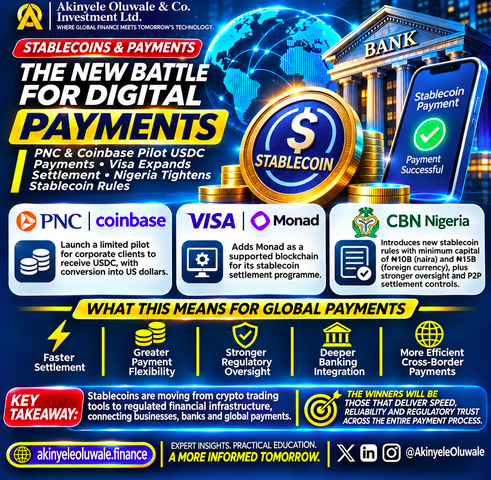
As stablecoins move deeper into banking, corporate treasury and international payments, financial institutions face a decisive question: can digital money deliver faster and more efficient settlement without weakening financial stability, consumer protection or regulatory accountability?
Published: 12 November 2026
Category: Stablecoins & Payments | Banking | Digital Finance
By: Akinyele Oluwale & Co. Investment Ltd.
The global stablecoin industry is entering a phase in which financial credibility matters as much as technological innovation. For years, stablecoins were discussed primarily as instruments for moving funds between cryptocurrency exchanges. Today, their potential applications extend to international business payments, corporate treasury, financial settlement and digital commerce.
This transition is changing the questions banks and regulators are asking. It is no longer enough for a digital token to move quickly across a blockchain network. Financial institutions must establish who stands behind the token, how its value is maintained, whether holders can redeem it and what happens when a transaction fails.
Nigeria's newly introduced stablecoin licensing framework illustrates the regulatory dimension of this transformation. Meanwhile, international payment networks and banks are exploring stablecoin settlement, tokenized deposits and automated financial transactions.
These developments point toward a more regulated and institutionally connected digital-payments market. However, the industry's long-term success will depend on a distinction that is frequently overlooked:
A faster transfer of digital tokens is not necessarily a faster, cheaper or safer end-to-end payment.
For stablecoins to become dependable financial infrastructure, the entire payment process must work from funding and authorisation to settlement, redemption and access to usable money.
Three Developments Changing the Payments Industry
Three recent announcements illustrate the direction of stablecoin adoption. On November 9, PNC Bank and Coinbase announced a limited pilot for corporate and institutional clients. The proposed service allows eligible businesses to receive USDC stablecoins, with conversion into US dollars. This is an important development because it connects blockchain-based transfers with conventional banking services. However, the initiative remains a limited pilot rather than a full commercial rollout. Reuters
On November 10, the Monad Foundation announced that Visa had added the Monad blockchain as an option within its stablecoin settlement programme. Participating issuers and acquirers can use the supported network for eligible settlement arrangements. This expands the range of blockchain infrastructure available to participating institutions. GlobeNewswire
In Nigeria, the Central Bank's regulations, effective November 5, introduced separate licensing requirements for naira-referenced and foreign-currency-referenced stablecoins. The framework also strengthens oversight of payment services, reserves, redemption and platform-facilitated peer-to-peer transactions.
These developments reveal three priorities shaping the industry: bank integration, settlement infrastructure and regulatory accountability. The strategic opportunity is substantial. Stablecoins could improve selected cross-border payment processes, increase settlement flexibility and support new financial services but the risks are equally important. A payment arrangement must manage liquidity, custody, operational failures, legal responsibilities and customer protection. The next generation of stablecoin services will be judged not merely by transaction speed, but by whether businesses can reliably receive, convert and use their funds.
Why This Matters: Stablecoins Are Moving Into the Banking System
The stablecoin industry is undergoing a structural transformation. Historically, much of its activity was associated with cryptocurrency trading. Traders used dollar-referenced tokens to transfer value between exchanges, manage trading balances and avoid repeatedly moving funds through conventional banking channels. That use remains relevant, but financial institutions are now examining a broader opportunity.
Stablecoins could become part of the infrastructure supporting corporate payments, international transfers, treasury operations and settlement between financial institutions. Consider a Nigerian business purchasing goods from an international supplier. The company needs to make a payment, obtain the necessary foreign currency, satisfy regulatory requirements and ensure that the supplier receives usable funds. A blockchain-based payment may transfer a digital token quickly.
However, the complete transaction involves more than that transfer. The business must obtain the appropriate currency or digital asset. The recipient must accept the payment. The funds must be redeemable, and all relevant regulatory obligations must be satisfied. If the token arrives immediately but the recipient cannot convert it into spendable money until the following day, the commercial benefit may be limited. This explains why banking integration is becoming important.
Banks provide services involving liquidity, account management, foreign exchange, compliance and customer relationships. Blockchain networks may offer additional settlement capabilities. The opportunity lies in combining these functions effectively.
The future of stablecoin payments is not necessarily about replacing banks. It may increasingly involve banks incorporating digital settlement technology into existing financial services.
What Happened? Five Developments Reshaping Stablecoins and Payments
On November 9, 2026, PNC Bank and Coinbase announced a limited stablecoin payment pilot targeting corporate and institutional clients. Under the arrangement, eligible businesses can receive USDC, with the stablecoins converted into US dollars. The significance lies in the connection between blockchain-based transfers and traditional bank money. For many businesses, receiving a stablecoin is not the ultimate objective. They need usable funds for salaries, inventory, suppliers and operating expenses. A service that connects stablecoin receipts to dollar conversion may help address that practical requirement.
However, the announcement should be interpreted carefully. A limited pilot is not evidence that the service is available to all PNC customers. Nor does it demonstrate that stablecoin payments are already cheaper or faster than every conventional alternative. Those claims require transaction-level evidence. The pilot will be more meaningful if participating businesses can demonstrate improved settlement availability, lower overall costs or more efficient cross-border collections.
Institutional implication: Stablecoin adoption is becoming increasingly dependent on how effectively digital assets connect with regulated banking services.
On November 10, the Monad Foundation announced that Visa had added support for Monad within its stablecoin settlement programme. The development gives participating Visa issuers and acquirers another supported blockchain network for eligible settlement activities. This is significant because payment networks operate at considerable scale. Their requirements extend beyond transaction processing. They must consider operational reliability, network availability, financial controls, reconciliation and settlement arrangements.
A blockchain network may offer technical advantages, but it must also meet the needs of participating financial institutions. Importantly, adding a blockchain as a settlement option does not mean every Visa card payment now uses that network. It also does not establish that all merchants or cardholders can directly settle transactions using stablecoins. The relevant activity concerns eligible participating institutions within Visa's settlement arrangements. The announcement highlights an emerging competitive question. Which blockchain networks can provide the reliability, capacity, operational controls and integration required for institutional financial services?
Institutional implication: Blockchain infrastructure is increasingly being evaluated as part of established payment networks rather than solely as a platform for cryptocurrency transactions.
The Monad announcement follows Visa's October 15 disclosure that its Visa Direct stablecoin-enabled prefunding capability had progressed into an initial commercial deployment. Inyo Global became the first enabler supporting the offering for eligible Visa Direct clients and partners. The distinction between a pilot and commercial deployment matters. A pilot tests whether a proposed service can function under defined conditions. A commercial deployment indicates that a service is being made available for actual business use, although the initial scope may remain limited.
Visa's approach focuses on enabling businesses to fund eligible cross-border payment activities using stablecoin infrastructure. This could provide greater flexibility in how payment providers manage funding. For example, businesses operating internationally may need to maintain funds across different banking relationships and payment systems. A suitable stablecoin-based prefunding arrangement could potentially improve access to settlement liquidity.
However, the economic benefits depend on funding costs, redemption arrangements, foreign-exchange charges and the requirements of participating financial institutions.
Institutional implication: The strongest evidence of stablecoin adoption will come from sustained commercial activity, not announcements of technical capability alone.
Nigeria's Central Bank introduced its Regulations for the Operations of Non-Security Virtual Assets in Nigeria, effective November 5, 2026. The framework establishes licensing and supervisory requirements for stablecoin issuers and other regulated virtual-asset service providers.
Its principal capital thresholds are:
| Regulatory category | Minimum paid-up capital |
|---|---|
| Class 1: Naira-referenced stablecoin issuers | ₦10 billion |
| Class 2: Foreign-currency-referenced stablecoin issuers | ₦15 billion |
| Other qualifying non-security virtual-asset service providers | Generally ₦1 billion |
The rules also address reserve backing, redemption arrangements, cybersecurity, governance and financial-crime controls. Foreign-currency-referenced stablecoins offered in Nigeria face local incorporation, licensing and token-approval requirements, subject to the specific provisions governing different activities. For Nigerian fintech companies, the framework creates a clearer regulatory pathway.
However, the financial requirements are substantial. A smaller technology company may have the expertise to build a useful payment service without possessing the capital required to issue its own stablecoin.
This could encourage partnerships with larger financial institutions. It could also concentrate direct issuance among a relatively small number of well-capitalised companies. Neither outcome is automatically beneficial or harmful. The important question is whether the framework supports financial stability while allowing credible businesses to compete.
Institutional implication: Stablecoin regulation is becoming a major determinant of market structure, operating costs and competitive access.
One of the most important aspects of Nigeria's new framework concerns platform-facilitated peer-to-peer transactions. The regulations require relevant providers to obtain appropriate approval and maintain stronger controls over customer identity and transaction reconciliation. For applicable naira-settled transactions, the framework includes requirements linking verified customer information with the bank accounts used for payment. This addresses a practical problem. A digital-asset transaction may have two separate settlement components.
The first is the transfer of the stablecoin or other token. The second is the corresponding payment through a bank or other fiat-currency channel. If one component succeeds and the other fails, the parties may face a dispute. Consider a hypothetical transaction. A customer agrees to exchange a digital token for a naira payment.
The token transfer is completed, but the corresponding bank payment is delayed, rejected or disputed. The blockchain may show that the token moved successfully. That does not necessarily establish that the overall commercial exchange was completed. The parties still need arrangements governing reconciliation, liability, dispute resolution and potential recovery. This is why financial regulation must extend beyond the technical transfer of tokens.
Institutional implication: End-to-end settlement certainty matters more than blockchain confirmation speed alone.
The latest developments reveal that stablecoin competition is no longer limited to token issuers. Several groups are positioning themselves within the emerging market. Banks are exploring how to receive, convert and manage stablecoin payments. Payment networks are adding blockchain settlement capabilities. Stablecoin issuers are developing reserve-backed digital money products. Blockchain networks are competing to provide reliable transaction infrastructure. Regulators are establishing conditions for participation. Technology companies are building systems that connect these different components. The resulting market may resemble a network of specialised financial services rather than a single blockchain-based replacement for banking.
A business might initiate a payment through a familiar financial application. Behind the scenes, an approved service provider could use a stablecoin for part of the settlement process. The recipient could receive funds through a conventional bank account. In that arrangement, the customer may not need to interact directly with a cryptocurrency wallet. The technology would operate as part of the financial infrastructure. This is an important distinction.
The most commercially successful stablecoin services may be those that solve payment problems without requiring customers to understand the technical details of blockchain.
At Akinyele Oluwale & Co. Investment Ltd., we believe the stablecoin industry is moving toward a more demanding commercial environment. For several years, blockchain transaction speed dominated discussions about digital payments but speed is only one component of financial efficiency. A payment can be fast and still be expensive. It can settle on-chain and still be difficult to redeem. It can be technologically secure and still involve an incorrect beneficiary and it can operate on a reliable blockchain while depending on a financially weak issuer.
These distinctions matter.
The PNC–Coinbase pilot is significant because it addresses the connection between digital tokens and conventional bank money. Visa's expanding settlement infrastructure matters because it demonstrates how blockchain technology may be incorporated into established financial networks.
Nigeria's regulatory framework matters because it establishes financial and operational obligations for participants in the digital-payments market. Together, these developments suggest that the industry is moving toward an institutional model in which technology, banking and regulation must operate together. We believe five principles should guide the next stage of stablecoin adoption.
First, redemption must be reliable. A stablecoin should have credible arrangements supporting its stated value. Second, settlement must be complete. The entire payment process should be assessed, not merely the blockchain transfer. Third, financial responsibilities must be clear. Institutions should understand who bears liability when transactions fail. Fourth, regulatory compliance must be built into operations. Financial innovation should not depend on avoiding applicable obligations. Fifth, commercial value must be measurable. Stablecoin services should demonstrate improvements in cost, availability, liquidity management or customer experience.
These principles provide a more useful framework than treating every stablecoin announcement as evidence of an approaching financial revolution.
Our institutional assessment is that the next generation of successful payment infrastructure will combine digital settlement capabilities with the reliability, accountability and customer protections expected of established financial services.
What to Watch Next
Several developments deserve close attention during the remainder of November 2026. PNC and Coinbase: Monitor whether the corporate stablecoin pilot expands and produces evidence of commercial benefits. Visa's settlement network: Watch for additional participating institutions, supported networks and transaction activity. Commercial stablecoin payments: Assess whether Visa Direct's initial deployment attracts broader adoption. Nigeria's licensing process: Follow CBN clarifications and applications under the new framework. International stablecoin issuers: Monitor whether major foreign issuers establish the required Nigerian operating arrangements. Reserve transparency: Watch for stronger disclosures concerning stablecoin backing and redemption capacity. Peer-to-peer settlement: Assess how regulated platforms implement identity verification and reconciliation controls. Cross-border payments: Look for evidence of reduced total transaction costs, rather than faster token transfers alone. Banking integration: Monitor whether more financial institutions offer stablecoin receipt, conversion and settlement services. Consumer protection: Evaluate how payment disputes, operational failures and redemption problems are addressed.
These indicators will provide a more reliable picture of industry progress than speculative price predictions.
Akinyele Oluwale & Co. Investment Ltd. is an institutional financial intelligence platform focused on global macroeconomics, central banking, institutional cryptocurrency, stablecoins, digital payments, tokenization, real-world assets, artificial intelligence and blockchain technology. Our editorial mission is to provide evidence-based analysis that helps readers understand how financial institutions, regulatory frameworks and emerging technologies are shaping the future of global finance. We believe financial innovation should be evaluated through its economic usefulness, institutional credibility and capacity to improve financial outcomes.
The latest developments in stablecoins and payments demonstrate that the industry is moving beyond its earlier dependence on cryptocurrency trading. PNC and Coinbase are testing how stablecoin receipts can connect with conventional banking. Visa is expanding the blockchain infrastructure available to participating financial institutions. Nigeria is introducing a more demanding regulatory framework for stablecoin issuance and related payment activities. These developments share a common direction.
Digital money is becoming increasingly connected to the institutions responsible for financial settlement, liquidity management and regulatory compliance. However, the transition remains incomplete. Limited pilots must demonstrate commercial value. New settlement networks must establish operational reliability. Regulatory frameworks must protect financial stability without unnecessarily restricting competition and businesses must determine whether stablecoin services provide genuine advantages over existing payment arrangements.
The future of stablecoins will not be determined by how quickly tokens move across a blockchain. It will be determined by how reliably value moves between businesses, banks and customers.
That is the real transformation taking place in global digital payments.
Observe the change. Understand the implications. Position with discipline.
Akinyele Oluwale & Co. Investment Ltd.
Where Global Finance Meets Tomorrow's Technology.
Website: akinyeleoluwale.finance
Editorial disclaimer: This article provides general financial education and institutional market analysis. It does not constitute investment, legal or personalised financial advice.