

Published: October 24, 2026 | Category: Macro & Global Markets | Series: Investing Lessons | By: Akinyele Oluwale
Investors spend enormous amounts of time trying to identify the next winning investment.
Which shares will outperform?
Where is Bitcoin heading?
Is gold still attractive?
Will property prices rise?
Are technology companies too expensive?
These are legitimate questions but underneath almost every major financial market sits another force that receives far less attention from ordinary investors:
the cost of money.
When central banks change interest rates, they are not merely changing a number discussed by economists on television.
They are changing one of the fundamental prices in the economy.
Interest rates influence what households pay to borrow.
They influence corporate financing.
They influence bond yields.
They affect currencies.
They affect property.
They influence how investors value future corporate earnings and they can affect how willing investors are to take risks.
This is particularly important today because the global interest-rate environment remains complicated.
The U.S. Federal Reserve's target range currently stands at 3.75%–4.00%, with another policy meeting scheduled for October 27–28. The European Central Bank raised its three key rates by 25 basis points in September, taking its deposit facility rate to 2.50%, as inflation pressures persisted. The Bank of England, meanwhile, maintained Bank Rate at 3.75% in September while warning that energy prices could keep inflation elevated.
There is an important investing lesson here.
Never analyse an investment without understanding the monetary environment surrounding it.
Central banks influence financial markets primarily through monetary policy. When inflation becomes too high, a central bank may increase interest rates to reduce demand and bring inflation under control. When economic activity becomes very weak and inflation is subdued, it may lower rates to support borrowing, spending and investment.
For investors, this creates an important chain:
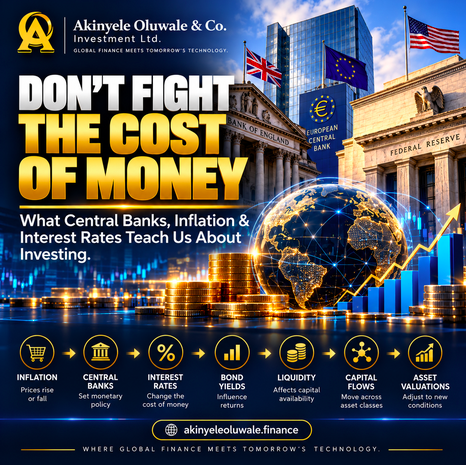
Inflation → Central Banks → Interest Rates → Bond Yields → Liquidity → Capital Flows → Asset Valuations
Understanding this chain does not allow us to predict markets perfectly.
Nothing does but it helps explain why assets sometimes behave differently even when the underlying businesses have not dramatically changed.
Consider a simple example.
If relatively safe investments begin offering higher returns because interest rates have risen, investors may demand higher potential returns before taking additional risk elsewhere.
That can affect how much they are prepared to pay for shares, property and other assets. Conversely, when rates decline significantly, investors may become more willing to search for returns elsewhere.
The important lesson is therefore not:
High rates = sell everything.
Nor is it:
Rate cuts = buy everything.
Both would be oversimplifications.
The better lesson is:
The cost of money changes the price investors are willing to pay for risk.
Imagine that someone offers you two investments.
Investment A is relatively low risk and pays 2%.
Investment B involves considerably more uncertainty but is expected to return 5%.
You may consider B attractive because you are receiving an additional expected return for accepting additional risk. Now imagine the return available on Investment A rises from 2% to 4.5%.
Investment B still offers 5% but suddenly the additional expected return for taking substantially greater risk is much smaller.
Nothing necessarily changed about Investment B itself. What changed was the alternative available to you. This idea sits at the heart of asset valuation. Money has an opportunity cost.
Capital will continually compare:
What return can I earn?
against:
What risk must I take to earn it?
This is why investors should pay attention to government bond yields and central-bank policy. They help establish important reference points for pricing risk throughout financial markets. Interest rates also affect companies directly.
A business borrowing at 4% faces a different economic environment from one borrowing at 8%.
Higher financing costs can reduce:
Investment
Expansion
Profitability
Acquisition activity
Property development
Consumer borrowing
And eventually economic activity.
So when central banks change monetary policy, the effect can travel far beyond commercial banks.
The global economy currently provides an excellent demonstration of why investors need to understand monetary policy. The IMF's October World Economic Outlook expects global growth of 3.1% in 2026 before an improvement to 3.4% in 2027. At the same time, global headline inflation is projected at 4.7% this year before easing to 4.1% next year.
That combination matters. Growth has remained resilient but inflation has not simply disappeared. Different economies are also experiencing different pressures.
In the United States, the Federal Reserve's policy rate currently sits at 3.75%–4.00%. PCE inflation was 3.4% in August, while unemployment was 4.2% in September. The next FOMC decision is scheduled for October 28.
In the euro area, the ECB raised rates by 25 basis points in September. Its projections put average headline inflation at 3.0% in 2026, 2.5% in 2027 and 2.1% in 2028.
In Britain, the Bank of England maintained its policy rate at 3.75% in September. Six members supported holding while three preferred a 25-basis-point increase. The Bank highlighted higher energy prices and the risk that inflation could remain persistent.
There is no single global monetary-policy story and that itself is the lesson.
Many investors hear the phrase "interest rates" and immediately think only about loans.
The connection is much broader.
Let us follow the chain.
Prices across the economy begin increasing too quickly.
Depending on the causes and outlook, monetary authorities may raise policy rates or maintain restrictive rates for longer.
Banks, businesses and households face higher financing costs.
Investors demand returns reflecting inflation expectations, policy expectations, fiscal risk and other factors.
The present value of future cash flows is influenced by the rate used to discount them.
Higher required returns can therefore place pressure on valuations, particularly when prices already assume strong future growth.
Investors reconsider the trade-off between:
Cash
Bonds
Shares
Property
Commodities
Alternative assets
This gives us the full framework:
Once an investor understands this chain, central-bank news stops looking like abstract economics. It becomes investment intelligence.
Higher rates can affect equities in two major ways.
First, companies may face higher borrowing costs.
Second, investors may apply higher required returns when valuing future earnings.
This can be particularly important for businesses whose valuations depend heavily on profits expected far into the future but we should be careful.
Higher interest rates do not automatically mean all shares fall.
Companies with strong cash generation, low debt, pricing power and resilient business models may behave differently.
Interest rates and bond prices have an important relationship.
When newly issued bonds offer higher yields, existing lower-yielding bonds may become less attractive unless their prices adjust.
This is why bond investors must understand interest-rate risk.
Property is often heavily dependent on financing.
Higher borrowing costs can affect mortgage affordability, property demand and the economics of new development.
Interest-rate expectations can influence international capital flows.
But currencies are affected by many other factors too, including inflation, trade, fiscal conditions, political risk and economic growth.
Crypto markets are not isolated from macroeconomic conditions.
Changes in liquidity and investor risk appetite can influence demand for volatile assets.
That does not mean a central-bank decision mechanically determines Bitcoin's next move.
It means global liquidity belongs in the analysis.
At Akinyele Oluwale & Co. Investment Ltd., we believe one of the biggest mistakes investors make is analysing an asset in isolation.
A company may be excellent but what valuation are you paying?
A property may be attractive but what does financing cost?
A bond may offer a high coupon but what are inflation and market yields doing?
A digital asset may have a compelling narrative but what is happening to global liquidity and risk appetite?
Investing always happens inside an economic environment.
That leads us to an important principle:
Before asking what an asset will do next, understand what is happening to the price of money.
There is another lesson.
Do not try to predict every central-bank meeting.
That can become another form of speculation.
Instead, understand the direction and transmission of policy.
Ask:
Is monetary policy becoming tighter or easier?
Is inflation rising or falling?
Are real borrowing costs increasing?
Are bond yields moving?
Is liquidity expanding or contracting?
Are companies refinancing at higher rates?
Are investors demanding greater compensation for risk?
Those questions are more useful than trying to guess every 25-basis-point decision. The investor's job is not to become a central banker.
The investor's job is to understand how central-bank decisions affect capital.
The next scheduled FOMC meeting takes place on October 27–28. Investors should pay attention not only to the decision but also to the Fed's assessment of inflation, employment and the broader economy.
Its next scheduled rate decision is November 5. The Bank is balancing inflation risks from higher energy prices against softer labour-market conditions.
The ECB has made clear that it is not pre-committing to a particular rate path. Decisions will remain dependent on inflation, incoming economic data and monetary-policy transmission.
Energy shocks can affect inflation, household purchasing power, company costs and central-bank decisions.
Investors should increasingly watch fiscal policy alongside monetary policy. Large government borrowing requirements can influence bond markets and financial conditions.
Actual inflation matters but expectations also matter.
If households, businesses and investors begin believing that inflation will remain high, behaviour can change in ways that make inflation more persistent.
1. Interest rates are the price of money.
They influence borrowing, saving, investment and asset valuation.
2. Central banks matter to investors because monetary policy travels through the financial system.
The transmission mechanism is:
Inflation → Central Banks → Interest Rates → Bond Yields → Liquidity → Capital Flows → Asset Valuations
3. Higher rates change the opportunity cost of taking risk.
Investors compare potential returns across different assets.
4. Never analyse valuation without considering interest rates.
The required return investors demand is fundamental to asset pricing.
5. Central banks are not currently moving in perfect synchronisation.
The Fed, ECB and Bank of England face different combinations of inflation and economic conditions.
6. Do not turn monetary policy into a guessing game.
Understanding the direction and consequences of policy is more valuable than trying to predict every meeting.
7. Macro conditions should inform portfolio decisions—not dictate emotional reactions.
The framework for investors is:
Understand that chain and many market movements begin to make more sense.
Akinyele Oluwale & Co. Investment Ltd. provides financial intelligence and investment education focused on the intersection of global finance, institutional capital, markets and emerging technology.
Our Investing Lessons series has one objective:
To make important financial concepts understandable without making them simplistic.
Central banking is a perfect example. An investor does not need to work at the Federal Reserve, European Central Bank or Bank of England to understand why monetary policy matters but every serious investor should understand the basic chain connecting inflation, interest rates, liquidity and asset prices.
Because markets do not exist in isolation.
Shares compete for capital with bonds.
Bonds compete with cash.
Property depends partly on financing.
Businesses depend on credit.
Currencies respond to economic and financial conditions.
Digital assets operate within global risk markets and behind much of this sits the price of money.
This is why successful investing requires more than identifying promising assets.
It requires context.
The investor must understand both:
WHAT THEY OWN
and
THE ENVIRONMENT IN WHICH THEY OWN IT.
When money is cheap, capital can behave one way.
When money becomes expensive, behaviour can change.
When inflation falls, central banks may gain flexibility.
When inflation persists, that flexibility can disappear.
When bond yields rise, valuation assumptions may need to change.
When liquidity tightens, speculative excess can become more difficult to sustain.
These relationships are not perfect formulas.
Markets remain influenced by earnings, innovation, geopolitics, investor psychology and countless other variables but monetary conditions provide part of the foundation.
So the next time the Federal Reserve, ECB, Bank of England or any major central bank announces an interest-rate decision, do not simply ask:
"Did they raise or cut rates?"
Ask the more useful questions:
Why did they make the decision?
What does it tell us about inflation?
What could it mean for borrowing costs?
What could happen to bond yields?
How could capital respond?
And what assumptions are already reflected in asset prices?
That is how a central-bank headline becomes an investing lesson.
Observe the change. Understand the implications. Position with discipline.
Akinyele Oluwale & Co. Investment Ltd.
Where Global Finance Meets Tomorrow's Technology.
akinyeleoluwale.finance
This publication is provided for educational and informational purposes only and does not constitute individualized investment, financial, legal or tax advice.