

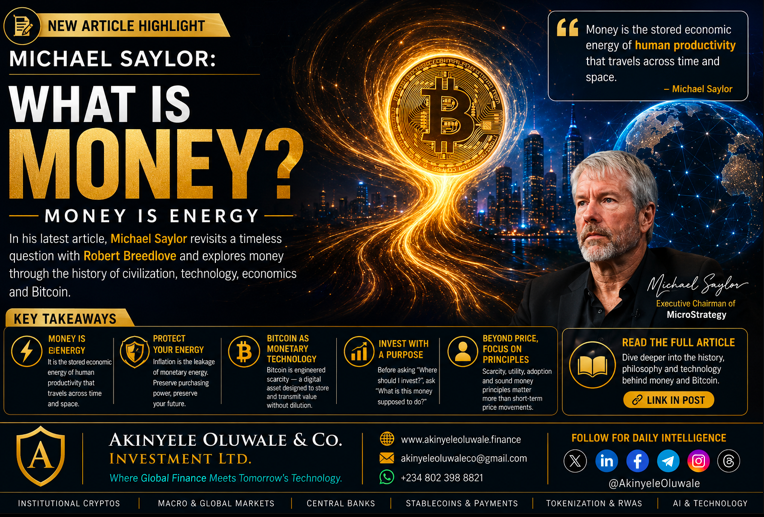
What Is Money? Michael Saylor Returns to First Principles: Money as Energy, Bitcoin as a Monetary Technology
Michael Saylor has revived one of the most fundamental questions in finance what exactly is money? His answer, developed with Robert Breedlove, goes far beyond currency. Saylor sees money as stored economic energy that allows human productivity to travel across time and space, with Bitcoin representing an engineered attempt to preserve that energy.
Published: 16 August 2026
Category: Bitcoin • Digital Assets • Investing Lessons
By: Akinyele Oluwale & Co. Investment Ltd.
Executive Summary
Michael Saylor has returned to one of the central ideas behind his Bitcoin thesis: “Money is energy.”
In a newly promoted article, What Is Money?, Saylor points readers back to his long-running intellectual exploration with Robert Breedlove, beginning with the history of civilisation, technology and economics before arriving at Bitcoin.
This is not a new theory from Saylor. His original discussions with Breedlove developed across an extensive series in which money was described as a mechanism for storing and transferring human economic energy across time and space. Saylor's own website continues to archive The Saylor Series as part of his Bitcoin resources. (Strategy)
The investing lesson is bigger than Bitcoin:
Before deciding where to invest money, understand what money is supposed to preserve your past productivity and future purchasing power.
What Happened?
Saylor shared What Is Money? with the statement:
“Money is Energy.”
The article revisits his discussions with Breedlove and approaches money through the history of civilisation, technological advancement and monetary systems before connecting those ideas to Bitcoin.
Breedlove's What Is Money? project itself defines money conventionally as a universal medium of exchange, but then explores deeper questions around time, human action, productivity and value. (The Freedom Analects)
Saylor takes the argument further.
His thesis is that human beings convert time, intelligence, labour and resources into economic output. Money allows part of that output to be stored rather than consumed immediately.
In that sense, money becomes a claim on future economic resources.
Context / Background
Think about a worker earning ₦1 million.
That money didn't simply appear.
Behind it were hours of work, knowledge, experience and productive effort.
If the worker spends ₦700,000 and saves ₦300,000, that remaining money effectively carries part of today's productive effort into the future.
This is where Saylor's energy analogy becomes useful.
If the monetary asset storing that value loses purchasing power rapidly, some of the holder's economic capacity disappears with it.
Saylor argues that monetary inflation therefore resembles leakage from an energy system. His discussions with Breedlove repeatedly connect monetary debasement with loss of stored economic energy. (Podcast Notes)
It is a powerful metaphor but investors should recognise it as an economic and philosophical framework, not a literal claim that money is physical energy governed identically by thermodynamics.
Why It Matters
Most investors begin with:
“What should I buy?”
Saylor's framework forces an earlier question:
“What am I trying to preserve?”
Cash provides liquidity and transactional convenience.
Bonds exchange capital for contractual income.
Equities provide ownership in productive businesses.
Property provides access to scarce physical assets and income potential.
Gold has historically served as a monetary store of value.
Bitcoin attempts something different: digitally scarce ownership transferable globally without requiring a central monetary issuer.
Once money is viewed as stored purchasing power, investment becomes partly a search for ways to protect and increase that purchasing power over time.
Winners & Losers / Key Stakeholders
Saylor's argument naturally favours scarce assets when fiat currencies lose purchasing power.
Bitcoin is his preferred answer.
Its maximum supply is governed by protocol rules, while its network enables value to move globally without relying on the monetary policy of an individual country.
But scarcity alone does not make an investment successful.
Investors must still consider valuation, volatility, custody, regulation, liquidity and opportunity cost.
Bitcoin can be structurally scarce and still experience enormous price declines.
That distinction matters.
Short-Term Impact
Saylor's latest message is unlikely to change Bitcoin's short-term price direction by itself.
Bitcoin remains influenced by ETF flows, global liquidity, interest rates, regulation, leverage and investor sentiment.
The significance of the article is therefore intellectual rather than immediately market-moving.
It reinforces the long-term thesis behind Saylor's Bitcoin strategy rather than making a short-term trading call.
Long-Term Impact
The deeper debate concerns what people will choose to use as stores of economic value in an increasingly digital economy.
For centuries, societies moved between commodities, precious metals, banknotes, deposits and electronic money.
Bitcoin introduces another possibility: digitally native scarcity.
Whether Bitcoin ultimately becomes a dominant global store of value remains uncertain.
But the question it has forced investors to confront is increasingly difficult to ignore:
What characteristics should good money possess in a digital world?
Editorial Perspective
This is where Saylor's argument becomes useful even for investors who disagree with his conclusion.
You do not have to believe Bitcoin will replace fiat currencies to appreciate the underlying question.
Every person who saves is making a monetary decision.
Keeping cash is a decision.
Buying bonds is a decision.
Owning equities is a decision.
Buying property, gold or Bitcoin is a decision.
And every decision involves exchanging present consumption for expected future purchasing power.
The real enemy is therefore not simply volatility.
It is permanent loss of purchasing power.
What to Watch Next
Watch institutional Bitcoin adoption, ETF flows, corporate treasury strategies, monetary inflation, sovereign debt, real interest rates and regulatory treatment.
Also watch whether Bitcoin increasingly functions as collateral and a treasury reserve asset rather than primarily as a speculative trading instrument.
That transition would provide a stronger test of Saylor's monetary thesis.
Investing Lesson
Before asking:
“Where should I invest my money?”
Ask:
“What am I trying to make this money do?”
Preserve purchasing power?
Generate income?
Provide liquidity?
Compound capital?
Protect against inflation?
Different objectives require different assets.
Understanding the purpose of your money should come before selecting the investment.
Key Takeaways
Saylor's “money is energy” thesis views money as a technology for storing and transmitting economic productivity across time and space. Bitcoin, in his framework, attempts to improve that function through engineered digital scarcity. (Podcast Notes)
But investors should distinguish the philosophical thesis from investment certainty.
Scarcity matters. Price matters too.
Editorial Bottom Line
The most valuable part of Saylor's argument may not be his answer.
It is the question:
What is money?
If money represents stored economic effort, then inflation, investing, saving and asset allocation look different.
You stop seeing investing merely as a hunt for returns.
You begin seeing it as a battle to carry today's productive effort safely into tomorrow.
Bitcoin may be Saylor's answer.
Every investor still has to determine their own.
Sources / Notes
Primary context: Michael Saylor's Saylor Series resources and Robert Breedlove's What Is Money? project; supporting historical material from their extended discussions on money, technology, energy and Bitcoin. (Strategy)
Akinyele Oluwale & Co. Investment Ltd.
Where Global Finance Meets Tomorrow's Technology.