

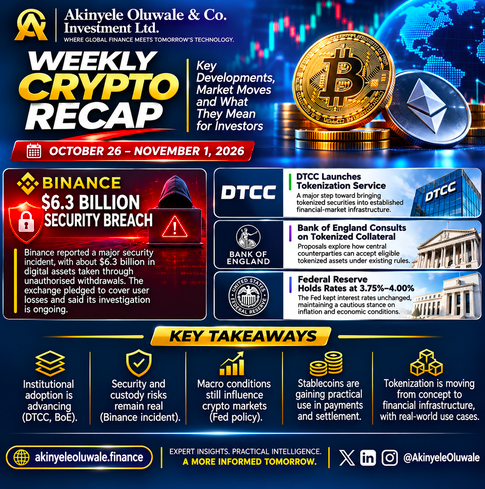
WEEKLY CRYPTO RECAP | OCTOBER 26 – NOVEMBER 1, 2026
Published: Sunday, November 1, 2026 | Category: Crypto & Digital Assets | By: Akinyele Oluwale
From tokenized securities and stablecoin payments to artificial intelligence, central-bank policy and investment risk, the week's developments reveal a financial industry trying to turn blockchain innovation into practical, regulated infrastructure.
This week's recap brings together the seven editorial themes covered by Akinyele Oluwale & Co. Investment Ltd.: institutional cryptocurrency, AI and blockchain, macroeconomics, stablecoins, tokenization, investing discipline and their implications for global financial markets.
The central lesson is that technological progress, commercial adoption and investment returns are three different things. Investors and business leaders need to distinguish between them.
The following developments provide the factual foundation for the recap:
October 28 — DTCC launched its Tokenization Service, allowing eligible participants to create tokenized representations of securities held within DTC infrastructure. This is a significant development for institutional settlement and collateral mobility. DTCC
October 28 — The US Federal Reserve held interest rates at 3.75%–4.00%, reinforcing the importance of inflation and monetary policy for financial-market valuations. Federal Reserve issues FOMC statement
October 29 — The Bank of England opened a consultation on tokenized collateral, examining how central counterparties could accept eligible tokenized assets within existing regulatory standards. The UK's central bank
October 30 — Cryptocurrency markets remained under pressure. One seven-day market analysis reported Bitcoin down approximately 4.7% and Ethereum down 5.9% for the period ending October 30. Performance figures vary with the measurement window and data provider. Sector Alpha
These events point to a striking contrast: institutional blockchain infrastructure continued to advance even as cryptocurrency prices weakened.
Executive Summary
The final week of October 2026 delivered a powerful reminder that cryptocurrency markets and blockchain infrastructure are developing along different paths.
While Bitcoin and other major digital assets faced selling pressure, important financial institutions continued building systems for tokenized securities, collateral management and digital payments.
However, the most consequential event of the week was a major security breach disclosed by Binance.
The exchange reported that approximately $6.3 billion in digital assets had been taken through unauthorised withdrawals following a compromise of its hot-wallet infrastructure.
Binance committed to covering affected user balances using corporate resources and its Secure Asset Fund for Users (SAFU). The investigation and recovery process remained ongoing.
At the same time, the Depository Trust & Clearing Corporation launched its Tokenization Service, marking a significant development in the integration of blockchain technology with traditional securities infrastructure.
The Bank of England also published proposals concerning the acceptance of tokenized collateral by central counterparties.
Meanwhile, the US Federal Reserve maintained its benchmark interest-rate range at 3.75%–4.00%, keeping monetary policy and financial conditions firmly in focus.
Together, these developments reveal three important realities.
First, institutional interest in blockchain infrastructure continues despite cryptocurrency price volatility.
Second, cybersecurity, custody and operational resilience remain critical challenges for the digital-asset industry.
Third, macroeconomic conditions still influence the valuation and liquidity of digital assets.
The central lesson is that institutional adoption does not eliminate investment risk, and technological innovation does not automatically guarantee financial security.
Consider two developments occurring during the same week.
A major financial-market infrastructure provider launches a system for tokenizing securities held within established custody arrangements.
At nearly the same time, a leading cryptocurrency exchange discloses a multibillion-dollar security incident.
At first glance, these events may appear contradictory.
One suggests increasing institutional confidence in blockchain technology.
The other raises serious concerns about digital-asset security.
But both developments can be true.
Blockchain networks, digital-asset exchanges, custodians and financial institutions perform different functions.
A blockchain may provide a record of transactions, while a trading platform is responsible for maintaining its own operational and security controls.
A security failure at an intermediary does not automatically establish a failure of the underlying blockchain network.
Likewise, the successful launch of tokenization infrastructure does not prove that every digital-asset platform is secure.
For investors and corporate executives, understanding these distinctions is essential.
The financial industry should evaluate each development according to its actual economic and operational implications.
Institutional cryptocurrency adoption continued to attract attention as banks, custodians and financial-market infrastructure providers explored digital-asset services.
The important development is not simply that traditional financial institutions are interested in cryptocurrency.
It is that digital assets increasingly require the same standards of governance, custody, compliance and operational resilience expected elsewhere in finance.
Institutional participation can bring professional risk-management processes and established market relationships.
However, the presence of a major financial institution does not automatically remove technology, counterparty or market risks.
The week's subsequent security developments reinforced that distinction.
The lesson: Institutional credibility must be demonstrated through effective controls, not merely through corporate participation.
Artificial intelligence and blockchain continued to feature prominently in discussions about financial infrastructure.
AI can support data analysis, fraud detection, transaction monitoring and operational efficiency.
Blockchain systems can provide shared transaction records and mechanisms for verifying certain digital claims.
However, neither technology should be treated as a complete solution to financial trust.
An AI-generated output may contain errors.
A blockchain record may be technically valid while the information entered into the system is inaccurate.
Financial institutions must therefore distinguish between the reliability of a technological process and the accuracy of the underlying information.
For business leaders, the relevant question is whether AI and blockchain applications improve measurable outcomes while maintaining accountability.
The lesson: Technology should strengthen verification, not replace professional judgement.
On October 28, the Federal Reserve maintained its benchmark interest-rate target range at 3.75%–4.00%.
The central bank pointed to continued economic expansion while acknowledging elevated inflation and uncertainty.
This decision matters for cryptocurrency markets because interest rates influence financing conditions, investment valuations and the relative attractiveness of financial assets.
When borrowing costs remain elevated, investors may become more selective about risk.
Assets whose valuations depend heavily on future expectations can be particularly sensitive to changes in monetary policy.
However, the relationship between interest rates and cryptocurrency prices is not mechanical.
Digital-asset markets are also influenced by security incidents, regulation, investor positioning and liquidity.
The lesson: Cryptocurrency analysis must consider macroeconomic conditions rather than treating digital assets as isolated markets.
Stablecoins remained an important area of financial innovation.
Earlier in October, Visa announced that its Visa Direct stablecoin-enabled prefunding capabilities had progressed from pilot testing to commercial deployment, with Inyo Global as the first enabler.
This represented a practical development in the use of stablecoins within cross-border payment infrastructure.
However, the week's Binance security incident highlighted a different dimension of the stablecoin ecosystem.
Stablecoins may be used in payments, held on exchanges or transferred across blockchain networks.
Their operational safety depends partly on the systems and intermediaries involved.
A stablecoin's reserve structure does not protect an investor from every possible custody or platform failure.
Likewise, the ability to freeze certain tokens during an investigation can support recovery efforts while raising important questions about governance and control.
For businesses considering stablecoin payments, the relevant considerations include settlement efficiency, legal rights, custody arrangements, redemption reliability and operational security.
The lesson: Faster money movement is valuable only when supported by reliable financial controls.
October 28 marked an important development when DTCC launched its Tokenization Service.
The service enables tokenized representations of eligible securities held within DTC infrastructure.
Its stated objectives include improving collateral mobility, capital efficiency and access to liquidity.
This is significant because it connects blockchain-based representations with established financial-market infrastructure.
On October 29, the Bank of England launched a consultation concerning central counterparties accepting tokenized forms of eligible collateral.
The Bank indicated that existing regulatory arrangements can accommodate tokenized collateral when the relevant requirements are satisfied.
These requirements include the ability to value, transfer and realise collateral, including during stressed market conditions.
The distinction is important.
Tokenization does not automatically make an asset acceptable as collateral.
The asset must still satisfy legal, financial and operational standards.
The lesson: Institutional tokenization is increasingly being evaluated according to practical financial usefulness rather than technological novelty.
The week's cryptocurrency price movements reinforced the importance of risk management.
One seven-day market analysis covering the period ending October 30 reported Bitcoin declining approximately 4.7% and Ethereum approximately 5.9%.
These figures are dependent on the observation period and pricing methodology.
The broader lesson is more important than the precise percentage.
An investor can believe in the long-term potential of blockchain technology and still experience substantial short-term investment losses.
Consider a portfolio worth ₦1 million.
A 20% decline reduces its value to ₦800,000.
To recover the original amount, the portfolio must subsequently gain 25%.
A 50% loss requires a 100% gain to recover.
This mathematics demonstrates why diversification, liquidity and realistic risk assessment matter.
Investors should also recognise that diversification cannot eliminate all losses, particularly during broad market disruptions.
The lesson: Financial resilience matters more than confidence in market predictions.
The most consequential digital-asset event of the week was Binance's disclosure of a major security breach.
According to the exchange's October 30 statement, unauthorised withdrawals followed a compromise of hot-wallet infrastructure beginning on October 29.
Binance estimated the value of the affected assets at approximately $6.3 billion.
The company reported that around $3 billion in affected assets had been frozen on-chain.
It also committed to covering the financial impact through corporate funds and SAFU resources.
At the time of its update, Binance said its investigation remained ongoing and that it had not found evidence of leaked wallet private keys.
Withdrawals were temporarily suspended while the exchange carried out security checks and remediation work.
These statements describe the company's reported position during an active investigation. They should not be interpreted as an independently completed forensic assessment or proof that all recovery measures have succeeded.
For the wider cryptocurrency industry, the incident raises questions about operational security, exchange custody, internal controls and the management of concentrated digital-asset holdings.
It also highlights the importance of distinguishing between assets held through intermediaries and assets held under other custody arrangements.
The lesson: Security is not a secondary consideration in digital finance. It is a fundamental requirement for institutional trust.
The week's developments reveal a structural change in the cryptocurrency industry.
The conversation is moving beyond whether digital assets will attract institutional attention.
The more demanding question is whether the infrastructure supporting those assets can meet the operational standards expected in global finance.
DTCC's tokenization launch demonstrates how established financial-market infrastructure can integrate digital representations of securities.
The Bank of England's consultation shows regulators examining how tokenized assets might function within existing clearing arrangements.
Visa's stablecoin deployment demonstrates that blockchain-linked payment capabilities are entering selected commercial workflows.
However, Binance's security incident illustrates that digital-asset infrastructure remains vulnerable to serious operational failures.
These developments should not be viewed in isolation.
They form part of the same financial transformation.
Technology is changing how assets are represented, transferred, safeguarded and used.
But the fundamental responsibilities of financial institutions remain.
Assets must be protected.
Ownership must be legally clear.
Transactions must be properly authorised.
Financial obligations must be enforceable.
And risks must be identified, monitored and managed.
The institutions that combine technological efficiency with strong governance may be better positioned to develop durable financial services.
Cryptocurrency markets experienced downward pressure during the week.
The combination of security concerns, macroeconomic uncertainty and changing investor expectations illustrates how multiple risks can influence prices simultaneously.
Price weakness should not automatically be interpreted as proof that the underlying technology has failed.
Equally, long-term technological potential does not guarantee an investment return.
The Binance incident places renewed attention on exchange security, custody arrangements, operational controls and transparency.
Investors and institutions may increasingly scrutinise how trading platforms safeguard assets and manage potential disruptions.
The freezing of affected assets during the security response demonstrates that certain stablecoin arrangements include mechanisms through which issuers can restrict token movements.
Such mechanisms can be relevant to investigations and recovery efforts, but they also require clear governance and accountability.
The week's events reinforce the commercial importance of custody, asset servicing and operational resilience.
Financial institutions entering digital-asset markets must demonstrate that their systems can withstand technical failures and security threats.
DTCC's launch and the Bank of England's consultation support the view that tokenization is becoming a serious financial-infrastructure subject.
However, adoption will depend on enforceable rights, regulatory compatibility and measurable economic benefits.
For African financial institutions and businesses, digital finance may offer opportunities to improve cross-border payments and market infrastructure.
But successful adoption requires attention to local regulation, currency exposure, customer protection, cybersecurity and reliable financial counterparties.
The economic case must be evaluated carefully.
At Akinyele Oluwale & Co. Investment Ltd., we believe this week's developments offer an important lesson for investors, regulators and financial executives.
Blockchain innovation is advancing, but the quality of financial infrastructure remains the decisive issue.
A successful technology demonstration is not the same as a sustainable commercial business.
A tokenized asset is not automatically more liquid than its underlying asset.
A stablecoin is not automatically equivalent to a protected bank deposit.
And an institution's involvement in cryptocurrency does not eliminate operational risk.
The industry must move beyond announcements and examine results.
Are transactions becoming more efficient?
Are investors receiving clearer legal protections?
Are custody arrangements becoming more resilient?
Can financial institutions demonstrate measurable cost savings?
Are security controls capable of protecting assets under adverse conditions?
These questions deserve greater attention than speculative predictions about future cryptocurrency prices.
For corporate executives, the appropriate response is neither unconditional enthusiasm nor blanket rejection.
It is disciplined evaluation.
Technology should be adopted when it solves a genuine business problem and when the expected benefits justify the associated risks and costs.
For investors, the same principle applies.
A convincing market narrative should never replace valuation, financial analysis or an understanding of potential losses.
The future of digital finance will be shaped not only by what technology can do, but by what institutions can reliably deliver.
As November begins, several developments deserve close attention.
1. Binance's security investigation
Monitor verified disclosures concerning the cause of the breach, recovery of affected assets, restoration of services and the exchange's updated controls.
2. Proof of reserves and customer protection
Watch whether Binance publishes the promised updated reserve information and how independently verifiable its disclosures are.
3. DTCC's tokenization adoption
The launch of infrastructure is only the beginning. The next question is how extensively eligible participants use the service in real financial workflows.
4. Bank of England consultation
Monitor industry responses and subsequent supervisory guidance concerning tokenized collateral.
5. Federal Reserve policy
Inflation, economic activity and future monetary-policy decisions may continue influencing global liquidity and digital-asset valuations.
6. Stablecoin commercial adoption
Distinguish announced partnerships from actual transaction activity, commercial volumes and measurable financial benefits.
7. Institutional custody standards
Expect increased scrutiny of operational resilience, asset segregation, cybersecurity and third-party risk management.
8. Cryptocurrency market volatility
Investors should monitor changing financial conditions without treating short-term price movements as reliable predictions of future returns.
The week's most serious digital-asset development was Binance's reported $6.3 billion security breach.
Binance committed to covering affected customer losses, but its investigation and recovery process remained ongoing.
DTCC launched institutional tokenization infrastructure on October 28.
The Bank of England opened a consultation on tokenized collateral on October 29.
The Federal Reserve maintained its interest-rate target range at 3.75%–4.00%.
Bitcoin and Ethereum experienced price weakness during the period, demonstrating continued market volatility.
Stablecoins are advancing into commercial payment infrastructure, but custody and operational risks remain important.
Tokenization does not automatically establish liquidity, legal ownership or collateral eligibility.
Institutional adoption must be supported by governance, security and measurable economic value.
Long-term investment discipline requires understanding risk rather than relying on technological optimism.
Akinyele Oluwale & Co. Investment Ltd. is an institutional financial intelligence platform focused on cryptocurrency, blockchain, artificial intelligence, stablecoins, tokenization, real-world assets, central banking and global financial markets.
Our mission is to provide evidence-based analysis that explains significant developments, identifies their implications and supports informed financial decision-making.
We believe financial innovation should be evaluated according to its economic usefulness, legal foundations, operational resilience and contribution to responsible financial development.
The final week of October 2026 demonstrated that digital finance is entering a more demanding stage of development.
Traditional financial institutions are introducing blockchain-based infrastructure.
Regulators are examining how tokenized assets fit within established financial systems.
Payment companies are exploring practical stablecoin applications.
Yet serious security failures remind the industry that technological progress must be accompanied by strong operational safeguards.
For investors and executives, the conclusion is clear.
Do not confuse adoption with safety.
Do not confuse innovation with profitability.
And do not confuse market enthusiasm with sustainable financial value.
The next chapter of cryptocurrency will be determined by which institutions can combine innovation, security, legal certainty and financial discipline.
Observe the change. Understand the implications. Position with discipline.
Akinyele Oluwale & Co. Investment Ltd.
Where Global Finance Meets Tomorrow's Technology.