

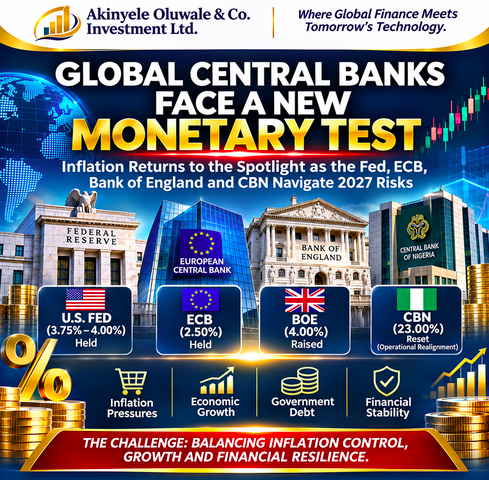
As the world approaches 2027, central banks face a complex challenge: controlling inflation without unnecessarily weakening economic activity, while managing government debt pressures, financial-market vulnerabilities and the growing influence of artificial intelligence.
Published: 18 November 2026
Category: Macro & Central Banks
By: Akinyele Oluwale & Co. Investment Ltd.
Global monetary policy is entering a period in which interest-rate decisions are becoming increasingly difficult. For several years, the central question facing central banks was how aggressively they should respond to inflation. Today, the challenge is broader. Monetary authorities must assess inflation alongside employment, economic growth, financial stability, government borrowing costs and the risks emerging from highly valued technology-related investments. The United States Federal Reserve, European Central Bank, Bank of England, Bank of Japan and Central Bank of Nigeria operate in different economic environments. Their policy decisions therefore need not move in the same direction. This divergence matters. Interest-rate differences influence international capital flows, exchange rates, government bond yields, business financing costs and investor expectations. For emerging economies such as Nigeria, developments in advanced-economy monetary policy can have consequences beyond domestic borders.
Our central assessment is that the next phase of monetary policy will be defined not simply by whether interest rates rise or fall, but by how successfully central banks balance price stability, sustainable growth and financial resilience.
At its meeting on 28 October 2026, the Federal Reserve maintained its benchmark federal funds rate at 3.75%–4.00%. The decision was not unanimous. Two policymakers preferred a quarter-percentage-point increase, demonstrating continuing concern about inflation. The Federal Reserve acknowledged resilient economic activity and strong productivity growth but maintained that inflation remained elevated. "Federal Reserve issues FOMC statement". The policy challenge is clear: raising interest rates further could help restrain inflation but might also increase financing costs and weaken interest-sensitive economic activity. Conversely, reducing rates prematurely could allow inflationary pressures to persist. The Federal Reserve is scheduled to release the minutes of its October meeting later on 18 November. As of this article's publication time, those minutes are not yet available.
United Kingdom: The Bank of England Raises Rates to 4%
One of the most important recent developments occurred on 5 November, when the Bank of England announced an increase in Bank Rate from 3.75% to 4.00%. The Monetary Policy Committee voted 8–1 for the increase, with the dissenting member favouring a larger rise. The decision followed renewed inflationary pressure associated with elevated energy prices. UK consumer price inflation had reached 3.5% in September, and the Bank projected that inflation could rise to approximately 5% by the middle of 2027.
Nigeria's monetary policy environment remains fundamentally different from those of the major advanced economies. At its September 2026 meeting, the Central Bank of Nigeria reset the Monetary Policy Rate to 23.00%, while retaining a 45% cash reserve requirement for deposit money banks. The CBN explicitly described the rate reset and corridor recalibration as an operational realignment, rather than a change in the underlying monetary-policy stance. "Central Bank of Nigeria". That distinction is important. A reduction in a published policy-rate number does not necessarily mean that monetary conditions have become proportionately easier. The practical effects depend on banking liquidity, market interest rates, credit availability and the transmission of monetary policy to the wider economy. For Nigerian businesses, the immediate concerns remain financing costs, access to credit, exchange-rate stability and inflation. For households, monetary policy affects purchasing power, savings returns and borrowing conditions. The central question is whether restrictive monetary conditions can help establish durable price stability without imposing excessive pressure on productive investment.
Latest verified policy decisions available as of the morning of 18 November 2026.
Central bank | Policy rate | Latest position |
|---|---|---|
U.S. Federal Reserve | 3.75%–4.00% | Held on 28 October |
European Central Bank | 2.50% | Deposit rate held on 29 October |
Bank of England | 4.00% | Raised on 5 November |
Central Bank of Nigeria | 23.00% | Operational reset in September |
These rates are not directly comparable measures of economic strength. They reflect different policy instruments, inflation conditions and financial systems.
The International Monetary Fund's October 2026 Global Financial Stability Report identified elevated sovereign bond yields as a significant risk to global financial stability. The IMF also highlighted vulnerabilities involving highly valued AI-related assets, nonbank financial institutions and cybersecurity "International Monetary Fund". Government borrowing costs deserve particular attention. When interest rates remain elevated, governments refinancing maturing debt may face higher financing expenses. This can increase pressure on public budgets, especially where debt-service obligations already consume a substantial share of government revenue. The consequences can extend to households and businesses.
Higher government borrowing requirements may contribute to tighter financing conditions, while rising bond yields can influence the pricing of corporate loans and other financial assets. However, central banks should not automatically reduce interest rates simply to make government borrowing cheaper. Their responsibilities include preserving price stability and maintaining confidence in the monetary system.
The institutional challenge is to avoid allowing fiscal pressures to undermine monetary-policy credibility.
The current monetary environment has several practical implications. For commercial banks, interest-rate changes influence funding costs, lending margins, credit demand and the quality of loan portfolios. For businesses, elevated borrowing costs can delay investment decisions and increase working-capital pressures. For households, inflation affects purchasing power, while interest rates influence borrowing and saving decisions. For bond markets, changing inflation expectations can alter yields and the market value of existing fixed-income securities. For equity markets, higher discount rates can reduce the present value investors assign to expected future earnings, particularly for companies whose valuations depend heavily on distant growth. For cryptocurrency markets, changes in global liquidity and risk appetite can influence demand, although no single interest-rate decision determines digital-asset prices. The important lesson is that monetary policy affects financial markets through several channels simultaneously.
At Akinyele Oluwale & Co. Investment Ltd., we believe the present global monetary environment requires greater analytical discipline. Investors and businesses often focus almost exclusively on whether central banks will raise or lower interest rates. That approach is incomplete. A central bank may hold interest rates steady while financial conditions become tighter because government bond yields rise or banks become less willing to lend. Similarly, a reduction in the policy rate does not automatically translate into cheaper credit for businesses. The effectiveness of monetary policy depends on the financial system through which it operates. Three principles deserve particular attention.
First, inflation must be examined beyond headline numbers. Energy prices, wage developments, currency movements and supply constraints can influence whether inflationary pressures persist. Second, monetary policy must be evaluated alongside fiscal conditions. Government borrowing requirements and debt-service obligations can affect financial stability and market interest rates. Third, central bank credibility remains essential. Businesses and investors make decisions based partly on their confidence that monetary authorities will respond consistently to economic developments. For Nigeria, the implications are especially important.
Sustainable economic development requires price stability, functioning credit markets, productive investment and confidence in the financial system. High interest rates may be necessary under certain inflationary conditions, but they also impose costs on businesses that depend on external financing. The policy objective should therefore be durable macroeconomic stability rather than an arbitrary interest-rate target.
Our institutional assessment is that the most successful central banks will be those that respond to economic evidence without allowing short-term political or market pressure to undermine their responsibilities.
The following developments will help determine the direction of monetary policy as 2027 approaches.
Federal Reserve meeting minutes: The October FOMC minutes are scheduled for release on 18 November. They may provide further insight into policymakers' inflation concerns and disagreements.
U.S. inflation and employment: Future readings will help assess whether the Federal Reserve needs to maintain or adjust its restrictive stance.
ECB's December decision: Markets will assess whether the ECB responds to persistent energy-related inflation with another increase.
Bank of England: Its next scheduled decision on 17 December will be important given its projection of higher inflation in 2027.
Nigeria's monetary policy: Attention should remain on inflation, liquidity conditions, exchange-rate developments and the CBN's subsequent policy decisions.
Government bond markets: Rising sovereign yields could create additional financing pressure for governments and businesses.
AI-related financial vulnerabilities: Investors should assess whether technology-sector earnings justify prevailing market valuations.
These are developments to monitor, not predictions of predetermined outcomes.
The Federal Reserve maintained its policy-rate range at 3.75%–4.00% in October.
The Bank of England increased Bank Rate to 4.00% in November.
The ECB held its deposit rate at 2.50% in October amid concerns about energy-driven inflation.
Nigeria's CBN reset its Monetary Policy Rate to 23.00% in September, describing the adjustment as an operational realignment.
Energy prices, fiscal pressures and geopolitical developments are complicating central bank decisions.
Elevated government borrowing costs remain a significant financial stability concern.
Monetary policy affects businesses through credit availability, financing costs, exchange rates and market confidence.
The direction of interest rates alone does not fully describe the state of monetary conditions.
Akinyele Oluwale & Co. Investment Ltd. is an institutional financial intelligence platform specialising in global macroeconomics, central banking, financial markets, institutional cryptocurrency, stablecoins, digital payments, tokenization, real-world assets, artificial intelligence and blockchain technology. Our editorial approach combines evidence-based financial analysis, practical economic education and strategic interpretation of developments affecting global finance. We believe financial intelligence should help readers understand not only what policymakers decide, but why those decisions matter for businesses, investors and the wider economy.
The latest central bank decisions demonstrate that global monetary policy is no longer moving along one predictable path. The Federal Reserve is maintaining restrictive rates. The Bank of England has increased borrowing costs in response to renewed inflationary pressures. The European Central Bank is weighing the effects of energy shocks on inflation and economic activity. Nigeria continues to confront the challenges of monetary stability, financing costs and policy transmission. These developments are interconnected, but their implications differ across economies.
For businesses, the priority is understanding financing risks and preserving operational resilience. For governments, sustainable fiscal management is increasingly important. For central banks, credibility and price stability remain fundamental and for financial-market participants, the lesson is to evaluate economic conditions rather than assume that lower interest rates are inevitable.
The defining challenge for central banks approaching 2027 is not simply choosing the next interest-rate move. It is protecting monetary credibility while managing inflation, economic growth, sovereign debt pressures and financial stability.
Observe the change. Understand the implications. Position with discipline.
Akinyele Oluwale & Co. Investment Ltd.
Where Global Finance Meets Tomorrow's Technology.
Website: www.akinyeleoluwale.finance
Editorial disclaimer: This article is intended for general economic education and institutional financial analysis. It does not constitute personalised investment advice