

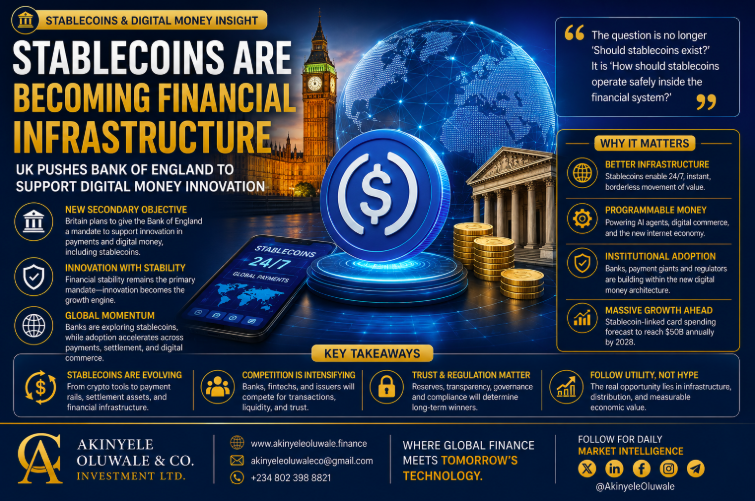
Stablecoins Are Becoming Financial Infrastructure: Britain Pushes the Bank of England to Embrace Digital Money Innovation
The UK government is preparing to give the Bank of England a new secondary objective supporting innovation in payments and digital money, including stablecoins. The significance goes beyond Britain: governments, banks and payment giants are increasingly accepting that programmable money is becoming part of mainstream financial infrastructure.
Published: 27 August 2026
Category: Stablecoins • Digital Money • Payments • Central Banks
By: Akinyele Oluwale & Co. Investment Ltd.
Executive Summary
The stablecoin debate has entered a different phase.
Britain plans to give the Bank of England a secondary objective to support innovation in payments and digital forms of money, while preserving financial stability as its primary responsibility. (Reuters)
That distinction matters.
The question is increasingly moving from:
“Should stablecoins exist?”
to:
“How should stablecoins operate safely inside the financial system?”
At the same time, banks that once viewed stablecoins largely as competitive threats are reportedly exploring their own initiatives. (The Wall Street Journal)
Stablecoins are moving from crypto-market plumbing toward financial infrastructure.
What Happened?
The British government wants the Bank of England to support innovation in areas including stablecoins and other new forms of digital money while continuing to protect monetary and financial stability.
This builds on regulatory work already underway.
In June, the Bank of England published its framework for systemic stablecoin issuers, working alongside the Financial Conduct Authority. The objective is to allow stablecoins to scale while maintaining resilience and confidence in money.
Meanwhile, stablecoin adoption continues expanding beyond crypto exchanges.
Global stablecoin-linked card spending is forecast by payments company RedotPay to reach $50 billion annually by 2028, compared with current levels around one-quarter of that amount.
Background
Stablecoins began primarily as digital dollars for cryptocurrency trading.
That description is becoming outdated.
They are increasingly being used for:
Cross-Border Payments → Treasury Operations → Settlement → Digital Commerce → Tokenized Markets → AI-Agent Payments
Circle reported $73.3 billion of USDC in circulation at the end of Q2 2026 and $14.8 trillion of quarterly on-chain transaction volume. Its payment network had 175 enrolled financial institutions. (Circle)
The technology is therefore moving beyond speculation.
Money itself is becoming programmable.
Why It Matters
Stablecoins solve an important mismatch.
The internet operates:
24 hours a day. Globally. Instantly.
Traditional money often doesn't.
Bank transfers can still depend on jurisdictions, intermediaries, settlement windows and legacy infrastructure.
Stablecoins potentially allow digital dollars and other currencies to move on internet-native rails while remaining connected to conventional money.
That becomes particularly important as commerce itself becomes increasingly automated.
Circle's Agent Stack, for example, allows software agents to hold and transact in USDC programmatically. Circle says 99.3% of x402 agent-payment volume was settling in USDC as of its latest quarterly update.
Winners & Losers / Key Stakeholders
Stablecoin issuers, blockchain networks, payment companies, custodians and digital-asset infrastructure providers could benefit from growing transaction volumes.
Banks face a more complicated choice.
Stablecoins could compete with deposits but banks can also issue, custody, settle or integrate them.
That helps explain why some institutions are reconsidering their earlier resistance.
Central banks and regulators face the hardest balancing act:
Encourage innovation without weakening monetary sovereignty, financial stability or consumer protection.
Short-Term Impact
Expect competition to intensify.
Stablecoins, tokenized bank deposits and conventional payment networks will increasingly overlap.
But investors shouldn't assume every stablecoin or blockchain automatically benefits.
The key question is where sustainable economic value accumulates.
Long-Term Impact
The bigger transformation could be invisible.
Consumers may eventually send money internationally, businesses may settle invoices, and AI agents may purchase computing resources without users thinking about blockchain at all.
The underlying infrastructure simply works.
That is usually what happens when technology becomes genuinely mainstream.
Editorial Perspective
The strongest argument for stablecoins is no longer that they are “crypto.”
It is that they may become better infrastructure for certain forms of digital money movement.
But programmability doesn't eliminate financial risk.
Reserves must remain credible. Redemption must work. Governance must withstand scrutiny. Cybersecurity must be strong.
Technology can improve settlement. It cannot rescue bad collateral or weak governance.
What to Watch Next
Watch UK legislation, Bank of England implementation, bank-issued stablecoin projects, transaction volumes, reserve standards and cross-border payment adoption.
Also watch AI.
Machine-to-machine commerce could become one of stablecoins' most important long-term demand drivers.
Investing Lesson
Follow utility before valuation.
The serious stablecoin thesis isn't:
“Which token will pump?”
It is:
Who owns the infrastructure, liquidity, distribution and economics of programmable money?
Key Takeaways
The evolution is accelerating:
Crypto Trading Tool → Digital Dollar → Payment Rail → Settlement Asset → Programmable Money → Financial Infrastructure
That transition is what investors should understand.
Editorial Bottom Line
Stablecoins are no longer knocking on the door of traditional finance.
Traditional finance is increasingly rebuilding the door around them.
The winners will not necessarily be those with the loudest crypto narrative.
They will be the institutions that make digital money trusted, liquid, compliant and useful at global scale.
Akinyele Oluwale & Co. Investment Ltd.
Where Global Finance Meets Tomorrow’s Technology