

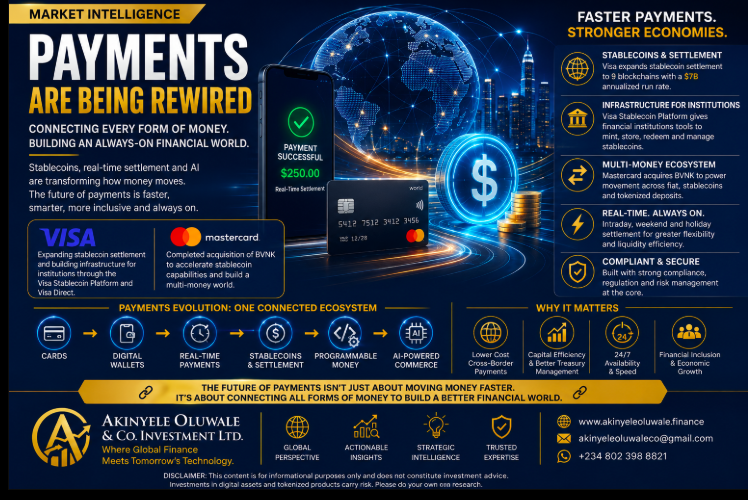
Payments Are Being Rewired: Stablecoins, Real-Time Settlement and AI Push Money Into an Always-On Era
The payments industry is entering a structural transition. Visa is expanding stablecoin settlement and programmable-money infrastructure, while Mastercard has completed its acquisition of BVNK and is pushing toward a “multi-money” ecosystem. The battle is no longer simply about cards versus crypto, it is about connecting every form of money.
Published: 21 August 2026
Category: Stablecoins & Payments • Digital Finance • Market Intelligence
By: Akinyele Oluwale & Co. Investment Ltd.
Executive Summary
Global payments are changing at both ends of the transaction.
At the front end, contactless payments, digital wallets and increasingly AI-powered commerce are changing how transactions begin. Behind the scenes, stablecoins, real-time payments and blockchain settlement are changing how money actually moves.
Visa's stablecoin settlement pilot has expanded to nine blockchains and reached a $7 billion annualised settlement run rate. Mastercard, meanwhile, completed its acquisition of stablecoin infrastructure company BVNK on 3 August, strengthening its ability to connect fiat currencies, stablecoins and tokenized deposits. (Visa Corporate)
The direction is becoming clearer:
Payments are moving from isolated rails toward interconnected, always-on financial infrastructure.
What Happened?
Visa has been steadily moving stablecoins deeper into its payment network.
Its Visa Direct pilot allows businesses to use stablecoins for prefunding cross-border payouts, potentially reducing the need to park fiat capital across numerous accounts and currencies. Visa is also piloting direct stablecoin payouts to recipients' wallets. (Visa Corporate)
In July, Visa went further with the Visa Stablecoin Platform, providing financial institutions and fintechs with infrastructure for accessing, storing, redeeming, minting and burning stablecoins. (Visa Corporate)
Mastercard is following a similarly ambitious path. Its BVNK acquisition adds infrastructure for businesses to move, hold, convert and manage value across digital and traditional currencies. (Mastercard)
Background
For decades, payments largely depended on separate systems.
Cards handled one type of transaction.
Banks handled another.
Remittance companies specialised in cross-border transfers.
Blockchain networks developed separately.
That separation is beginning to disappear.
Mastercard describes the emerging environment as a “multi-money world” where fiat currencies, stablecoins, tokenized deposits and other forms of value coexist. (Mastercard Investor Relations)
The next competitive advantage may therefore be interoperability.
Why It Matters
The biggest transformation may be invisible to consumers.
Imagine paying normally with a card while the institutions behind that transaction settle using stablecoins.
The customer experience barely changes.
The financial plumbing does.
Mastercard announced plans in June for additional intraday, weekend and holiday settlement alongside regulated stablecoin settlement, giving issuers and acquirers greater flexibility over liquidity. (Mastercard)
For businesses, that could mean less trapped capital, faster access to funds and better treasury management.
In cross-border payments, those efficiencies become especially valuable.
Winners & Losers / Key Stakeholders
Visa and Mastercard could remain powerful precisely because they are adapting rather than defending old infrastructure.
Banks can participate through deposits, stablecoins, custody and settlement.
Fintechs can build specialised services on top of these rails.
Blockchain networks compete for institutional transaction activity.
Businesses and consumers potentially gain faster and more flexible payments.
Traditional intermediaries dependent on slow settlement and unnecessary friction face the greatest pressure.
Short-Term Impact
Stablecoins are likely to gain fastest behind the scenes.
Businesses don't necessarily care whether a payment uses a blockchain, card network or bank rail.
They care whether it is:
Fast. Cheap. Reliable. Compliant. Available.
This is why institutional payment adoption may look very different from speculative crypto adoption.
The technology could become successful precisely when ordinary users stop noticing it.
Long-Term Impact
Payments could eventually become always-on and increasingly intelligent.
Mastercard says stablecoins, AI and real-time payment systems are converging into a more interoperable payments stack. (Mastercard)
AI agents may initiate transactions.
Stablecoins could provide programmable settlement.
Real-time networks could move domestic money instantly.
Traditional card and banking infrastructure could connect everything together.
Money would increasingly move at internet speed.
Editorial Perspective
The mistake is assuming new payment technology must destroy the old system.
Visa and Mastercard demonstrate another possibility:
incumbents can absorb new rails.
The future may not be:
Banks OR blockchain.
It may be:
Banks + Cards + Stablecoins + Blockchains + Real-Time Payments + AI.
The strategic prize belongs to whoever makes those systems work together reliably.
What to Watch Next
Watch Visa's stablecoin settlement volumes and additional Visa Direct partners.
Watch Mastercard's integration of BVNK and expansion of stablecoin settlement.
For Africa, Mastercard's partnership with Yellow Card is particularly worth following because it targets remittances, B2B settlement and treasury applications across EEMEA. (Mastercard)
Also watch AI-powered payments. The convergence between programmable money and autonomous commerce could become the next major story.
Investing Lesson
Don't only follow the payment method. Follow the infrastructure connecting payment methods.
Technologies change.
Successful networks survive by becoming the bridge between them.
Key Takeaways
The payments revolution is evolving through:
Cards → Digital Wallets → Real-Time Payments → Stablecoins → Programmable Money → AI-Powered Commerce
But these systems are increasingly converging rather than simply replacing one another.
Editorial Bottom Line
The future of payments isn't merely about moving money faster.
It is about making money interoperable, programmable and continuously available.
Visa, Mastercard, banks, fintechs and blockchain companies are increasingly competing for the same strategic position:
the infrastructure layer connecting every form of money.
Whoever controls that connection could help define how global commerce moves for decades.
Notes
Primary sources: Visa and Mastercard announcements covering Visa Direct, stablecoin settlement, the Visa Stablecoin Platform, Mastercard's BVNK acquisition and next-generation settlement infrastructure. (Visa Corporate)
Akinyele Oluwale & Co. Investment Ltd.
Where Global Finance Meets Tomorrow's Technology.