

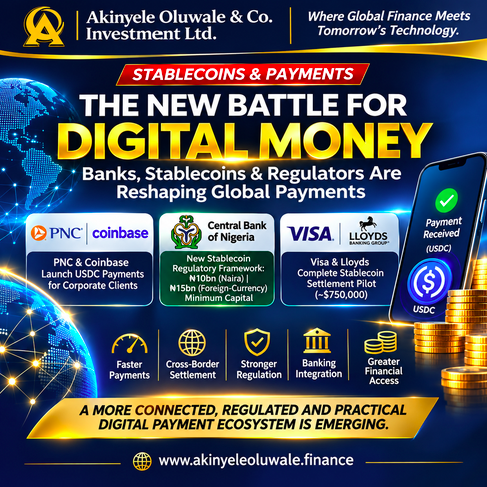
THE NEW BATTLE FOR DIGITAL MONEY: WHY STABLECOINS, BANKS AND PAYMENT NETWORKS ARE COMPETING TO CONTROL GLOBAL SETTLEMENT
Stablecoins are moving beyond cryptocurrency trading into the infrastructure of international payments. As banks, payment companies and regulators develop new approaches to digital money, the central question is shifting from how quickly value can move to whether that value can be redeemed, regulated and reliably used.
Published: Thursday, 19 November 2026
Category: Stablecoins & Payments
By: Akinyele Oluwale & Co. Investment Ltd.
Editorial focus: Stablecoin Regulation | Cross-Border Payments | Digital Banking | Institutional Settlement | Nigeria | Financial Infrastructure
The global stablecoin industry is entering a more demanding phase of development. For years, stablecoins were primarily discussed as instruments that allowed cryptocurrency traders to move between digital assets without immediately converting their holdings into conventional bank money. Today, their potential applications extend much further. Banks, payment networks, fintech companies and regulators are examining how stablecoins could support international transfers, business payments, digital commerce and institutional settlement but this transition raises a fundamental question: What makes a digital token reliable enough to function as money?
A stablecoin may move across a blockchain within seconds, yet its practical usefulness depends on several additional factors: the quality of its reserves, the enforceability of redemption rights, the reliability of its issuer, the availability of banking connections and compliance with applicable regulations. The emerging competition is therefore not simply between different stablecoin tokens. It is increasingly a competition between payment infrastructures, regulatory frameworks and institutions capable of connecting blockchain-based value with the traditional financial system. For Nigeria and other emerging markets, the implications are particularly important. Digital payments could improve certain cross-border financial processes, but successful adoption will depend on consumer protection, foreign-exchange rules, banking integration and financial stability.
Our central assessment is that the future of stablecoins will be determined less by transaction speed alone and more by the ability to deliver trustworthy, redeemable and commercially useful digital money.
On 9 November 2026, PNC Bank announced an institutional payment service developed with Coinbase. The service allows eligible corporate and institutional banking clients to receive USDC, a U.S. dollar-backed stablecoin, through the Ethereum blockchain. The incoming USDC is automatically converted into U.S. dollars and credited to the client's designated PNC bank account. The service is initially available to a limited group of eligible clients as a pilot.
This development is significant for three reasons. First, it connects blockchain-based payments with a conventional commercial bank account. Second, it reduces the need for participating businesses to manage received stablecoins as a separate operational activity. Third, it demonstrates that established banks are exploring stablecoin infrastructure without requiring every corporate client to become a cryptocurrency specialist. Consider a business receiving payment from an overseas customer. Under a conventional arrangement, the transfer may involve correspondent banks, processing schedules and intermediary charges. A stablecoin-based arrangement could potentially simplify some stages of that process. However, the final outcome still depends on banking access, conversion arrangements, compliance checks and transaction costs.
The central lesson is that a stablecoin becomes more commercially useful when businesses can convert it into ordinary bank money through reliable financial infrastructure.
One of the most consequential developments for African digital finance occurred on 5 November 2026. The Central Bank of Nigeria introduced its Regulations for the Operations of Non-Security Virtual Assets in Nigeria. The framework establishes licensing and supervisory requirements for stablecoin issuers and specified virtual-asset service providers.
It distinguishes between two categories of stablecoin issuers.
Regulatory category | Type of stablecoin | Minimum paid-up capital |
|---|---|---|
Class 1 | Naira-referenced stablecoins | ₦10 billion |
Class 2 | Foreign-currency-referenced stablecoins | ₦15 billion |
Other covered virtual-asset service providers face separate licensing and capital requirements, with a reported minimum of ₦1 billion for relevant categories. The regulations also address reserve arrangements, governance, transaction monitoring, customer identification and financial-crime controls. An important distinction is that the introduction of a regulatory framework does not mean every existing stablecoin has automatically received authorisation to operate in Nigeria. Issuers must satisfy the applicable requirements and obtain the necessary approvals. The rules also restrict algorithmic stablecoins that rely primarily on market mechanisms rather than eligible reserve assets to maintain their value.
Existing operators are subject to transitional compliance requirements. For Nigeria, this marks an important change in the regulatory treatment of digital money. Stablecoin activity is increasingly being assessed through the same fundamental questions applied to conventional financial services: who issues the instrument, what supports its value, who supervises the issuer and how customers are protected.
Our assessment is that Nigeria's new framework raises the cost of regulatory compliance while potentially creating a clearer foundation for institutional participation.
Another important development came from Visa and Lloyds Banking Group. On 30 September 2026, the companies announced the completion of a seven-day live pilot involving stablecoin-based cross-border settlement. During the pilot, Lloyds settled approximately $750,000 in payment obligations with Visa. According to the companies, funds reached Visa in under an hour, including transactions conducted over the weekend.
The pilot demonstrates a potential benefit of blockchain-based settlement: financial obligations may be settled outside conventional banking hours. This could be valuable for businesses operating across time zones. However, a successful pilot should not be confused with unrestricted commercial deployment. A controlled test demonstrates technical and operational feasibility under specified conditions. Widespread adoption requires additional evidence concerning reliability, costs, compliance, liquidity and integration with existing financial systems. The commercial opportunity is nevertheless important. Businesses increasingly operate around the clock, while some traditional financial processes remain dependent on banking schedules.
Stablecoins could help reduce that mismatch where the supporting financial arrangements are properly designed.
An October 2026 report citing blockchain analytics firm Allium estimated that stablecoin payments reached approximately $482 billion during the first nine months of 2026, representing reported growth of 45%. The analysis also highlighted efforts by Visa, Mastercard and Stripe to connect stablecoin infrastructure with established payment services. These figures should be interpreted carefully. Stablecoin transaction activity can be measured in different ways. Total blockchain transfers may include trading, treasury movements, transfers between wallets and other activities that do not represent purchases of goods or services.
Therefore, analysts must distinguish between total transfer volume and economic payment activity. The significance of the reported growth is not simply the dollar amount. It is the increasing interest in using stablecoins within familiar financial workflows. Businesses generally do not want to operate complicated payment systems merely to access a new technology. They want payments that are reliable, affordable, compliant and easy to reconcile. That is why integration with existing banking and payment infrastructure is becoming strategically important.
The stablecoin industry is often presented as a competition between individual digital currencies. That perspective is becoming increasingly incomplete. The more important competition may involve the institutions providing the infrastructure around those currencies. This includes stablecoin issuers, banks, payment processors, custodians, blockchain networks and regulatory authorities. A stablecoin issuer may create a digital representation of a currency but businesses still require reliable methods to receive, redeem, transfer and account for that value.
A payment processor may provide the connection between a blockchain transaction and a merchant's existing financial systems. A bank may provide the deposit account into which the stablecoin is converted. Regulators establish requirements intended to protect users and support financial stability. These functions must work together. The emerging financial model is therefore not necessarily one in which stablecoins replace banks. It may be one in which banks and payment companies incorporate stablecoins into selected services. PNC's arrangement with Coinbase illustrates this possibility. The customer receives the benefit of a digital payment mechanism while ultimately holding funds in a conventional bank account.
The strongest stablecoin infrastructure may be the infrastructure that makes digital payments useful without forcing customers to understand every technical process behind them.
Nigeria has important reasons to examine stablecoin development carefully. Cross-border payments remain relevant to international trade, remittances and businesses providing services to overseas clients. In principle, stablecoins could support some of these activities by enabling digital transfers across participating networks. However, technological capability does not automatically establish legal permission or economic advantage. Nigeria must consider the relationship between foreign-currency stablecoins and domestic monetary conditions. For example, widespread use of foreign-currency-referenced tokens could influence demand for naira-denominated financial instruments.
Regulators must also consider how such activity interacts with foreign-exchange rules and financial-crime prevention. The CBN's November framework reflects an attempt to establish clearer regulatory responsibilities. Yet the capital requirements may also create barriers for smaller financial technology companies. A ₦15 billion minimum paid-up capital requirement for foreign-currency stablecoin issuers is substantial. This could favour well-capitalised institutions while limiting the number of firms able to compete directly in issuance. That outcome may support stronger supervision but could also affect market concentration and innovation. The appropriate policy balance will depend on implementation, competition and the quality of regulatory oversight.
Nigeria's opportunity is not merely to increase stablecoin activity. It is to build a financial system in which legitimate digital payments can operate safely, transparently and efficiently.
At Akinyele Oluwale & Co. Investment Ltd., we believe stablecoins are becoming an increasingly important subject in institutional finance. However, the industry must avoid treating transaction speed as the ultimate measure of financial progress. A payment that moves in seconds can still create serious problems if the issuer cannot honour redemption requests. A transaction recorded on a blockchain can still involve an unauthorised recipient and a stablecoin operating across borders may still face legal, regulatory and banking restrictions.
The most important question is whether the payment arrangement works reliably from beginning to end. We believe five principles should guide institutional stablecoin development. First, redemption must be credible. Users need clarity about the conditions under which digital tokens can be exchanged for the referenced currency. Second, reserves must be transparent and appropriate. Financial backing should be evaluated through the applicable regulatory and disclosure requirements. Third, compliance must be integrated into operations. Financial innovation does not remove obligations concerning customer identification and financial-crime prevention. Fourth, interoperability matters. Stablecoins become more useful when they connect with established banking and payment services. Fifth, commercial value must be demonstrated. The relevant question is whether stablecoin-based systems improve cost, reliability, accessibility or settlement efficiency compared with available alternatives. The recent PNC–Coinbase initiative provides an example of institutional integration.
The Visa–Lloyds pilot demonstrates the potential for round-the-clock settlement. Nigeria's regulatory framework illustrates the growing importance of licensing and financial oversight. Together, these developments suggest that the stablecoin market is entering a phase in which operational credibility will increasingly determine competitive advantage.
Our institutional conclusion is that the future of digital payments belongs not necessarily to the fastest blockchain, but to the financial arrangements that combine speed with trust, compliance, liquidity and dependable redemption.
Several developments deserve attention as 2026 approaches its conclusion.
PNC and Coinbase: Whether the limited USDC payment pilot expands to additional corporate clients.
Nigeria's licensing framework: How issuers and service providers respond to the new capital and compliance requirements.
Reserve transparency: Whether issuers improve disclosures concerning the assets supporting stablecoins.
Banking integration: Whether additional commercial banks introduce stablecoin payment services.
Cross-border settlement: Whether pilot projects demonstrate measurable cost savings and operational reliability.
Regulatory cooperation: How authorities coordinate supervision of cross-border digital payment activities.
Merchant adoption: Whether businesses increasingly accept stablecoin-linked payments through existing financial services.
Consumer protection: How disputes, redemption failures and operational incidents are addressed.
The strongest evidence of progress will come from reliable commercial activity rather than promotional announcements.
PNC Bank announced a limited USDC payment service with Coinbase on 9 November 2026.
Eligible corporate clients can receive USDC that is automatically converted into U.S. dollars.
Nigeria introduced a new stablecoin regulatory framework on 5 November.
The CBN established separate licensing categories for naira-referenced and foreign-currency-referenced stablecoins.
The framework includes minimum capital requirements of ₦10 billion and ₦15 billion for the respective issuer categories.
Visa and Lloyds completed a stablecoin settlement pilot involving approximately $750,000.
Stablecoin payment activity is attracting greater attention from traditional payment companies.
Transaction speed alone does not guarantee financial safety or commercial usefulness.
Redemption, compliance, liquidity and banking integration remain essential to sustainable adoption.
Akinyele Oluwale & Co. Investment Ltd. is an institutional financial intelligence platform covering global macroeconomics, central banking, institutional cryptocurrency, stablecoins, digital payments, tokenization, real-world assets, artificial intelligence and blockchain technology. Our editorial mission is to provide evidence-based analysis that explains how financial institutions, regulatory developments and emerging technologies are reshaping the global financial system.
We believe responsible financial innovation must be evaluated through economic usefulness, institutional accountability and long-term financial stability.
The latest developments demonstrate that stablecoins are becoming more closely connected to conventional financial infrastructure. PNC and Coinbase are testing how corporate clients can receive blockchain-based payments through familiar banking arrangements. Visa and Lloyds have demonstrated the potential for settlement outside traditional banking hours.
Nigeria is establishing a more demanding regulatory environment for stablecoin issuance and related financial services. These developments do not mean that stablecoins have solved every challenge associated with global payments. They show that banks, regulators and payment companies are increasingly examining how digital money can function within established financial systems. For businesses, the priority is reliable settlement and practical financial integration. For regulators, it is preserving financial stability and protecting users.
For stablecoin issuers, it is demonstrating credible reserves, redemption arrangements and compliance and for financial institutions, it is determining where blockchain-based settlement offers measurable advantages.
The next generation of global payments will not be defined simply by how quickly digital money moves. It will be defined by whether that money remains trustworthy, redeemable, accessible and useful when it reaches its destination.
Observe the change. Understand the implications. Position with discipline.
Akinyele Oluwale & Co. Investment Ltd.
Where Global Finance Meets Tomorrow's Technology.
Website: www.akinyeleoluwale.finance
Editorial disclaimer: This article provides general financial education and institutional analysis. It does not constitute personalised investment advice, a recommendation to acquire digital assets or a guarantee concerning the stability of any financial instrument.