

Published: October 2026
Category: Institutional Finance
By: Akinyele Oluwale
For years, one question dominated the institutional conversation around cryptocurrency:
Will Wall Street embrace Bitcoin?
That question made sense when digital assets were still largely outside the traditional financial system. Banks were cautious. Regulators were uncertain. Large asset managers were reluctant to move too quickly. Much of the market was driven by retail participation, crypto-native companies and investors willing to operate beyond familiar financial structures.
That world is changing.
The more interesting question today is no longer whether traditional financial institutions will participate in digital assets.
Increasingly, the question is:
What happens when they begin building digital assets into the financial system itself?
There is an important difference between the two.
Buying or providing exposure to Bitcoin is one thing.
Building custody systems, execution services, settlement networks, regulated stablecoin infrastructure, tokenized deposits and blockchain-based financial products is something much bigger.
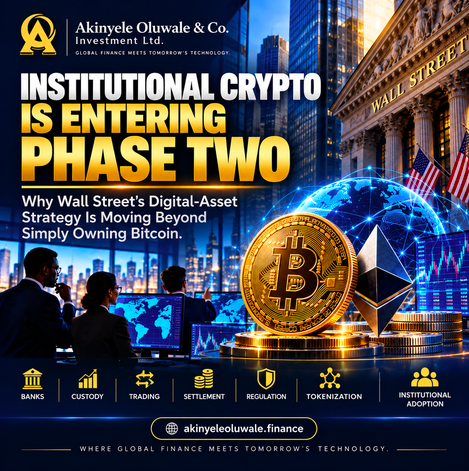
It suggests that institutional crypto may be entering what I would describe as Phase Two.
Phase One was primarily about exposure.
Phase Two is increasingly about integration.
Recent developments reinforce this view. The U.S. Office of the Comptroller of the Currency has reaffirmed that national banks can undertake certain crypto custody, execution and distributed-ledger activities, while its October 2026 final rule implementing key provisions of the GENIUS Act establishes federal requirements around payment stablecoins, including reserve backing, redemption and risk management.
Meanwhile, Deutsche Bank is preparing to launch digital-asset custody and has outlined plans that could eventually extend into stablecoins, tokenized deposits and blockchain-based securities issuance.
Individually, these developments can look like separate headlines.
Viewed together, they tell a larger story.
Institutional crypto is moving from the edge of finance toward its infrastructure.
The first chapter of institutional crypto was largely about gaining access to a new asset class.
Could an institution hold Bitcoin?
Could an asset manager offer exposure?
Could a bank provide custody?
Could digital assets sit alongside stocks, bonds, commodities and other investments?
Those questions have not disappeared, but the conversation is expanding. The emerging institutional landscape increasingly includes custody, execution, regulated stablecoins, tokenized deposits, blockchain-based securities, programmable settlement and connections between traditional financial institutions and digital networks.
This gives us a useful framework:
Observation → Exposure → Infrastructure → Integration → Scale
At the beginning, institutions observed.
Then they experimented with exposure.
Now parts of the financial industry are building infrastructure.
If that infrastructure becomes trusted, interoperable and economically useful, the next stage could be deeper integration.
That does not mean every cryptocurrency will succeed.
It does not mean traditional finance is about to move entirely onto public blockchains.
And it certainly does not mean risk has disappeared.
It means something more measured but potentially more important:
Digital assets are increasingly being treated as a financial-infrastructure question rather than simply a speculative-asset question.
That distinction could shape the next decade of institutional crypto.
Financial history teaches us that an asset becoming popular is not the same thing as that asset becoming institutionalised.
Institutions require systems.
Consider the traditional securities market.
Behind the simple act of buying a share sits an enormous financial architecture involving brokers, exchanges, custodians, clearing houses, settlement systems, banks, regulators, auditors and risk-management processes.
Most investors rarely think about this machinery.
But without it, modern capital markets could not operate at their current scale.
Digital assets face a similar test.
Bitcoin may be technologically capable of moving between wallets without a traditional bank. But institutional participation involves responsibilities that go far beyond transferring an asset from one address to another.
An institution managing other people's money must consider governance.
Who can approve transactions?
How are assets protected?
How is ownership verified?
How are trades executed?
What happens when something goes wrong?
How are transactions reported?
What regulations apply?
How are operational risks controlled?
How does digital-asset activity connect with the institution's existing financial systems?
These questions are not particularly exciting compared with dramatic cryptocurrency price movements but they are precisely the questions that matter if digital assets are to become a durable part of institutional finance.
The Bank for International Settlements noted in April that connections between crypto markets and traditional finance have been growing through areas such as exchange-traded products, custody arrangements, product partnerships and stablecoin reserve holdings, although banks' direct exposures remain relatively small.
That last point is important.
We should not confuse direction of travel with completion of the journey.
Institutional integration is developing.
It is not finished.
A series of developments over the past two years has gradually changed the institutional environment.
In the United States, the OCC reaffirmed in March 2025 that national banks and federal savings associations could engage in certain crypto activities, including custody and some stablecoin and distributed-ledger activities. Two months later, it clarified that banks could also provide certain crypto execution services and use third-party providers, provided appropriate risk-management standards were followed.
The regulator later confirmed that national banks could undertake certain riskless-principal crypto transactions—essentially acting as intermediaries while simultaneously offsetting the transaction rather than maintaining the crypto asset as inventory.
Fast-forward to October 2026.
The OCC has now issued its final rule implementing significant parts of the GENIUS Act for payment stablecoins. The rule establishes standards covering areas including reserves, redemption and risk management, and takes effect in January 2027.
At the institutional level, Deutsche Bank's planned digital-asset custody service provides another useful signal. The significance is not merely that a major global bank wants to custody Bitcoin and Ether.
Its longer-term plans extend into stablecoin transactions, tokenized deposits and blockchain-based securities issuance. The bank has also framed these services as complementary to traditional banking rather than as a replacement for it.
That last point deserves attention.
For years, digital assets were often presented as a challenge to the traditional banking system. Increasingly, some of the institutions inside that system are exploring how digital technology can become part of their own infrastructure.
That is a very different phase of development.
The easiest way to understand this transition is to separate institutional crypto into stages.
Traditional financial institutions initially watched the market.
Bitcoin was interesting, but risky.
Blockchain technology attracted attention, but practical applications were uncertain.
Institutions experimented carefully while keeping most activity separate from their core businesses.
The next stage was about giving investors access.
Investment products expanded.
Custody capabilities improved.
Institutional investors became more comfortable analysing digital assets as part of the broader investment landscape.
Crypto was increasingly something that traditional finance could invest in.
This is where the market is now developing.
Banks and financial institutions are considering:
Custody
Execution
Stablecoins
Tokenized deposits
Digital securities
Blockchain settlement
Programmable payments
Institutional risk management
This changes the relationship.
Crypto is no longer simply an external asset that institutions may choose to buy. Elements of digital-asset technology are beginning to interact directly with financial infrastructure.
If infrastructure becomes reliable enough, institutions can begin connecting digital assets with existing banking, payments and capital-market systems.
The model becomes:
Traditional Finance + Digital Infrastructure
rather than:
Traditional Finance vs Crypto
Scale is the hardest stage.
Technology alone cannot create it.
For digital finance to operate at institutional scale, customers, banks, counterparties, regulators and market infrastructure need to work together.
A recent BIS assessment made this point clearly: isolated tokenized platforms may struggle to access broader liquidity, while scaling requires customers, counterparties and financial-market infrastructure to move together.
That gives us our full progression:
Observation → Exposure → Infrastructure → Integration → Scale
What does this transition mean for markets?
First, it changes how we should measure institutional adoption.
Bitcoin's price alone is an inadequate measure.
So is the number of institutions making announcements about blockchain.
A more useful set of questions would be:
Are regulated institutions building custody capabilities?
Are they developing execution services?
Can digital assets connect efficiently with traditional settlement systems?
Are institutions using blockchain for real financial transactions?
Is liquidity deep enough?
Are regulatory frameworks becoming clearer?
Are digital-money instruments becoming sufficiently trusted for settlement?
Can different platforms communicate with one another?
These questions move us away from headlines and toward infrastructure.
Second, institutional integration could gradually blur some of the boundaries between conventional and digital markets.
Imagine a financial environment where a regulated institution can hold digital assets for clients, execute transactions, use tokenized money for settlement and participate in blockchain-based securities markets.
At that point, "crypto" becomes less useful as a description of the entire system.
We begin talking instead about digital financial infrastructure.
Third, this could increase competition.
Traditional banks are not the only organisations building these systems.
Crypto-native custodians, exchanges, fintech companies, payment providers and technology firms have spent years developing digital-asset capabilities.
Traditional institutions therefore enter a market where specialist companies already possess significant technological experience.
The competition could ultimately revolve around a powerful combination:
Technology + Regulation + Distribution + Trust
Whoever combines those four elements effectively may occupy valuable positions in the next generation of financial infrastructure.
At Akinyele Oluwale & Co. Investment Ltd., we believe the institutional crypto story should be analysed with discipline.
It is easy to move from legitimate institutional developments to exaggerated conclusions.
A bank offering crypto custody does not mean the banking system has moved onto blockchain.
A regulator creating rules does not eliminate market risk.
A tokenized asset does not automatically become more valuable simply because it exists on a distributed ledger.
And institutional participation does not guarantee that every digital asset will survive.
The stronger interpretation is more nuanced.
The financial system is experimenting with digital infrastructure because certain technologies may improve how value is stored, transferred, settled and administered.
The winners will therefore not necessarily be the technologies with the loudest communities or the assets with the strongest short-term price performance.
The long-term winners are more likely to be systems that solve real financial problems while meeting institutional requirements for security, liquidity, compliance, governance and reliability.
This leads to an important principle:
Institutional adoption begins with access, but it reaches scale through integration.
There is another lesson.
For years, much of the crypto industry assumed that disruption meant removing traditional institutions.
The emerging reality may be different.
Sometimes disruption does not destroy the old system.
It changes what the old system is capable of doing.
Banks may remain banks.
Asset managers may remain asset managers.
Central banks may remain central banks.
But the infrastructure connecting money, securities and financial institutions could become increasingly digital, programmable and interconnected.
That would still represent a profound transformation.
Several indicators will tell us whether institutional crypto is genuinely moving from infrastructure building toward integration.
First, watch the banks.
Not merely whether banks announce digital-asset projects, but whether those projects become commercial services used by real clients.
Custody is one area. Execution is another. Tokenized deposits and digital securities could become increasingly important.
Second, watch regulation.
Regulation is often portrayed as an obstacle to innovation, but institutional capital generally needs predictable rules.
The October 2026 OCC stablecoin framework is particularly significant because it introduces concrete requirements around areas such as reserve backing, redemption and risk management.
Third, watch settlement.
A digital asset can trade quickly, but institutional finance requires confidence that both the asset and the corresponding payment can move with certainty.
BIS work on Project Agorá demonstrated a prototype combining tokenized commercial-bank deposits with tokenized central-bank reserves for wholesale cross-border settlement, with the project moving toward real-value testing.
That is an important development because the future of digital finance is not only about digitising assets.
It is also about modernising the money used to settle them.
Fourth, watch interoperability.
A hundred sophisticated digital platforms that cannot communicate effectively with one another could simply create a new form of financial fragmentation.
Institutional adoption needs connections between assets, money, banks, custodians and settlement infrastructure.
Finally, watch actual economic usefulness.
This may be the most important test.
Does the technology reduce settlement friction?
Does it lower operational costs?
Does it improve liquidity?
Does it reduce reconciliation?
Does it create useful financial products?
Does it make cross-border finance more efficient?
Technology becomes economically important when it solves problems.
1. Institutional crypto is evolving beyond investment exposure.
The next phase increasingly involves custody, execution, payments, settlement and digital financial infrastructure.
2. Banks are moving deeper into the ecosystem.
Regulatory clarification and new services are allowing regulated institutions to explore a broader range of digital-asset activities.
3. Stablecoins are becoming part of the institutional conversation.
The new U.S. framework shows that digital money is increasingly being brought within formal regulatory structures rather than treated solely as a crypto-market phenomenon.
4. Integration is more important than experimentation.
A successful pilot proves that technology can work.
Institutional adoption requires that technology to connect with real financial systems, counterparties and customers.
5. Interoperability will matter.
Digital finance cannot reach its full potential through isolated networks.
6. Traditional finance and digital assets are converging.
The future may not be a simple contest between banks and crypto.
It may involve regulated financial institutions adopting elements of digital-asset technology within existing financial structures.
7. Scale will depend on trust.
Security, regulation, governance, liquidity and operational resilience remain fundamental.
Our framework therefore remains:
Observation → Exposure → Infrastructure → Integration → Scale
Akinyele Oluwale & Co. Investment Ltd. provides financial intelligence at the intersection of global finance, institutional capital and emerging technology.
Our coverage spans artificial intelligence, blockchain and technology, crypto and digital assets, institutional finance, stablecoins and payments, tokenization and real-world assets, central banks, and macro and global markets.
Our purpose is not simply to tell readers what happened.
Financial headlines are everywhere.
The greater value lies in understanding why developments matter, how they connect and what they could mean for the future allocation of capital.
Institutional crypto is a good example.
If we look only at cryptocurrency prices, we see a volatile asset market.
If we look underneath the prices, we see something broader taking shape:
Banks developing custody.
Regulators establishing frameworks.
Financial institutions exploring tokenized deposits.
Market participants experimenting with digital securities.
Central banks and commercial banks testing new forms of settlement.
Technology providers building connections between networks.
None of this guarantees the outcome.
But it tells us where serious institutions are investing time, capital and expertise.
That deserves attention.
The institutional crypto story may therefore be entering a more consequential stage.
The first question was:
Will institutions enter crypto?
The next question is:
How deeply will digital assets become integrated into the infrastructure of global finance?
And eventually, we may arrive at an even bigger question:
At what point does “digital finance” simply become finance?
That is the transition investors, institutions and policymakers should now be watching.
Observe the change. Understand the implications. Position with discipline.
Akinyele Oluwale & Co. Investment Ltd.
Where Global Finance Meets Tomorrow’s Technology.
akinyeleoluwale.finance
This publication is provided for educational and informational purposes and does not constitute individualized investment, financial, legal or tax advice.