

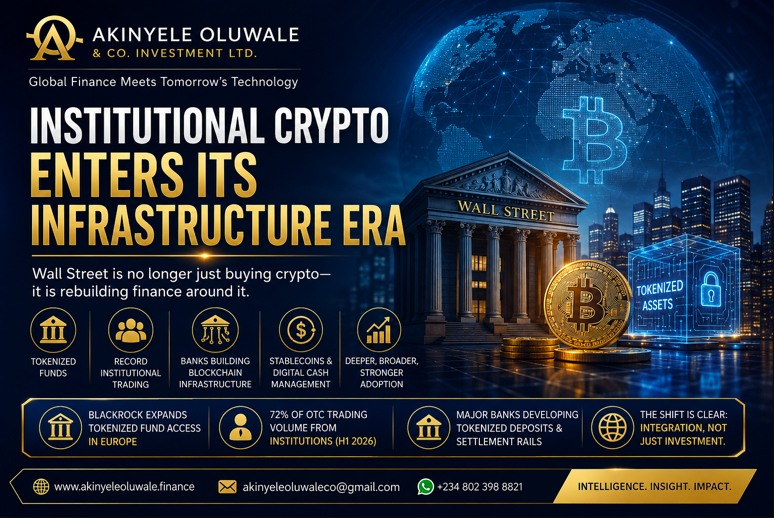
Institutional Crypto Enters Its Infrastructure Era: Wall Street Is No Longer Just Buying Crypto It Is Rebuilding Finance Around It
BlackRock's tokenized fund expansion, record institutional OTC participation and deeper bank involvement suggest the institutional crypto story is moving beyond Bitcoin exposure toward the infrastructure of digital finance.
Published: 10 August 2026
Category: Institutional Crypto • Digital Assets • Tokenization • Global Finance
By: Akinyele Oluwale & Co. Investment Ltd.
Executive Summary
Institutional crypto is entering a different phase.
For years, institutional adoption was measured primarily by a simple question:
Who is buying Bitcoin?
That question still matters, but it no longer captures the full story.
Recent developments show major financial institutions moving deeper into the infrastructure surrounding digital assets—tokenized funds, settlement, custody, stablecoins, institutional trading and blockchain-based cash management.
BlackRock has expanded tokenized access to money-market funds in Europe, extending its on-chain cash strategy beyond the United States. (CoinDesk)
Institutional participation in trading is also becoming harder to ignore. Wintermute reported that institutions accounted for a record 72% of its OTC spot trading volume during the first half of 2026. (Kitco)
Meanwhile, major banks are exploring or developing tokenized deposit and settlement infrastructure, demonstrating that blockchain adoption is increasingly taking place inside traditional finance rather than outside it. (crypto.news)
The message for investors is becoming clearer:
Institutional crypto adoption is no longer simply about owning digital assets. It is increasingly about rebuilding the financial infrastructure around them.
Why This Matters
There is an important difference between institutional investment and institutional integration.
Investment means buying an asset.
Integration means changing how the institution actually operates.
A pension fund purchasing Bitcoin exposure is adoption.
But a global bank developing blockchain settlement infrastructure is something deeper.
An asset manager tokenizing money-market funds is deeper still.
A payment network integrating stablecoins into treasury and settlement operations represents another layer entirely.
These developments suggest blockchain is moving from the investment portfolio toward the financial operating system.
And historically, infrastructure transitions can create opportunities far beyond the original asset that introduced the technology.
What Happened?
BlackRock Pushes Tokenized Cash Further Into Europe
BlackRock continues to emerge as one of the most important institutional participants in digital assets.
Its latest move expands tokenized access to money-market funds in Europe.
The underlying funds themselves are not new speculative crypto products. They are established money-market vehicles representing hundreds of billions of dollars in assets.
What changes is the infrastructure through which eligible investors can access them.
Blockchain-based ownership can potentially improve settlement, transparency, transferability and integration with digital financial markets. (CoinDesk)
This distinction is critical.
BlackRock is not trying to convince institutional investors to abandon traditional finance.
It is bringing traditional finance onto new rails.
That may prove far more consequential.
Institutional Trading Is Becoming a Bigger Part of Crypto
Another revealing signal comes from the trading market.
According to Wintermute, institutional investors represented a record 72% of its OTC spot trading volume during the first half of 2026. (Kitco)
OTC markets matter because large institutions rarely execute multimillion-dollar positions in the same way individual investors do.
They require:
Growth in institutional OTC activity therefore suggests that the professional infrastructure surrounding digital assets continues to mature.
This does not mean retail investors are disappearing.
It means crypto's market structure is changing.
Banks Are Building Their Own Blockchain Rails
Perhaps the most interesting institutional development is happening inside banking.
JPMorgan, Citi, Bank of America, Wells Fargo and other major financial institutions have been developing or exploring tokenized deposits and blockchain-based settlement infrastructure. (crypto.news)
That creates an interesting distinction between two emerging forms of digital money.
Stablecoins
Typically issued by non-bank or regulated digital-asset companies and backed by reserves.
Tokenized Deposits
Digital representations of deposits already held within the commercial banking system.
Banks naturally have strong incentives to develop the second model.
If money increasingly moves through blockchain networks, traditional banks will want deposits to remain inside their ecosystems.
This could create one of the defining institutional competitions of the next decade:
Stablecoins versus tokenized bank deposits.
The eventual financial system may use both.
The Bigger Picture
Institutional crypto used to mean:
Bitcoin.
Then it expanded to:
Bitcoin ETFs.
Then:
Ethereum and other regulated investment products.
Now the conversation includes:
Stablecoins.
Tokenized Treasuries.
Money-market funds.
Tokenized deposits.
Digital custody.
Institutional collateral.
Blockchain settlement.
Tokenized real-world assets.
That progression matters.
KPMG's 2026 digital-asset outlook describes Bitcoin as increasingly consolidating its position as a macro and balance-sheet asset while institutional infrastructure around ETFs, structured products, prime brokerage and collateral continues to deepen. It separately identifies stablecoins as emerging payment and settlement infrastructure. (KPMG Assets)
The institutional crypto market is therefore becoming an ecosystem rather than a single investment thesis.
Bitcoin Still Matters
None of this means Bitcoin has become irrelevant to institutional adoption.
Quite the opposite.
Bitcoin remains the most established institutional entry point into digital assets.
ARK Invest's 2026 research describes Bitcoin as maturing into the leader of a new institutional asset class, pointing to developments including ETF expansion, pension-fund participation and growing access through established financial institutions. (ARK Invest)
The important change is what happens after institutions become comfortable with Bitcoin.
Once custody systems exist...
Once compliance frameworks exist...
Once trading desks exist...
Once risk models exist...
Once regulators provide clearer rules...
The cost of exploring additional digital-asset opportunities becomes lower.
Bitcoin can therefore function as the institutional doorway.
The wider blockchain economy may be what institutions discover after walking through it.
Institutional Adoption Doesn't Mean Crypto Prices Must Rise
Investors need to separate two ideas that are often incorrectly treated as the same thing.
Institutional adoption can grow while cryptocurrency prices fall.
The IMF's Crypto Assets Monitor showed how significantly crypto ETP values declined after their 2025 peak even while corporate and institutional participation remained part of the market structure. (IMF Connect)
That distinction matters enormously.
Infrastructure adoption is a long-term structural trend.
Asset prices are determined by many shorter-term forces:
Institutional adoption does not eliminate market cycles.
It changes the structure underneath them.
Market Impact
Bitcoin
Greater institutional accessibility strengthens Bitcoin's position as the primary institutional digital asset.
ETFs, custody, structured products and corporate treasury strategies have created routes into Bitcoin that barely existed several years ago.
But institutional participation also means Bitcoin increasingly interacts with traditional portfolio management, liquidity conditions and macroeconomic risk.
That can make Bitcoin simultaneously more institutional and more connected to global financial markets.
Ethereum and Blockchain Infrastructure
The next institutional phase may increasingly focus on infrastructure.
If tokenized funds, stablecoins and real-world assets expand, blockchain networks capable of supporting settlement and programmable financial applications could become increasingly important.
But investors should avoid assuming that every blockchain benefits equally.
Institutions will demand reliability, security, liquidity, compliance and interoperability.
Banks
Banks may become some of blockchain's biggest adopters.
Not because they want to become crypto companies.
Because they do not want financial infrastructure to evolve without them.
Tokenized deposits, custody and blockchain settlement allow banks to participate while preserving regulated financial relationships.
Asset Managers
BlackRock's continued activity creates competitive pressure.
If tokenization improves distribution, settlement or collateral efficiency, competing asset managers will have strong incentives to develop similar capabilities.
That can turn experimentation into industry adoption.
Risks Investors Should Not Ignore
Institutional involvement does not make digital assets risk-free.
Several challenges remain.
Concentration
A large share of institutional crypto custody and infrastructure can become concentrated among relatively few providers.
Regulation
Different jurisdictions continue to take different approaches to digital assets.
Liquidity
Institutional liquidity can disappear quickly during periods of stress.
Technology
Smart contracts, bridges, custody infrastructure and blockchain networks still introduce technical risks.
Valuation
Institutional adoption does not justify buying an asset at any price.
That final point is particularly important.
A strong long-term trend can still become a bad investment if purchased without regard to valuation or risk.
Editorial Perspective
Institutional crypto is becoming more interesting precisely because it is becoming less about crypto.
That may sound contradictory.
It isn't.
The first phase of institutional adoption asked:
"Should we own Bitcoin?"
The next phase asks:
"Can blockchain improve the way we move money, settle securities, manage collateral and distribute financial products?"
Those are fundamentally different questions.
The first is an investment decision.
The second is an infrastructure decision.
And infrastructure decisions can last for decades.
Investors should therefore resist measuring institutional adoption only by ETF inflows or Bitcoin purchases.
Watch what institutions are building.
Watch where banks are allocating technology budgets.
Watch what asset managers are tokenizing.
Watch which blockchain networks are attracting regulated financial products.
Watch where custody, compliance and settlement infrastructure is developing.
The biggest institutional crypto story may eventually have very little to do with people saying the word "crypto."
Blockchain could simply disappear underneath ordinary financial products.
And when that happens, institutional adoption will have moved from participation to integration.
What to Watch Next
Several developments deserve close attention:
One question should sit above all of them:
Is institutional capital merely buying digital assets—or is institutional finance permanently integrating digital-asset infrastructure?
The second would represent the much bigger transformation.
Investing Lesson
Don't follow institutional headlines. Follow institutional commitment.
An announcement can disappear tomorrow.
Infrastructure is harder to reverse.
When an institution builds custody systems, integrates blockchain settlement, creates tokenized products, trains compliance teams and commits technology budgets, something deeper is happening.
Capital allocation tells you what an institution believes today.
Infrastructure investment tells you what it believes tomorrow will require.
For long-term investors, understanding that difference can be enormously valuable.
Key Takeaways
About Akinyele Oluwale & Co. Investment Ltd.
Akinyele Oluwale & Co. Investment Ltd. delivers research-driven intelligence covering Institutional Crypto, Tokenization & RWAs, Stablecoins & Payments, Artificial Intelligence, Macro & Central Banks, and Digital Assets.
Every article answers five essential questions:
What happened?
Why does it matter?
What does it mean for investors?
What's our Editorial Perspective?
What should readers watch next?
Global Finance Meets Tomorrow's Technology.