

Stablecoins are evolving from cryptocurrency trading instruments into potential infrastructure for international payments, digital commerce and financial settlement. But as banks and payment companies explore their use, the critical questions are shifting toward regulation, liquidity, redemption rights and who ultimately controls the movement of money.
The most important development in the stablecoin industry is not simply the number of tokens in circulation. It is the growing interest in using tokenized money to solve practical payment problems.
For decades, businesses have relied on banks, correspondent banking networks and payment processors to move money between countries. These systems perform essential functions, but cross-border payments can involve multiple intermediaries, currency conversions, compliance checks and delays.
Stablecoins offer a different technical approach: transferring digital claims to value over blockchain networks.
That creates possibilities for more continuous settlement and programmable transactions. Yet a faster blockchain transfer does not automatically mean faster access to usable money in a recipient's bank account.
A significant change is taking place in global payments.
Stablecoins, once used primarily to move funds within cryptocurrency markets, are increasingly being integrated into banking systems, corporate payment platforms and international settlement networks.
The latest announcements show that this transition is moving beyond experimentation.
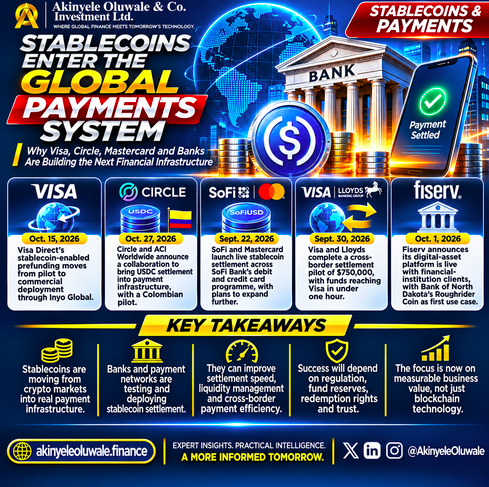
On October 15, 2026, Visa announced that its Visa Direct stablecoin-enabled prefunding capabilities had progressed from pilot testing into an initial commercial deployment through Inyo Global.
On October 27, Circle and ACI Worldwide announced a collaboration designed to bring USDC settlement into existing payment infrastructure in Latin America, supported by a Colombian pilot.
Earlier, on September 22, SoFi and Mastercard announced that stablecoin settlement was live across SoFi Bank's debit and credit card programme.
Meanwhile, Visa and Lloyds Banking Group reported a completed cross-border settlement pilot involving $750,000, with funds reaching Visa in under an hour.
On October 1, Fiserv announced that its digital-asset platform was live with financial-institution clients, with Bank of North Dakota's Roughrider Coin serving as its first live use case.
These developments illustrate an important change in the financial industry's approach.
Rather than asking whether blockchain can move money, payment providers are increasingly asking whether stablecoins can improve the economics and operational efficiency of established financial services. However, commercial deployment does not eliminate financial risk.
Stablecoin issuers must maintain appropriate reserves, redemption arrangements and regulatory compliance. Payment providers must manage fraud, operational resilience and liquidity.
Our central assessment is that stablecoins are becoming a serious component of payment infrastructure, but their long-term success will depend on trust, financial controls and measurable commercial value not technological enthusiasm alone.
Consider a Nigerian business that needs to pay an international supplier. The company may have to purchase foreign currency, provide supporting documentation, comply with banking requirements and wait for payment confirmation.
The process can involve several financial institutions.
A stablecoin-based arrangement may allow part of the transaction to be settled through a blockchain network.
However, the company still needs to establish that the payment is lawful, that the recipient can access the funds and that the digital asset can be redeemed or converted into the required currency.
This distinction is essential.
A blockchain transaction may be completed quickly, but the entire commercial payment is not necessarily complete until the recipient can use the money.
For example, imagine a business transferring the equivalent of $50,000 to an overseas supplier.
The blockchain transfer may settle within minutes but if the supplier requires payment into a conventional bank account, the transaction may still involve currency conversion, compliance screening and banking processes.
Therefore, the correct measure of payment efficiency is not blockchain speed alone. It includes the total time, cost, reliability and accessibility of the transaction.
For financial institutions, stablecoins could create opportunities to manage liquidity more efficiently and offer additional settlement options.
For businesses, they may eventually reduce some payment delays and operational costs but these benefits must be demonstrated in real commercial environments.
On October 15, Visa announced that its stablecoin-enabled prefunding capabilities were moving from pilot testing into commercial deployment.
Inyo Global became the first enabler of the offering.
The arrangement allows eligible businesses using Inyo's infrastructure to prefund certain Visa Direct cross-border payment activities with USDC.
Why is this important?
Traditional payment businesses may need to maintain funds in different locations to support international transactions.
This can create liquidity-management challenges.
Stablecoin-enabled prefunding may allow participating businesses to move funding more flexibly.
However, it is important to understand what Visa announced.
The development concerns an initial commercial deployment through a specific infrastructure partner.
It does not mean every Visa transaction worldwide now settles in stablecoins.
Nor does it establish that all merchants and consumers have direct access to the capability.
The significance lies in the movement from experimentation toward selected production use.
The lesson: Stablecoins are beginning to support established payment infrastructure rather than operating exclusively within cryptocurrency markets.
On October 27, Circle and ACI Worldwide announced a collaboration to integrate USDC settlement into existing payment infrastructure.
The initiative includes a Colombian pilot demonstrating how financial institutions could incorporate stablecoin settlement into their established operations.
This approach is commercially significant.
Banks and payment companies already operate complex systems involving compliance, customer records, liquidity management and transaction processing.
Replacing all these systems with blockchain infrastructure would be expensive and operationally disruptive.
A more practical approach may involve adding stablecoin settlement as another payment option.
For example, a payment provider could maintain its existing customer interface while using different settlement mechanisms behind the scenes.
The customer may not need to understand the technical infrastructure supporting the transaction.
However, the Colombian initiative remains a pilot and should not be described as a fully deployed regional payment network.
The lesson: The most commercially useful stablecoin systems may be those that integrate with existing financial infrastructure.
On September 22, SoFi and Mastercard announced that stablecoin settlement was live across SoFi Bank's debit and credit card programme.
The arrangement uses SoFiUSD, a bank-issued stablecoin, to support settlement within Mastercard's payment infrastructure.
SoFi also announced plans to migrate its wider card programme, which it described as representing more than $25 billion in annualised volume.
An important distinction is necessary.
The announced programme size is not evidence that $25 billion in stablecoin transactions has already been processed.
The announcement concerns a live capability and a planned migration.
The development nevertheless illustrates growing interest in connecting bank-issued digital money with conventional payment networks.
For banks, this may provide opportunities to explore settlement efficiency and liquidity management.
For payment networks, it creates another potential method of transferring value between participating institutions.
The lesson: Stablecoins are increasingly being considered alongside traditional bank money within established payment systems.
On September 30, Visa and Lloyds Banking Group announced the completion of a seven-day live pilot involving stablecoin settlement.
During the pilot, Lloyds used stablecoins to settle $750,000 of payment obligations with Visa.
According to the companies, funds reached Visa in under an hour, including during the weekend.
The pilot tested settlement across private and public blockchain environments.
This is important because traditional banking settlement arrangements may be affected by operating hours and intermediary processes.
Continuous settlement capabilities could improve flexibility for certain financial institutions. However, the pilot's results should not be generalised to every cross-border payment.
The reported speed applied to a specific test involving defined participants and arrangements.
It does not prove that all stablecoin transactions will be completed within an hour or that the technology will always be cheaper.
The lesson: Real-world pilots are beginning to demonstrate practical settlement possibilities, but commercial performance must be assessed across larger transaction volumes and different operating conditions.
On October 1, Fiserv announced that its digital-asset platform was live with financial-institution clients.
The first live use case involves Roughrider Coin, a dollar-backed stablecoin associated with Bank of North Dakota.
The arrangement includes VersaBank as issuer, Fireblocks providing digital-asset infrastructure and the Solana blockchain supporting transaction processing.
The significance lies in the involvement of an established financial technology provider.
Banks depend on technology systems for account management, payments, reconciliation and reporting.
If stablecoin capabilities can be incorporated into those systems, financial institutions may be able to evaluate digital settlement without independently building every component.
However, platform availability does not guarantee widespread banking adoption.
Institutions must assess implementation costs, regulatory requirements, operational risks and commercial demand.
The lesson: Stablecoin adoption may increasingly depend on the financial technology providers that connect banks to payment infrastructure.
On October 12, the Financial Stability Board published material addressing global stablecoin arrangements and cross-border financial vulnerabilities.
The FSB's work reinforces the importance of consistent regulatory oversight.
Stablecoins can create financial risks if holders cannot redeem their tokens reliably or if reserve assets are insufficiently liquid.
Cross-border arrangements may also involve differences in legal frameworks and supervisory responsibilities.
For example, a stablecoin may be issued in one jurisdiction, transferred through infrastructure operating internationally and held by a user in another country.
If a dispute occurs, determining the applicable legal protections can become complicated.
This is why regulation must address more than technological security.
It must also consider reserve management, governance, redemption rights, consumer protection and operational resilience.
The lesson: Financial stability and legal certainty are essential requirements for sustainable stablecoin adoption.
The emerging competition is not simply between cryptocurrency companies. It increasingly involves banks, card networks, payment processors, stablecoin issuers and financial technology providers.
Each participant brings different capabilities.
Banks provide regulated financial relationships, compliance systems and access to traditional money.
Payment networks provide established commercial acceptance and transaction infrastructure.
Stablecoin issuers provide digital representations of value that may be transferred over blockchain networks.
Financial technology companies provide the systems connecting these services.
The strategic opportunity is to combine these capabilities in ways that improve financial transactions.
However, the industry should avoid assuming that stablecoins will replace conventional payment systems.
Existing banking networks continue to provide important services, including customer protection, compliance, dispute handling and access to local currencies.
In many cases, stablecoins may function as an additional settlement mechanism rather than a complete replacement.
The most likely competitive question is therefore not whether banks or blockchains will win.
It is which institutions can combine digital settlement with reliable financial services.
Stablecoin infrastructure may create opportunities to improve liquidity management and international settlement.
However, banks must consider deposit funding, customer protection and regulatory obligations.
Card networks and payment processors may expand their services by incorporating stablecoin settlement into existing operations.
Their commercial advantage may depend on interoperability and established customer relationships.
Growing institutional adoption may increase demand for credible, well-managed stablecoin arrangements.
But issuer profitability and long-term viability depend on reserve economics, regulatory requirements and commercial adoption.
Companies involved in international commerce may benefit from additional payment options.
However, businesses must evaluate total transaction costs, foreign-exchange conversion, redemption arrangements and counterparty risk.
Greater settlement activity may increase demand for blockchain infrastructure.
Nevertheless, increased stablecoin usage does not automatically produce higher prices for a network's native cryptocurrency.
Stablecoin-enabled payment services may eventually improve access to certain financial products.
But consumers must understand the difference between stablecoin balances and insured bank deposits, where applicable.
At Akinyele Oluwale & Co. Investment Ltd., we believe the stablecoin industry is entering a more commercially demanding phase.
For several years, much of the discussion focused on blockchain transaction speeds, token issuance and cryptocurrency market activity.
Those subjects remain relevant but institutional adoption requires a different standard of evaluation.
A bank does not adopt a payment system simply because the technology is innovative.
It must determine whether the system improves efficiency, reduces operational friction and satisfies regulatory requirements.
A business does not need a stablecoin merely because it can move across a blockchain.
It needs a payment solution that delivers money reliably, at an acceptable cost, to the intended recipient.
And an investor should not assume that increasing stablecoin adoption guarantees investment returns.
The economic benefits may accrue to payment processors, technology providers, financial institutions or stablecoin issuers in different ways.
These distinctions matter.
Consider two payment arrangements.
The first uses a conventional banking network and completes a transaction reliably at a low total cost.
The second uses a blockchain but requires additional fees, conversion arrangements and operational procedures.
The second arrangement is not automatically superior.
The correct decision depends on measurable outcomes.
Our editorial assessment is that stablecoins will earn a sustainable place in global finance only where they offer practical advantages while maintaining strong financial safeguards.
This is the difference between technological possibility and commercial usefulness.
Several developments deserve attention during the remainder of 2026.
Visa Direct commercial adoption: Monitor whether the initial deployment expands to additional eligible participants and payment corridors.
Circle and ACI Worldwide: Watch the progress of the Colombian pilot and evidence of practical settlement improvements.
SoFi and Mastercard: Assess the implementation of the announced card-programme migration and actual stablecoin settlement activity.
Bank-issued stablecoins: Monitor whether additional regulated financial institutions introduce commercially useful digital settlement products.
Redemption arrangements: Examine the quality, liquidity and legal protection of stablecoin reserves.
Cross-border regulation: Follow developments concerning supervisory cooperation and stablecoin compliance requirements.
Payment economics: Compare total transaction costs, settlement times and liquidity requirements with conventional alternatives.
African market implications: Evaluate whether stablecoin-enabled infrastructure can address genuine payment challenges without weakening financial safeguards.
Stablecoins are increasingly being integrated into conventional banking and payment infrastructure.
Visa Direct announced an initial commercial deployment of stablecoin-enabled prefunding through Inyo Global on October 15, 2026.
Circle and ACI Worldwide announced a collaboration involving USDC settlement and a Colombian pilot on October 27.
SoFi and Mastercard introduced live stablecoin settlement within SoFi Bank's card programme.
Visa and Lloyds completed a $750,000 stablecoin settlement pilot, with funds reaching Visa in under an hour.
Fiserv announced that its digital-asset platform was live with financial-institution clients.
The Financial Stability Board continues to emphasise regulatory and financial-stability risks associated with global stablecoin arrangements.
Faster blockchain transfers do not automatically guarantee faster access to spendable funds.
Stablecoin adoption does not necessarily translate into higher cryptocurrency prices.
Sustainable growth will depend on reliability, regulation, redemption arrangements and measurable payment efficiency.
Akinyele Oluwale & Co. Investment Ltd. is an institutional financial intelligence platform focused on global macroeconomics, central banking, institutional cryptocurrency, stablecoins, digital payments, tokenization, artificial intelligence and blockchain technology.
Our editorial mission is to explain financial developments through evidence-based research, practical education and an institutional perspective.
We examine the relationship between technological innovation, financial markets, regulation and business strategy.
The latest developments in stablecoins and payments demonstrate a significant shift in financial innovation.
Stablecoins are moving beyond their original role within cryptocurrency markets.
They are increasingly being tested and deployed as components of established payment infrastructure.
Visa is moving selected stablecoin capabilities into commercial operations.
Circle is collaborating with payment technology providers.
SoFi and Mastercard are connecting bank-issued digital money with card settlement.
Lloyds and Visa have demonstrated cross-border settlement possibilities.
Fiserv is bringing digital-asset infrastructure into financial-institution operations.
These developments deserve attention.
However, the future of stablecoins will not be determined by announcements alone.
It will depend on whether businesses can use these systems safely, whether customers can redeem their funds reliably and whether financial institutions can demonstrate genuine operational improvements.
The next major competition in global payments is not simply about moving digital dollars faster. It is about building trusted financial infrastructure that moves money efficiently, securely and responsibly across different systems.
That is where the long-term value of stablecoin innovation will be determined.
Observe the change. Understand the implications. Position with discipline.
Akinyele Oluwale & Co. Investment Ltd.
Where Global Finance Meets Tomorrow's Technology.
Website: akinyeleoluwale.finance