

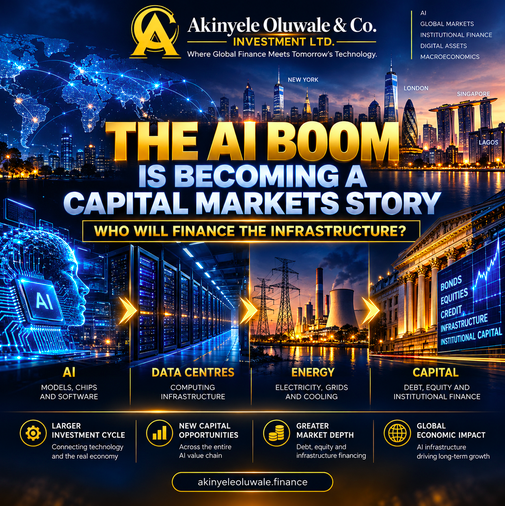
The AI Boom Is Becoming a Capital Markets Story: Who Will Finance the Infrastructure and Will the Investment Generate Adequate Returns?
Published: October 3, 2026
Category: AI
By: Akinyele Oluwale
Artificial intelligence began as a technology story. It became an investment story. Now, as hundreds of billions of dollars flow into chips, data centres, electricity and computing infrastructure, AI is increasingly becoming a global capital-markets story.
AI → Chips → Data Centres → Energy → Capital → Returns
The next stage of the AI revolution will therefore be determined not only by technological capability, but also by capital allocation, financing capacity and return on investment.
EXECUTIVE SUMMARY
Artificial intelligence may appear digital, but the infrastructure supporting it is remarkably physical and expensive.
Advanced AI requires semiconductors, servers, data centres, electricity generation, grid connections, cooling systems, fibre networks and enormous amounts of capital.
J.P. Morgan estimates that hyperscaler capital expenditure could reach approximately $697 billion in 2026, making AI infrastructure one of today's largest capital-deployment themes.
The financing model is also changing.
The Bank of England reports that AI-focused companies reached an important turning point in 2025 when required investment began exceeding their capacity to finance expansion entirely from internal cash flows. During the first half of 2026, external financing accelerated across public debt, private markets and bank lending. This changes the investment question.
Investors should no longer ask only:
“Which company will build the most powerful AI?”
They should increasingly ask:
“Who will finance the infrastructure behind AI, how much will that capital cost, and what return will it ultimately generate?”
That question connects AI directly with global capital markets.
WHY THIS MATTERS
AI is becoming one of the largest investment cycles in the global economy but technological importance and investment profitability are not necessarily the same thing.
A revolutionary technology can transform economies while individual companies or projects investing in that technology still produce disappointing financial returns.
That distinction becomes particularly important when debt enters the equation.
AI infrastructure increasingly requires capital from:
Corporate cash flow
Equity markets
Investment-grade bonds
Bank lending
Private credit
Infrastructure funds
Structured finance
Special-purpose investment vehicles
The Bank of England reports that the five major AI hyperscalers represented only around 3% of outstanding U.S. investment-grade debt at the end of 2025, but accounted for more than 15% of year-to-date issuance by early May 2026.
That is an important structural shift.
AI isn't merely influencing technology stocks.
It is increasingly influencing credit markets, infrastructure investment, energy demand and global capital allocation.
WHAT HAPPENED?
Several developments are converging.
AI Spending Continues to Expand
J.P. Morgan estimates hyperscaler capital expenditure will reach approximately $697 billion during 2026.
Expectations further into the future have risen sharply.
The Bank of England notes that consensus estimates for hyperscaler capital expenditure in 2028 had been below $600 billion when it published its December 2025 Financial Stability Report.
By July 2026, that estimate had increased to more than $1 trillion.
The direction is clear:
The AI investment cycle is becoming increasingly capital intensive.
Debt Financing Is Accelerating
Companies cannot necessarily finance infrastructure of this magnitude indefinitely through operating cash flows alone.
The Bank of England says AI-related companies have rapidly expanded their use of:
public debt,
private credit,
leveraged finance,
and structured finance.
The institution also reports that hyperscaler bond issuance during the first half of 2026 had already exceeded their issuance for the whole of 2025. That tells investors something important.
AI is migrating from corporate technology budgets into the global financial system.
Investors Are Becoming More Selective
Capital remains available, but investors are increasingly examining the quality of AI-related borrowing.
Recent Reuters reporting showed that borrowing connected with AI in riskier parts of U.S. credit markets has increased substantially, while investors are demanding stronger evidence of sustainable revenue from lower-rated borrowers.
That is healthy market discipline.
There is a significant difference between financing a highly profitable hyperscaler and financing a highly leveraged AI business whose future revenues remain uncertain.
The label “AI” cannot replace fundamental credit analysis.
THE BIGGER PICTURE
The AI investment cycle increasingly connects three economic systems.
Technology
Models, software and semiconductors.
↓
Physical Infrastructure
Data centres, electricity, grids, cooling and networks.
↓
Global Finance
Equity, bonds, banks, private credit and infrastructure capital.
Put together:
AI Innovation → Computing Demand → Infrastructure → Financing → Revenue → Return on Capital
This framework is more useful than viewing AI simply as another technology-sector theme.
AI Is Becoming an Energy Story
Data centres cannot operate without enormous quantities of reliable electricity.
That means AI investment increasingly affects:
power generation,
transmission networks,
grid infrastructure,
cooling,
land,
construction,
and energy policy.
J.P. Morgan identifies power availability, supply-chain constraints and permitting timelines as important factors that can delay data-centre projects and affect their financing.
The investment ecosystem therefore extends considerably beyond semiconductor manufacturers.
AI Is Becoming a Credit Story
As infrastructure spending expands, debt financing becomes increasingly important.
The Bank of England says more than half of projected external financing requirements for global data-centre capital expenditure between 2026 and 2028 could be financed through debt, based on Morgan Stanley estimates cited in its Financial Stability Report.
This introduces questions about:
leverage,
interest expense,
refinancing,
collateral,
asset lives,
and debt-service capacity.
These are traditional financial questions applied to an extraordinary technological transformation.
MARKET IMPACT
The AI infrastructure boom could affect several areas of financial markets simultaneously.
Equity Markets
AI remains an important driver of investor sentiment.
Global equity funds received approximately $34.76 billion of net inflows in the week reported on October 2, marking a second consecutive week of inflows, with Reuters reporting that optimism around AI-related investment remained one contributor to risk appetite.
But investors increasingly need to distinguish between:
revenue growth
and
capital expenditure growth.
A company can grow revenue while simultaneously spending so heavily that free cash flow comes under pressure.
Reuters reported in July that the rising cost of AI infrastructure was already putting pressure on free cash flow among major technology companies.
Bond Markets
Large technology companies are becoming increasingly important borrowers.
That creates a new relationship:
AI Investment → Debt Issuance → Bond Supply → Financing Costs
There is not yet clear evidence that AI borrowing is broadly preventing other companies or governments from accessing credit markets, according to the Bank of England.
But the scale deserves monitoring.
If AI borrowing continues expanding, technology companies could become increasingly important participants in global fixed-income markets.
Private Capital
Not every AI infrastructure project will be financed publicly.
Private infrastructure funds, real-estate capital and private-credit investors are also becoming more important sources of financing for data-centre development. Reuters reported earlier this year that private infrastructure and real-estate capital are expected to play a larger role as the AI data-centre boom expands.
This could broaden the AI investment ecosystem well beyond listed technology companies.
Energy and Utilities
AI creates potential demand for electricity generation and grid infrastructure.
That could create opportunities for some utilities, power producers, equipment manufacturers and infrastructure providers.
But investors should avoid assuming that every company associated with electricity or data centres automatically benefits.
The questions remain:
At what price is the infrastructure built?
Who pays for it?
What margins are earned?
What return does the investment generate?
EDITORIAL PERSPECTIVE
At Akinyele Oluwale & Co. Investment Ltd., our view is that the AI investment discussion needs to mature.
The first stage focused heavily on technological capability:
How powerful are the models?
The second focused on semiconductor demand:
Who supplies the computing power?
The next stage increasingly requires financial analysis:
Who finances the infrastructure, and what return will that capital generate?
This is where investment discipline becomes critical.
The world has experienced transformational infrastructure cycles before:
railways,
electricity,
telecommunications,
the internet,
and mobile communications.
Each changed economic activity profoundly.
But not every company participating in those transformations created sustainable shareholder value.
The same distinction should be applied to AI.
A technology can transform the world without every investment associated with that technology becoming a good investment.
That is why investors should resist the temptation to treat “AI exposure” as an investment thesis by itself.
Technology must eventually translate into:
Revenue → Cash Flow → Profitability → Return on Capital
Otherwise, technological leadership may not translate into investment success.
WHAT TO WATCH NEXT
Investors should monitor eight indicators as the AI infrastructure cycle develops.
1. Capital Expenditure
How rapidly are major AI companies increasing investment?
2. Free Cash Flow
Can operating cash flows continue financing expansion?
3. Debt Issuance
How much external borrowing is entering the AI ecosystem?
4. Cost of Capital
Are bond yields and financing costs increasing?
5. AI Revenue
Is monetisation growing fast enough to justify infrastructure investment?
6. Data-Centre Utilisation
Is the expensive computing capacity being used efficiently?
7. Energy Availability
Can electricity generation and grids support the planned infrastructure?
8. Return on Invested Capital
Ultimately:
Is the enormous amount of capital being deployed actually creating economic value?
That may become the defining financial question of the next stage of the AI boom.
KEY TAKEAWAYS
AI is becoming more than a technology story. It is increasingly a physical-infrastructure and capital-markets story.
Infrastructure requirements are enormous. J.P. Morgan estimates hyperscaler capital expenditure could reach approximately $697 billion in 2026.
Debt is becoming more important. AI companies are increasingly accessing public bonds, private credit, bank lending and structured finance.
Energy matters. Data centres require substantial electricity, grid capacity and supporting infrastructure.
Financing structures matter. The source, cost and duration of capital will increasingly influence investment returns.
AI exposure is not enough. Investors must distinguish technological importance from investment profitability.
And above all:
Capital must eventually earn a return.
The AI revolution may change the global economy.
But it does not repeal the fundamental principles of finance.
ABOUT AKINYELE OLUWALE & CO. INVESTMENT LTD.
Akinyele Oluwale & Co. Investment Ltd. is a global finance and digital-economy intelligence platform focused on helping investors, professionals and decision-makers understand the forces reshaping modern markets.
Our research and analysis cover:
Artificial Intelligence • Global Markets • Macroeconomics • Digital Assets • Institutional Finance • Stablecoins & Payments • Blockchain & Technology • Tokenization & Real-World Assets • Central Banks
Our objective is not simply to report what happened.
We focus on three questions:
What changed?
Why does it matter?
What should investors watch next?
Because in rapidly changing markets, information alone is not enough.
Understanding the implications is what creates intelligence.
RELATED INTELLIGENCE
Institutional Finance
How banks, bond markets and private capital are financing the AI infrastructure cycle.
Macro & Global Markets
Interest rates, liquidity and the changing global cost of capital.
Blockchain & Technology
Emerging technologies reshaping economic and financial infrastructure.
Tokenization & RWAs
The migration of traditional financial assets toward programmable infrastructure.
About the Author
Akinyele Oluwale
Founder & Chief Investment Strategist
Akinyele Oluwale & Co. Investment Ltd.
Research and commentary covering global finance, macroeconomics, artificial intelligence, digital assets, institutional finance, tokenization and emerging financial technology.
Akinyele Oluwale & Co. Investment Ltd.
Where Global Finance Meets Tomorrow’s Technology.
akinyeleoluwale.finance