

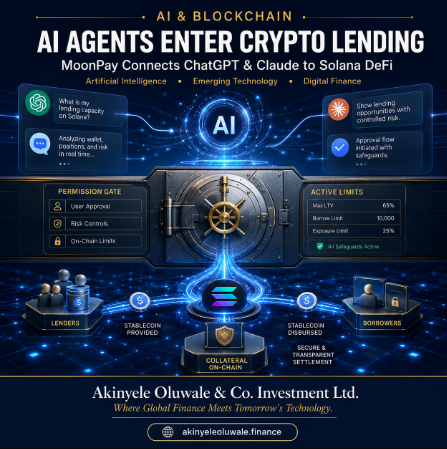
AI Agents Enter Crypto Lending as MoonPay Connects ChatGPT and Claude to Solana DeFi
Published: 1 September 2026
Category: Artificial Intelligence • Emerging Technology • Digital Finance
By: Akinyele Oluwale & Co. Investment Ltd.
Executive Summary
Artificial intelligence is moving beyond answering financial questions. It is beginning to execute financial instructions.
MoonPay has integrated Kamino, a major Solana-based lending protocol, into PayBox its payment vault designed for AI assistants. Eligible users can now instruct ChatGPT or Claude to lend crypto assets, earn yield or borrow USDC against collateral through an ordinary conversation.
Users may approve every transaction individually or permit the AI to operate within predefined limits.
This is an important step in agentic finance, but the convenience of a conversational interface does not remove lending, liquidation or smart-contract risks.
Context and Background
AI agents are increasingly being developed to perform tasks rather than simply provide information. For these systems to operate more independently, they need the ability to make payments, access services and interact with financial infrastructure.
Blockchain networks provide programmable settlement that can operate continuously without requiring traditional banking hours.
MoonPay’s PayBox already supports payments, token swaps, blockchain bridging and access to certain yield products. The Kamino integration extends those capabilities into collateralized lending on Solana.
A user could, for example, instruct an AI assistant to deposit tokens into Kamino to earn yield or borrow USDC against existing crypto collateral.
The AI does not become a bank, nor does it replace Kamino. The assistant interprets the instruction, PayBox controls permissions, Kamino provides the lending market, and Solana records the transaction.
Why It Matters
Most early AI-agent payments involved relatively small purchases, such as paying for data, computing power or digital services.
Lending is different.
A payment normally ends when value reaches the recipient. A loan creates an ongoing financial position. Collateral values change, interest accumulates and liquidation thresholds must be monitored.
Natural-language access could make decentralized finance easier to use. However, it could also encourage users to enter complex positions without fully understanding the underlying risk.
The real innovation is not that ChatGPT can “lend money.” It is that AI is becoming an interface and orchestration layer between users and blockchain-based financial protocols.
Stakeholders: Winners and Those Under Pressure
Potential winners
* AI platforms expanding into financial execution
* Blockchain networks offering fast, inexpensive settlement
* DeFi protocols receiving users through conversational interfaces
* Stablecoin issuers supporting automated lending and payments
* Wallet and permission providers protecting user credentials
* Experienced users seeking more efficient portfolio management
Those facing pressure
* Traditional DeFi interfaces that remain difficult to navigate
* Financial intermediaries dependent on manual transaction processes
* Protocols without strong risk controls or reliable liquidity
* Users who allow excessive AI autonomy over their assets
* Regulators attempting to establish responsibility when automated transactions fail
Short-Term Impact
The integration could increase activity within Kamino and the wider Solana lending ecosystem. It may also encourage other wallets and DeFi platforms to develop AI-based transaction interfaces.
Adoption will initially be limited. The service is reportedly unavailable in the United States, United Kingdom, European Union and Australia, while access may vary by asset and jurisdiction.
Users are also likely to remain cautious about allowing AI agents to execute transactions without individual approval.
Long-Term Impact
AI agents could eventually manage payments, compare lending rates, rebalance collateral, monitor risk and execute transactions across multiple blockchain networks.
That future will require more than intelligence. It will need secure identity, restricted permissions, reliable data, transaction limits, audit trails and clear legal accountability.
Blockchain may become the settlement layer for autonomous software, while AI becomes the interface through which financial instructions are created and managed.
The largest opportunity may therefore lie in the control layer connecting users, AI systems, wallets and financial protocols.
Editorial Perspective
This development is meaningful, but it should not be confused with the removal of financial risk.
A conversational interface can simplify the process of borrowing; it cannot make collateral volatility disappear. If asset prices fall below the required threshold, liquidation can still occur.
Investors should begin with transaction-by-transaction approval, conservative limits and assets they fully understand. Convenience should never be allowed to outrun control.
The future of agentic finance will depend less on what AI can do and more on what it is permitted to do.
What to Watch Next
* Usage levels for AI-assisted lending
* Expansion into additional DeFi protocols and blockchains
* Permission controls and transaction limits
* Errors caused by unclear natural-language instructions
* Liability when agents execute unintended transactions
* Regulatory treatment of autonomous financial activity
* Whether AI improves collateral monitoring or increases leverage
Sources and Notes
This analysis draws on [MoonPay’s newsroom announcement](https://www.moonpay.com/newsroom/partnerships) and [CoinDesk’s reporting on the Kamino integration](https://www.coindesk.com/business/2026/08/27/moonpay-s-newest-integration-lets-ai-agents-handle-crypto-lending-on-solana).
This publication is for informational and educational purposes only. It does not constitute financial, investment or legal advice.
Akinyele Oluwale & Co. Investment Ltd.
Where Global Finance Meets Tomorrow's Technology.