

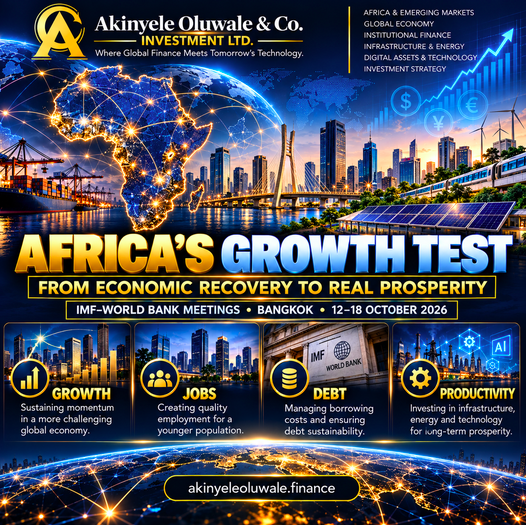
Africa enters the upcoming IMF–World Bank Annual Meetings with an encouraging economic outlook but significant development challenges.
Economic reforms are beginning to produce measurable improvements in several countries.
Investor confidence has strengthened in parts of the continent.
And international financial institutions are increasingly recognising Africa's growth potential.
But a fundamental question remains.
Is Africa's economic recovery translating into meaningful improvements in the lives of its people?
On 6 October, the World Bank raised its 2026 growth forecast for sub-Saharan Africa to approximately 4.3%.
However, it also warned that economic expansion remains insufficient to deliver the scale of poverty reduction and employment creation required across the region. Reuters
Nigeria offers a particularly important example.
On 8 October, the World Bank projected that Nigeria's economy could grow by an average of 4.4% annually through 2028, provided reforms continue and public-service delivery improves. Reuters
These forecasts provide reasons for cautious optimism.
But growth projections are not guarantees.
And rising gross domestic product does not automatically translate into rising household prosperity.
The next phase of Africa's economic development must therefore focus on converting macroeconomic progress into measurable improvements in productivity, employment and living standards.
Africa's economic outlook is improving, but several structural challenges remain.
Four developments deserve particular attention.
First, economic growth is recovering.
The World Bank has raised its 2026 growth forecast for sub-Saharan Africa to approximately 4.3%.
Second, Nigeria's medium-term outlook remains positive.
The World Bank expects average annual growth of approximately 4.4% through 2028, subject to continued reforms.
Third, debt and financing costs remain major constraints.
Elevated global interest rates and substantial debt-servicing obligations can limit governments' capacity to finance development.
Fourth, productivity and job creation remain essential.
Africa's youthful population creates considerable economic potential, but this potential requires investment in education, infrastructure, technology and productive industries. Reuters
The central development framework is:
Africa's long-term success will depend on strengthening every part of this chain.
Economic growth is one of the most widely discussed indicators of national progress.
But growth alone does not provide a complete picture of economic well-being.
A country's GDP can increase while many households continue struggling with high food prices, unemployment and declining purchasing power.
Consider a simplified example.
Suppose an economy grows by 4% annually.
At the same time, its population grows by 3%.
The improvement in economic output per person would be much smaller than the headline GDP growth rate.
Using the exact relationship:
This demonstrates an important principle.
Headline GDP growth is not the same as growth in economic output per person.
Even rising GDP per capita does not guarantee that the benefits are distributed widely.
This is particularly relevant for African economies experiencing rapid population growth.
The objective must extend beyond producing stronger GDP figures.
It must include:
Growth becomes meaningful when it improves economic opportunity and living standards.
On 6 October 2026, the World Bank raised its economic growth forecast for sub-Saharan Africa to approximately 4.3%.
The improved outlook reflects economic reforms and stronger performance across several countries.
However, the institution also highlighted persistent development challenges.
Growth in income per person remains relatively modest, while debt-servicing pressures and high financing costs continue to affect public investment. Reuters
This creates an important distinction.
Economic recovery is underway, but the transformation required to deliver broad-based prosperity remains incomplete.
On 8 October, the World Bank projected that Nigeria could achieve average annual economic growth of approximately 4.4% through 2028.
The projection depends on continued reforms and improvements in public-service delivery. Reuters
This represents an opportunity.
However, the relevant questions extend beyond the growth forecast.
Will businesses become more productive?
Will electricity become more reliable?
Will food inflation ease?
Will investment create employment?
Will household purchasing power improve?
These are the indicators that determine whether macroeconomic progress translates into meaningful economic development.
The global financial environment remains difficult for many developing economies.
High sovereign borrowing costs, energy-price pressures and concerns about debt sustainability are expected to feature prominently during the IMF–World Bank meetings.
The IMF has warned that rising debt and elevated energy costs threaten the global growth outlook. Reuters
For African governments, this reinforces the importance of prudent borrowing and productive capital allocation.
The 2026 Annual Meetings take place in Bangkok, Thailand, from 12–18 October.
The meetings bring together finance ministers, central-bank governors, development institutions and financial-sector leaders.
They provide an opportunity to discuss global economic stability, development financing, debt sustainability and international financial cooperation. International Monetary Fund
For Africa, the important question is how these discussions translate into practical financing solutions and stronger economic outcomes.
Africa's economic development challenge can be understood through five interconnected priorities.
Stable economic conditions help businesses and households make long-term decisions.
Persistent inflation, exchange-rate instability and unpredictable policies increase uncertainty.
Greater stability can support investment confidence.
However, stability should be viewed as the foundation of economic development rather than its final destination.
Investment must expand the economy's productive capacity.
Examples include electricity infrastructure, manufacturing facilities, transportation networks, agricultural processing and digital connectivity.
Productive investment can improve efficiency and create opportunities for businesses.
Africa's young population represents considerable potential.
But that potential depends on the availability of productive employment.
Economic policies should therefore encourage industries capable of expanding output and creating sustainable jobs.
Artificial intelligence, digital payments, modern logistics and financial technology can help businesses improve efficiency.
The World Bank has highlighted opportunities for African countries to use AI in education, agriculture and small-business operations. Reuters
However, technology adoption requires investment in electricity, connectivity, skills and effective regulation.
Economic transformation requires capital.
But governments must ensure that borrowing remains sustainable.
Projects should be evaluated based on their economic benefits, financing costs and implementation risks.
The objective should be to strengthen productive capacity without creating excessive future financial obligations.
Nigeria's improving economic outlook could support investor confidence if reforms continue and economic fundamentals strengthen.
However, investors will continue monitoring inflation, exchange-rate developments, government borrowing and corporate earnings.
The distinction between projected growth and realised economic performance remains essential.
Debt sustainability is particularly important for sovereign bond investors.
Government borrowing costs depend on factors including inflation, fiscal credibility, monetary policy and investor perceptions of risk.
Improved fiscal management can strengthen confidence.
Conversely, excessive borrowing and weak revenue mobilisation can increase financing pressure.
Stronger economic activity can support demand for financial services.
But financial institutions must balance growth opportunities with credit quality, liquidity management and regulatory compliance.
Higher interest rates may improve some lending margins while simultaneously increasing borrowers' repayment difficulties.
Reliable electricity, transportation and digital connectivity remain central to Africa's productivity challenge.
Well-designed infrastructure investments can reduce business costs and support long-term economic growth.
However, financing structures must be sustainable.
Digital payments, artificial intelligence and financial technology can improve access to services and reduce transaction costs.
Their contribution to development will depend on practical adoption, reliable infrastructure and effective consumer protection.
Emerging-market investment remains sensitive to global interest rates and risk appetite.
Recent data showed significant portfolio outflows from emerging markets during September, illustrating the vulnerability of international capital flows to changing financial conditions. Reuters
For African economies, deeper domestic capital markets could help reduce excessive dependence on volatile external financing.
At Akinyele Oluwale & Co. Investment Ltd., we believe Africa's next development challenge is not simply achieving higher economic growth.
It is ensuring that growth becomes productive, inclusive and financially sustainable.
Macroeconomic stability matters.
Investor confidence matters.
International financing matters.
But these achievements must eventually translate into stronger businesses, productive employment and improved living standards.
For Nigeria, this distinction is especially important.
Economic reforms can create the conditions for recovery.
However, the long-term success of those reforms should be assessed through measurable improvements in productivity, infrastructure, purchasing power and employment.
A country does not become economically prosperous simply because investors become more optimistic.
Prosperity requires sustained improvements in the economy's capacity to produce goods and services efficiently.
This is why we believe Africa's development strategy must increasingly connect:
The continent has considerable economic potential.
But potential must be converted into productive capacity.
Our Day 34 editorial principle:
Economic recovery creates opportunity. Productive investment converts that opportunity into lasting prosperity.
As the IMF–World Bank Annual Meetings begin, eight developments deserve attention.
1. Updated Global Growth Forecasts
Will the IMF revise its outlook for global economic growth?
2. Africa's Economic Outlook
Will international institutions maintain their expectations for improving regional growth?
3. Debt Sustainability
What measures will be proposed to address elevated debt-servicing costs?
4. Development Financing
Will multilateral institutions announce new financing commitments or policy initiatives?
5. Nigeria's Reform Outlook
Will international assessments identify further improvements or emerging risks?
6. Inflation and Energy Prices
How will elevated energy costs affect economic growth and household purchasing power?
7. Private-Sector Investment
What measures could encourage greater investment in productive African industries?
8. Technology and Employment
How can Africa adopt emerging technologies while expanding economic opportunities?
These developments will help determine whether the region's improving growth outlook can translate into sustained economic progress.
Africa's economic outlook has improved.
The World Bank expects stronger growth across sub-Saharan Africa in 2026.
Nigeria's medium-term growth outlook also remains positive, subject to continued reforms.
However, economic growth alone is insufficient.
High debt-servicing costs, inflation, infrastructure deficiencies and employment challenges remain important constraints.
The next phase of development must prioritise productivity, sustainable investment and job creation.
The central framework is:
And today's most important conclusion is:
The true test of Africa's economic recovery is not simply whether GDP rises, but whether economic opportunity and living standards improve.
Akinyele Oluwale & Co. Investment Ltd. is a global finance and digital-economy intelligence platform dedicated to explaining developments reshaping financial markets, institutional investment and emerging technologies.
Our coverage includes:
Artificial Intelligence, Blockchain & Technology, Crypto & Digital Assets, Institutional Finance, Stablecoins & Payments, Tokenization & RWAs, Central Banks, and Macro & Global Markets.
We connect global economic developments with their implications for investors, businesses and policymakers.
Our editorial framework focuses on three questions:
What changed?
Why does it matter?
What should investors watch next?
We believe informed investment decisions require an understanding of economic fundamentals, technological transformation and disciplined capital allocation.
Where Global Finance Meets Tomorrow's Technology.