

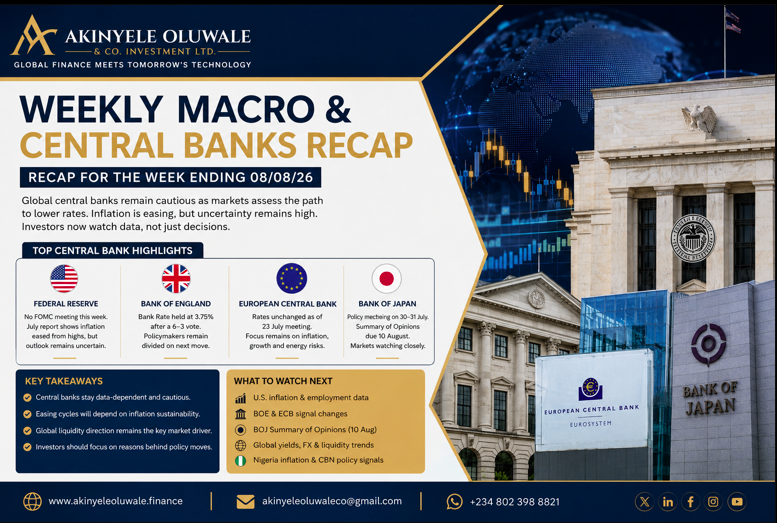
Weekly Macro & Central Banks Recap: Markets Enter August Watching Rates, Inflation and the Next Liquidity Turn
The week ending 8 August 2026 reinforced one of the most important lessons in investing: markets may trade the headlines, but monetary policy, inflation and liquidity continue to shape the bigger picture.
Published: 8 August 2026
Category: Weekly Recap • Macro & Central Banks • Global Markets • Investing
By: Akinyele Oluwale & Co. Investment Ltd.
Executive Summary
The first full week of August gave investors something valuable: time to digest where the world's major central banks actually stand.
There was no dramatic synchronized policy pivot. Instead, the message across major economies remained one of patience, data dependence and caution.
In the United States, investors continued assessing the Federal Reserve's path after its latest policy meeting, with attention shifting toward incoming inflation, employment and growth data. The Fed's July Monetary Policy Report had already described inflation as having eased significantly from its highs while emphasizing that the outlook remained uncertain. (Federal Reserve)
Across the Atlantic, the Bank of England remained at 3.75% after its late July decision, while the European Central Bank's latest Economic Bulletin confirmed that its three key rates had also been left unchanged at the 23 July meeting. (Bank of England)
Japan remained another important piece of the puzzle, with markets awaiting the Bank of Japan's 10 August Summary of Opinions from its 30–31 July policy meeting. (Bank of Japan)
The week's lesson was straightforward:
The global easing story has become more complicated. Central banks want lower inflation, but they also want evidence that cutting rates will not reignite it.
Why This Matters
Investors sometimes treat central-bank meetings as isolated events.
They are not.
The Federal Reserve, ECB, Bank of England, Bank of Japan and other major central banks collectively influence the price and availability of capital throughout the global financial system.
Their decisions affect:
And importantly, markets rarely wait until a rate actually changes.
They trade expectations.
That means an investor needs to understand not only what central banks did last week, but what markets believe they may do next.
What Happened This Week?
🇺🇸 United States: The Fed Remains the Centre of the Global Liquidity Debate
The Federal Reserve did not hold a scheduled FOMC meeting during the week ending 8 August; its calendar shows the next scheduled policy meeting later in the year rather than this week. (Federal Reserve)
That made incoming information and expectations around future policy more important.
The Fed's July Monetary Policy Report had emphasized that inflation had fallen substantially from its peak but remained an important policy consideration, while uncertainty around the economic outlook persisted. (Federal Reserve)
For investors, the question is increasingly less about where rates are today and more about when monetary conditions can become meaningfully easier.
That distinction matters enormously for risk assets.
🇬🇧 United Kingdom: Bank of England Holds at 3.75%
The Bank of England entered August with Bank Rate at 3.75% after the Monetary Policy Committee voted 6–3 at its meeting ending 29 July to leave rates unchanged. (Bank of England)
That vote itself is worth watching.
It demonstrates that policymakers are not completely aligned about the appropriate next step.
The UK's central challenge remains familiar: balancing inflation risks against economic weakness.
Cut too quickly and inflation could prove stubborn.
Remain restrictive for too long and economic activity could suffer unnecessarily.
For investors, that tension means the path toward lower rates is unlikely to be perfectly smooth.
🇪🇺 Eurozone: ECB Stays Patient
The ECB's Economic Bulletin published during the week reiterated that the Governing Council had left its three key interest rates unchanged at its 23 July meeting. (European Central Bank)
That matters because Europe remains exposed to a complicated combination of growth, energy and geopolitical risks.
ECB research published this week also highlighted how Europe's changing electricity mix has reduced some exposure to fossil-fuel price shocks compared with the past an important structural consideration for inflation and economic resilience. (European Central Bank)
The ECB therefore remains in a position familiar to many central banks:
Wait for the data. Preserve flexibility. Avoid premature victory over inflation.
🇯🇵 Japan: The BOJ Remains a Global Wild Card
Japan deserves particular attention.
The Bank of Japan held its latest monetary policy meeting on 30–31 July, and its official calendar shows that the Summary of Opinions from that meeting is due on 10 August. (Bank of Japan)
Why should an investor outside Japan care?
Because Japanese interest rates and the yen influence international capital flows.
For years, extremely low Japanese borrowing costs encouraged capital to move into higher-yielding assets elsewhere.
Any meaningful normalization of Japanese monetary policy can therefore affect:
The yen. Japanese bonds. Global yields. Carry trades. Equities. Crypto.
The BOJ may not dominate financial headlines every day, but investors should not underestimate its global importance.
The Bigger Picture
Step away from individual central banks and a broader picture emerges.
The era of aggressive post-inflation tightening has evolved into something more nuanced.
Policymakers increasingly face three competing objectives:
Bring inflation under control.
Avoid unnecessarily damaging economic growth.
Maintain financial stability.
Those goals do not always point in the same direction.
And that is why monetary policy becomes especially interesting at turning points.
Markets want to price the next easing cycle before central banks are comfortable delivering it.
Central banks, meanwhile, want sufficient evidence that inflation will remain controlled.
The gap between those two expectations can create volatility—and opportunity.
Nigeria: What Should Domestic Investors Be Watching?
For Nigerian investors, global monetary policy cannot be separated from domestic conditions.
The Central Bank of Nigeria's published macroeconomic outlook expects inflation to continue moderating during 2026, supported by factors including exchange-rate and energy-market stability and the lagged effect of previous monetary tightening. Its baseline forecast places 2026 inflation at 12.94%, while its transitional inflation target is 16.5% ±2 percentage points. (Central Bank of Nigeria)
The CBN also emphasizes that monetary policy will need flexibility as it balances price stability and growth.
This matters because Nigerian investors are simultaneously exposed to:
Domestic inflation + naira movements + local interest rates + global dollar liquidity.
Understanding only one of those variables is no longer enough.
Market Impact
For investors, the current environment creates several important considerations.
Bonds: Expectations of eventual monetary easing can support fixed-income assets, although renewed inflation pressure could quickly reverse that trade.
Equities: Lower discount rates generally support valuations, but earnings and economic growth must justify them.
Gold: Policy uncertainty, real yields and currency expectations remain important drivers.
Bitcoin and crypto: Digital assets remain highly sensitive to global liquidity and risk appetite, even as institutional adoption creates additional structural demand.
Currencies: Diverging central-bank policies can create substantial FX movements, particularly when one country eases while another remains restrictive.
The critical point is that no asset trades in isolation.
Editorial Perspective
This week did not give investors a dramatic central-bank headline.
And perhaps that was precisely the lesson.
Sometimes the most important market development is not a rate hike or rate cut.
It is the change in direction beneath the surface.
Central banks spent the inflation shock proving they were willing to tighten.
Now they must determine how long restrictive policy should remain in place and how quickly it can eventually be removed.
Investors should resist the temptation to turn that process into a simple prediction:
"Rates are going down, therefore markets must go up."
Markets are more complicated.
If rates fall because inflation is under control while economic activity remains resilient, risk assets may welcome it.
If rates fall because the economy is deteriorating rapidly, the market response could look very different.
The reason behind the rate move matters as much as the rate move itself.
That is the macro lesson investors should carry into the rest of August.
What to Watch Next
The coming period deserves close attention. Investors should watch:
The next major market move may begin in expectations long before it appears in an official rate decision.
Investing Lesson of the Week
Never study an interest-rate decision without asking why it happened.
A rate cut can mean victory over inflation.
It can also mean economic trouble.
A rate hike can hurt markets initially.
It can also restore credibility and create the foundation for longer-term stability.
Macro investing requires context.
So instead of simply asking:
"Will central banks cut rates?"
Ask:
"What economic conditions would make them cut—and what would those conditions mean for my investments?"
That is a much more powerful question.
Key Takeaways
About Akinyele Oluwale & Co. Investment Ltd.
Akinyele Oluwale & Co. Investment Ltd. delivers research-driven intelligence covering Macro & Central Banks, Institutional Crypto, Artificial Intelligence, Stablecoins & Payments, Tokenization & RWAs, and Digital Assets.
Every weekly recap is designed to answer five essential questions:
What happened?
Why does it matter?
What does it mean for investors?
What's our editorial perspective?
What should readers watch next?
Global Finance Meets Tomorrow's Technology.