

As major financial institutions explore blockchain-based securities, tokenized funds and digital settlement, the financial industry is confronting a fundamental question: Can traditional assets become more accessible and operationally efficient without compromising investor protection, legal ownership and market stability?
Published: Friday, 20 November 2026 Category: Tokenization & Real-World Assets (RWAs) By: Akinyele Oluwale & Co. Investment Ltd.
A significant transformation is taking place within global financial markets, although much of it remains outside public attention. For years, blockchain technology was associated primarily with Bitcoin, cryptocurrency trading and speculative digital assets. Today, major financial institutions are examining a different application: using blockchain infrastructure to represent, transfer and administer conventional financial assets. This process is known as tokenization.
Tokenization involves creating a digital representation of an asset or financial claim, potentially including government securities, money-market funds, bonds, investment funds, private credit and other real-world assets. The underlying asset does not necessarily change. What changes is the technology used to record, manage or transfer rights associated with it.
That distinction is important. A tokenized government bond remains economically connected to a government debt obligation. A tokenized investment fund still depends on the assets held by the fund, the legal rights of investors and the responsibilities of its manager.
Blockchain technology may improve certain operational processes, but it does not eliminate the financial risks associated with the underlying investment. Recent institutional developments demonstrate growing interest in integrating tokenization with established financial infrastructure. The opportunity extends beyond issuing digital tokens. It includes improving settlement processes, collateral management, recordkeeping and the interaction between securities and digital payment systems. However, the industry's progress must be measured carefully. Announced integrations, regulatory initiatives and pilot programmes are not equivalent to fully operational, universally accessible financial markets.
Our central assessment is that tokenization is becoming a serious institutional infrastructure strategy, but its long-term success will depend on legal certainty, operational resilience, liquidity and measurable economic benefits.
The importance of tokenization becomes clearer when we examine how traditional financial markets operate. When an institution buys a security, several processes may be involved: trade execution, clearing, settlement, custody, recordkeeping and regulatory reporting. These functions are essential, but they can also involve separate systems, reconciliation procedures and operational delays. Tokenization offers the possibility of coordinating some of these processes through shared digital infrastructure. For example, an institution holding government securities may want to use them as collateral for financing. Under conventional arrangements, transferring or pledging that collateral may involve multiple intermediaries and operational steps. A properly designed tokenized system could allow eligible securities to move between approved participants more efficiently while preserving the underlying legal and regulatory protections. This matters because financial institutions manage large amounts of capital.
Even modest improvements in collateral mobility, settlement efficiency and operational coordination can have significant implications when applied across major financial markets. However, efficiency gains must be demonstrated rather than assumed. Blockchain infrastructure introduces its own challenges, including cybersecurity, smart-contract vulnerabilities, digital identity management and dependence on technology providers. The institutional question is therefore not whether blockchain is inherently superior to conventional infrastructure. It is whether tokenization can deliver measurable improvements without introducing disproportionate risks.
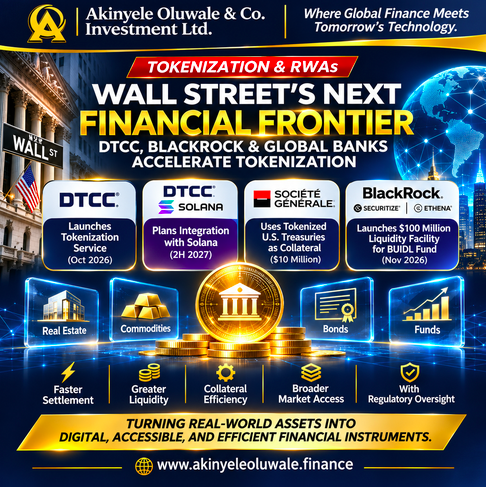
On 28 October 2026, the Depository Trust & Clearing Corporation announced the production launch of its DTCC Tokenization Service, known as DTS. The service enables eligible participants to create tokenized representations of selected securities held through The Depository Trust Company. Its intended applications include more efficient asset transfers, collateral mobility and capital utilisation.
This development is particularly important because DTCC is a major provider of post-trade infrastructure for conventional financial markets. Its involvement indicates that tokenization is no longer confined to technology companies experimenting outside established securities systems. Instead, it is being incorporated into infrastructure already used by regulated financial institutions. The service operates within a defined regulatory framework, following a U.S. Securities and Exchange Commission no-action letter issued in December 2025. The authorisation covers specified securities and eligible participants rather than unrestricted tokenization of all financial assets. This distinction matters.
A production service for eligible institutional participants is a meaningful achievement, but it does not mean every investor can immediately trade every security on a blockchain.
On 12 November 2026, DTCC announced plans to connect its Tokenization Service with the Solana blockchain. The integration is expected in the second half of 2027. Under the proposal, eligible securities held through DTC could become available in tokenized form on Solana, subject to the service's requirements. DTCC said the initiative would support its broader strategy of connecting traditional market infrastructure with multiple blockchain networks.
DTCC's Solana integration is a planned 2027 development, not a completed November 2026 deployment.
It would therefore be misleading to describe the announcement as evidence that all eligible DTCC securities are already trading on Solana. The more accurate conclusion is that a major securities infrastructure provider is expanding its future blockchain connectivity.
On 2 November 2026, Société Générale announced that its Prime Services & Clearing division had completed a controlled transaction involving $10 million in tokenized U.S. Treasury securities. The securities were accepted as collateral on the Canton Network, using assets associated with DTCC's tokenization infrastructure. The transaction demonstrated that tokenized Treasury securities could be transferred through blockchain infrastructure and reflected in the bank's existing collateral and back-office systems. This development deserves attention because collateral management is one of the more commercially relevant applications of tokenization.
Collateral supports lending, derivatives transactions and other financial obligations. Its availability and transferability can influence how efficiently institutions manage liquidity and financing requirements. A system that enables eligible collateral to move more efficiently could potentially reduce operational friction. Nevertheless, the transaction was conducted under controlled conditions. Its completion does not establish that every institutional collateral process can now be executed through blockchain networks. What it demonstrates is the feasibility of connecting tokenized securities with existing institutional risk-management and collateral procedures.
On 12 November 2026, Securitize and Ethena Labs announced the launch of a $100 million liquidity facility supporting BlackRock's USD Institutional Digital Liquidity Fund, commonly known as BUIDL. The facility allows eligible participants to exchange supported tokenized fund interests and stablecoins outside conventional market hours. It launched with $50 million in initial liquidity, with additional capacity available under the announced arrangement. The significance extends beyond the headline amount. Tokenized assets may be technically transferable around the clock, but investors still need counterparties and liquidity when they wish to transact. A blockchain operating continuously does not automatically guarantee that an asset can be sold immediately at a fair price. Liquidity facilities attempt to address this practical limitation. The arrangement illustrates how tokenized investment products and stablecoins may become increasingly connected within institutional financial services. It also highlights an important distinction between technological availability and economic liquidity.
A token can move 24 hours a day, but the ability to convert it into usable funds depends on the supporting market structure.
The developments involving DTCC, Société Générale, BlackRock and Securitize reveal a common theme. Institutional tokenization is increasingly focused on improving how financial assets function after they have been issued. Historically, much of the discussion surrounding tokenization concentrated on converting assets into digital tokens. Today, the more commercially important questions concern what institutions can actually do with those tokens. Can tokenized securities be used as collateral? Can investors exchange tokenized fund interests for cash or stablecoins outside conventional market hours? Can financial institutions reconcile blockchain transactions with their existing custody and accounting systems? Can ownership rights and investor protections remain enforceable? These questions determine whether tokenization becomes useful financial infrastructure or remains a limited technological experiment. A particularly important development is the growing relationship between tokenized assets and digital payment systems. For example, a tokenized government security may represent the investment asset, while a regulated payment instrument may facilitate settlement. If both sides of a transaction can operate through compatible systems, certain settlement processes could become more efficient. However, the technology must be supported by appropriate legal arrangements, reliable payment assets and operational safeguards.
The next phase of tokenization is therefore about connecting digital securities, liquidity and settlement into a coherent financial system.
Banks and financial institutions: Tokenization could improve collateral mobility, securities administration and liquidity management. However, institutions must address cybersecurity, operational resilience and regulatory obligations. Asset managers: Tokenized funds may offer new distribution and administration capabilities. Their commercial value depends on investor eligibility, fund governance, liquidity and cost efficiency. Blockchain infrastructure providers: Institutional integrations could create demand for secure networks, custody services and interoperability solutions. Announcements alone, however, do not guarantee network revenue or token-price appreciation. Investors and regulators: Investors may eventually benefit from improved access and settlement processes, but regulators must ensure that digital ownership records correspond to enforceable rights and appropriate investor protections.
A November 2026 asset-manager tracker reported approximately $8.18 billion in tokenized assets across 12 traditional managers covered by its analysis. Of that amount, approximately $7.51 billion was associated with money-market and Treasury-related products. The figures illustrate the importance of relatively familiar, income-generating financial instruments within the tracked institutional tokenization market. Composition of tracked tokenized assets Selected traditional asset managers, approximately 1–2 November 2026

■ Credit-related products
■ Money-market and Treasury products
Source: BlockWest Research tracker; figures rounded. This is a selected-manager sample, not the entire RWA market.
These figures should not be confused with the total global value of all tokenized real-world assets. Market estimates differ depending on which instruments, issuers and blockchain representations are included. They nevertheless suggest that institutional adoption is concentrated in products with relatively established financial characteristics.
For Nigeria and other African economies, tokenization presents both opportunities and policy challenges. Potential applications include government securities, investment funds, infrastructure financing and selected private-market assets. In principle, tokenization could make certain financial processes more transparent and reduce administrative friction. For example, an appropriately regulated tokenized investment product could support digital recordkeeping and more efficient investor administration. However, tokenization cannot resolve underlying weaknesses in an investment. A poorly structured infrastructure project does not become financially sound simply because its ownership interests are represented by blockchain tokens. Similarly, tokenizing real estate does not automatically resolve disputes over land title, valuation or legal ownership. These distinctions are particularly relevant in markets where documentation, custody, investor protection and financial-market infrastructure require continued development. For Nigerian regulators, the central challenge would be establishing how tokenized securities fit within existing capital-market laws and supervisory responsibilities.
Important questions include:
Who legally owns the underlying asset?
What rights does the token holder possess?
Which institution is responsible for custody?
How are disputes resolved?
What happens if the tokenization platform fails?
Can the instrument be transferred or redeemed under applicable law?
Nigeria's opportunity lies in developing credible financial infrastructure rather than simply encouraging the issuance of more digital tokens.
The most valuable African tokenization projects will be those that address genuine financing, settlement or market-access problems while preserving legal certainty and investor protection.
At Akinyele Oluwale & Co. Investment Ltd., our assessment is that tokenization is progressing from a largely experimental concept towards practical institutional applications. The evidence is becoming more substantial. DTCC has launched a production tokenization service. Société Générale has demonstrated the use of tokenized U.S. Treasuries as collateral. Securitize and Ethena have introduced a liquidity facility for eligible participants in BlackRock's BUIDL fund and DTCC has announced plans to expand its blockchain connectivity to Solana in 2027. These are meaningful developments. However, they do not justify the conclusion that tokenization has already transformed every segment of global finance.
Institutional adoption remains subject to technical limitations, regulatory requirements and commercial considerations. Three principles deserve particular emphasis.
First, legal rights matter more than digital presentation. A token must represent clearly defined, enforceable rights. Without that foundation, technological sophistication offers limited protection.
Second, liquidity must be real. The ability to transfer a token does not guarantee the existence of buyers, sufficient market depth or immediate redemption. Third, operational efficiency must be measurable. Financial institutions should evaluate tokenization against conventional infrastructure using settlement costs, processing times, reliability, capital efficiency and risk exposure. These principles distinguish sustainable financial innovation from speculative enthusiasm. They also help explain why major institutions are concentrating on securities custody, collateral management and tokenized investment funds. Such applications address existing financial processes where improvements can potentially be measured. Our institutional view is that tokenization will be judged by the financial problems it solves, not by the number of assets placed on a blockchain.
The following developments will help determine whether tokenization continues gaining institutional relevance.
DTCC's service expansion: Additional eligible securities, participating institutions and supported blockchain networks.
Solana integration in 2027: Whether DTCC achieves its planned second-half deployment.
Tokenized collateral: Whether banks expand beyond controlled transactions into recurring commercial use.
Institutional liquidity: Whether facilities supporting tokenized funds demonstrate dependable liquidity under varying market conditions.
Regulatory developments: How securities regulators address ownership rights, custody and market conduct.
Interoperability: Whether different blockchain networks and conventional financial systems can exchange reliable information and assets.
Commercial adoption: Whether tokenization delivers measurable cost savings and operational improvements.
African market participation: Whether credible regulatory and institutional frameworks emerge for tokenized financial instruments.
The central measure of progress will be the transition from announcements and isolated transactions to sustained, economically useful activity.
DTCC launched its Tokenization Service on 28 October 2026.
On 12 November, DTCC announced plans to connect the service to Solana in the second half of 2027.
The proposed integration is not yet a completed deployment.
Société Générale completed a controlled transaction involving $10 million in tokenized U.S. Treasuries as collateral.
Securitize and Ethena launched a liquidity facility with up to $100 million in capacity for eligible BUIDL-related transactions.
Tokenized funds and government securities are becoming important institutional use cases.
Blockchain transferability does not automatically create market liquidity.
Tokenization must preserve enforceable ownership rights, appropriate custody arrangements and regulatory safeguards.
Institutional adoption should be evaluated through commercial usefulness rather than speculative token-price expectations.
Akinyele Oluwale & Co. Investment Ltd. is an independent financial intelligence and research platform covering institutional cryptocurrency, macroeconomics, central banking, stablecoins, digital payments, tokenization, real-world assets, artificial intelligence and blockchain technology. Our editorial mission is to explain how technological developments, financial institutions and regulatory decisions are reshaping the global economy. We provide research-driven analysis designed to help readers distinguish meaningful financial innovation from speculation. Our approach emphasises factual accuracy, institutional accountability, economic reasoning and responsible financial decision-making.
TOKENIZATION IS NO LONGER JUST ABOUT PUTTING ASSETS ON A BLOCKCHAIN. IT IS ABOUT REBUILDING HOW FINANCIAL ASSETS MOVE, SETTLE AND SUPPORT ECONOMIC ACTIVITY.
The recent developments involving DTCC, Société Générale, BlackRock and Securitize suggest that institutional tokenization is becoming more operationally relevant but technological progress must not be mistaken for universal adoption. The strongest projects will be those that combine digital efficiency with legal certainty, liquidity, investor protection and dependable financial infrastructure. For global markets, the opportunity is substantial. For emerging economies, including Nigeria, the challenge is to establish the legal and institutional foundations necessary to participate responsibly.
The future of tokenization will not be determined by how many assets are converted into tokens, but by how effectively those tokens function within the real economy.
Observe the change. Understand the implications. Position with discipline.
Akinyele Oluwale & Co. Investment Ltd.
Where Global Finance Meets Tomorrow's Technology.
www.akinyeleoluwale.finance
Editorial disclaimer: This publication is for financial education and institutional analysis. It does not constitute personalised investment advice or a recommendation to purchase any security, cryptocurrency or tokenized asset.