

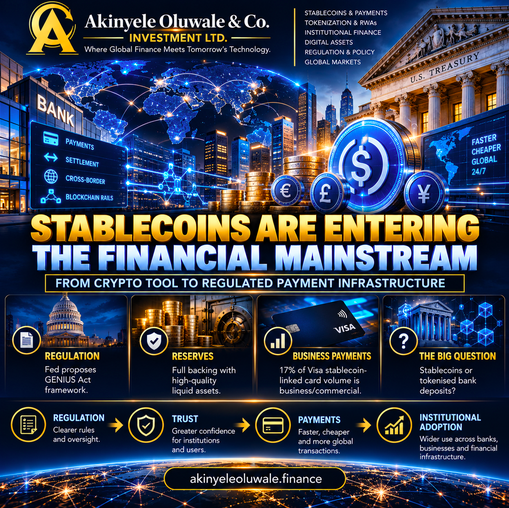
For years, stablecoins were discussed primarily as instruments used inside cryptocurrency markets.
That description is becoming increasingly incomplete.
Stablecoins are moving into payments, settlement, treasury management, commercial cards and cross-border financial infrastructure.
At the same time, regulators are moving from asking whether stablecoins should exist to determining how regulated issuers should operate.
On September 24, the Federal Reserve requested public comment on two proposals implementing its responsibilities under the GENIUS Act. Among other things, the proposed framework would require supervised payment-stablecoin issuers to maintain eligible reserve assets and meet capital and risk-management requirements. Federal Reserve
And commercial adoption is developing alongside regulation.
Visa reported on October 1 that approximately 17% of stablecoin-linked card volume in its FY2026 year-to-date data came through business and commercial card programmes. Visa Investor Relations
The question is therefore changing.
It is no longer simply:
“Will stablecoins survive?”
Increasingly, it is:
“What role will stablecoins play in the architecture of global money and payments?”
Stablecoins are entering a new phase.
The first phase was dominated by cryptocurrency trading.
The next phase increasingly involves payments and financial infrastructure.
The Federal Reserve's proposed GENIUS Act framework would require Board-supervised payment stablecoin issuers to fully back their tokens with specified permissible reserve assets, including certain short-term Treasury securities and other high-quality liquid assets. It would also establish standardized capital and risk-management requirements. Federal Reserve
Banks could also become direct participants. A second Fed proposal establishes an application process for supervised banks seeking approval for subsidiaries to issue payment stablecoins. Federal Reserve
Meanwhile, commercial adoption is becoming more visible.
Visa says it now supports more than 160 stablecoin-linked card programmes covering consumer, business and commercial activity. Visa Investor Relations
But important questions remain.
Can stablecoins maintain redemption at par during stress?
Could migration from bank deposits into stablecoins affect bank funding?
Will stablecoins compete with tokenised bank deposits?
And how will central banks preserve monetary control if privately issued digital money becomes much more important?
These questions move stablecoins beyond crypto.
They place them directly inside the future of banking and global payments.
Money performs several functions, but payments ultimately depend on trust.
A digital token claiming to represent one dollar must reliably remain redeemable for one dollar.
That is why reserves matter.
It is why regulation matters.
And it is why stablecoin adoption cannot be analysed solely by looking at blockchain transaction volumes.
The emerging chain is:
If regulators establish credible standards and issuers demonstrate reliable redemption, stablecoins could become more attractive for legitimate financial applications.
Those applications potentially include:
cross-border payments,
business settlement,
treasury management,
commercial payments,
digital-asset settlement,
and eventually deeper integration with tokenised financial markets.
That potentially places stablecoins at the intersection of:
The Fed's September 24 proposals are significant because they begin translating stablecoin legislation into operating requirements.
The proposed framework covers areas including:
reserve assets,
capital requirements,
risk management,
safekeeping of reserve assets,
and the circumstances under which supervised banks may undertake stablecoin-related activities. Federal Reserve
The reserve requirement is particularly important.
Under the proposal, supervised issuers would need full backing using specified permissible assets such as short-term Treasury bills and other high-quality liquid assets. Federal Reserve
The objective is straightforward:
Federal Reserve Governor Michael Barr highlighted precisely this issue, arguing that stablecoins must remain reliably and promptly redeemable at par, including during periods of market stress. Federal Reserve
The second Fed proposal is equally important.
It establishes procedures for insured state-member banks seeking approval for a subsidiary to issue payment stablecoins.
Applications would require information including a business plan and financial information. Federal Reserve
This changes the competitive landscape.
The future stablecoin market may not simply involve:
crypto companies versus banks.
It could increasingly involve:
operating across interconnected digital-payment infrastructure.
Regulation would matter less without real-world use.
That is where Visa's latest data becomes particularly interesting.
Visa reported that approximately 17% of stablecoin-linked card volume during FY2026 year-to-date occurred across business and commercial card programmes.
It also said it supports more than 160 stablecoin-linked card programmes. Visa Investor Relations
Businesses and financial institutions are exploring stablecoins for:
settlement,
treasury management,
payouts,
and cross-border commerce. Visa Investor Relations
That represents an important shift.
Stablecoins are gradually moving from:
toward
The bigger story is not simply stablecoins.
It is the digitalisation of money itself.
Several models are developing simultaneously:
Privately issued digital tokens designed to maintain a stable value relative to an underlying currency.
Traditional commercial-bank deposits represented or transferred using programmable digital infrastructure.
Central-bank liabilities represented through new digital architectures, depending on jurisdiction and design.
These approaches are not identical.
The Bank for International Settlements has emphasised important differences between stablecoins and tokenised deposits.
Tokenised deposits remain liabilities of regulated banks and can settle through central-bank money, whereas stablecoins can involve separate issuers and may trade away from par during periods of stress. Bank for International Settlements
That creates one of the most important financial-infrastructure questions of the coming decade:
Will the future of digital money be dominated by stablecoins, tokenised bank deposits, central-bank money—or an interconnected combination of all three?
The answer remains uncertain.
But the competition has clearly begun.
Stablecoins potentially create both an opportunity and a challenge for banks.
The opportunity is obvious.
Banks could participate in issuance, custody, settlement and tokenised financial markets.
But there is another side.
If significant amounts of money move from traditional deposits into stablecoins, banks could lose an important source of relatively inexpensive funding.
The Swiss National Bank recently warned that large-scale shifts from commercial-bank deposits toward stablecoins could reduce banks' lending capacity and weaken the transmission of monetary policy. Reuters
That makes stablecoins a banking issue—not merely a crypto issue.
Reserve requirements create another important connection.
If regulated stablecoins must hold substantial amounts of high-quality liquid assets, including short-term government securities, growth in stablecoin issuance could create additional demand for those reserve assets.
The relationship becomes:
That connects blockchain-based payments directly to traditional sovereign debt markets.
Stablecoins could change how value moves across borders.
Traditional cross-border payments can involve multiple intermediaries, banking hours and reconciliation systems.
Blockchain-based settlement potentially offers different operating models, including continuous availability and programmable settlement.
But traditional payment networks are not necessarily being displaced.
Visa's activity illustrates how existing payment infrastructure and stablecoin infrastructure can increasingly become interconnected. Visa Investor Relations
The future may therefore involve integration rather than simple replacement.
Stablecoins remain one of the most important bridges between conventional currencies and blockchain markets.
Greater regulatory clarity could potentially increase institutional confidence in compliant stablecoin infrastructure.
But investors should distinguish between:
stablecoin adoption
and
the investment performance of unrelated cryptocurrencies.
Growth in digital payments does not automatically make every digital asset valuable.
That distinction is essential.
At Akinyele Oluwale & Co. Investment Ltd., we believe the stablecoin conversation has reached an important turning point.
For too long, the discussion was framed as:
Crypto versus banks.
That framework is becoming obsolete.
The emerging financial system looks more interconnected:
The winners may not necessarily be those attempting to destroy traditional finance.
They may be the institutions that successfully connect traditional financial trust with programmable digital infrastructure.
But regulation alone cannot create success.
A stablecoin must ultimately solve an economic problem.
It must make some combination of:
payments faster,
settlement more efficient,
cross-border transfers easier,
treasury operations better,
or
financial markets more programmable.
Technology becomes financially important when it creates genuine economic utility.
That is the standard investors should apply.
The next phase deserves close attention across eight areas: the final shape of U.S. GENIUS Act rules; bank applications to issue stablecoins; reserve requirements; redemption standards; business-payment adoption; cross-border usage; competition from tokenised bank deposits; and central-bank responses.
The Federal Reserve's application proposal currently lists November 30, 2026 as the comment deadline, meaning the regulatory architecture is still being developed rather than being a finished regime. Federal Reserve
Investors should therefore distinguish carefully between:
and
That distinction matters.
Stablecoins are moving beyond cryptocurrency trading.
The Federal Reserve is developing a formal supervisory framework under the GENIUS Act. Federal Reserve
Reserve quality and redemption at par are central to building trust.
Banks themselves may become stablecoin issuers.
Business usage is becoming measurable: roughly 17% of Visa's stablecoin-linked card volume in FY2026 year-to-date was business/commercial activity. Visa Investor Relations
Stablecoins could affect banking deposits, government securities and monetary-policy transmission.
Tokenised deposits could become an important competitor or complement.
And today's central Day 29 lesson is:
Stablecoins are no longer simply a crypto story. They are becoming a financial-infrastructure story.
Akinyele Oluwale & Co. Investment Ltd. is a global finance and digital-economy intelligence platform focused on helping investors, professionals and decision-makers understand the forces reshaping modern markets.
Our intelligence covers:
Artificial Intelligence • Blockchain & Technology • Crypto & Digital Assets • Institutional Finance • Stablecoins & Payments • Tokenization & RWAs • Central Banks • Macro & Global Markets
Our analysis is organised around three questions:
We connect developments across traditional finance, digital assets, macroeconomics and emerging technology to explain not merely what happened but what it could mean.
Information tells you what happened.