

Published: 29 August 2026
Category: Tokenization • RWAs • Central Banks • Digital Finance
By: Akinyele Oluwale & Co. Investment Ltd.
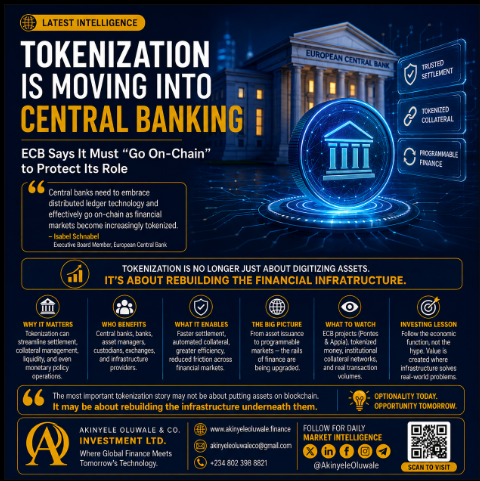
Tokenization just received one of its strongest institutional signals yet. European Central Bank Executive Board member Isabel Schnabel argued at Jackson Hole that central banks need to embrace distributed-ledger technology and effectively “go on-chain” as financial markets become increasingly tokenized. (Reuters)
Her argument goes beyond issuing digital currency.
Tokenized central-bank money could eventually support settlement, collateral management, liquidity provision and even more programmable monetary-policy operations.
This is significant because tokenization is moving from:
Digitizing Assets → Tokenizing Markets → Rebuilding Financial Infrastructure
The investment lesson is equally important: the long-term opportunity may lie less in creating more tokens and more in modernising the infrastructure connecting money, securities and collateral.
Schnabel argued that central banks risk weakening their role if privately issued digital money and tokenized financial markets develop without corresponding central-bank infrastructure.
She highlighted blockchain's programmability, including the potential for automated collateral processes and more flexible financial operations. The ECB is already pursuing this direction through projects including Pontes, designed to connect distributed-ledger platforms with existing settlement infrastructure, and Appia, its longer-term initiative for tokenized wholesale finance.
This is no longer simply a fintech experiment.
It is becoming a question of how central-bank money itself interacts with tokenized capital markets.
Tokenization means representing ownership or claims on conventional assets through digital tokens on programmable infrastructure.
The underlying asset can remain familiar:
Treasuries • Bonds • Funds • Deposits • Private Credit • Commodities • Real Estate
What changes is the infrastructure used to issue, record, transfer and settle ownership.
BlackRock, for example, expanded its tokenized cash-management strategy in August with two blockchain-based money-market products while retaining regulated fund structures. (BlackRock)
The direction is increasingly clear:
Traditional assets are not disappearing.
Their financial rails are changing.
Settlement is one of the least visible but most important parts of global finance. Traditional transactions can involve separate systems for trading, custody, clearing, settlement and collateral. Tokenization potentially compresses some of those processes through programmable infrastructure.
Imagine:
Asset + Ownership Record + Settlement Instructions + Collateral Rules
operating within connected digital systems.
The economic opportunity isn't simply “putting assets on blockchain.”
It is reducing friction between financial processes that historically operated separately.
Asset managers, custodians, banks, exchanges, blockchain infrastructure providers and regulated tokenization platforms could benefit. Central banks themselves may become important participants by providing trusted settlement assets for tokenized markets.
But public blockchains or crypto tokens shouldn't automatically be assumed to win.
Institutions will care about legal certainty, interoperability, cybersecurity, liquidity, privacy, compliance and settlement finality.
Infrastructure unable to satisfy those requirements could struggle regardless of technological sophistication.
Expect more pilots, institutional partnerships and tokenized products. However, investors should distinguish between three very different things:
Tokenized asset value → Transaction activity → Economic value captured by a blockchain or token
They are not automatically the same. A trillion dollars of assets represented digitally does not mean a particular crypto asset becomes worth a trillion dollars.
That distinction is critical.
The deeper transformation could be the creation of programmable capital markets.
Securities could settle faster.
Collateral could move automatically.
Liquidity could become available across connected networks.
Funds could become more accessible.
Central-bank money could potentially provide the settlement foundation underneath those markets.
If successful, tokenization may eventually become invisible to end users—just as most people using digital banking today rarely think about the databases operating underneath it.
The tokenization narrative is maturing.
The early question was:
“Can we tokenize this asset?”
The institutional question is now:
“Does tokenization make this market better?”
That requires measurable improvements in liquidity, settlement, transparency, collateral efficiency or distribution.
Putting an asset on-chain without improving its economics is digitization not transformation.
Watch the ECB's Pontes and Appia initiatives, tokenized central-bank money, institutional collateral networks, tokenized deposits, money-market funds and interoperability between blockchain systems.
Most importantly, watch real transaction volumes rather than announcements.
Follow the economic function, not the word “tokenization.”
Ask:
What problem is being solved? Who uses the infrastructure? Who earns the fees? Where does value accumulate?
Those questions separate infrastructure investment from narrative speculation.
Tokenization is progressing:
Experimentation → Asset Issuance → Settlement → Collateral → Programmable Markets → Financial Infrastructure
The arrival of central banks in that progression changes the scale of the conversation.
The most important tokenization story may not ultimately be about putting stocks, bonds or property on blockchain.
It may be about rebuilding the financial infrastructure underneath them.
When central bankers themselves begin discussing going on-chain, tokenization is no longer standing outside traditional finance asking to be admitted.
It is beginning to influence how traditional finance designs its next generation of infrastructure.
Akinyele Oluwale & Co. Investment Ltd.
Where Global Finance Meets Tomorrow’s Technology.