

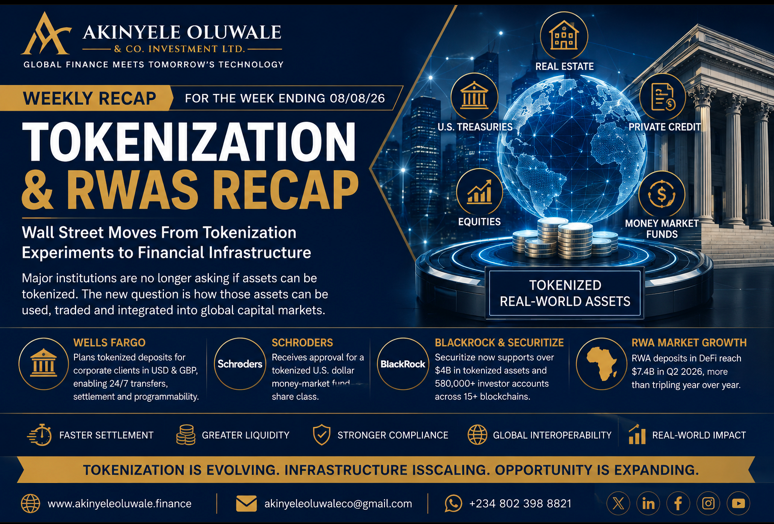
Weekly Tokenization & RWAs Recap: Wall Street Is Moving From Tokenization Experiments to Financial Infrastructure
The week ending 8 August 2026 delivered another important signal for investors: tokenization is no longer mainly about proving that traditional assets can exist on a blockchain. The next battle is making those assets useful, liquid and integrated into everyday capital markets.
Published: 8 August 2026
Category: Weekly Recap • Tokenization & RWAs • Institutional Finance • Digital Assets
By: Akinyele Oluwale & Co. Investment Ltd.
Executive Summary
The week ending 8 August 2026 strengthened the argument that real-world asset tokenization is entering a more serious stage of institutional adoption.
Several developments stood out.
Wells Fargo announced plans to introduce tokenized deposits for corporate and commercial clients, initially covering U.S. dollars and British pounds and enabling round-the-clock transfers, settlement and programmability. (The Wall Street Journal)
Schroders received approval from the Central Bank of Ireland for a tokenized share class of a U.S. dollar money-market fund, using JPMorgan's Kinexys infrastructure. (Financial News London)
At the same time, BlackRock's continued expansion into tokenized money-market products and the growing infrastructure surrounding Securitize demonstrate how quickly traditional asset managers are moving beyond blockchain experimentation. Securitize says it now supports more than $4 billion in tokenized assets and more than 580,000 investor accounts. (Securitize)
Perhaps the most revealing market data came from the RWA sector itself: reporting on CoinShares research showed RWA deposits in DeFi reaching approximately $7.4 billion in Q2 2026, more than tripling year over year, alongside a significant increase in tokenized-asset trading activity.
The lesson from this week is increasingly clear:
Tokenization is moving from "Can we put assets on-chain?" to "What can those assets actually do once they're there?"
Why This Matters
For years, tokenization sounded like a technology searching for a financial use case.
That is changing.
Government bonds can be tokenized.
Money-market funds can be tokenized.
Private credit can be tokenized.
Bank deposits can be tokenized.
Equities can increasingly be represented and traded through blockchain infrastructure.
But simply creating a digital representation of an asset is not enough.
For tokenization to transform global finance, those assets need:
Liquidity.
Legal ownership.
Custody.
Settlement.
Compliance.
Interoperability.
Collateral utility.
And ultimately, investors who actually want to own and trade them.
This week's developments suggest that institutions are increasingly working on those harder parts.
What Happened This Week?
1. Wells Fargo Takes Bank Deposits On-Chain
One of the week's most important developments came from traditional banking.
Wells Fargo plans to launch tokenized deposits for corporate and commercial clients beginning this fall.
The initial product will represent U.S. dollar and British pound deposits digitally on the bank's proprietary blockchain infrastructure.
Clients are expected to gain the ability to transfer, program and settle funds around the clock, initially for cross-border payments. (The Wall Street Journal)
This matters because tokenized deposits represent a different institutional path from stablecoins.
A stablecoin generally represents a claim on reserves held by an issuer.
A tokenized bank deposit represents a customer's existing commercial-bank deposit in tokenized form.
Banks may therefore see tokenized deposits as a way to capture many of blockchain's operational benefits while maintaining established banking relationships, compliance structures and regulatory control.
That could eventually create competition between two forms of digital money:
Stablecoins versus tokenized deposits.
The eventual outcome may not be one replacing the other.
Both could coexist and serve different parts of the financial system.
2. Schroders Pushes Money-Market Funds Further On-Chain
Schroders also moved deeper into tokenization this week.
The asset manager received approval from the Central Bank of Ireland to introduce a tokenized share class for a U.S. dollar money-market fund.
The product uses JPMorgan's Kinexys tokenization infrastructure, allowing transactions to be executed using blockchain-based smart contracts. (Financial News London)
This is particularly important because money-market funds are emerging as one of tokenization's strongest institutional use cases.
Why?
Because they combine several attractive characteristics:
Rather than asking investors to embrace an entirely unfamiliar financial product, tokenization changes the infrastructure beneath something they already understand.
That may prove to be one of the fastest routes toward mainstream adoption.
3. BlackRock Keeps Pushing Tokenized Cash
BlackRock's continued tokenization push remains central to the industry's development.
Through Securitize, BlackRock's BUIDL fund has become a major example of how traditional asset management can connect with blockchain infrastructure.
Securitize says it has now brought more than $4 billion of assets on-chain, supports over 580,000 investor accounts, and operates across more than 15 blockchain networks. (Securitize)
BlackRock's involvement matters for reasons extending beyond its own products.
When the world's largest asset manager invests time, capital and reputation into tokenized funds, competitors must ask whether they can afford not to investigate the same infrastructure.
That is how institutional adoption can accelerate.
One firm experiments.
Another follows.
Infrastructure improves.
Regulators respond.
Distribution expands.
Eventually, what once looked experimental begins looking normal.
4. RWAs Reach $7.4 Billion Across DeFi
Market activity also provided an important signal.
Research reported this week showed real-world asset deposits across DeFi reaching roughly $7.4 billion during Q2 2026, more than tripling from a year earlier.
Tokenized Treasuries, yield-bearing dollar products and other RWAs are increasingly being used not merely as assets to hold, but as collateral and trading instruments.
That distinction matters.
An asset sitting inside a wallet demonstrates ownership.
An asset being borrowed against, traded, transferred and integrated into other financial products demonstrates utility.
And utility is where tokenization becomes economically meaningful.
The Bigger Picture: Wall Street Is Learning to Love Blockchain
Perhaps the week's broader story can be summarized simply:
Traditional finance is becoming increasingly comfortable using blockchain without necessarily becoming "crypto."
Major institutions are adopting the technology because of what it can potentially improve:
The Financial Times noted this week that Wall Street institutions are increasingly embracing blockchain and tokenization as regulatory conditions improve, although interoperability, cybersecurity, fragmented liquidity and legal clarity remain significant challenges. (Financial Times)
That distinction is important for investors.
The institutional blockchain story may ultimately become much larger than cryptocurrency itself.
From Tokenized Assets to Tokenized Markets
The first generation of tokenization asked:
Can we represent this asset on blockchain?
The second generation asks:
Can we build an actual market around it?
Those are very different challenges.
A tokenized Treasury that cannot easily be transferred or traded provides limited improvement over the conventional product.
But imagine that same asset becoming:
Now the underlying asset has not changed.
But its financial utility has.
That may ultimately be the real value proposition of tokenization.
Market Impact
Asset Managers
Tokenization offers asset managers another distribution and operational channel.
Funds can potentially become more accessible, programmable and easier to integrate with digital financial infrastructure.
The winners may be firms that combine strong investment products with strong technological distribution.
Banks
Banks face both opportunity and disruption.
Tokenized deposits could allow banks to modernize money movement while preserving regulated deposit relationships.
At the same time, blockchain settlement could challenge traditional processes built around limited operating hours and multiple intermediaries.
Wells Fargo joining JPMorgan and Citi in tokenized-deposit infrastructure demonstrates how seriously large banks are taking this shift. (The Wall Street Journal)
Blockchain Networks
Ethereum, Solana and other networks are increasingly competing for institutional assets.
But institutions will care about more than transaction speed.
They will evaluate:
Security.
Liquidity.
Compliance infrastructure.
Reliability.
Interoperability.
Developer ecosystems.
The blockchain that attracts speculative activity is not automatically the blockchain that wins institutional finance.
Tokenization Infrastructure Providers
Companies providing issuance, custody, compliance, transfer-agent services and secondary-market infrastructure may occupy strategically important positions.
Securitize is a useful example.
Its infrastructure already supports tokenized products from major asset managers, and the company says it has more than $4 billion of tokenized assets on its platform. (Securitize)
This is why investors should not study tokenization only through individual tokens.
The infrastructure providers may be equally important.
The Challenge Nobody Should Ignore: Liquidity
There is still a major gap between tokenizing an asset and creating a liquid market for it.
Academic research examining RWA markets has highlighted limited secondary trading, regulatory restrictions, custodial concentration and fragmented liquidity as important barriers. (arXiv)
This deserves attention.
Putting a $100 million asset on blockchain does not magically create $100 million of liquidity.
Someone still needs to buy it.
Someone needs to make markets.
Legal ownership must be enforceable.
Prices must remain reliable.
Investors need access.
Settlement systems need interoperability.
Tokenization can improve the infrastructure.
It cannot repeal the economics of markets.
Editorial Perspective
This week reinforced something we believe investors should understand clearly:
Tokenization itself is not the investment thesis. Utility is.
Anyone can create a token representing an asset.
The difficult work begins afterward.
Can that token be traded?
Can institutions legally own it?
Can banks custody it?
Can investors borrow against it?
Can it settle against digital cash?
Can ownership transfer across jurisdictions?
Can traditional financial systems recognize what happened on-chain?
Those questions separate tokenization as a technological demonstration from tokenization as financial infrastructure.
This is why developments involving BlackRock, Wells Fargo, Schroders, JPMorgan and Securitize matter.
These institutions are not trying to make finance look more like crypto.
They are exploring whether blockchain can make traditional finance work better.
That is a much more powerful proposition.
Eventually, the strongest sign that tokenization has succeeded may be that we stop calling assets "tokenized."
Investors don't say they own an "electronically recorded stock."
They simply say they own a stock.
One day, the blockchain layer may become equally invisible.
When tokenization disappears into the infrastructure, that may be when it has truly won.
What to Watch Next
The coming months should provide important evidence about whether this transition is accelerating.
Investors should watch:
One metric deserves particular attention:
How much tokenized value is actually being used—not simply issued?
Investing Lesson of the Week
Don't invest in tokenization because an asset has been placed on blockchain. Invest in the ecosystem when tokenization creates something economically better.
A tokenized asset needs a reason to exist.
Does it settle faster?
Does it reduce costs?
Does it improve collateral efficiency?
Does it create broader distribution?
Does it increase transparency?
Does it unlock previously inaccessible liquidity?
If the answer is no, blockchain may simply be an expensive new wrapper around an old product.
But when the answer becomes yes, the investment case changes.
This is the discipline investors need as the RWA market expands:
Don't chase the word "tokenized." Follow the utility created by tokenization.
Takeaways
About Akinyele Oluwale & Co. Investment Ltd.
Akinyele Oluwale & Co. Investment Ltd. delivers research-driven intelligence covering Tokenization & RWAs, Institutional Crypto, Stablecoins & Payments, Artificial Intelligence, Macro & Central Banks, and Digital Assets.
Every weekly recap answers five essential questions:
What happened?
Why does it matter?
What does it mean for investors?
What's our Editorial Perspective?
What should readers watch next?
Global Finance Meets Tomorrow's Technology.