

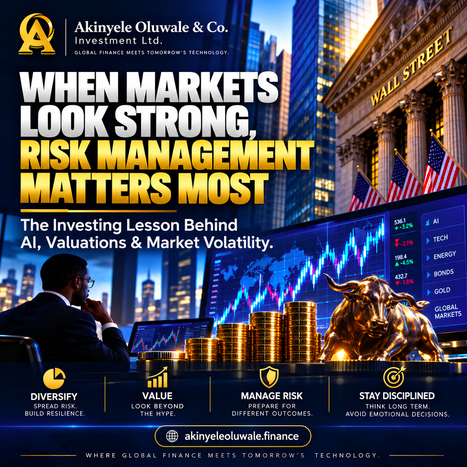
Published: October 24, 2026 | Category: Macro & Global Markets | Series: Investing Lessons | By: Akinyele Oluwale
One of the most dangerous moments for an investor is not necessarily when markets are falling. Sometimes, it is when everything appears to be going well.
When markets rise for an extended period, confidence grows. Recent winners begin to look unbeatable. Investors become more comfortable taking risks. Valuations that once looked expensive begin to feel normal.
Then something changes.
It may be an earnings disappointment.
A change in interest-rate expectations.
A geopolitical shock.
A sudden increase in oil prices.
A heavily indebted company struggling to refinance.
Or simply investors deciding that the price they were willing to pay yesterday no longer makes sense today.
This week's markets offered another useful reminder.
Wall Street ended Friday lower after a volatile week in which investors questioned the enormous cost of artificial-intelligence investment. The S&P 500 lost 0.5% for the week and the Nasdaq declined 0.7%, while energy shares benefited from higher oil prices. Investors are also looking ahead to the Federal Reserve's October 27–28 meeting.
The lesson is bigger than AI.
It is one of the oldest lessons in investing:
A good investment story does not remove investment risk.
And when markets are strong, risk management often matters more not less.
Investors naturally want returns but successful investing is not simply about identifying the asset that could rise the most.
It is also about surviving when expectations prove wrong. That distinction matters today.
Global markets have remained surprisingly resilient despite geopolitical tensions, high borrowing costs and economic uncertainty. The IMF says solid growth, strong corporate earnings and optimism surrounding artificial intelligence have helped support markets but the IMF also warns that resilience should not be confused with safety.
It identifies several potential sources of market stress, including disappointment around AI investment and profitability, higher sovereign bond yields driven by inflation or fiscal concerns, and increasingly sophisticated cyber risks.
For investors, the message is straightforward:
Do not build a portfolio that works only when your forecast is correct.
Build one that can survive when your forecast is wrong.
That requires:
Goals → Asset Allocation → Diversification → Valuation Discipline → Liquidity → Patience → Rebalancing
Investing is not about eliminating uncertainty.
That is impossible.
It is about managing uncertainty intelligently.
Imagine two investors.
The first investor sees an asset rising rapidly.
Everyone is discussing it.
News coverage is positive.
Social media is full of success stories.
The investor concludes:
"If everyone is making money, I am missing out."
So he concentrates most of his portfolio in the hottest investment.
The second investor also sees the opportunity but before investing, he asks different questions.
What am I actually buying?
What assumptions are already reflected in the price?
How much could I lose?
What happens if earnings disappoint?
What happens if interest rates rise?
How much of my portfolio should be exposed?
What other assets do I own?
Which investments could behave differently if conditions change?
Both investors may initially make money but they are not taking the same risk.
That difference often becomes visible only when markets turn.
This is why diversification matters.
Investor.gov describes diversification as spreading investments across different assets so that poor performance in one investment may be partly offset by others. It also stresses that asset allocation should reflect an investor's time horizon and ability to tolerate risk.
Diversification does not guarantee that a portfolio will never lose money.
It does something more realistic.
It reduces dependence on a single outcome.
That is the purpose of risk management.
The latest market environment gives us an excellent case study.
Artificial intelligence remains one of the most powerful investment themes in global markets.
Companies are spending extraordinary amounts on chips, data centres, computing capacity, electricity and other infrastructure.
There are legitimate reasons for optimism.
AI could improve productivity, create new products, transform industries and reshape how businesses operate but investors have started asking a harder question:
How much economic return will all this investment ultimately produce?
That question contributed to significant volatility this week.
Thursday brought a sharp technology sell-off, with the Nasdaq suffering its largest decline in four months. On Friday, AI-related shares were more mixed as investors continued assessing whether massive capital spending and debt-financed infrastructure investments would generate sufficient returns.
Yet something else was happening at the same time.
Global equity funds attracted about $28.16 billion in the week ending October 21, their fifth consecutive week of inflows. Bond funds and money-market funds also attracted capital.
This is important.
Markets are rarely simply "risk-on" or "risk-off."
Capital moves between sectors, regions and asset classes as investors continually reassess:
Risk
Return
Valuation
Liquidity
Interest Rates
Economic Growth
That is why investors should resist reducing the entire market to one headline.
The bigger lesson is about the difference between a great story and a great investment. They are not automatically the same thing. A company can operate in an extraordinary industry and still be a poor investment if its price assumes unrealistic future profits.
Likewise, an ordinary business purchased at a sensible valuation can sometimes become a strong investment.
This is where valuation enters the discussion.
When investors buy an asset, they are not simply buying today's business.
They are paying for expectations about tomorrow. The higher the valuation, the greater those expectations may be.
That creates what I call the:
EXPECTATIONS GAP
Consider this sequence:
Strong Theme → Investor Excitement → Capital Inflows → Rising Valuation → Higher Expectations
Everything can continue working as long as reality keeps meeting or exceeding those expectations but if results disappoint:
High Expectations → Earnings Disappointment → Revaluation → Falling Price
This does not mean investors should avoid innovative sectors. It means innovation does not eliminate valuation discipline. A transformative technology can change the world. Investors can still overpay for it. Both statements can be true simultaneously.
What should investors learn from this environment?
An asset rising in price tells you what other investors are currently willing to pay.
It does not automatically tell you what the asset is fundamentally worth.
Good investing requires understanding the difference.
Concentration can produce impressive returns when the investment thesis works.
It can also produce significant losses when it does not.
Diversification spreads exposure across investments and asset classes rather than allowing one decision to determine the outcome of the entire portfolio.
Interest rates influence borrowing costs, business investment and asset valuation.
The Federal Reserve raised its target range to 3.75%–4.00% in September, and its next scheduled meeting is October 27–28.
When capital becomes more expensive, investors generally become more demanding about the returns they expect from investments.
Investors often think about returns before they think about liquidity.
That can be a mistake.
You should understand how easily an investment can be converted into cash and whether doing so during difficult market conditions could involve significant losses.
Markets generate endless information.
Not every headline requires action.
One of the most valuable investing skills is learning the difference between:
Information that changes your investment thesis
and
Noise that changes your emotions.
At Akinyele Oluwale & Co. Investment Ltd., our view of investing begins with a simple principle:
The objective is not merely to participate in opportunity. It is to participate without allowing one mistake to destroy your financial position.
That requires discipline. Investors should understand that risk management is not pessimism. Diversification is not a prediction that markets will collapse. Holding appropriate liquidity is not necessarily a prediction that stocks will fall.
Rebalancing is not an admission that your previous investment decisions were wrong. These are tools for managing something every investor must eventually confront:
uncertainty.
There will always be uncertainty.
No analyst knows every future interest-rate decision.
No investor knows exactly how geopolitical events will develop.
No one knows with certainty which technology company will dominate an industry ten years from now.
Good investing therefore requires humility.
You develop a thesis.
You examine the evidence.
You estimate value.
You understand the risks.
You allocate capital.
Then you continue testing your assumptions.
That is investing.
Prediction alone is not.
One principle deserves particular emphasis:
Urgency is one of the greatest enemies of intelligent investing.
Whenever an investment opportunity creates the feeling that you must act immediately or lose your chance forever, that is often precisely when discipline becomes most valuable.
Investors should watch five areas carefully.
The question is shifting from how much companies are spending on AI to how much economic value that spending produces.
Watch revenue growth, margins, cash generation and returns on invested capital not merely capital expenditure announcements.
Higher yields increase the opportunity cost of holding riskier assets and can affect valuations across equities, property and other markets.
The IMF specifically identifies sovereign-yield shocks as one potential trigger for broader market stress.
Prices can move on narratives for a while.
Over the longer term, businesses must produce economic results.
Revenue matters.
Profitability matters.
Cash flow matters.
Debt matters.
Investors should understand whether apparently diversified portfolios are actually concentrated in the same companies, sectors or economic themes.
Owning several investments does not necessarily create genuine diversification if they all depend on the same underlying risk.
Perhaps the greatest risk is sometimes not the market.
It is the investor.
Fear can make people sell after large declines.
Greed can make people buy after extraordinary gains.
FOMO can make investors abandon valuation discipline.
A resilient investment process should therefore manage both financial risk and behavioural risk.
1. Strong markets are not automatically safe markets.
The IMF says markets have remained resilient, but financial-stability risks remain elevated.
2. A great investment theme can still become overpriced.
Innovation and valuation must be analysed separately.
3. Diversification remains fundamental.
The purpose is not to eliminate losses but to reduce dependence on a single investment or outcome.
4. Your time horizon matters.
The appropriate level of investment risk depends partly on when the money will be needed and how much volatility can reasonably be tolerated.
5. Do not confuse market excitement with investment analysis.
Popularity is not valuation.
6. Rebalancing can restore discipline.
When market movements cause one asset class to become disproportionately large, rebalancing can return a portfolio toward its intended risk allocation.
7. Patience remains an investment advantage.
The investor who does not feel compelled to respond to every headline can often make decisions more deliberately.
Our Investing Lessons framework is therefore:
GOALS → ASSET ALLOCATION → DIVERSIFICATION → VALUATION → LIQUIDITY → PATIENCE → REBALANCING
And the principle underneath it:
Build a portfolio that does not require every prediction to be correct.
Akinyele Oluwale & Co. Investment Ltd. provides financial intelligence and investment education focused on the intersection of global finance, institutional capital, markets and emerging technology.
Our work covers artificial intelligence, blockchain and technology, crypto and digital assets, institutional finance, stablecoins and payments, tokenization and real-world assets, central banks, and macro and global markets but understanding markets requires more than following what rises and falls each day.
Investors also need principles.
They need to understand risk.
They need to understand valuation.
They need to understand how interest rates affect assets.
They need to understand diversification.
And they need the discipline to separate investment decisions from emotion.
That is the purpose of our Investing Lessons series.
We are not interested in teaching investors how to chase yesterday's winner.
Our objective is to help readers develop the thinking required to evaluate tomorrow's opportunities intelligently.
Markets will change.
Today's dominant technology may eventually be replaced.
Interest rates will rise and fall.
Economic cycles will turn.
New asset classes will emerge.
Investment narratives will come and go.
But several principles remain remarkably durable:
Understand what you own.
Know why you own it.
Understand what could go wrong.
Do not risk what you cannot afford to lose.
Diversify intelligently.
Respect valuation.
Keep appropriate liquidity.
Think long term.
And perhaps most importantly:
Never allow excitement to replace analysis.
This week's market volatility is therefore not simply another financial-market event.
It is a lesson.
The strongest investors are not necessarily those who predict every market movement correctly.
They are often those who build a disciplined process capable of surviving when markets do something they did not predict.
Returns matter. Risk matters too.
The intelligent investor learns to respect both.
Observe the change. Understand the implications. Position with discipline.
Akinyele Oluwale & Co. Investment Ltd.
Where Global Finance Meets Tomorrow's Technology.
akinyeleoluwale.finance
This publication is provided for educational and informational purposes only and does not constitute individualized investment, financial, legal or tax advice.