

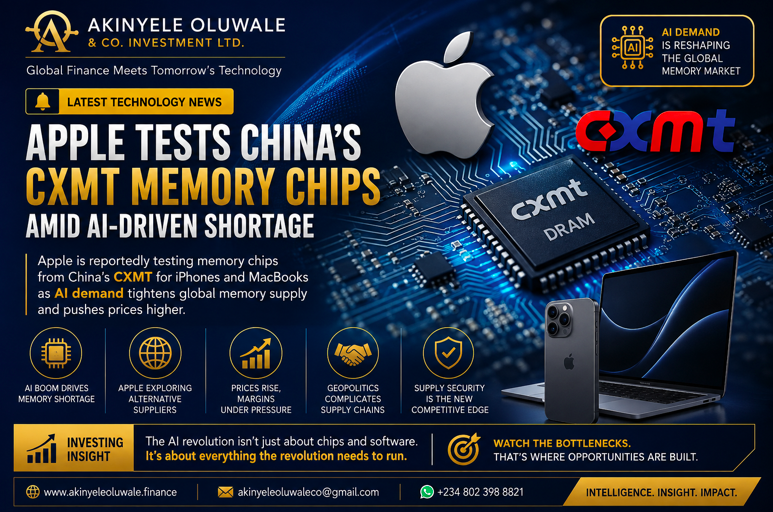
Apple Tests China's CXMT Memory Chips as the AI Boom Tightens the Global Semiconductor Supply Chain
Apple's reported testing of Chinese-made memory for iPhones and MacBooks reveals an overlooked consequence of the AI infrastructure boom: AI is no longer competing only for capital and electricity. It is increasingly competing for the components needed to build everyday technology.
Published: 10 August 2026
Category: AI & Technology • Semiconductors • Global Supply Chains • Investing
By: Akinyele Oluwale & Co. Investment Ltd.
Executive Summary
Apple is reportedly testing DRAM memory chips from China's ChangXin Memory Technologies (CXMT) across products including iPhones and MacBooks as the global memory market remains squeezed by extraordinary AI-related demand.
According to reporting originating with The Wall Street Journal and subsequently reported by Reuters, Apple has held preliminary discussions with CXMT about potentially supplying components, particularly for devices sold in China. No supply agreement has been announced, Apple has not committed to commercially using CXMT chips, and neither company commented to Reuters. (Reuters)
That qualification matters.
This is testing—not yet a confirmed sourcing deal.
However the bigger story extends far beyond Apple.
Artificial intelligence infrastructure is consuming enormous quantities of advanced memory. As manufacturers direct capacity toward higher-value AI applications, the pressure is spreading into conventional DRAM used by smartphones, computers and other consumer electronics.
Apple's willingness to evaluate another supplier demonstrates how seriously technology companies are treating the shortage.
For investors, there is a larger lesson:
The AI boom is creating winners far beyond GPUs. Memory, manufacturing capacity, power, networking and supply-chain security are becoming strategic assets in their own right.
Why This Matters
When investors think about the AI boom, one company often dominates the conversation: Nvidia.
But an AI server cannot operate on processing power alone.
It requires an entire ecosystem:
Memory has become one of the most important constraints.
AI systems need enormous quantities of memory to keep processors supplied with data. As manufacturers prioritize the rapidly expanding AI market, less capacity can be available for other applications.
That creates an unusual situation.
AI demand can affect the price and availability of components inside products that have little to do with generative AI itself.
Apple is now confronting that reality.
What Happened?
Apple Is Testing CXMT Memory
Apple has reportedly been testing memory produced by Chinese semiconductor manufacturer CXMT for potential use across products including iPhones and MacBooks.
The company has also held early discussions with CXMT regarding possible component supply, with particular consideration being given to Apple products sold inside China. (Reuters)
CXMT has become an increasingly significant participant in the global DRAM industry.
Earlier reporting indicated that Apple had been evaluating CXMT's DRAM through technical qualification procedures normally undertaken before a new supplier can be approved for production. But Apple had not committed to using those chips commercially. (MacRumors)
That distinction should not be lost in the headline.
Testing does not equal purchasing.
But Apple does not test alternative suppliers without a strategic reason.
And right now, that reason is increasingly clear.
AI Is Squeezing the Memory Market
The global memory industry is experiencing one of its most consequential demand shifts in years.
AI data centres require enormous quantities of memory, particularly high-bandwidth memory, or HBM.
Manufacturers naturally have an incentive to allocate investment and production toward the segments generating the strongest demand and margins.
The consequence is pressure elsewhere.
Samsung and SK hynix have previously warned that significant memory shortages could continue through at least 2027 as AI demand absorbs capacity. (Tom's Hardware)
Micron has similarly indicated that memory supply remains constrained, while industry customers search for alternatives and workarounds. (The Wall Street Journal)
For Apple, this isn't an abstract semiconductor story.
Memory is required across enormous product volumes.
An iPhone cannot ship without DRAM.
Neither can a MacBook.
So when memory becomes scarce, securing reliable supply becomes strategically important.
Apple Has Already Felt the Cost
The memory shortage has already reached consumers.
Apple CEO Tim Cook said in June that rising memory costs made price increases unavoidable, and Apple subsequently raised prices on some Macs and iPads by $200 or more. (The Wall Street Journal)
That gives the CXMT story a different perspective.
Apple isn't merely shopping around for a cheaper component.
It is trying to protect:
Margins.
Production volumes.
Product availability.
Pricing competitiveness.
Supply-chain resilience.
For a company operating at Apple's scale, even relatively small changes in component costs can have enormous financial consequences.
Why CXMT?
For decades, the global DRAM industry has been dominated by a small number of manufacturers, particularly Samsung Electronics, SK hynix and Micron.
CXMT is challenging that concentration.
Earlier reporting placed the Chinese company as the world's fourth-largest DRAM producer, with roughly 11% of global DRAM wafer capacity last year. (MacRumors)
That creates another potential source of supply at precisely the moment large technology companies need one.
And Reuters reported that other PC manufacturers, including HP and Acer, have already incorporated CXMT memory into some products distributed outside the United States. (Reuters)
But Apple's situation is more complicated.
Because CXMT sits within the increasingly sensitive intersection of technology, trade and U.S.-China relations.
The Geopolitical Problem
This is where the story moves beyond semiconductors.
CXMT has been included on a U.S. Defense Department list of Chinese entities believed to have links to China's military.
Previous reporting indicated Apple had sought U.S. government support for potentially sourcing memory from CXMT and Chinese NAND manufacturer YMTC for devices sold in China. (The Japan Times)
That places Apple between two powerful forces.
On one side:
Supply-chain economics.
Apple wants adequate memory supply at competitive prices.
On the other:
Geopolitical risk.
Washington increasingly treats advanced semiconductor technology as a matter of national security.
Apple therefore cannot evaluate CXMT purely on performance and cost.
It must also evaluate political consequences.
This is becoming normal for multinational technology companies.
The Bigger Picture
AI Is Reorganising the Semiconductor Industry
The AI boom is often presented as a demand story.
More AI applications.
More GPUs.
More data centres.
More cloud computing.
But underneath that demand sits a competition for finite industrial resources.
Memory manufacturing capacity cannot be expanded overnight.
Semiconductor fabs take years and billions of dollars to build.
Equipment must be installed.
Processes must be qualified.
Yield must improve.
Customers must validate the resulting components.
That means supply can respond far more slowly than AI demand.
And when one industry begins consuming disproportionately large amounts of semiconductor capacity, other industries feel the consequences.
AI is therefore not simply creating new technology demand. It is reallocating existing industrial capacity.
China Gains an Unexpected Opening
There is another interesting dimension.
Western restrictions were designed partly to limit China's access to advanced semiconductor technology.
But shortages can create opportunities for alternative suppliers.
If Samsung, SK hynix and Micron cannot fully satisfy conventional memory demand because AI infrastructure is absorbing so much industry capacity, Chinese manufacturers gain an opening.
CXMT can potentially compete in areas where global customers are searching for additional supply.
Reuters reports that CXMT is also planning another production facility in Beijing as it expands capacity. (Reuters)
This doesn't mean China has overtaken the leading global memory manufacturers.
It means the competitive landscape is changing.
And shortages can accelerate that change.
What It Means for Apple
For Apple, supplier diversification offers several potential advantages.
Supply Security
Additional qualified suppliers reduce dependence on a small group of manufacturers.
Pricing Power
More competition among suppliers can strengthen Apple's negotiating position.
China Strategy
Locally sourced components could potentially make economic and operational sense for products manufactured or sold within China.
Risk Diversification
A broader supplier base reduces exposure to production problems at any single manufacturer.
But there are trade-offs.
Political scrutiny could be substantial.
Quality and reliability standards must be satisfied.
Supply-chain security would require careful examination.
And any use of Chinese memory would have to fit within applicable U.S. regulatory restrictions.
What It Means for Samsung, SK hynix and Micron
The existing memory leaders are in an unusual position.
AI demand is generating enormous opportunities.
But those opportunities also encourage customers to diversify.
If memory prices remain elevated long enough, buyers have stronger incentives to qualify new suppliers.
That can gradually change industry structure.
This is a classic economic response.
High prices attract competition.
The established manufacturers may therefore benefit enormously from the AI memory boom today while simultaneously helping create conditions for stronger competitors tomorrow.
Investors should understand both sides.
Market Impact
Memory Manufacturers
The AI boom has transformed memory from a cyclical semiconductor segment into one of the most strategically watched areas of technology.
Companies able to expand high-value memory capacity efficiently may remain major beneficiaries.
But investors should watch capacity expansion closely.
Today's shortage can eventually become tomorrow's oversupply if too much manufacturing capacity arrives simultaneously.
Apple
Memory inflation places pressure on Apple's hardware margins and consumer pricing.
Adding suppliers could improve Apple's bargaining position and supply resilience.
However, any CXMT relationship could introduce political and regulatory complications.
Chinese Semiconductor Companies
The shortage provides Chinese memory manufacturers with an opportunity to demonstrate that they can become credible suppliers to global technology companies.
Winning Apple—even initially only for China-market devices—would carry significance far beyond the immediate revenue.
It would represent validation.
Consumers
Consumers ultimately sit at the end of the semiconductor supply chain.
Higher memory prices can contribute to:
AI infrastructure spending therefore has consequences far beyond data centres.
Editorial Perspective
The most interesting part of this story isn't Apple testing a Chinese chip.
It is why Apple feels compelled to test it.
AI has become so capital- and component-intensive that its effects are spreading across the entire technology supply chain.
First, investors focused on GPUs.
Then advanced packaging became scarce.
Then electricity became part of the AI conversation.
Now memory has become another strategic bottleneck.
This pattern tells us something important about investing in technological revolutions.
The obvious winner is rarely the entire opportunity.
When a new technology expands rapidly, investors should look for the constraints surrounding it.
What does the technology consume?
What infrastructure does it require?
What becomes scarce because demand is growing faster than supply?
Who controls that scarce resource?
Those questions can reveal opportunities the market initially overlooks.
There is also a geopolitical lesson.
Globalisation once encouraged companies to source components wherever economics were most attractive.
The emerging technology order is different.
Today, Apple must consider not only:
"Is this memory chip good enough?"
But also:
"Will Washington allow us to buy it?"
Technology, economics and geopolitics are increasingly inseparable.
For investors, that makes semiconductor analysis more complicated but also much more important.
What to Watch Next
Several developments now deserve attention:
The key indicator is no longer simply AI chip demand.
Watch what AI demand makes scarce next.
Investing Lesson
When everyone is watching the product, study the bottleneck.
During a technological boom, investors naturally gravitate toward the companies selling the headline product.
But enormous value can also accumulate around whatever limits that product's growth.
AI needs GPUs.
GPUs need memory.
Data centres need electricity.
Semiconductors need advanced manufacturing.
And global manufacturers need reliable supply chains.
The investment opportunity therefore extends far beyond artificial intelligence software.
The lesson is simple:
Don't only ask, "Who is leading the AI revolution?"
Ask:
"What does the AI revolution increasingly need—and who controls the supply?"
Sometimes the most important investment opportunity is hiding inside the constraint.
Key Takeaways
About Akinyele Oluwale & Co. Investment Ltd.
Akinyele Oluwale & Co. Investment Ltd. delivers research-driven intelligence covering AI & Technology, Institutional Crypto, Macro & Central Banks, Stablecoins & Payments, Tokenization & RWAs, and Digital Assets.
Every article answers five essential questions:
What happened?
Why does it matter?
What does it mean for investors?
What's our Editorial Perspective?
What should readers watch next?
Global Finance Meets Tomorrow's Technology.