

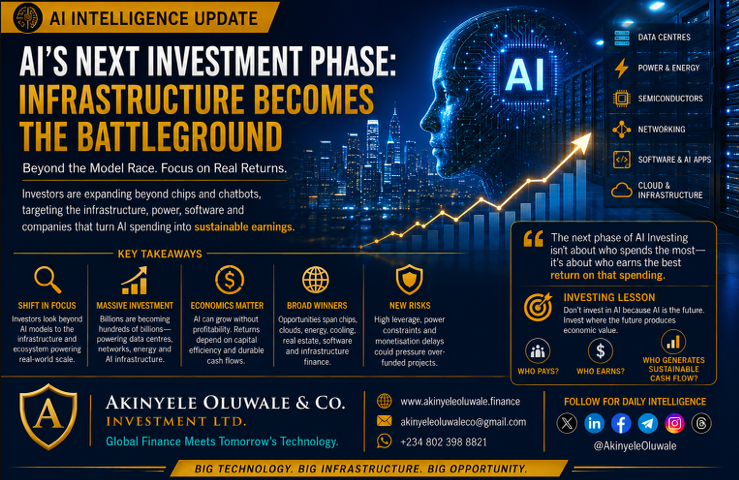
AI’s Next Investment Phase: Wall Street Looks Beyond the Model Race as Infrastructure Becomes the Battleground
The AI investment story is broadening. After years of focusing on model leaders and semiconductor winners, major investors are increasingly searching across power, data centres, networking, software and companies capable of turning AI spending into durable earnings.
Published: 18 August 2026
Category: Artificial Intelligence • Market Intelligence
By: Akinyele Oluwale & Co. Investment Ltd.
Executive Summary
The AI trade is entering a more demanding phase.
Major global investors are increasingly looking beyond the obvious semiconductor and hyperscaler winners for companies that can convert artificial intelligence into sustainable earnings. Reuters reports that investors are expanding their search across AI infrastructure, software and industrial beneficiaries as concerns over massive capital expenditure begin to ease. (Reuters)
At the same time, the scale of infrastructure investment continues to grow. Nvidia has committed up to $105 billion in guarantees supporting OpenAI's planned Ohio data-centre development and will invest $1.5 billion in SB Energy. (Reuters)
The investment question is changing:
Not “Who is spending the most on AI?” but “Who ultimately earns the best return from that spending?”
What Happened?
Wall Street's AI focus is widening.
After another strong earnings season for AI-linked companies, institutional investors are increasingly hunting for the next group of beneficiaries rather than concentrating solely on Nvidia and America's largest technology companies. (Reuters)
Infrastructure remains central.
OpenAI's planned Ohio campus, being developed by SoftBank subsidiary SB Energy, is expected to reach as much as 8 gigawatts of capacity, with the first 800 megawatts targeted for 2028. Nvidia's guarantees are designed to support parts of OpenAI's long-term lease and infrastructure financing. (Reuters)
Meanwhile, America's electricity consumption is projected to reach record levels in both 2026 and 2027, with expanding AI and data-centre demand among the major drivers. (Reuters)
AI is therefore becoming as much an energy and capital story as a software story.
Background
The first investment phase of generative AI was relatively straightforward.
Investors bought companies supplying the scarce resources required to build AI especially advanced GPUs and cloud computing.
The second phase is more complicated.
Billions are becoming hundreds of billions. Data centres require enormous power supplies. Financing structures are becoming increasingly sophisticated. And shareholders are beginning to ask when all that investment translates into durable cash flow.
This creates a transition from AI excitement to AI economics.
Why It Matters
AI may be transformative while still producing very different investment outcomes across the value chain.
A company can experience explosive AI-related revenue while earning weak returns on the capital required to generate it.
Another company perhaps supplying electricity, cooling equipment, networking or data-centre infrastructure could quietly capture attractive economics without ever developing an AI model.
That's why investors increasingly need to separate:
AI adoption from AI profitability.
The technology can win while individual investments lose.
Winners & Losers / Key Stakeholders
Potential beneficiaries increasingly extend across the AI stack:
Semiconductors → Networking → Data Centres → Power → Cooling → Cloud → Models → Software → AI Agents
Power and infrastructure providers are already feeling the impact. Siemens Energy recently reported record quarterly sales, margins and orders, helped partly by booming data-centre demand. (Reuters)
The vulnerable side includes companies whose valuations assume enormous AI growth without a credible route to monetisation.
Capital expenditure alone isn't competitive advantage.
Eventually, return on invested capital matters.
Short-Term Impact
AI-linked equities could remain powerful, but market leadership may broaden.
Investors are likely to increasingly distinguish between companies merely announcing AI initiatives and those demonstrating measurable revenue, productivity gains or infrastructure demand.
Expect continued volatility whenever hyperscalers disclose capital expenditure.
The market is beginning to ask harder questions about how much AI infrastructure is enough and how quickly that investment will generate returns.
Long-Term Impact
AI could reshape capital markets far beyond technology stocks.
Electricity generation, transmission networks, nuclear power, industrial equipment, real estate, private credit and infrastructure finance could all become connected to the AI investment cycle.
That also introduces new risks.
An AI slowdown would no longer affect only technology companies. Highly leveraged data-centre projects, power investments and infrastructure financiers could also feel the consequences.
AI is becoming deeply embedded in the physical economy.
Editorial Perspective
Investors should resist the temptation to reduce AI investing to one company, one chip or one chatbot.
The bigger opportunity is understanding where economic value accumulates.
Nvidia may sell the computing power.
Utilities may provide the electricity.
Data centres house the infrastructure.
Cloud companies distribute the compute.
AI developers build intelligence.
Software companies monetise it.
The eventual winners could emerge at several points along that chain.
What to Watch Next
Watch hyperscaler capital expenditure, data-centre financing, electricity prices, power-grid investment and enterprise AI revenue.
Most importantly, watch AI monetisation.
The next major market debate may not be whether AI works.
It may be whether the financial returns justify the extraordinary amount of capital being deployed.
Investing Lesson
Don't invest in AI because AI is the future. Invest where the future produces economic value.
Ask three questions:
Who pays?
Who earns?
Who generates sustainable free cash flow?
Technology narratives attract capital.
Cash flows ultimately justify valuations.
Key Takeaways
AI investing is moving beyond the model race.
Infrastructure, power and financing are becoming critical parts of the opportunity, while investors are increasingly demanding evidence that unprecedented spending can generate sustainable returns. (Reuters)
Editorial Bottom Line
The first AI trade rewarded those who recognised the technology early.
The next phase may reward investors who understand its economics.
AI will create enormous value.
But the investment winners will be the companies that capture that value not simply the companies that spend the most trying to build it.
Sources
Primary sources include Reuters reporting dated August 2026 on institutional investor positioning, Nvidia/OpenAI infrastructure financing, U.S. electricity-demand forecasts and AI-driven energy infrastructure demand. (Reuters)
Akinyele Oluwale & Co. Investment Ltd.
Where Global Finance Meets Tomorrow's Technology.