

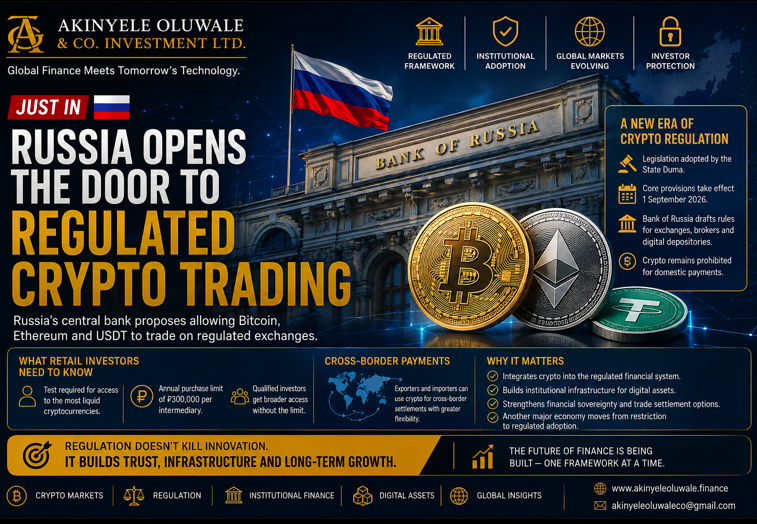
Russia Opens the Door to Regulated Crypto Trading: Bitcoin, Ethereum and Stablecoins Move Inside the Financial System
Russia is moving from restricting cryptocurrency toward regulating it. New legislation creates a domestic framework for crypto exchanges, brokers and digital depositories, while the Bank of Russia is now drafting the rules needed for organised trading.
Published: 12 August 2026
Category: Crypto Regulation • Institutional Crypto • Global Markets
By: Akinyele Oluwale & Co. Investment Ltd.
Executive Summary
The viral headline is directionally correct, but the /Truth is more significant than the post suggests.
Russia is establishing a regulated domestic cryptocurrency market. The State Duma adopted legislation in July allowing both retail and qualified investors to transact in cryptocurrencies through regulated intermediaries, with the core provisions taking effect on 1 September 2026. (Central Bank of Russia)
The Bank of Russia has subsequently published draft regulations establishing the operational framework for organised trading, crypto exchanges and digital depositories. (Central Bank of Russia)
However, this is not unrestricted crypto legalisation.
Ordinary investors will face testing requirements and an annual purchase ceiling of ₽300,000 per intermediary for eligible liquid cryptocurrencies. Qualified investors can access a broader range without that monetary limit, subject to testing. Foreign stablecoins are also brought within the regulatory framework. (Central Bank of Russia)
And one major restriction remains:
Crypto still cannot be used for domestic payments in Russia.
The bigger story is therefore not Russia embracing Bitcoin as money.
It is Russia bringing crypto inside its regulated financial perimeter.
What Happened?
On 21 July, the Bank of Russia confirmed that the State Duma had adopted legislation governing cryptocurrency circulation.
The framework creates something Russia previously lacked at this scale: a formal infrastructure through which cryptocurrencies can be bought and sold using regulated financial intermediaries.
That infrastructure will include:
Crypto exchanges.
Digital depositories.
Brokers.
Asset-management companies.
Organised trading platforms.
The Bank of Russia followed on 27 July with draft regulations setting requirements for organised digital-currency trading and the institutions responsible for recording and settling those assets. (Central Bank of Russia)
This is a major change in regulatory architecture.
Russia isn't simply tolerating crypto ownership.
It is constructing a supervised market around it.
Why This Matters
Russia has historically taken a cautious and often hostile position toward private cryptocurrencies.
The Bank of Russia previously worried about:
Capital flight.
Financial instability.
Money laundering.
Consumer losses.
Competition with the ruble.
Monetary sovereignty.
Those concerns have not disappeared.
What has changed is the regulatory strategy.
Rather than attempting to keep cryptocurrency largely outside conventional finance, Russia is creating a framework where crypto activity can occur through institutions the state can supervise.
That means:
Know Your Customer rules.
Transaction records.
Custody standards.
Regulatory reporting.
Investor restrictions.
Tax visibility.
This isn't deregulation.
It is controlled integration.
What Retail Investors Can Actually Do
The distinction between ordinary and qualified investors is crucial.
Non-qualified investors will be permitted to purchase the most liquid eligible cryptocurrencies only after passing an investor test.
They will also face a limit:
No more than ₽300,000 annually through one intermediary. (Central Bank of Russia)
Qualified investors must also complete testing, but can purchase and sell cryptocurrencies without the same monetary ceiling and with broader asset access.
This creates a two-tier market.
Russia is effectively saying:
Crypto can enter mainstream finance but retail exposure will be controlled.
That resembles the approach governments often take toward complex securities rather than ordinary currency.
What About Bitcoin, Ethereum and USDT?
The social-media post specifically names Bitcoin, Ether and USDT.
That needs some qualification.
The official Bank of Russia material I verified confirms that the new framework covers cryptocurrencies and that requirements also extend to foreign stablecoins. It also confirms that retail investors will be limited to the most liquid qualifying cryptocurrencies. (Central Bank of Russia)
The broader direction is therefore credible.
But investors should distinguish between the enacted legal framework and the detailed eligibility rules being developed under it.
That matters because the regulatory architecture is still being implemented.
The safest conclusion today is:
Russia is opening regulated access to qualifying cryptocurrencies and foreign stablecoins not opening every crypto asset to unrestricted public trading.
Crypto Is Still Not Money in Russia
This may be the most important limitation.
The Bank of Russia explicitly states:
Cryptocurrencies remain prohibited for domestic payments. (Central Bank of Russia)
You may be able to invest through regulated infrastructure.
That does not mean Bitcoin becomes legal tender or a substitute for the ruble at shops and businesses.
Russia therefore draws a clear distinction between:
Crypto as an investable asset
and
crypto as domestic money.
That distinction protects the ruble's monetary role while allowing the government to capture some of the investment and financial-market benefits of digital assets.
Cross-Border Payments Are Different
Here the policy becomes much more interesting.
Russia's new framework permits exporters and importers to use cryptocurrencies for cross-border payments without the domestic investment limits, including through intermediaries or directly using wallets. (Central Bank of Russia)
This gives digital assets a second role.
Domestically:
Investment asset.
Internationally:
Potential settlement infrastructure.
Given Russia's restricted access to parts of the Western financial system, the strategic attraction is obvious.
Crypto and digital assets can provide additional financial rails for international commerce.
That makes Russia's policy partly about crypto adoption—but also about financial sovereignty and trade infrastructure.
Stablecoins Could Be Particularly Important
Russia's stablecoin strategy deserves attention.
The Bank of Russia published a consultation paper in June examining the development of a ruble stablecoin marketand acknowledged that stablecoin activity globally has expanded rapidly. (Central Bank of Russia)
Russia already allows digital financial assets with stablecoin-like characteristics, including potential use in cross-border settlement, although domestic payment use remains restricted. (Central Bank of Russia)
This means Russia is simultaneously developing:
The digital ruble.
Regulated cryptocurrency markets.
Digital financial assets.
Stablecoin infrastructure.
Cross-border digital settlement.
Taken together, this is much larger than a simple Bitcoin-trading announcement.
Winners and Losers
Potential Winners
Bitcoin and major cryptocurrencies: Regulatory recognition strengthens their status as legitimate investable assets.
Russian financial institutions: Banks, brokers, exchanges and asset managers could gain entirely new digital-asset business lines.
Institutional investors: Regulated custody and trading remove some barriers associated with offshore crypto markets.
Digital infrastructure providers: Custody, compliance, settlement and blockchain analytics become increasingly important.
Potential Losers
Unregulated exchanges: Domestic investors now have stronger incentives to use licensed intermediaries.
Smaller altcoins: Liquidity and eligibility requirements could concentrate regulated activity among established assets.
Anonymous crypto services: Greater institutionalisation means greater identity and reporting requirements.
Short-Term Impact
This is unlikely to create an immediate explosion in Russian Bitcoin demand.
Retail investors face limits.
Implementation is still underway.
Market participants also have a transition period extending to 1 July 2027 to obtain licences and comply with the new framework. (Central Bank of Russia)
The near-term impact is therefore more regulatory than price-driven.
But the signal matters.
Another major economy has concluded that cryptocurrency should be regulated rather than simply excluded.
Long-Term Impact
The larger trend is difficult to ignore.
The United States is developing crypto market structure.
Europe has MiCA.
Hong Kong has expanded regulated digital-asset markets.
Japan is reforming its framework.
Brazil is integrating tokenization.
And now Russia is building regulated cryptocurrency infrastructure.
Different governments disagree profoundly about crypto.
Yet many are gradually reaching a similar conclusion:
Digital assets require permanent financial-market infrastructure.
That is institutionalisation.
Editorial Perspective
Russia hasn't suddenly become a crypto-libertarian jurisdiction.
Quite the opposite.
This framework is designed to bring cryptocurrency under greater state supervision.
But that is precisely why the development matters.
Institutional adoption rarely looks like governments abandoning regulation.
It looks like governments deciding:
“Crypto is staying. Now we need rules.”
Russia wants the benefits of digital assets without surrendering control over domestic money.
Hence the compromise:
Buy and hold crypto through regulated institutions.
Use digital assets for certain international transactions.
Develop stablecoins and digital financial infrastructure.
But keep the ruble at the centre of domestic payments.
For investors, that represents another step in crypto's evolution from a parallel financial experiment into an increasingly integrated asset class.
What to Watch Next
Watch the final Bank of Russia regulations, the precise list of cryptocurrencies available to retail investors, licensing of exchanges and digital depositories, institutional trading volumes, foreign-stablecoin treatment and adoption of crypto for cross-border trade.
Also watch 1 September 2026, when the core legal framework takes effect. (Central Bank of Russia)
Investing Lesson
Regulation does not necessarily kill an asset class. Sometimes regulation is what allows it to scale.
Institutions need custody.
Investors need legal protection.
Markets need settlement rules.
Governments need oversight.
And businesses need certainty.
The investment lesson is therefore not simply:
“Is crypto legal?”
Ask instead:
“What infrastructure is being built around it?”
That is often where the bigger investment opportunity lies.
Key Takeaways
Editorial Bottom Line
Russia spent years debating how to contain crypto. Now it is building the infrastructure to regulate it.
That shift from resistance to controlled integration is the real headline.
Official references
Bank of Russia — Russia introduces cryptocurrency regulation
Bank of Russia — Draft regulations for Russia's cryptocurrency market
Bank of Russia — Stablecoins consultation paper
Akinyele Oluwale & Co. Investment Ltd.
Global Finance Meets Tomorrow’s Technology.