

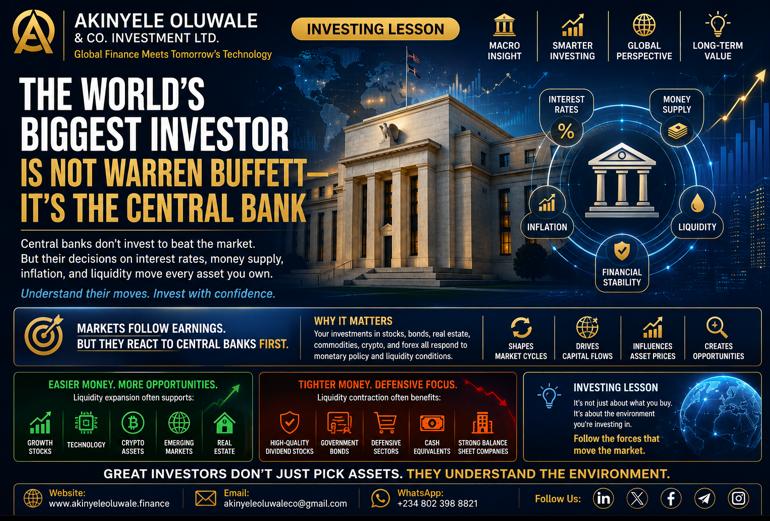
Investing Lesson: The World's Biggest Investor Is Not Warren Buffett It's the Central Bank
Before you study stocks, bonds, or cryptocurrencies, learn to understand the institution that quietly influences every financial market in the world.
Published: 8 August 2026
Category: Investing Lesson • Macro & Central Banks • Global Markets
By: Akinyele Oluwale & Co. Investment Ltd.
Executive Summary
Many investors spend countless hours analysing company earnings, economic news, and market charts. Few spend enough time understanding the institutions that influence almost every asset they own.
Central banks do not buy stocks to outperform the market, nor do they invest like hedge funds. Yet their decisions on interest rates, money supply, inflation, and liquidity shape the environment in which every investor operates.
Whether you invest in equities, bonds, real estate, commodities, cryptocurrencies, or foreign exchange, central bank policy affects the value of your investments.
One of the most valuable lessons an investor can learn is this:
Markets often react to central banks before they react to company news.
Why This Matters
Successful investing is not just about choosing the right asset.
It is about understanding the environment in which that asset exists.
Imagine planting a healthy seed.
Even the strongest seed struggles if the weather turns hostile.
Financial markets work in much the same way.
A great company can still see its share price decline if borrowing costs rise sharply.
A promising cryptocurrency can struggle when global liquidity contracts.
Property markets often cool as interest rates increase.
The macroeconomic climate matters.
And central banks help shape that climate.
What Happened?
Over the past several years, central banks around the world have reminded investors just how powerful monetary policy can be.
We've witnessed:
Each policy decision has influenced capital flows across global markets.
Stock valuations have changed.
Bond yields have moved.
Currencies have strengthened or weakened.
Gold prices have reacted.
Cryptocurrencies have experienced shifts in investor sentiment.
These are not isolated events.
They are connected through monetary policy.
The Bigger Picture
Many investors think markets move because of headlines.
Experienced investors often ask a different question:
What is happening to liquidity?
Liquidity is the fuel of financial markets.
When liquidity expands:
When liquidity contracts:
Central banks influence this cycle through:
Understanding these tools helps investors interpret market movements with greater confidence.
Market Impact
Winners During Easier Monetary Conditions
Historically, periods of abundant liquidity have often supported:
Winners During Tighter Monetary Conditions
When monetary policy becomes restrictive, investors frequently rotate toward:
Every cycle creates opportunities.
The key is recognising which environment you are investing in.
Editorial Perspective
Many investors spend too much time predicting tomorrow's stock price. Too few spend time understanding tomorrow's monetary policy. Central banks rarely tell investors which asset to buy.
But they often determine which assets become easier—or harder—to own.
This is why macro investing deserves attention. Markets are not driven only by company performance. They are influenced by the availability and cost of money itself. That does not mean every central bank decision immediately changes market direction.
Markets also respond to earnings, innovation, geopolitics, fiscal policy, and investor psychology. However, ignoring monetary policy is like trying to navigate an ocean while ignoring the tides.
You may still reach your destination.
But the journey becomes much harder.
One of the greatest advantages an investor can develop is learning to ask not only:
"What should I buy?"
But also:
"What environment am I buying into?"
That simple shift in thinking often separates reactive investors from disciplined ones.
What to Watch Next
Every investor should pay close attention to:
These indicators often provide early clues about changing market conditions before they become obvious in asset prices.
Investing Lesson
Don't just follow the market. Follow the forces that move the market.
Company earnings matter.
Innovation matters.
Valuation matters.
But none of them exist in isolation.
The cost of money influences almost every investment decision.
The investor who understands monetary policy gains an additional lens through which to interpret markets.
You do not need to become an economist.
You simply need to appreciate that central banks are among the most influential participants in global finance.
Understanding their decisions will not eliminate uncertainty.
But it can improve your ability to invest with greater perspective and discipline.
Key Takeaways
About Akinyele Oluwale & Co. Investment Ltd.
Akinyele Oluwale & Co. Investment Ltd. delivers research-driven intelligence covering Macro & Central Banks, Institutional Crypto, Stablecoins & Payments, Tokenization & RWAs, Artificial Intelligence, and Digital Assets.
Every article is built around five essential questions:
Global Finance Meets Tomorrow's Technology.