

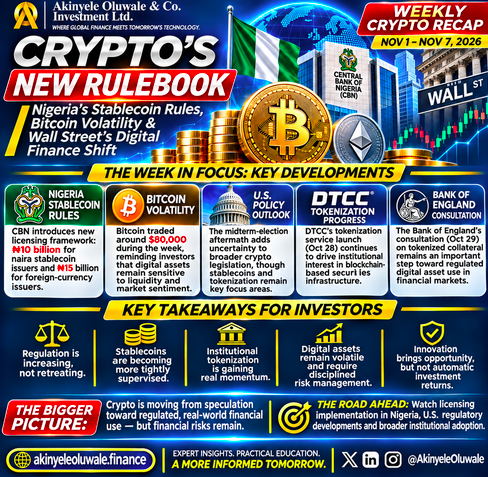
The cryptocurrency industry's most consequential developments are increasingly taking place beyond token-price charts. From Nigeria's new stablecoin licensing framework to institutional tokenization and changing global financial conditions, the central question is whether digital assets can become trusted, economically useful financial infrastructure.
Reporting period: Sunday, November 1 – Saturday, November 7, 2026
Publication date: Sunday, November 8, 2026
Category: Weekly Crypto Recap
Date clarification: November 3, 2026, was a Tuesday, not a Saturday. This edition therefore covers the complete week ending Saturday, November 7, 2026.
The defining theme of the week was the growing importance of regulation, institutional infrastructure and financial discipline in cryptocurrency markets.
Nigeria's newly reported stablecoin licensing framework brought attention to the financial obligations of digital-money issuers. Meanwhile, developments involving securities tokenization, digital payments and the integration of blockchain technology into traditional finance continued to shape the industry's longer-term direction.
At the same time, investors faced a familiar challenge: distinguishing technological progress from investment returns.
A new regulatory framework does not automatically increase the value of a cryptocurrency. A successful blockchain pilot does not guarantee widespread adoption. And institutional interest does not eliminate market, liquidity or operational risks.
Our central assessment is that digital finance is increasingly being judged by the same standards as conventional finance: financial strength, legal certainty, liquidity, governance and demonstrable commercial value.
The first full week of November 2026 delivered an important reminder about the direction of the cryptocurrency industry.
While Bitcoin and other digital assets continued to respond to changes in investor sentiment, the most consequential structural development came from Nigeria.
On November 5, the Central Bank of Nigeria introduced a regulatory framework covering non-security virtual assets, including stablecoins and related financial services.
The regulations establish minimum paid-up capital requirements of ₦10 billion for naira-referenced stablecoin issuers and ₦15 billion for foreign-currency-referenced issuers.
They also address reserve backing, redemption, licensing, cybersecurity and financial-crime controls.
Elsewhere, institutional tokenization remained an important theme following DTCC's October 28 launch of its Tokenization Service and the Bank of England's October 29 consultation on tokenized collateral.
Although these two announcements preceded the reporting week, their implications remained relevant to the institutional digital-asset discussion.
Meanwhile, the November 4 United States midterm-election aftermath added uncertainty to the outlook for broader cryptocurrency legislation. Industry reporting suggested that stablecoin and tokenization initiatives could remain commercially important even if more comprehensive digital-asset legislation became harder to advance.
Bitcoin also experienced substantial price volatility. On November 4, market reporting showed Bitcoin trading near $80,000, illustrating the sensitivity of digital assets to changes in macroeconomic expectations and investor positioning.
The key conclusion is that cryptocurrency markets are developing along two different paths.
The first is the market-price cycle, influenced by liquidity, leverage, investor expectations and macroeconomic conditions.
The second is the institutional infrastructure cycle, shaped by regulation, custody, tokenization and real payment applications.
These cycles are connected, but they are not identical.
Our institutional assessment is that the long-term development of digital finance should be measured through regulatory clarity, operational adoption and economic usefulness not cryptocurrency prices alone.
For many retail investors, cryptocurrency news is primarily about whether Bitcoin, Ethereum or another digital asset has increased or declined in price.
That is understandable.
Market prices are visible, constantly changing and easy to compare.
However, an institutional investor approaches the industry differently.
A bank considering digital-asset custody must examine legal responsibilities, cybersecurity and operational controls.
A payment company considering stablecoins must evaluate reserve quality, redemption arrangements and transaction costs.
A securities depository considering tokenization must determine whether digital representations of assets can be transferred safely and recognised legally.
These developments may have a greater influence on the future of financial infrastructure than short-term token-price movements.
Consider a simple example.
A cryptocurrency may rise by 15% in one week because investors anticipate favourable news.
However, if the underlying project has no sustainable business model, limited economic demand or weak governance, that price increase does not establish long-term value.
Conversely, a financial institution may introduce an important blockchain-based settlement service without causing an immediate increase in the price of any particular cryptocurrency.
The lesson is straightforward.
Technological adoption, financial usefulness and investment returns must be evaluated separately.
That distinction is central to understanding the developments of the past week.
The most consequential regulatory development for African digital finance came from Nigeria.
On November 5, the Central Bank of Nigeria issued its Regulations for the Operations of Non-Security Virtual Assets in Nigeria.
The framework introduces separate licensing categories for naira-referenced and foreign-currency-referenced stablecoins.
The principal minimum capital requirements are:
| Category | Minimum paid-up capital |
|---|---|
| Naira-referenced stablecoin issuers | ₦10 billion |
| Foreign-currency-referenced stablecoin issuers | ₦15 billion |
| Other qualifying non-security virtual-asset service providers | Generally ₦1 billion |
These requirements are significant.
They indicate that the CBN intends to treat stablecoin issuance as a financially important activity requiring substantial resources and ongoing supervision.
The regulations also address reserves, redemption rights, customer protection, operational resilience and anti-money laundering obligations.
Foreign-currency stablecoins intended for the Nigerian market face specific local incorporation and licensing requirements.
The framework also prohibits certain algorithmic stablecoin structures.
However, the development should not be interpreted as a blanket ban on all cryptocurrency activities.
It establishes regulatory conditions for specified activities.
For Nigerian fintech businesses, the framework creates both opportunities and challenges.
A clearer licensing structure may improve confidence among financial institutions.
But substantial capital requirements may limit direct issuance to well-capitalised operators.
Our assessment: Nigeria is moving toward a more formal stablecoin market. The decisive question is whether the regulatory framework can protect consumers while preserving meaningful competition.
Bitcoin remained sensitive to changing investor expectations during the week.
Market reporting on November 4 placed Bitcoin near $80,000, following significant price movements associated with broader market uncertainty.
This illustrates a recurring feature of cryptocurrency markets.
Prices can change rapidly when investor expectations shift.
Digital assets are influenced by several factors, including interest rates, institutional investment flows, leverage, global liquidity and regulatory developments.
Bitcoin is often described as a potential alternative store of value.
However, that description should not obscure its substantial price volatility.
A store-of-value narrative does not eliminate the possibility of sharp market declines.
Investors must distinguish between an asset's long-term investment thesis and its short-term price behaviour.
For example, an investor may believe that Bitcoin has a role in the future of digital finance.
That belief does not establish that Bitcoin is appropriately valued at every market price.
Our assessment: Bitcoin remains an important indicator of digital-asset market sentiment, but short-term price movements should not be confused with evidence of fundamental financial stability.
The aftermath of the November 4 United States midterm elections generated renewed discussion about the outlook for digital-asset regulation.
Industry reporting suggested that broader cryptocurrency market-structure legislation could face political uncertainty.
At the same time, stablecoins and tokenization may retain commercial relevance because financial institutions are already developing practical applications.
This distinction matters.
Regulatory uncertainty can affect investment decisions, market confidence and the timing of new financial products.
However, institutional development does not necessarily stop whenever legislative negotiations become difficult.
Banks and payment providers may continue working on technologies that can operate within existing regulatory frameworks.
The important question is whether those arrangements satisfy applicable legal requirements.
Investors should also avoid treating political developments as guarantees of future market performance.
A favourable political announcement does not automatically translate into immediate institutional adoption.
Our assessment: The next stage of United States digital-asset regulation will influence market structure, but practical financial applications will continue to be judged by their commercial usefulness.
On October 28, shortly before the reporting week, DTCC announced that its Tokenization Service had gone live.
The service enables tokenized representations of eligible securities held through the Depository Trust Company.
Its stated objectives include improving collateral mobility, access to liquidity and capital efficiency.
Why does this matter?
Traditional securities markets depend on complex infrastructure for custody, ownership records, settlement and asset transfers.
Tokenization may allow some of these processes to become more efficient.
However, a tokenized security remains subject to the financial characteristics of the underlying asset.
A government bond does not become free from interest-rate risk because it is represented digitally.
Similarly, a tokenized share does not become more profitable merely because its ownership records use blockchain technology.
DTCC's development is important because it connects digital-asset technology with established securities infrastructure.
Our assessment: The most credible tokenization opportunities are likely to emerge from improvements in existing financial processes rather than speculative token issuance.
On October 29, the Bank of England launched a consultation on the acceptance of tokenized collateral by central counterparties.
Although the announcement preceded the reporting week, it remained relevant to the wider institutional tokenization discussion.
Central counterparties play an important role in managing financial-market risk.
They require collateral to help protect against the failure of market participants to meet their obligations.
Tokenization may make certain collateral transfers more efficient.
However, the underlying assets must remain appropriately valued, legally enforceable and capable of being realised when needed.
The Bank of England's consultation seeks to clarify supervisory expectations.
It does not provide unrestricted approval for every tokenized asset.
The consultation remains open until February 12, 2027.
Our assessment: Regulators are increasingly examining how tokenization can operate within existing financial safeguards rather than replacing those safeguards.
Stablecoin adoption remained an important theme during the week, supported by recent commercial developments.
In October, Visa announced an initial commercial deployment of stablecoin-enabled prefunding through Inyo Global.
Circle and ACI Worldwide also announced a collaboration involving USDC settlement and a Colombian pilot.
Earlier, SoFi and Mastercard announced live stablecoin settlement within SoFi Bank's card programme.
These developments provide useful context for the week's regulatory discussion.
Stablecoins are increasingly being evaluated as potential payment and settlement infrastructure.
However, their usefulness depends on more than blockchain transaction speed.
A stablecoin transfer may settle quickly while the recipient still faces delays converting the token into spendable money.
Businesses must also consider compliance requirements, redemption arrangements, transaction costs and counterparty risks.
Our assessment: The strongest stablecoin business models will be those that solve identifiable payment problems while maintaining reliable financial controls.
The week's developments also reinforced a broader investment lesson.
Digital finance is evolving rapidly, but innovation does not eliminate financial risk.
The IMF's October 2026 Global Financial Stability Report identified vulnerabilities involving artificial intelligence valuations, sovereign bond yields and cybersecurity.
These risks matter to cryptocurrency markets because digital assets operate within the wider global financial environment.
Changes in liquidity, financing costs and investor confidence can affect multiple asset classes.
A cryptocurrency may have a compelling technological narrative but still experience substantial losses during periods of financial stress.
Similarly, a financial institution may successfully adopt blockchain technology without producing immediate investment returns for holders of unrelated tokens.
Our assessment: Investors should distinguish between the economic value of financial innovation and speculative expectations surrounding digital-asset prices.
The most important development in cryptocurrency markets is the increasing involvement of established financial institutions.
Banks, securities depositories, payment companies and regulators are examining how blockchain technology can support financial activities.
This is a meaningful change from the industry's earlier emphasis on cryptocurrency trading.
However, institutional involvement does not guarantee that every digital asset will succeed.
Different parts of the industry have different economic functions.
Bitcoin operates as a decentralised digital asset.
Stablecoins are designed to maintain value relative to reference currencies.
Tokenized securities represent rights associated with traditional financial assets.
Blockchain infrastructure provides systems for recording and transferring information or value.
These categories should not be treated as interchangeable.
For example, growing institutional use of tokenized government bonds does not automatically establish investment demand for every cryptocurrency.
Likewise, increasing stablecoin settlement volumes do not necessarily translate into higher prices for all blockchain network tokens.
The economic relationships must be demonstrated.
The future of digital finance will depend on which technologies deliver measurable financial improvements, not simply which projects attract the most attention.
Bitcoin remains sensitive to market liquidity, macroeconomic developments and investor expectations.
Price volatility should be evaluated independently of long-term adoption narratives.
Nigeria's new licensing framework highlights the growing importance of capital adequacy, reserves, redemption rights and regulatory compliance.
Stablecoin issuers may face increasing costs as supervision becomes more demanding.
Institutional tokenization continues to develop through established financial-market infrastructure.
However, tokenization does not automatically improve an asset's underlying credit quality or investment value.
Financial institutions may benefit from improved settlement options, custody services and collateral management.
But implementation costs, operational risks and legal obligations remain important.
Nigeria's regulatory framework may encourage more formal participation in digital finance.
At the same time, high capital requirements could affect smaller companies' ability to enter certain markets.
The distinction between blockchain adoption and cryptocurrency investment returns remains essential.
Institutional investors should evaluate commercial economics, legal protections and financial risks separately.
At Akinyele Oluwale & Co. Investment Ltd., we believe the first week of November 2026 reinforces a critical shift in digital finance.
The industry is increasingly being evaluated through the standards that govern established financial markets.
This is a positive development in principle.
Financial innovation should be accompanied by accountability.
Stablecoin issuers should demonstrate that their tokens are appropriately backed.
Financial institutions should establish that tokenized assets have enforceable legal rights.
Payment providers should prove that new settlement arrangements deliver practical benefits and investors should understand the risks associated with their decisions.
However, the industry must avoid replacing one form of speculation with another.
The announcement of a new regulatory framework is not proof that all regulated businesses will become profitable.
A successful tokenization service does not guarantee that every participating institution will achieve substantial cost savings.
And institutional adoption does not automatically justify the market valuation of every cryptocurrency.
These distinctions are important.
Consider a hypothetical blockchain project that announces a partnership with a major financial institution.
The announcement may attract investor interest.
But a serious financial assessment should ask whether the partnership produces revenue, recurring demand or measurable economic benefits.
Without such evidence, the announcement may have limited significance for the token's underlying value.
The same principle applies to regulation.
Nigeria's stablecoin framework may improve the credibility of compliant operators.
However, its commercial impact will depend on licensing decisions, market participation, compliance costs and actual customer demand.
Our editorial position is that digital finance should be evaluated through measurable financial outcomes, not institutional names, technological claims or market excitement alone.
That is the difference between research-driven financial analysis and speculative commentary.
Several developments deserve attention during the coming week.
Nigeria's stablecoin regulations: Monitor further CBN clarifications, licensing procedures and industry responses.
International stablecoin issuers: Watch whether global operators announce plans to satisfy Nigeria's local regulatory requirements.
Bitcoin market conditions: Follow volatility, market liquidity and institutional investment flows.
United States regulation: Monitor the implications of the midterm-election results for digital-asset legislation.
Institutional tokenization: Watch for additional adoption announcements and evidence of actual transaction activity following DTCC's service launch.
Tokenized collateral: Follow institutional responses to the Bank of England's consultation.
Stablecoin payments: Look for evidence of broader commercial deployment beyond limited pilots.
Cybersecurity and custody: Assess whether financial institutions are strengthening operational safeguards as digital-asset services expand.
The most useful developments will be those supported by official disclosures, measurable activity and clear commercial outcomes.
Nigeria's new stablecoin licensing framework was the week's most significant African digital-finance regulatory development.
The CBN introduced minimum paid-up capital requirements of ₦10 billion for naira-referenced stablecoin issuers and ₦15 billion for foreign-currency-referenced issuers.
The framework establishes requirements covering reserves, redemption, compliance and operational resilience.
Bitcoin's price volatility reinforced the importance of market liquidity and investor risk management.
United States political developments created additional uncertainty surrounding broader cryptocurrency regulation.
DTCC's recent Tokenization Service launch remained an important institutional infrastructure milestone.
The Bank of England's tokenized-collateral consultation highlighted the importance of legal certainty and financial stability.
Stablecoins are increasingly being explored for practical payment and settlement applications.
Institutional blockchain adoption does not automatically guarantee higher cryptocurrency prices.
The long-term development of digital finance will depend on regulation, commercial usefulness and measurable financial benefits.
Akinyele Oluwale & Co. Investment Ltd. is an institutional financial intelligence platform focused on global macroeconomics, central banking, institutional cryptocurrency, stablecoins, digital payments, tokenization, real-world assets, artificial intelligence and blockchain technology.
Our editorial mission is to explain important financial developments through evidence-based research, practical education and an institutional perspective.
We examine what has changed, why it matters and what investors, businesses and policymakers should monitor next.
The week ended November 7, 2026, demonstrated that cryptocurrency's future is increasingly connected to the wider financial system.
Nigeria introduced a significant regulatory framework for stablecoins.
Institutional tokenization remained an important development.
Payment companies continued exploring blockchain-based settlement.
And investors faced renewed reminders that digital-asset markets remain sensitive to liquidity, policy and financial risk.
Together, these developments point toward an industry undergoing a gradual transformation.
The central question is no longer simply whether cryptocurrency prices will rise.
It is whether digital-asset technologies can deliver reliable, regulated and economically useful financial services.
For investors, the challenge is to distinguish between innovation and valuation.
For financial institutions, the priority is to integrate new technology without weakening financial safeguards.
For regulators, the responsibility is to support responsible innovation while protecting financial stability.
The future of cryptocurrency will not be determined by speculation alone. It will increasingly depend on whether digital assets can earn a sustainable place within the global financial system.
Observe the change. Understand the implications. Position with discipline.
Akinyele Oluwale & Co. Investment Ltd.
Where Global Finance Meets Tomorrow's Technology.
Website: akinyeleoluwale.finance
Editorial disclaimer: This publication provides general financial education and market analysis. It does not constitute personalised investment advice or a recommendation to buy or sell any digital asset.