

Published: October 24, 2026 | Category: Macro & Global Markets | Series: Investing Lessons | By: Akinyele Oluwale
There is a question investors ask constantly:
“What should I buy now?”
Stocks?
Bonds?
Gold?
Bitcoin?
Technology?
Property?
Cash?
It sounds like the right question but very often, it is not.
The better question is:
“How should I allocate my capital given my objectives, time horizon and the risks in today's market?”
That difference may appear small.
It is not.
One question encourages investors to search constantly for the next winner.
The other encourages them to build a portfolio and those are two very different approaches to investing. Recent global fund flows illustrate the point beautifully.
Investors have continued putting money into equities. But they have also allocated billions into bonds, money-market funds and precious metals.
That tells us something important.
Professional capital does not always make one enormous bet on a single market outcome.
Capital can pursue growth while maintaining liquidity.
It can seek income while preserving diversification.
It can participate in innovation while maintaining defensive positions.
This leads to one of the most important lessons in investing:
You do not need one asset to do everything. You need different assets to perform different jobs.
Investing is often presented as a selection problem.
Find the best stock.
Find the best fund.
Find the best cryptocurrency.
Find the next technology winner.
But long-term portfolio management is fundamentally a capital-allocation problem.
You have limited capital.
You have financial objectives.
You have a time horizon and you face uncertainty.
The investor's task is therefore to decide how much capital should be exposed to different risks.
That gives us today's framework:
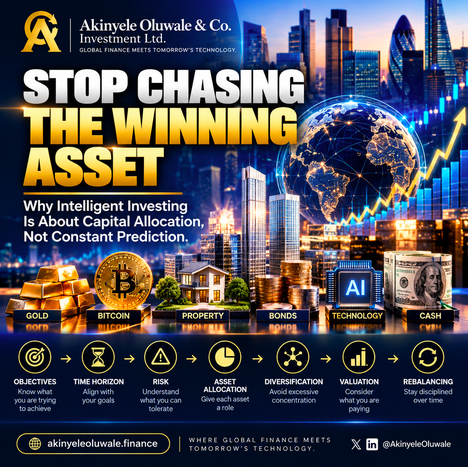
OBJECTIVES → TIME HORIZON → RISK → ASSET ALLOCATION → DIVERSIFICATION → VALUATION → REBALANCING
Notice what is missing.
Prediction.
Predictions can form part of investment analysis, but your entire financial future should not depend on getting every prediction right.
That matters particularly now.
Artificial intelligence remains a powerful investment theme, but investors are questioning whether enormous infrastructure spending will generate sufficient returns.
Government bond yields remain important.
Geopolitical risks are affecting energy markets.
Gold continues attracting defensive and diversification demand and capital continues moving into several asset classes simultaneously.
The intelligent response is not necessarily to jump from one asset to another every time the headlines change. It is to understand the role each investment plays within the portfolio.
Imagine an investor with ₦1 million.
He reads that technology shares are performing strongly.
He invests everything in technology.
A few weeks later, gold starts rising. He sells his technology investments and buys gold. Then Bitcoin rallies.
He sells gold and buys Bitcoin. Then bond yields become attractive.
He sells again. At every stage, the investor believes he is responding intelligently to the latest information but what may actually be happening?
He is chasing performance. That creates several problems.
First, he may repeatedly buy assets after prices have already risen.
Second, his investment strategy becomes controlled by headlines.
Third, transaction costs and taxes may accumulate where applicable.
Fourth, emotional decision-making begins replacing disciplined analysis.
And fifth, the portfolio no longer reflects a clearly defined financial objective.
Now consider another investor.
Before investing, she asks:
What am I trying to achieve?
When will I need this money?
How much volatility can I tolerate?
How much liquidity do I need?
Which risks am I prepared to accept?
Which risks should I diversify?
Only after answering those questions does she decide how to allocate capital.
The difference is fundamental.
The first investor asks:
“What is going up?”
The second asks:
“What job should this money perform?”
That is the beginning of intelligent capital allocation.
Current markets provide a useful real-world lesson.
Global equity funds attracted approximately $28.16 billion during the week ending October 21, marking a fifth consecutive week of inflows but investors were not buying equities alone.
Global bond funds received about $9.44 billion. Money-market funds attracted approximately $15.86 billion. Precious-metals funds received another $1.29 billion.
Technology funds also returned to inflows.
This is not the behaviour of a market in which every investor has reached the same conclusion. It demonstrates capital performing different functions.
Some investors are seeking growth.
Some are seeking income.
Some want liquidity.
Some want defensive exposure.
Some are balancing several objectives simultaneously.
Meanwhile, markets themselves remain complicated.
Equities have been supported by corporate earnings and optimism surrounding artificial intelligence but investors are increasingly scrutinising the enormous capital required to build AI infrastructure.
Government borrowing and bond yields remain significant.
Geopolitical uncertainty is affecting commodities.
Inflation risks have not disappeared.
The lesson is not that one of these asset classes must win.
The lesson is that different economic conditions reward different exposures at different times.
Think about a football team.
Would you select eleven strikers simply because strikers score goals?
Probably not.
You need defenders.
Midfielders.
A goalkeeper.
Players with different responsibilities.
A portfolio works in a similar way.
An asset should not be judged only by whether it produces the highest return.
It should also be judged by the role it performs.
Equities and other growth-oriented investments can provide exposure to business expansion, innovation and long-term economic growth.
Their role may be:
Capital appreciation.
Certain bonds and income-producing securities can provide contractual or relatively predictable cash flows.
Their role may be:
Income and portfolio stability.
Cash and appropriate short-term instruments may provide flexibility.
Their role may be:
Liquidity and optionality.
Some investors use assets such as gold as part of broader diversification or as protection against particular macroeconomic risks.
Their role may be:
Diversification and resilience.
None of these categories is automatically “better.”
The question is whether the combination serves the investor's objectives.
That is why portfolio construction should begin with purpose rather than popularity.
Current markets are also teaching investors why allocation matters.
Artificial intelligence may transform productivity and create enormous economic value.
But even transformative technology can attract too much capital or unrealistic expectations.
The IMF has specifically identified the possibility of an AI-related market correction if investment or profitability disappoints.
That does not mean:
“Avoid AI.”
It means:
Understand your exposure.
There is an enormous difference.
Government bond yields matter because bonds compete for capital.
When yields become more attractive, investors have another potential source of return.
That can change the relative attractiveness of other assets.
Cash is often dismissed during bull markets.
But liquidity has strategic value.
Cash gives investors flexibility.
It can meet near-term obligations without forcing the sale of long-term investments during unfavourable conditions.
Gold has remained supported by geopolitical concerns, reserve diversification and demand for portfolio hedges.
But gold also has limitations.
It does not generate corporate earnings or conventional interest income.
Its portfolio role therefore differs from equities and bonds.
Digital assets can offer exposure to emerging financial infrastructure and technological innovation.
They can also involve substantial volatility and different technological, regulatory and liquidity risks.
Again, the question should not simply be:
“Will the price rise?”
The portfolio question is:
“What role, if any, should this exposure perform, and what level of risk would it introduce?”
At Akinyele Oluwale & Co. Investment Ltd., we believe one of the most damaging habits in investing is the constant search for the next winning asset.
Markets make this temptation difficult to resist.
When stocks rise, people talk about stocks.
When gold rallies, everyone suddenly becomes interested in gold.
When Bitcoin rises, conversations shift to Bitcoin.
When property performs strongly, property becomes the “safest investment.”
This cycle repeats but investing should not be a popularity contest.
It should be a capital-allocation process.
The question is not:
“Which asset do people currently love?”
It is:
“What am I trying to achieve with my capital?”
That requires investors to separate three concepts:
GOOD ASSET
GOOD PRICE
GOOD PORTFOLIO FIT
They are not the same thing.
A good company can be purchased at an unreasonable price.
A reasonably priced asset can still be inappropriate for someone's time horizon and a good investment can become dangerous if it represents an excessive percentage of the portfolio.
This is why conviction should never eliminate risk management.
You can believe strongly in an investment thesis while still recognising that you may be wrong.
That is not weakness.
That is intellectual discipline.
Investors should watch several signals.
Corporate earnings will tell us whether market expectations—particularly around AI investment—are being supported by economic results.
Watch what government bond markets are saying about inflation, fiscal risk and future interest rates.
Capital flows can reveal where investors are increasing or reducing exposure.
But remember:
Flows are information—not instructions.
Just because billions of dollars enter an asset class does not mean an individual investor should automatically follow.
Ask whether expected future growth already appears reflected in today's price.
A portfolio containing ten investments can still be highly concentrated if all ten respond to the same economic factor.
Know how much capital you may need in the near term.
Money required soon should generally not depend on highly volatile assets performing well at precisely the moment it is needed.
The latest market environment gives investors several powerful lessons.
First: Stop trying to own only the winning asset.
No investor knows with certainty which asset class will lead next year.
Second: Give every investment a job.
Ask whether an investment exists in your portfolio for growth, income, diversification, liquidity or another clearly defined purpose.
Third: Asset allocation comes before excitement.
The structure of your portfolio can matter more than the latest headline.
Fourth: Diversification is not about owning many things.
It is about avoiding excessive dependence on the same risks.
Fifth: Valuation matters.
A wonderful asset purchased at an unreasonable price can produce disappointing results.
Sixth: Liquidity has value.
Being able to meet obligations without selling long-term investments at the wrong time is part of sound portfolio management.
Seventh: Rebalance instead of constantly chasing.
When market movements significantly change your intended allocation, disciplined rebalancing can restore the portfolio's original risk structure.
The framework is:
And the central principle:
Don't ask one investment to do every job in your portfolio.
Akinyele Oluwale & Co. Investment Ltd. provides financial intelligence and investment education focused on global finance, institutional capital, emerging technology and financial markets.
Our Investing Lessons series is built around a simple idea:
Good investing should be understandable.
Not simplistic.
Understandable.
Investors do not need to predict every market movement.
They do not need to react to every headline and they certainly do not need to own every asset that becomes popular.
What they need is a framework.
Start with your objective.
Understand your time horizon.
Know the risks.
Allocate capital deliberately.
Diversify intelligently.
Respect valuation.
Maintain appropriate liquidity.
Review your assumptions.
Rebalance when necessary and remain humble enough to accept that markets will occasionally prove your expectations wrong.
This final point is particularly important.
A portfolio should not be designed around the assumption that you will always be right. It should be designed with the understanding that sometimes you will be wrong.
Sometimes economic forecasts will fail.
Sometimes excellent companies will disappoint.
Sometimes markets will fall despite apparently good news.
Sometimes an asset everyone dislikes will recover and sometimes an investment everyone loves will decline.
This is why capital allocation matters.
It replaces the impossible requirement of perfect prediction with something far more practical:
Preparation.
The intelligent investor is therefore not necessarily the person who correctly predicts the next winning asset.
It is the person who understands what they own, why they own it, how much they own, what could go wrong and what role each investment performs within the broader portfolio.
That is the difference between collecting investments and building a portfolio.
Do not chase everything that moves.
Do not confuse popularity with value.
Do not allow one investment thesis to determine your entire financial future.
Instead:
Allocate with purpose.
Diversify with intelligence.
Value with discipline.
Rebalance with patience.
Because wealth is rarely built by making one perfect prediction.
More often, it is built through a series of sensible decisions made consistently over time.
Observe the change. Understand the implications. Position with discipline.
Akinyele Oluwale & Co. Investment Ltd.
Where Global Finance Meets Tomorrow's Technology.
akinyeleoluwale.finance
This publication is for educational and informational purposes and does not constitute individualized investment, financial, legal or tax advice.