

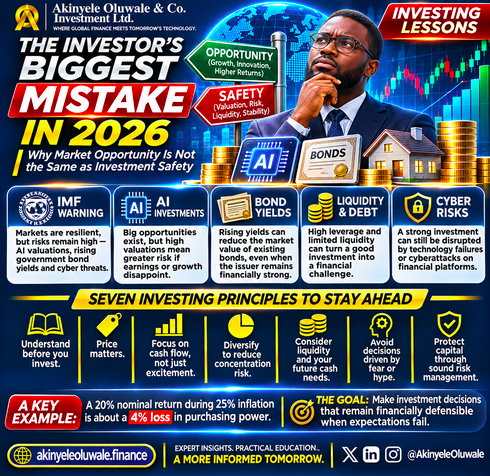
As investors navigate high borrowing costs, artificial intelligence, digital assets, government bonds and rapidly changing financial markets, one lesson deserves renewed attention: a promising investment is not necessarily a safe investment, and a profitable business is not automatically a good investment at any price.
Today's Investing Lessons edition examines the discipline of separating business quality, valuation, liquidity and risk. It explains why investors should assess what they are buying, what they are paying and what could go wrong before considering potential returns.
This is particularly relevant as institutional interest in tokenization and digital payments expands, while global monetary conditions continue to influence borrowing costs, bond valuations and investors' appetite for risk.
The central lesson: Successful investing is not about finding the most exciting opportunity. It is about making decisions that remain financially defensible when expectations fail.
Global financial markets are entering a period in which investment discipline may become more important than market optimism.
The International Monetary Fund's October 2026 Global Financial Stability Report warns that financial markets have remained resilient despite significant uncertainty, but underlying risks remain elevated.
The report identifies three important threats: a possible correction in artificial intelligence-related investments, rising government bond yields and increasingly sophisticated cyberattacks.
On November 2, European Central Bank Vice-President Boris Vujčić also highlighted concerns surrounding elevated AI valuations, sovereign bond market pressures and vulnerabilities among investment funds. These developments carry an important lesson.
A market can appear strong while the risks beneath it are increasing.
Investors must therefore distinguish between an asset that is performing well and an asset that is appropriately valued.
A company may be profitable, but its shares can still be overpriced.
A government bond may offer attractive interest income, but its market value can decline when yields rise.
A cryptocurrency may be supported by promising technology, but its price can still be driven by speculation.
The purpose of investing is not simply to identify assets that might appreciate. It is to allocate capital intelligently, understand the risks involved and protect the ability to meet future financial obligations.
For investors in Nigeria and other emerging markets, this requires additional attention to inflation, currency movements, liquidity and the reliability of financial institutions.
The central message is straightforward:
Investment opportunities should be evaluated through their underlying economics, not market excitement.
Consider two investors.
The first investor hears that a technology company is growing rapidly. Its share price has increased significantly, analysts are optimistic and social media discussions suggest that the company represents the future. Without examining its financial statements or valuation, the investor purchases the shares.
The second investor studies the same company.
The investor examines revenue growth, operating expenses, debt, cash flow and the assumptions reflected in the share price.
Both investors may eventually earn a profit but their decision-making processes are fundamentally different.
The first investor is relying largely on expectations.
The second is attempting to establish whether the potential return justifies the risk.
This distinction becomes particularly important when markets experience sudden changes.
A share price can fall even when the underlying company remains profitable.
Why?
Because investors may previously have expected much faster growth. If the company fails to meet those expectations, its market valuation may decline. This is one of the most important investing lessons of 2026.
A good company is not necessarily a good investment at every price.
The same principle applies to property, government securities, private businesses and digital assets.
Investors should always ask two separate questions:
Is the underlying asset financially sound?
And is the price reasonable relative to its expected benefits and risks?
In its October 2026 Global Financial Stability Report, the IMF explained that strong corporate earnings and economic growth had supported financial markets.
However, the institution warned that financial vulnerabilities remained significant.
The IMF identified possible AI-related market corrections, sovereign bond yield shocks and cyber incidents as important risks.
This matters because investors sometimes assume that a rising market indicates a healthy investment environment but rising prices can coexist with excessive borrowing, concentrated investment positions and unrealistic expectations.
For example, imagine an investment portfolio that increases by 25% during a year.
That performance may appear impressive.
However, if the portfolio is concentrated in a small number of highly correlated companies, a market correction could affect most of its holdings simultaneously.
The investor's past return does not establish the portfolio's future safety.
Investing lesson: Evaluate the risks behind performance, not merely the performance itself.
Artificial intelligence remains an important source of investment and economic activity. Companies are spending substantial amounts on data centres, semiconductor technology and computing infrastructure. These investments may support long-term productivity improvements.
However, the IMF has warned that weaker-than-expected profitability or investment demand could trigger corrections in AI-related asset prices.
The issue is not whether artificial intelligence has economic potential. The issue is whether investors are paying prices that already assume exceptionally strong future results.
Consider a hypothetical company earning $10 per share if investors pay $200 per share, the price-to-earnings ratio is:
P/E ratio = Share price ÷ Earnings per share
= $200 ÷ $10
= 20 times earnings.
If investors instead pay $400 for the same earnings, the P/E ratio becomes 40 times.
The second investment requires substantially greater confidence in future growth to justify the higher price if growth disappoints, the valuation could decline sharply.
This does not mean every company with a high P/E ratio is overvalued. It means that higher valuations generally require stronger supporting assumptions.
Investing lesson: Understand how much future success is already reflected in an asset's price.
Government bonds are often considered relatively conservative investments, particularly when issued by financially strong sovereign borrowers.
However, bonds are not free from risk.
One important relationship is that bond prices and market yields generally move in opposite directions.
When market yields rise, the prices of existing fixed-rate bonds typically fall.
Consider a hypothetical investor who purchases a government bond paying a fixed annual coupon if newly issued comparable bonds begin offering substantially higher yields, the existing bond becomes less attractive. Its market price may decline to compensate investors for the lower coupon.
This does not necessarily mean the bond issuer has defaulted. It reflects changes in market interest rates.
An investor holding a conventional bond to maturity may still receive the contracted principal and coupons, provided the issuer meets its obligations.
However, an investor who needs to sell before maturity could experience a capital loss. The IMF has warned that rising sovereign yields could affect financial markets more broadly.
Higher yields can also increase borrowing costs for businesses and reduce the present value of expected future cash flows.
Investing lesson: A fixed-income investment must be assessed for interest-rate risk, credit risk, inflation risk and liquidity needs.
The IMF's October report also examines vulnerabilities among nonbank financial institutions, including certain investment funds and private-credit arrangements.
These institutions play important roles in financial markets.
However, problems can arise when investments are difficult to sell quickly while investors or lenders demand immediate access to funds.
This is known as a liquidity mismatch.
Imagine an investment fund holding assets that may take several months to sell if many investors request withdrawals at the same time, the fund may struggle to raise cash without accepting significant discounts.
This can create financial pressure even when some underlying investments remain economically valuable. Borrowing can intensify the problem.
Leverage increases the potential return on invested capital, but it also magnifies losses.
An investor who borrows heavily may be forced to sell assets during a downturn. Such forced selling can occur at precisely the moment when market prices are least favourable.
Investing lesson: Financial strength depends not only on asset values but also on liquidity, debt obligations and the timing of cash flows.
Financial markets are becoming increasingly digital.
Online banking, digital investment platforms, tokenized securities and blockchain-based financial systems offer opportunities to improve access and efficiency.
However, they also introduce technological and operational dependencies. The IMF has highlighted cyber threats as a growing concern for financial stability.
An investment may have sound underlying economics, but access to the asset can still be disrupted by technology failures, compromised systems or operational weaknesses.
Investors should therefore understand the arrangements used to hold and administer their investments.
For example, the legal rights associated with a tokenized security may depend on its custody and issuance structure.
The existence of a blockchain record does not automatically guarantee that every legal or operational risk has been eliminated.
Investing lesson: Assess the reliability of the infrastructure supporting an investment, not just the asset itself.
An investor should be able to explain how an investment generates economic value.
For a company, this may involve profits and cash flows.
For a bond, it involves contractual payments and the issuer's ability to meet its obligations.
For property, it may involve rental income and long-term demand.
For a digital asset, investors must distinguish between genuine economic utility and speculative market demand if the investment cannot be explained clearly, further research is necessary.
Even a high-quality asset can produce disappointing returns when purchased at an excessive valuation.
The relevant question is not simply whether an asset will grow.
It is whether its expected growth adequately compensates for the price paid and the risks accepted.
A business can report growing revenue while experiencing serious cash-flow difficulties. For example, sales may increase, but customers may delay payment.
The company may still struggle to meet salaries, interest expenses and supplier obligations.
Investors should therefore examine operating cash flow alongside reported profits.
Diversification involves spreading exposure across investments whose risks are not perfectly correlated.
Holding several assets does not necessarily provide meaningful diversification if they all respond similarly to the same economic shock.
Diversification cannot eliminate market losses, but it can reduce dependence on a single company, sector or outcome.
An investment may be profitable on paper but difficult to sell when cash is needed.
Investors should consider the timing of future financial obligations before committing funds to illiquid assets.
Money required for near-term essential expenses should not depend on uncertain asset-sale proceeds.
Financial markets regularly experience periods of optimism and pessimism.
Neither emotion provides a reliable investment valuation method.
A disciplined investor uses consistent financial criteria rather than making decisions solely because prices are rising or falling.
Protecting capital does not mean avoiding every investment that could decline.
It means understanding possible losses, maintaining appropriate liquidity and avoiding exposures that could undermine essential financial commitments.
Risk management should be part of the investment decision from the beginning.
Equity investors should evaluate earnings quality, valuations, debt levels and business concentration.
Companies exposed to AI may have genuine growth opportunities, but expectations should be tested against realistic financial outcomes.
Bond investors should examine maturity, duration, issuer creditworthiness and the effect of changing interest rates.
A high quoted yield should not be considered independently of the underlying risks.
Property investors should evaluate rental income, occupancy, maintenance costs, financing expenses and market liquidity.
An increase in property prices does not necessarily imply an attractive investment return after costs.
Investors should distinguish between technological innovation and the investment characteristics of a particular token.
Institutional blockchain adoption does not automatically establish demand for every associated cryptocurrency.
Business owners and investors should assess operating cash flow, customer concentration, debt-service capacity and working-capital requirements.
Profitability without sufficient liquidity can create serious financial difficulties.
Investors operating in Nigeria must consider inflation, exchange-rate movements, regulatory developments and the difference between nominal and real returns.
A positive investment return may still represent a decline in purchasing power if inflation is higher.
At Akinyele Oluwale & Co. Investment Ltd., we believe one of the most expensive mistakes investors make is confusing confidence with competence.
A confident investor may speak convincingly about a company, cryptocurrency or market trend but confidence alone does not establish that the investment has been properly evaluated.
Professional investment decisions require evidence.
They require an understanding of financial statements, valuations, business models, liquidity and risk.
Consider a simple example.
An investor purchases an asset for ₦1 million.
After one year, its market value increases to ₦1.2 million.
The nominal return is:
(₦1.2 million − ₦1 million) ÷ ₦1 million × 100
= 20%.
That appears attractive.
However, assume inflation during the same period is 25%.
The approximate real return is negative.
Using the more precise calculation:
Real return = (1.20 ÷ 1.25 − 1) × 100
= −4%.
Although the investor gained ₦200,000 in nominal terms, the investment's purchasing power declined.
This example illustrates why financial education matters.
Investment success should not be measured exclusively by the amount of money gained. It should also consider inflation, risk, liquidity and the opportunity cost of capital.
Similarly, an investor may earn a high return by accepting substantial risk. That result does not automatically mean the original decision was prudent. A favourable outcome and a sound decision are not always the same thing.
Our editorial position is that sustainable investing requires a repeatable decision-making process, not dependence on occasional favourable market outcomes.
Investors should monitor several developments during the remainder of 2026 and into 2027.
AI corporate earnings: Are profits growing sufficiently to justify current valuations?
Capital expenditure: Are major technology companies generating adequate returns on their investments?
Government bond yields: Are rising yields reflecting inflation expectations, fiscal concerns or changing monetary policy?
Central bank decisions: How might policy changes affect financing costs and asset valuations?
Corporate debt: Are businesses maintaining sufficient cash flow to meet their obligations?
Financial-market liquidity: Are investment funds and financial institutions becoming more vulnerable to sudden withdrawals or financing pressures?
Cybersecurity: Are financial service providers strengthening operational resilience?
Inflation and purchasing power: Are nominal investment returns translating into genuine economic gains?
These questions are more useful than attempting to predict every short-term market movement.
Strong financial-market performance does not guarantee financial stability.
The IMF's October 2026 report identifies AI valuations, sovereign bond yields and cyber threats as major risks.
A profitable company can still be an unattractive investment when its shares are excessively priced.
Rising interest rates and bond yields can reduce the market value of existing fixed-rate bonds.
Liquidity and debt obligations are essential considerations when evaluating investment risk.
Diversification should address underlying economic exposures, not merely the number of assets held.
Technology innovation does not automatically create investment value.
Nominal investment gains must be assessed against inflation.
Financial discipline is more reliable than market excitement.
The quality of an investment decision should be evaluated separately from its eventual outcome.
Akinyele Oluwale & Co. Investment Ltd. is an institutional financial intelligence platform focused on global financial markets, macroeconomics, central banking, institutional cryptocurrency, stablecoins, tokenization, real-world assets, artificial intelligence and blockchain technology.
Our editorial mission is to provide evidence-based financial analysis and practical education that helps readers understand the forces shaping modern finance.
We examine investment opportunities alongside the risks, economic conditions and financial structures that influence their long-term sustainability.
The financial markets of 2026 offer important lessons.
Artificial intelligence is creating new economic possibilities.
Digital finance is transforming financial infrastructure.
Government bonds remain central to global capital markets and financial innovation continues to create new investment opportunities.
However, opportunity and safety are not the same thing.
An investment can be technologically innovative but economically unattractive.
A business can be profitable but excessively valued.
A government bond can provide predictable contractual income while exposing investors to market-price fluctuations.
And a portfolio can perform strongly while remaining vulnerable to concentrated risks.
The defining quality of a disciplined investor is not the ability to identify every opportunity. It is the ability to distinguish opportunities worth evaluating from risks that are poorly understood or inadequately compensated.
The objective is not to eliminate uncertainty.
It is to make informed financial decisions despite uncertainty.
Observe the change. Understand the implications. Position with discipline.
Akinyele Oluwale & Co. Investment Ltd.
Where Global Finance Meets Tomorrow's Technology.
Website: akinyeleoluwale.finance
Disclaimer: This article is provided for financial education and market analysis. It does not constitute personalised investment advice or a recommendation to purchase or sell any particular security or digital asset.