

Published: Thursday, 15 October 2026
Primary Category: Stablecoins & Payments
By: Akinyele Oluwale
The global financial system is entering a new phase of digital transformation. For years, stablecoins were primarily associated with cryptocurrency trading, digital-asset exchanges and blockchain transactions.
Today, the conversation is expanding. Banks are examining blockchain-based payment instruments. Payment networks are exploring stablecoin settlement. Financial technology companies are developing cross-border payment infrastructure.
Regulators are establishing frameworks for issuance, reserves and oversight and institutional investors are evaluating the financial infrastructure supporting digital money.
These developments suggest that stablecoins are increasingly being considered as potential components of mainstream payment systems but this transition raises an important question:
Will traditional banks dominate?
Will established payment networks retain their central position?
Will blockchain-native companies develop alternative settlement systems?
Or will the future involve interconnected networks combining traditional finance with digital assets?
The answer will depend on several factors.
Regulation.
Institutional trust.
Liquidity.
Interoperability.
Transaction costs.
Consumer protection.
And commercial adoption.
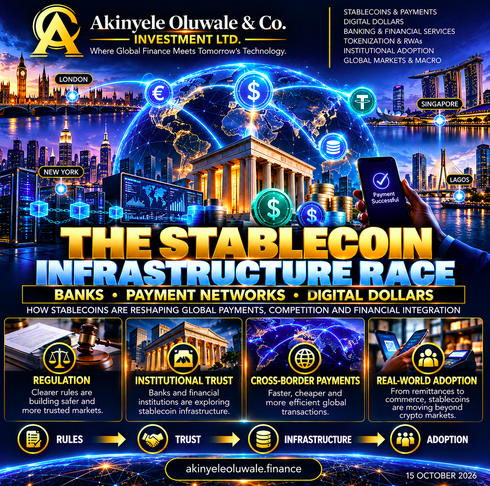
The emerging framework is:
The next stage of stablecoin development may be less about speculative trading and more about the infrastructure supporting real financial transactions.
Stablecoins are digital assets designed to maintain a relatively stable value against a reference asset, commonly a national currency such as the US dollar.
Unlike highly volatile cryptocurrencies, fiat-referenced stablecoins generally seek to maintain a fixed exchange relationship with their reference currency.
However, that stability is not guaranteed.
Their reliability depends on reserve quality, redemption arrangements, governance, market liquidity and regulatory oversight.
Recent developments demonstrate growing institutional interest.
First, traditional financial institutions are exploring stablecoin issuance and settlement.
Second, regulatory frameworks are becoming more detailed.
Third, stablecoins are increasingly being evaluated for cross-border payments.
Fourth, payment infrastructure is emerging as an important competitive advantage.
Fifth, developing economies such as Nigeria are becoming significant markets for digital-dollar transactions.
The important shift is:
This does not mean stablecoins will replace commercial banks or traditional payment networks.
It means competition and cooperation between existing financial institutions and blockchain-based infrastructure are becoming more important.
International payments remain a major challenge for businesses and households.
Traditional cross-border transactions can involve multiple intermediaries.
These may include:
Sending banks.
Correspondent banks.
Clearing institutions.
Foreign-exchange providers.
Receiving banks.
Each stage can introduce costs, delays or operational complexity. For businesses, these frictions can affect working capital and cash-flow management.
For households, they can increase the cost of receiving money from abroad.
Stablecoins offer a potential alternative settlement mechanism.
For example, a digital-dollar transfer can move across a blockchain network without requiring the same sequence of correspondent-bank transfers.
However, the complete payment still depends on other important processes.
The sender must obtain the stablecoin.
The recipient must be able to receive it.
The recipient may need to convert it into local currency.
Financial institutions must comply with applicable regulations.
And users must be protected against operational, fraud and issuer risks.
Therefore:
The total transaction cost matters.
So do reliability, liquidity, compliance and customer protection.
The opportunity is significant, but the economics must be assessed carefully.
Recent reports indicate that Qivalis, a European banking consortium, has obtained electronic-money institution authorisation from the Dutch central bank.
The consortium reportedly includes 37 banks across 15 countries and is preparing a euro-denominated digital payment token.
The initiative is intended to operate within the European Union's regulatory framework for crypto-assets.
However, regulatory authorisation should not be confused with the commercial launch of a stablecoin.
Additional requirements and implementation steps may still apply. bloomingbit
The development illustrates how established banking institutions are considering participation in blockchain-based payment infrastructure.
It also highlights an emerging question:
Will stablecoin markets remain dominated by dollar-denominated tokens, or will regulated alternatives in other currencies gain meaningful adoption?
The answer will depend on liquidity, user demand, distribution networks and interoperability.
On 13 October 2026, Tether announced an investment in EFY Finance.
The stated objective is to strengthen infrastructure connecting stablecoins with traditional financial systems across Latin America.
The announcement focuses on institutional use cases involving USDT and USA₮. Tether
Stablecoin competition increasingly involves more than token issuance.
Issuers and infrastructure providers are seeking stronger relationships with:
Financial institutions.
Payment companies.
Business customers.
Liquidity providers.
And regulated financial intermediaries.
The competitive advantage may therefore shift toward distribution, institutional integration and practical payment utility.
The United States has moved toward a more defined regulatory structure for payment stablecoins through the GENIUS Act.
On 29 September 2026, the Federal Reserve published proposed regulations concerning its responsibilities under the legislation.
The proposal addresses regulatory requirements for certain permitted payment-stablecoin issuers and related activities.
The public comment deadline is 30 November 2026. GovInfo
Regulatory clarity can influence institutional participation.
Banks and payment companies need to understand the rules governing issuance, reserves, supervision and customer protection.
However, proposed regulations are not the same as finalised rules.
Investors should distinguish between:
Legislation enacted.
Regulations proposed.
Regulations finalised.
Institutions authorised.
Products commercially launched.
These are separate stages of market development.
In June 2026, the IMF published an assessment of stablecoin use in Nigeria.
The institution reported that Nigeria received approximately $59 billion in total crypto-asset inflows between July 2023 and June 2024.
Importantly, this figure represents crypto-asset inflows generally, not exclusively stablecoin transactions.
The IMF also reported that Nigeria accounted for approximately 60% of stablecoin inflows into sub-Saharan Africa over the period examined.
It identified cross-border payments, remittances and business transactions among the relevant use cases. International Monetary Fund
Nigeria illustrates how demand for digital dollars can arise from practical financial needs.
These include cross-border transfers, access to foreign-currency payment channels and international commercial transactions.
However, the IMF also identified important risks.
These include financial integrity, consumer protection, currency substitution and potential implications for monetary policy.
The policy challenge is to support useful innovation while maintaining financial stability.
The stablecoin infrastructure race involves five interconnected developments.
US dollar-denominated stablecoins currently play an important role in digital-asset markets.
But other currencies may become increasingly represented through regulated digital payment instruments.
Euro-denominated stablecoin initiatives illustrate this possibility.
The long-term outcome will depend on liquidity, adoption and trust.
Banks have established customer relationships, regulatory experience and payment infrastructure.
Blockchain-native companies often possess expertise in digital-asset technology and settlement networks.
Payment companies connect merchants, consumers and financial institutions.
The future may involve competition in some activities and cooperation in others.
Regulation can influence the credibility of stablecoin arrangements.
Reserve requirements, redemption rights, governance and supervision are especially important.
However, regulation cannot guarantee that every stablecoin arrangement will operate without risk.
Stablecoins may offer advantages for certain international transactions.
But commercial adoption requires reliable conversion between digital assets and traditional currencies.
It also requires compliance with applicable financial regulations.
The long-term opportunity is not necessarily the replacement of traditional finance.
It may involve greater integration between bank accounts, payment networks and blockchain-based settlement systems.
The emerging structure could be:
The commercial challenge is making these systems work together securely and efficiently.
Stablecoins may create opportunities for banks to develop new payment and settlement services.
However, they could also increase competition in certain payment activities.
Banks will need to evaluate regulatory obligations, customer demand and commercial viability.
Established payment networks may integrate blockchain-based settlement into existing services.
Their competitive advantages include distribution, merchant relationships and established operational systems.
The key question is whether stablecoin infrastructure improves payment economics.
Competition may increasingly depend on reserve transparency, redemption reliability, liquidity and institutional distribution.
A stablecoin's market relevance cannot be judged solely by its supply.
Actual payment use and sustainable commercial demand also matter.
Networks supporting stablecoin transfers may benefit from increased settlement activity.
However, transaction volume does not automatically translate into proportional economic value for a blockchain's native token.
Network fees, competitive conditions and token economics must be evaluated separately.
Businesses could benefit from faster settlement and improved payment visibility.
However, foreign-exchange conversion, compliance costs and liquidity remain important.
Stablecoins may continue to attract attention where international payments are expensive or difficult.
Nevertheless, financial inclusion must be balanced with consumer protection, monetary stability and effective regulation.
The broader investment theme is the development of financial infrastructure.
Relevant areas include payment technology, compliance systems, digital custody, settlement services and financial software.
The critical analytical distinction is:
Commercial success depends on business models, costs, competition and sustainable demand.
At Akinyele Oluwale & Co. Investment Ltd., we believe the next phase of stablecoin development should be assessed through financial infrastructure rather than market excitement alone.
For years, digital-asset discussions frequently focused on token prices and trading activity.
But payment systems operate according to a different economic logic.
Their value depends on reliability.
Efficiency.
Liquidity.
Trust.
Security.
And adoption.
A payment instrument that attracts attention but cannot provide reliable settlement has limited commercial usefulness.
Similarly, a technically advanced payment network may struggle to gain adoption without appropriate regulatory compliance and access to financial institutions.
This is why institutional integration matters.
The emerging competition involves three important questions.
First: Who issues the digital money?
Second: Who controls the payment infrastructure?
Third: Who owns the customer relationship?
These functions may be performed by different organisations.
For example, a regulated issuer may create a stablecoin.
A blockchain network may process transfers.
A financial technology company may provide the customer interface.
A bank may facilitate currency conversion.
And a payment network may connect the transaction to merchants.
Understanding these relationships is essential for evaluating the economics of digital payments.
For Nigeria, the opportunity must be considered alongside the risks.
Stablecoins may address certain cross-border payment difficulties.
But sustainable financial development also requires strong domestic payment systems, credible regulation and effective consumer protection.
Our editorial principle is:
The next generation of digital payments will be defined not simply by the movement of tokens, but by the creation of trusted, efficient and interoperable financial infrastructure.
The most important question is no longer only whether stablecoins can move money.
It is whether they can do so reliably, affordably and at meaningful commercial scale.
Eight developments deserve particular attention.
Will bank-backed euro stablecoin projects complete their remaining requirements and launch commercially?
How will final rules under the GENIUS Act affect issuers and financial institutions?
Are banks and payment companies expanding stablecoin-based settlement services?
What proportion of stablecoin transactions reflects payments and commerce rather than trading-related transfers?
Are issuers providing reliable information about reserves and redemption arrangements?
Are stablecoin-based payment services reducing total end-to-end transaction costs?
How are African regulators balancing payment innovation with financial stability?
Can stablecoin infrastructure connect efficiently with existing banking and payment systems?
These indicators will help determine whether stablecoins develop into widely used financial infrastructure.
Stablecoins are increasingly being evaluated as payment and settlement infrastructure.
Traditional banks are exploring participation in digital-money markets.
Institutional stablecoin infrastructure is attracting investment.
Regulators are developing more detailed frameworks.
Cross-border payments represent an important potential use case.
Nigeria is already a significant market for stablecoin-related financial activity.
However, adoption does not eliminate reserve, operational, regulatory or consumer risks.
The emerging framework is:
Day 38 conclusion:
The stablecoin infrastructure race will ultimately be determined by trust, interoperability, regulatory credibility and real economic utility—not token popularity alone.
Akinyele Oluwale & Co. Investment Ltd. is a global finance and digital-economy intelligence platform focused on developments reshaping investment, financial markets and emerging technologies.
Our intelligence coverage includes:
Artificial Intelligence.
Blockchain & Technology.
Crypto & Digital Assets.
Institutional Finance.
Stablecoins & Payments.
Tokenization & RWAs.
Central Banks.
Macro & Global Markets.
We examine global developments through three essential questions:
What changed?
Why does it matter?
What should investors watch next?
Our objective is to connect global financial developments with their implications for investors, businesses and economic decision-makers.
Akinyele Oluwale & Co. Investment Ltd.
Where Global Finance Meets Tomorrow's Technology.