

Published: October 9, 2026
Category: AI
Secondary Category: Institutional Finance
By: Akinyele Oluwale
Artificial intelligence is rapidly changing how companies operate, how technology is built and how investors think about the future.
But the AI investment story is entering a more demanding phase.
The first stage was dominated by technological excitement.
The second has been characterised by enormous spending on semiconductors, servers, data centres, electricity infrastructure and cloud computing.
The next stage will increasingly be about financial accountability.
Investors are beginning to ask harder questions:
How much capital will AI infrastructure require?
Who will finance it?
Where will the electricity come from?
How quickly will these investments generate revenue?
And, ultimately:
Will the cash flows generated by AI justify the enormous amount of capital being invested today?
This does not mean the artificial-intelligence revolution is ending.
It means the investment debate is maturing.
A technology can transform the world without every company, project or valuation associated with that technology becoming a successful investment.
That distinction could become one of the most important investment lessons of the AI era.
Artificial intelligence remains one of the most consequential technological developments in the global economy.
But building the infrastructure behind it requires extraordinary amounts of capital.
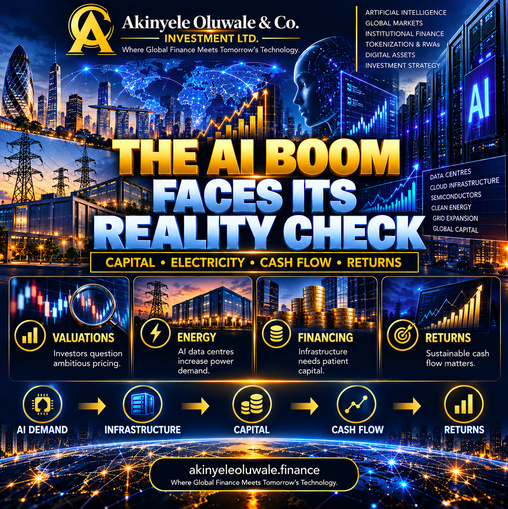
The investment chain increasingly looks like this:
Every part of that chain matters.
A shortage of computing capacity can constrain AI growth.
Insufficient electricity can delay data-centre development.
Expensive financing can reduce investment returns.
Excessive valuations can leave investors vulnerable even when the underlying business grows.
And enormous capital expenditure becomes economically valuable only when it eventually generates sufficient cash flow.
The investment question is therefore changing.
Yesterday's question was:
How large can the AI opportunity become?
Today's more sophisticated question is:
How much sustainable economic value will AI investment actually create?
This transition from technological excitement to financial discipline could define the next phase of the AI investment cycle.
AI often appears to be a software story.
Underneath the software, however, sits an enormous physical infrastructure system.
Generative AI requires advanced semiconductors.
Those chips operate inside servers.
Servers operate inside data centres.
Data centres require cooling, fibre connectivity and enormous amounts of electricity.
Electricity requires generation and transmission infrastructure.
And almost everything in that chain requires capital.
The AI revolution is therefore simultaneously a:
Technology story.
Infrastructure story.
Energy story.
Capital-markets story.
Investment-return story.
This distinction is essential for investors.
Suppose Company A announces $10 billion of AI investment while Company B invests $5 billion.
Company A is not automatically creating more shareholder value.
The investor still needs to know:
What revenue will each investment generate?
What are the operating costs?
How much debt is required?
What is the cost of financing?
When will the investment become productive?
And what return will ultimately be earned on the capital deployed?
This leads to an important principle:
Investment size is not the same as investment value.
Capital expenditure creates capacity.
Productive capital expenditure creates economic value.
One indication of changing sentiment has emerged from the data-centre market.
Investors have increasingly scrutinised the valuations, financing requirements and expansion assumptions attached to AI infrastructure businesses.
This does not necessarily represent declining confidence in artificial intelligence itself.
It represents something healthier:
An investor can simultaneously believe that AI will transform the global economy and conclude that a particular AI-related company is too expensive.
Those positions are not contradictory.
The same distinction has appeared throughout financial history.
Transformational technologies can create enormous economic value while individual businesses operating within those transformations still fail to generate attractive shareholder returns.
Computing power requires electrical power.
That simple relationship is becoming increasingly important.
Large AI data centres can consume substantial amounts of electricity, making access to reliable and affordable energy an important consideration when determining where new facilities are constructed.
The AI infrastructure equation therefore extends beyond:
to:
This could create investment opportunities far beyond conventional technology companies.
Utilities, grid infrastructure, power generation, cooling technology and energy-management systems could all become increasingly connected to the AI investment cycle.
But investors should apply the same discipline here.
Higher electricity demand does not automatically make every electricity-related investment attractive.
Costs, regulation, capital requirements and expected returns still matter.
Another development deserves attention.
Technology companies, data-centre operators and utilities are increasingly examining whether computing workloads can become more flexible.
Some AI workloads could potentially be shifted between locations or periods of the day depending on electricity availability.
If implemented effectively, such flexibility could reduce pressure on electricity grids and potentially improve infrastructure economics.
This introduces another potential competitive advantage:
The future AI winner may not simply be the company with the most computing power—it may be the company that uses computing power most efficiently.
Efficiency could therefore become increasingly important alongside scale.
The scale of planned AI infrastructure means corporate balance sheets alone may not always provide sufficient funding.
Companies can therefore turn toward:
Corporate bonds
Bank lending
Private credit
Joint ventures
Infrastructure funds
Special-purpose financing structures
and other capital-market solutions.
That brings another variable into the equation:
An AI project might appear attractive when borrowing costs are low.
The same project may look considerably less attractive when interest rates and bond yields are elevated.
That directly connects today's AI story with our recent analysis of central banks and global capital markets.
The AI investment cycle can increasingly be understood through three stages.
The market discovers the transformative potential of generative artificial intelligence.
Attention focuses on:
AI models,
semiconductors,
software,
productivity,
and technological leadership.
Valuations rise as investors anticipate future growth.
Companies begin investing enormous amounts of money to build the infrastructure necessary to support expected demand.
Attention shifts toward:
Semiconductors
Servers
Cloud infrastructure
Data centres
Electricity
Cooling
Networking
and increasingly:
Financing.
Capital expenditure accelerates.
Eventually, investors begin asking whether the infrastructure actually produces sufficient financial returns.
The relevant metrics change.
Instead of focusing mainly on:
AI spending
investors increasingly examine:
Revenue growth
Operating margins
Capital expenditure
Debt
Free cash flow
and
Return on invested capital.
That is where the AI investment cycle becomes particularly interesting.
The market begins moving from:
toward:
That is a much more important long-term question.
Large technology companies face increasing pressure to demonstrate that AI expenditure eventually translates into commercially valuable products and services.
Revenue growth will matter.
But investors will increasingly look beyond revenue.
They will examine whether companies can convert AI investment into:
higher margins,
stronger cash generation,
productivity gains,
and ultimately:
higher returns on capital.
Semiconductor demand remains central to the AI infrastructure buildout.
Advanced processors are effectively the engines behind modern AI computing.
But even strong chip demand must eventually connect to sustainable downstream economics.
If customers spend heavily on computing infrastructure but struggle to monetise that capacity, investment expectations throughout the supply chain could eventually adjust.
Electricity is becoming increasingly connected to AI development.
This potentially creates opportunities across:
power generation,
transmission infrastructure,
grid modernisation,
energy storage,
cooling,
and efficiency technologies.
The relationship increasingly becomes:
That makes AI a potentially important capital-allocation story for the energy sector as well.
Banks, private-credit providers, asset managers and infrastructure investors may increasingly finance the AI buildout.
Their challenge is different from that of technology investors.
They must ask:
Will the project generate enough cash to service its obligations?
AI enthusiasm does not eliminate credit risk.
Lenders must still evaluate:
cash flows,
collateral,
project execution,
counterparty strength,
and debt-service capacity.
AI investment increasingly intersects with the bond market.
Large technology companies and infrastructure developers can issue debt to finance expansion.
But governments are simultaneously borrowing heavily.
That creates competition for global capital.
The chain becomes:
This is why developments in AI cannot be separated completely from developments in interest rates and government bond markets.
For equity investors, the issue becomes valuation.
Higher expected growth can justify higher valuations.
But only to a point.
If:
capital expenditure rises faster than cash flow,
or
financing costs rise faster than expected returns,
valuation pressure can emerge.
The equation is straightforward:
That does not mean AI equities must decline.
It means valuation discipline becomes increasingly important.
At Akinyele Oluwale & Co. Investment Ltd., we believe investors should separate three questions that are often incorrectly treated as one.
Will artificial intelligence transform the global economy?
There are strong reasons to believe AI will have significant economic consequences.
Will demand for AI infrastructure continue growing?
Current investment trends suggest substantial infrastructure development remains necessary.
Will every AI-related investment generate attractive returns?
Absolutely not.
That third question is where investment discipline begins.
Financial history repeatedly demonstrates that revolutionary technologies do not automatically create successful investments at every valuation.
An investor can correctly predict the future of a technology and still lose money by paying too much for exposure to it.
That is why our attention is increasingly moving toward:
The crucial question is not simply:
How many billions are being invested in AI?
It is:
How much sustainable cash flow will each billion of investment ultimately generate?
This is our Day 32 principle:
Investors should now monitor eight indicators closely.
Are technology companies continuing to increase infrastructure spending?
Is AI-related revenue expanding quickly enough to justify investment?
How much cash remains after companies fund their enormous capital-expenditure programmes?
Are companies increasingly relying on borrowing to finance AI infrastructure?
Can power grids accommodate expanding data-centre demand?
Can AI companies reduce electricity consumption per unit of computing output?
Are newly constructed facilities being used sufficiently to justify their cost?
Are investors paying reasonable prices relative to realistic future earnings?
These indicators lead to one overriding question:
Will the growth in AI-related cash flows ultimately justify the amount of capital being committed today?
That question may become increasingly important throughout the remainder of 2026 and beyond.
Artificial intelligence remains a potentially transformative technology.
But technological transformation and investment performance are not the same thing.
AI requires enormous physical infrastructure.
That infrastructure requires electricity.
Electricity and infrastructure require capital.
Capital carries a cost.
And capital ultimately requires a return.
Therefore:
Investors should increasingly monitor free cash flow, debt, capital expenditure and return on invested capital not simply AI announcements.
Companies capable of combining technological leadership with disciplined capital allocation may be better positioned for the next phase.
And the central Day 32 lesson is:
Technology creates opportunity. Financial discipline determines investment quality.
Akinyele Oluwale & Co. Investment Ltd. is a global finance and digital-economy intelligence platform helping investors, professionals and decision-makers understand the forces reshaping modern markets.
Our intelligence covers:
Artificial Intelligence
Blockchain & Technology
Crypto & Digital Assets
Institutional Finance
Stablecoins & Payments
Tokenization & RWAs
Central Banks
Macro & Global Markets
Our research is organised around three fundamental questions:
We connect developments across technology, global markets, institutional finance and digital assets because the modern investment landscape increasingly requires understanding how these forces interact.
Information tells you what happened.