

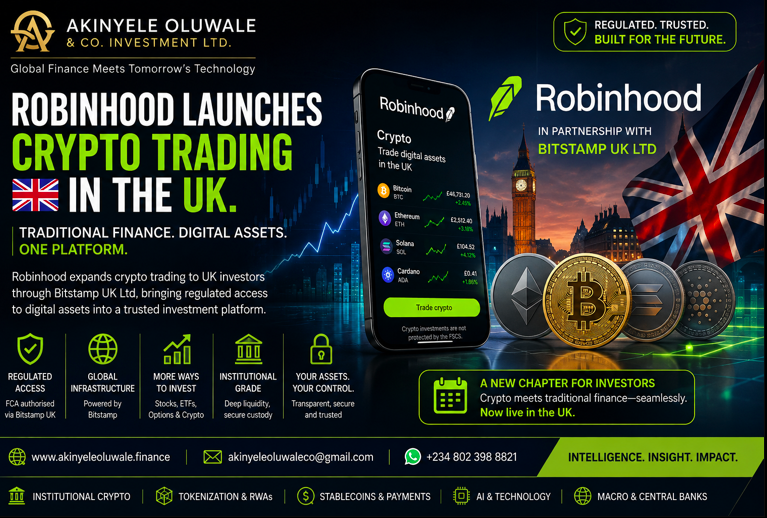
Robinhood Launches Crypto Trading in the UK: Another Wall Between Traditional Finance and Digital Assets Comes Down
Robinhood's UK crypto launch is bigger than another trading app adding Bitcoin. It shows how regulated financial platforms are steadily bringing digital assets into the same ecosystem as stocks, derivatives and conventional investment products.
Published: 10 August 2026
Category: Institutional Crypto • Digital Assets • UK Markets • Financial Infrastructure
By: Akinyele Oluwale & Co. Investment Ltd.
Executive Summary
Robinhood has officially launched cryptocurrency trading for investors in the United Kingdom, marking another significant step in the company's international digital-asset expansion.
The launch gives UK customers access to crypto trading through Bitstamp UK Ltd, the cryptocurrency exchange business acquired by Robinhood in June 2025. Robinhood confirmed the UK launch on 10 August 2026. (Robinhood)
This development deserves attention for a reason that extends beyond Robinhood. The dividing line between traditional investment platforms and cryptocurrency platforms continues to weaken.
Robinhood already provides UK customers with access to conventional investment products, while Bitstamp gives the wider group established crypto-market infrastructure. Robinhood's own disclosures describe Bitstamp as a globally scaled exchange serving both retail and institutional customers. (Robinhood)
Bringing cryptocurrency trading into the UK therefore represents another stage in a larger transition:
Crypto is increasingly becoming another asset class delivered through established financial platforms rather than a completely separate financial universe.
For investors, that may ultimately matter more than the launch itself.
Why This Matters
There was a time when buying cryptocurrency usually meant leaving traditional financial infrastructure.
You opened an account with a specialist crypto exchange.
You learned a new interface.
You dealt with unfamiliar custody arrangements.
You moved money between separate financial ecosystems.
That model is changing.
Traditional financial platforms are increasingly integrating:
Stocks.
ETFs.
Options.
Crypto.
Tokenized assets.
Private markets.
Prediction markets.
And eventually, potentially much more.
Robinhood is an especially interesting example because it is evolving from a retail brokerage into a broader financial platform with both traditional and blockchain-based infrastructure.
The UK's crypto launch pushes that strategy another step forward.
What Happened?
Robinhood Officially Brings Crypto Trading to UK Investors
On 10 August 2026, Robinhood announced the launch of cryptocurrency trading for UK investors.
Customers will trade digital assets through Bitstamp UK Ltd, bringing the exchange infrastructure acquired by Robinhood last year into its UK expansion strategy. (Robinhood)
This follows regulatory progress earlier this month that positioned Robinhood to offer crypto services in Britain. Bitstamp UK appears on the Financial Conduct Authority's register. (register.fca.org.uk)
The sequence is important:
Acquire infrastructure.
Secure regulatory positioning.
Integrate products.
Expand distribution.
That is very different from simply announcing support for another cryptocurrency.
It is an infrastructure strategy.
Bitstamp Is the Institutional Piece of the Story
This is where the story becomes particularly relevant to Institutional Crypto.
Robinhood completed its acquisition of Bitstamp in June 2025, paying approximately $224 million after purchase-price adjustments, according to its annual filing. (FinancialFilings)
Bitstamp brought Robinhood something difficult to build overnight:
Global crypto infrastructure.
Licences and registrations.
Established market relationships.
Retail customers.
And importantly, institutional customers.
Robinhood says Bitstamp expanded its institutional capabilities to include products and services such as:
The acquisition also accelerated Robinhood's reach across Europe, the UK and Asia. (FinancialFilings)
That makes today's UK launch part of something larger.
Robinhood isn't simply adding crypto to an app.
It is connecting traditional brokerage distribution with established crypto-market infrastructure.
The Bigger Picture
Crypto Is Becoming a Feature of Finance
This may be the most important takeaway.
We are gradually moving from:
“Crypto platforms versus traditional finance.”
toward:
“Financial platforms that include crypto.”
That distinction could reshape the competitive landscape.
Robinhood already offers UK brokerage services through a regulated UK entity, while its broader group operates across equities, derivatives, crypto and other financial products. Its official disclosures state that Robinhood UK Ltd is authorised and regulated by the FCA for its UK brokerage operations. (Robinhood)
Now digital assets are being added to that expanding financial ecosystem.
The long-term implication is straightforward:
A future investor may not think:
"I need a cryptocurrency exchange."
They may simply open their existing investment platform and choose:
Stocks. Bonds. Funds. Bitcoin. Tokenized assets.
All from one financial interface.
That is how digital assets begin becoming ordinary.
Why the UK Matters
Britain remains one of the world's most important financial centres.
London has deep capital markets, international banks, asset managers, fintech companies and institutional investors.
Crypto demand among British consumers has also increased significantly. FCA research cited in its 2026 cryptoasset regime analysis indicates that demand among UK adults doubled between 2020 and 2025. (FCA)
At the same time, the regulatory environment is becoming more structured.
The UK's new comprehensive cryptoasset regulatory regime is scheduled to commence on 25 October 2027, bringing activities including crypto trading platforms, custody, dealing and qualifying stablecoin issuance further within the FCA's regulatory perimeter. (FCA)
That makes the current period particularly important.
Companies are positioning themselves before the next regulatory architecture fully arrives.
Robinhood is one of them.
Regulation Is Becoming a Competitive Advantage
For much of crypto's history, regulation was treated primarily as an obstacle.
That perception is changing.
For large financial companies, regulatory approval can become a competitive moat.
Why?
Because institutional investors need:
Compliance.
Governance.
Custody standards.
Capital requirements.
Transaction monitoring.
Market-abuse controls.
Clear accountability.
The FCA's new framework includes detailed requirements covering prudential standards and market conduct for crypto firms. (FCA)
Smaller operators may struggle with those costs.
Larger regulated financial platforms may be better positioned to absorb them.
That could gradually consolidate parts of the crypto market around institutions capable of meeting traditional financial standards.
Robinhood Is Building Beyond Crypto Trading
Another reason investors should not view today's announcement in isolation is Robinhood's broader strategy.
The company has already launched its Robinhood Chain, an Ethereum Layer 2 designed for real-world assets. (Robinhood)
It has expanded stock tokens and decentralized-finance products internationally. (Robinhood)
It owns Bitstamp.
It operates crypto custody infrastructure.
And it has stated that one of its strategic priorities is expanding tokenization through products including Robinhood Chain. (FinancialFilings)
Put together, the direction becomes clearer:
Robinhood doesn't appear to be treating crypto merely as a trading product.
It is increasingly treating blockchain as part of its future financial infrastructure.
What It Means for Coinbase and Crypto Exchanges
Robinhood's expansion also increases competitive pressure.
Specialist crypto exchanges historically had an obvious advantage:
They offered digital assets that traditional brokers didn't.
That advantage weakens when mainstream investment platforms offer crypto alongside conventional investments.
The competition could increasingly shift toward:
Crypto-native exchanges still possess considerable advantages in blockchain expertise and product depth.
But traditional platforms possess something equally powerful:
Existing financial relationships with millions of investors.
The eventual winners may be companies capable of combining both.
Robinhood's acquisition of Bitstamp appears designed to do exactly that.
Market Impact
Bitcoin and Major Digital Assets
Greater regulated distribution potentially expands the number of investors able to access cryptocurrency through familiar platforms.
That does not guarantee higher prices.
But over time, easier regulated access can reduce friction between traditional capital and digital assets.
Traditional Brokerages
Robinhood's move puts pressure on competing investment platforms to reconsider how crypto fits into their product strategies.
If customers increasingly expect stocks, funds and crypto from the same account, digital assets may become less of an optional extra.
Crypto Exchanges
Competition is becoming institutional.
The question is no longer simply which exchange lists the most tokens.
Increasingly it is:
Who has regulation, liquidity, custody, distribution and institutional infrastructure?
That is a much harder competitive battle.
Tokenization
Robinhood's crypto expansion should also be viewed alongside its tokenization strategy.
Crypto trading brings users into blockchain markets.
Tokenized securities can bring traditional assets onto blockchain infrastructure.
Robinhood is positioning itself on both sides of that convergence. (Robinhood)
That may ultimately prove more important than today's UK launch.
Risks Investors Should Not Ignore
Expansion does not eliminate risk.
Crypto remains volatile.
Regulatory requirements continue evolving.
International expansion increases compliance complexity.
Custody and cybersecurity remain critical.
Robinhood itself warns that international crypto operations expose the group to additional regulatory, operational, credit and liquidity risks. (FinancialFilings)
Competition is also intensifying.
Traditional financial institutions, fintech platforms and crypto-native exchanges increasingly want the same customers.
The future may be enormous.
It will not necessarily be easy.
Editorial Perspective
The most important part of today's announcement isn't that British investors can buy crypto through Robinhood.
They already had numerous ways to buy cryptocurrency.
The deeper story is where crypto is being placed.
Inside an increasingly broad financial ecosystem.
That's the institutional shift.
Crypto spent its early years building an alternative financial system outside traditional finance.
Now traditional finance is absorbing parts of the technology.
Brokerages are adding crypto.
Banks are developing tokenized deposits.
Asset managers are tokenizing funds.
Payment networks are integrating stablecoins.
Exchanges are exploring blockchain settlement.
The walls separating "crypto" and "finance" are becoming thinner.
Robinhood represents that convergence particularly well because it sits between both worlds.
It began as a mainstream brokerage.
It acquired a global crypto exchange.
It is building blockchain infrastructure.
It is experimenting with tokenized assets.
And now it is bringing crypto deeper into another major financial market.
The institutional crypto story is no longer simply about institutions buying Bitcoin.
It is about financial institutions redesigning themselves for a world in which digital assets and blockchain infrastructure become ordinary components of finance.
That is the bigger transformation investors should watch.
What to Watch Next
Investors should now monitor:
The critical question is:
Does crypto remain a separate product—or become a standard feature of every major investment platform?
The answer will tell us much about where institutional adoption is heading.
Investing Lesson
Mass adoption often begins when new technology stops feeling new.
The internet became transformative when people stopped thinking about "going online" and simply started living online.
Digital payments expanded when consumers stopped thinking about the underlying networks and simply tapped their phones.
Crypto may follow a similar path.
The ultimate adoption signal may not be another Bitcoin headline.
It may be investors opening the financial platform they already use and seeing Bitcoin sitting naturally beside equities, funds and tokenized assets.
For investors, therefore:
Don't only watch how much institutions invest in crypto. Watch how deeply they integrate crypto into ordinary finance.
That is where adoption can become permanent.
Key Takeaways
About Akinyele Oluwale & Co. Investment Ltd.
Akinyele Oluwale & Co. Investment Ltd. delivers research-driven intelligence covering Institutional Crypto, AI & Technology, Macro & Central Banks, Stablecoins & Payments, Tokenization & RWAs, and Digital Assets.
Every article answers five essential questions:
What happened?
Why does it matter?
What does it mean for investors?
What's our Editorial Perspective?
What should readers watch next?
Global Finance Meets Tomorrow's Technology.