

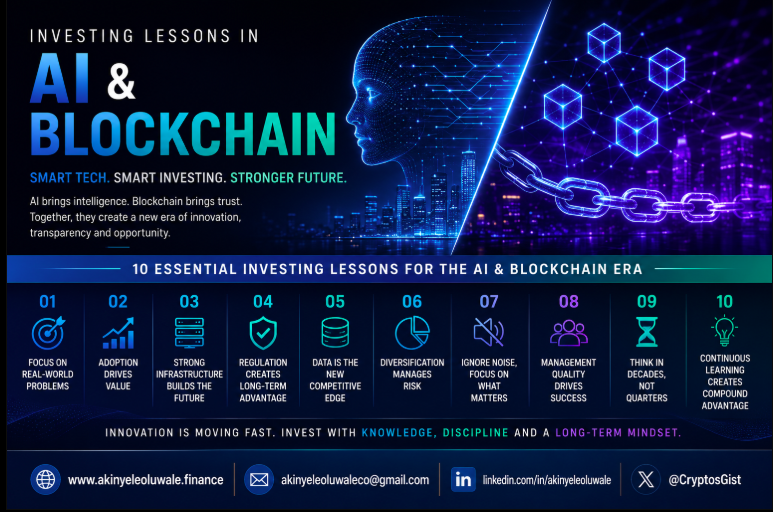
Artificial Intelligence and Blockchain: 10 Investing Lessons Every Forward-Thinking Investor Should Know
By Akinyele Oluwale & Co. Investment Ltd.
Global Finance Meets Tomorrow's Technology
Executive Summary
Artificial Intelligence (AI) and blockchain are two of the most transformative technologies of the 21st century. Individually, they are reshaping industries ranging from healthcare and finance to manufacturing and cybersecurity. Together, they have the potential to redefine how businesses operate, how value is exchanged and how investment opportunities are created.
Yet, despite the excitement surrounding both technologies, many investors continue to make the same mistake: they focus on headlines instead of fundamentals. A new AI model, a blockchain partnership or a surge in token prices often attracts attention, but lasting investment success rarely comes from reacting to the news of the day.
Institutional investors approach AI and blockchain differently. They evaluate long-term adoption, commercial viability, revenue potential, regulatory trends and the quality of management teams before committing capital.
As the global economy becomes increasingly digital, understanding how institutions assess these technologies can help individual investors make better decisions. The following lessons are not designed to predict tomorrow's market, but to build the mindset needed for long-term success in one of the fastest-evolving sectors of the global economy.
Lesson 1: Invest in Technology That Solves Real Problems
Not every AI application or blockchain project creates lasting value.
The most successful innovations solve genuine business problems.
Artificial Intelligence is helping companies improve productivity, automate repetitive tasks, analyse large datasets and enhance customer service.
Blockchain is improving transparency, reducing settlement times and enabling secure digital ownership.
Institutions invest where technology delivers measurable economic benefits not where marketing is loudest.
The first question should never be, "Is this trending?"
Instead, ask:
"What real-world problem does this solve?"
Lesson 2: Adoption Matters More Than Hype
Markets often reward excitement in the short term.
Long-term investors focus on adoption.
A blockchain network with thousands of active users and growing developer activity is generally more attractive than one with impressive promises but limited usage.
Likewise, AI companies generating real commercial revenue tend to be stronger investments than businesses relying solely on future expectations.
Technology becomes valuable when people use it consistently.
Adoption remains one of the strongest indicators of long-term success.
Lesson 3: Strong Infrastructure Creates Strong Markets
Many investors focus only on consumer-facing products.
Institutions often pay greater attention to infrastructure.
Examples include:
Infrastructure businesses frequently benefit regardless of which individual application becomes the market leader.
Sometimes the companies building the roads earn more than those driving on them.
Lesson 4: Regulation Is Becoming a Competitive Advantage
There was a time when regulation was viewed as a threat to innovation.
That perception is changing.
Clear regulatory frameworks provide certainty for businesses, investors and financial institutions.
Companies that embrace compliance often attract larger institutional partnerships because they reduce operational risk.
Successful investing requires understanding not only technology but also the regulatory environment in which it operates.
Lesson 5: Data Is the New Competitive Asset
Artificial Intelligence depends on high-quality data.
Blockchain depends on trusted and verifiable records.
Together, they create a powerful combination.
AI can analyse blockchain data to detect fraud, improve compliance and optimise financial services.
Meanwhile, blockchain can provide secure, tamper-resistant data that enhances AI decision-making.
Investors should recognise that future competitive advantages may come not only from algorithms but also from access to trusted information.
Lesson 6: Diversification Still Wins
Exciting technologies often tempt investors to place all their capital into a single project.
Institutions rarely do this.
Instead, they diversify across:
No one can accurately predict which company will dominate the next decade.
Diversification allows investors to participate in innovation while managing uncertainty.
Lesson 7: Ignore Daily Noise
The AI and blockchain sectors generate headlines almost every day.
New models.
New partnerships.
New token launches.
New regulations.
While staying informed is important, reacting emotionally to every announcement is rarely productive.
Professional investors separate information from distraction.
They ask:
Most daily headlines fail these tests.
Lesson 8: Management Quality Matters
Technology alone does not guarantee success.
Strong leadership often determines whether a promising idea becomes a successful business.
Institutional investors evaluate:
History shows that great businesses are built by capable leadership teams, not just innovative technology.
Lesson 9: Think in Decades, Not Quarters
Artificial Intelligence and blockchain are still relatively early in their development.
Some applications will succeed.
Others will disappear.
Institutional investors understand that transformational technologies often require years to mature.
Short-term market volatility should not distract investors from long-term structural trends.
The internet did not transform the world overnight.
Neither will AI or blockchain.
Patience remains one of the greatest competitive advantages.
Lesson 10: Continuous Learning Is Your Greatest Investment
Technology evolves quickly.
Investors who stop learning often fall behind.
Successful investors regularly study:
Knowledge compounds over time.
Just like financial capital.
The more you understand, the better equipped you become to recognise genuine opportunities and avoid costly mistakes.
Why AI and Blockchain Work Better Together
Many people treat AI and blockchain as separate industries.
Increasingly, they are becoming complementary technologies.
AI requires reliable data.
Blockchain provides trusted records.
AI can automate smart contract analysis.
Blockchain can improve AI accountability through transparent audit trails.
Financial institutions are already exploring ways to combine both technologies in areas such as:
The future may not belong to AI alone or blockchain alone.
It may belong to organisations that successfully combine both.
Common Mistakes Investors Should Avoid
Many investors repeat the same errors during every technology cycle.
These include:
Avoiding these mistakes often contributes more to investment success than finding the next market winner.
The Institutional Perspective
Professional investors rarely ask:
"What will happen next week?"
Instead, they ask:
These questions produce better investment decisions over time.
Final Thoughts
Artificial Intelligence and blockchain are no longer emerging technologies operating on the fringe of global finance.
They are becoming core components of the next generation of economic infrastructure.
The companies that succeed will likely be those that solve meaningful problems, build trusted ecosystems and create sustainable value rather than short-term excitement.
For investors, the greatest opportunity may not be predicting the next headline.
It may be developing the discipline to recognise long-term trends before they become obvious.
History consistently rewards patient investors who focus on fundamentals rather than speculation.
As AI and blockchain continue reshaping industries across the world, those who invest with knowledge, discipline and a long-term perspective will be better positioned to benefit from the opportunities ahead.
The future belongs not only to innovators, but also to investors who understand how innovation creates lasting value.
Key Takeaways
Editorial Standards
This article is published by Akinyele Oluwale & Co. Investment Ltd. as part of our commitment to delivering independent, research-driven analysis on artificial intelligence, blockchain, digital assets and global financial markets. The information provided is for educational and informational purposes only and should not be regarded as financial, investment, tax or legal advice. All investments involve risk, and readers should conduct independent research and seek professional advice before making financial decisions.